Program business in insurance is business a carrier allows another firm to underwrite and administer on its behalf: a defined class of risks, such as apartment buildings or small trucking fleets, written by a managing general agent (MGA) or program administrator under a written agreement that fixes how much premium it may write, at what rates, for which risks, up to which limits and in which territory. The carrier issues the policies on its paper and carries the risk, alone or with reinsurers behind it; the delegate finds the business, underwrites it, collects the premium and often settles the claims. What makes program business hard is that the party carrying the risk sees it only through the delegate's monthly accounts and files. Botminds' MGA Program Performance Analytics is built for that gap: it reads each delegate's bordereaux the day they land and shows the carrier how each program is running against its own plan and binder.
The examples on this page come from fictional sample data in the solution: a carrier, Harlow Ridge Specialty, and Corbel Program Underwriters, the MGA that writes its Brickline Habitational program of apartment property and general liability in five states. The rules come from NAIC's model act, state codes, UK regulators and a federal appeals court, linked where they appear.
Program business against business a carrier writes itself
Written by the carrier's own underwriters: The carrier's employed underwriters, inside its own systems.
Program business through an MGA: The MGA, which holds the insurer’s authority to accept or reject risk (Model #225 §2F) within the binder.
Written by the carrier's own underwriters: The carrier's.
Program business through an MGA: Still the carrier's: the policies are issued in its name, and the law treats the MGA's acts as the insurer's own (§6).
Written by the carrier's own underwriters: The carrier, from the day it is paid.
Program business through an MGA: The MGA, "in a fiduciary capacity" in an FDIC-insured account, until it is remitted at least monthly (§4B–C).
Written by the carrier's own underwriters: The carrier's claims staff.
Program business through an MGA: Often the MGA, within settlement authority; files go to the carrier on set triggers, such as a claim open more than six months (§4I).
Written by the carrier's own underwriters: Directly, policy by policy, as it is written.
Program business through an MGA: Through the MGA's accounts and bordereaux, at least monthly (§4B), and the right to access and copy its records (§4D).
Written by the carrier's own underwriters: Internal audit and management information.
Program business through an MGA: On-site reviews at least semi-annually under the model (annually in Florida), an actuarial opinion where the MGA sets reserves, audited statements (§5).
What is program business in insurance? Delegated underwriting with written limits
Program business is delegated underwriting organised around a class of risk. The delegate does not merely sell the carrier's policy; it decides which risks to accept, prices them from the carrier's rate basis and binds cover, which is what the NAIC's model act means by underwriting: holding the insurer's authority to accept or reject risk (Model #225 §2F; see MGA underwriter). The limits on that authority are what turn a relationship into a program.
The phrase "program business" is market usage, not a defined legal term. The statutes speak of managing general agents and their contracts; the London market speaks of coverholders and binding authorities; carriers speak of programs, program administrators and program managers. What all of them share is a written grant of underwriting authority with limits, a stream of accounts and data back to the risk carrier, and a carrier that stays responsible for what is written in its name.
Who writes program business? Three parties and the paper each holds
Three parties write program business together: the carrier that issues the policy and carries the risk, the MGA or program administrator that underwrites and administers it, and the retail agents or brokers who bring the insureds. Behind the carrier there is often a fourth: reinsurers who take most of the risk.
The MGA's license and contract define its place. Model #225 bars anyone from acting as an MGA for risks in a state unless licensed there as a producer (§3), and no MGA may place business "unless there is in force a written contract between the parties which sets forth the responsibilities of each party" (§4). Texas, which licenses MGAs separately, lets one license cover several carriers: a license "entitles the license holder to represent or act for one or more insurers as a managing general agent" (Tex. Ins. Code §4053.053). A single MGA can therefore run programs for several carriers, and a carrier can run programs through many MGAs.
The retail agents sit outside the program contract but inside its limits. The MGA may appoint them only after making sure each is properly licensed, and it may not appoint a sub-MGA (§4M). The program's rate guide, territory and risk types bind every policy they place.
What is a program carrier, and what does fronting mean?
A program carrier is the insurer whose policies the program issues. Sometimes it keeps most of the risk; sometimes it is a fronting carrier that issues the paper and passes nearly all the risk to reinsurers. A federal appeals court described the second arrangement, in an auto program, in plain terms.
In a fronted program the name on the policy and the balance sheet behind it belong to different companies.
That is how the Fifth Circuit described the arrangement in Lincoln General: the issuing insurer fronted auto policies in its own name but kept none of the risk (Lincoln General Insurance Co. v. U.S. Auto Insurance Services, 18 May 2015; the court's words are quoted in fronting carrier vs MGA).
In that case the reinsurer, Lincoln General, "reinsured 100% of S&C's liabilities under policies issued from 2003 through 2007", while the MGA, U.S. Auto, issued policies in the fronting carrier's name, collected premiums and adjusted claims (5th Cir. 2015). The case is remembered because the MGA moved premium to related companies before it reached the trust account; the court's account of the structure is the clearest public description of how a fronted program fits together.
Fronting does not move the legal duties. The carrier whose name is on the policy is still the insurer for the policyholder and the regulator, and the model act keeps reinsurance decisions with it: binding authority for reinsurance "shall rest with an officer of the insurer, who shall not be affiliated with the MGA" (§5D), and the MGA may not bind reinsurance except facultative cover under an agreed obligatory facultative agreement (§4M).
The binder's eight limits: what a program agreement must state
The model act requires every MGA contract to contain "Appropriate underwriting guidelines", and lists eight that together define a program. Each is also something the carrier can test against the monthly bordereau, which is why the list doubles as the backbone of program monitoring.
The eight underwriting guidelines Model #225 requires, and what each lets a carrier check every month
| Guideline in §4F | What the binder fixes | What the carrier can test from the bordereau |
|---|---|---|
| Maximum annual premium volume | The capacity the carrier commits to the program | Written premium to date against the cap and against the business plan |
| Basis of the rates | The rate guide and its surcharges and credits | Each renewal re-rated on the rate guide; rate achieved against plan |
| Types of risk that may be written | Classes, occupancies, construction | Each risk's class against the permitted list; the written mix against the plan |
| Maximum limits of liability | Per risk, per location, aggregate | Every row's limit against the maximum |
| Applicable exclusions | The wording the MGA must attach | Form codes on the policy rows |
| Territorial limits | States or regions where the MGA may bind | Every risk's location against the territory |
| Cancellation provisions | Who may cancel and how | Cancellations and return premium on the premium bordereau |
| Maximum policy period | How long a bound policy may run | Inception and expiry dates on every row |
In the sample, Corbel's binder limits Brickline to Texas, Georgia, Florida, Arizona and North Carolina. When Corbel's May risk bordereau arrived with one building in Lake Charles, Louisiana, the territory check flagged it and sent it to the program underwriter as a referral the same morning. Under a quarterly review that row would have waited for the on-site visit, where a sample of files might or might not include it.
How does program business work month by month?
Program business runs on a monthly cycle set by statute. The MGA binds and issues policies through the month, collects the premium into a fiduciary account, and then accounts to the insurer for every transaction and remits all funds due, at least monthly (§4B; quoted in premium remittance meaning). The carrier receives those accounts and the bordereaux behind them, books the premium and claims, and decides whether the program is running to plan.
The rules on money are tight because the money is not the MGA's. Under the model, the MGA may keep no more than three months of estimated claims payments and allocated loss adjustment expenses; Florida's version allows 60 days (Fla. Stat. §626.7451(3)). Texas requires an escrow account at an FDIC-insured bank and makes the MGA a fiduciary for the money it holds (§4053.105–.106). What a premium trust account is sets out these rules in full.
How one program's month moves through MGA Program Performance Analytics
A person decides
MGABinds, issues and services policies through the month; sends risk, premium and claims bordereaux and the monthly account after month end.
Agent
Bordereau intake checkerMaps each file to one standard and checks every row against the binder: control totals, premium against the account statement, limits, territory, classes, dates.
Never: edits the MGA's data or fills a missing field
Agent
Rate monitor, mix analyst, loss projectorRe-rate renewals on the rate guide, compare the written mix with the plan, and re-project the ultimate loss ratio with large losses separated.
Never: sets a case reserve or changes a rate
Agent
Bridge builder and commentary writerRedraw the program from plan to projected loss ratio, test the binder's re-price and off-ramp levels, and draft a commentary citing every number to its row or clause.
Never: sends a notice to the MGA
A person decides
Program actuary and head of program businessThe actuary signs the loss pick; the head of program business decides whether to grow, re-price, reduce the line or exit, and signs any notice.
Program business in London market terms: coverholders and binding authorities
The UK uses different words for the same structure. HM Revenue & Customs explains it for Lloyd's: a managing agent may hand its authority to write insurance for its syndicate to another firm, a Lloyd's broker included; that firm is the coverholder, and the document that sets its terms is the binding authority (HMRC Lloyd's Manual, LLM1100; see what a coverholder is).
The FCA's client money rules use the same term outside Lloyd's. An agency agreement that lets an intermediary commit the insurer to risk, settle claims or handle refunds is commonly called a binding authority, and where the intermediary acts as the insurer's agent, premium counts as received by the insurer as soon as the agent receives it (FCA Handbook, CASS 5.2). That is the UK's version of the US fiduciary rule: once the policyholder pays the coverholder, the risk of the money going astray sits with the insurer.
The FCA also decided in December 2025 who stays responsible for a delegated product. When firms co-manufacture an insurance product, respondents asked that MGAs be allowed to act as the single lead manufacturer, pointing out that MGA-led products are common in commercial lines. The FCA declined: the lead firm must be an insurer or a managing agent, because its review work found firms less able to show fair value and good outcomes for products that intermediaries had developed and designed (FCA PS25/21, in force 9 December 2025; see why an insurer uses an MGA).
Why do carriers watch program business so closely?
Carriers watch programs closely because they carry the risk and the regulatory responsibility for underwriting they did not do. Under the model act regulators may examine an MGA as though it were the insurer (§6), and Texas makes an MGA whose violations contribute materially to an insurer's insolvency reimburse the guaranty fund for losses beyond the program's earned premium, investment income and reserves (§4053.152). Supervisors in London make the same point from the prudential side.
“We have also observed that firms’ strategies for using such arrangements is not always clear.”
Prudential Regulation Authority, Insurance Supervision: 2026 priorities, letter to chief executives, 15 January 2026
The PRA's sentence sits in a paragraph on delegated authority underwriting, which it expects to grow across the London Market, and it asks firms to have strong oversight arrangements for the performance of those arrangements, including a view on how they would leave unprofitable ones (PRA, January 2026). A carrier that cannot say why it runs a program, what the program is meant to earn and how it would know when it stops earning it, is the carrier the regulator has in mind.
What makes a program work for both the carrier and the MGA?
A program works when the MGA is paid for writing business that the carrier would have chosen to write itself. Most programs pay the MGA a commission on premium and, often, a share of profit; the model act stops a profit share from being paid early where the MGA can influence it through reserves or claim payments: interim profits wait one year after they are earned on property business and five years on casualty, and are paid only once verified (§4L). Contingent profit commission in insurance quotes the section and shows how the hold-back works.
The other half is information. The carrier is entitled to access and copy the program's records in a form it can use (§4D), but usable is not the same as timely or comparable across programs. Each MGA sends its own layout, so the loss ratio, rate and mix of one program cannot be read against another until someone maps them to one standard. How a program's loss ratio is calculated from those files is worked through in its own guide.
One program as the carrier sees it, the morning a bordereau lands
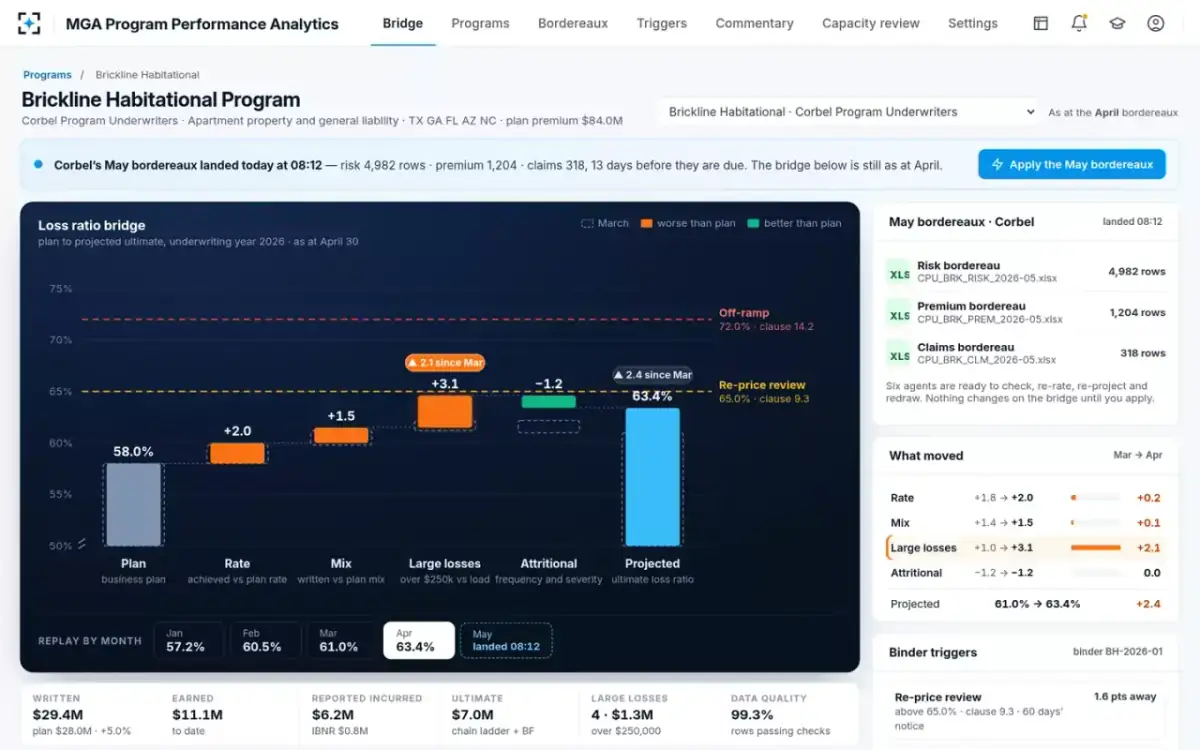
The shot shows the two things a carrier needs from each program that the statutes alone do not give it: the plan the program was written against, and the binder's own levels at which the carrier will act. When the May files were applied in the sample, two new large losses moved the projection to 69.4%, past the 65.0% re-price level.
Every row of a delegate's files checked against the binder
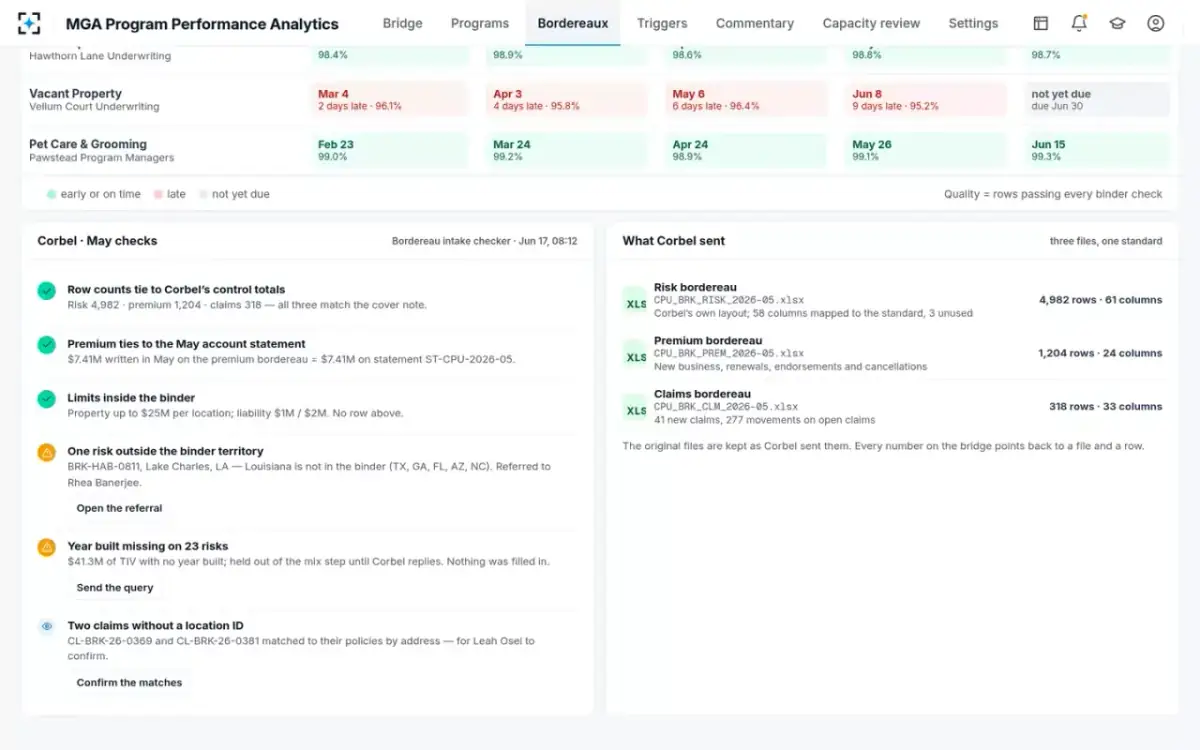
Who does that work at the carrier, and what the law asks of them, is the subject of the guide to the program administrator in insurance; how a carrier leaves a program that no longer works is set out in the MGA termination notice guide. To see a program's month end to end, start from MGA Program Performance Analytics.
Questions people ask
Is program business the same as delegated authority?
Program business is one form of delegated authority: authority to underwrite a defined class, usually with policy issue and often claims. Delegated authority is wider and includes claims-only arrangements with third-party administrators. The FCA's term "binding authorities" covers authority to commit an insurer to risk, to settle claims or to handle premium refunds.
What is a binder in program business?
The binder, or binding authority agreement, is the contract that grants the MGA its authority and sets its limits. In the US it must contain at least the provisions in Model #225 §4, including termination for cause, monthly accounts, fiduciary funds, usable records and the eight underwriting guidelines. In this sense the word has nothing to do with the temporary cover note also called a binder.
Can an MGA write programs for more than one carrier?
Yes. Texas expressly lets one MGA license cover "one or more insurers" (§4053.053), and the model act requires separate records of the business written for each insurer (§4D). Each carrier then has its own contract, binder and oversight duties toward the same MGA.
Who regulates program business?
In the US, state insurance departments license the MGA and regulate the carrier; the model act lets them examine an MGA "as if it were the insurer". In the UK the FCA regulates conduct, including who manufactures a product, and the PRA supervises the insurer's prudential oversight of its delegated arrangements.
What happens to a program's claim files if the carrier fails?
Under Model #225 §4I claim files are the joint property of the insurer and the MGA while the program runs, but on an order of liquidation of the insurer they become the sole property of the insurer or its estate. The MGA keeps a right to reasonable access and to copy the files on a timely basis.