An MGA termination notice is the written notice by which a carrier ends a managing general agent's authority to write, and often to settle claims on, a program of business in the carrier's name. Under the NAIC's model act every MGA contract must let the insurer "terminate the contract for cause upon written notice to the MGA" and "suspend the underwriting authority of the MGA during the pendency of any dispute regarding the cause for termination", and the insurer must tell the regulator in writing within 30 days of terminating (Model #225 §4A, §5E). The hard part is not the letter. It is everything the carrier needs after the letter: the policies still in force, the open claims, the premium in the MGA's accounts and the data that describes all three, much of it held by the party being terminated. Botminds' MGA Program Performance Analytics shows each program against the exit level written into its binder, month by month, and keeps every bordereau, check and decision, so a carrier that reaches for the termination clause already holds the program's data.
Where this guide uses examples, they come from fictional sample data in the solution: a carrier, Harlow Ridge Specialty, and its Small Fleet Auto program, written by Ridgeway Transport Underwriters, which has been above its off-ramp level for two months. The rules are quoted from the model act and state law; nothing here is legal advice on a particular contract.
From a crossed exit level to a signed termination notice
Agent
Bridge builderTests each program's projected loss ratio against its binder's off-ramp level every month, and opens an off-ramp decision when the clause's condition is met: two consecutive months above 72.0% for Small Fleet Auto.
Never: sends a notice
Agent
Commentary writerDrafts the decision paper: the bridge, the large losses, the rate and mix steps, the options, and a notice under the binder's clause for signature.
Never: approves its own draft
A person decides
Program actuarySigns the loss pick and the projections behind each option.
A person decides
Head of program businessDecides: hold to the next bordereau, re-price, reduce the line or exit; signs the notice if she exits.
A person decides
Carrier compliance and counselCheck the notice against the contract and state law, file the regulator notification within 30 days and plan the run-off.
What is an MGA termination notice?
An MGA termination notice is the carrier's written exercise of a termination right in the MGA contract: for cause, as every state following the model act requires the contract to allow, or under whatever other termination clause the parties agreed, such as on notice without cause or when a performance level is breached. It ends the MGA's authority to bind new business for the carrier from the date the contract specifies, and it starts several other clocks.
The model act sets a floor, not a ceiling. Its termination provision ends with a drafting note: "Nothing in the above subsection is intended to relieve the MGA or insurer of any other contractual obligation" (Model #225 §4A). In practice the binder decides how much notice is given, what counts as cause, what happens to business in force and who handles the claims, so the first document a carrier reads before sending a notice is its own contract.
How does an insurer terminate an MGA? For cause, by contract, and with the regulator told
An insurer terminates an MGA by giving the written notice its contract requires, after which it must notify the state regulator. The details differ from state to state, and a carrier with programs in several states follows each one.
Termination rights and regulator notices for MGA contracts, by state
| Jurisdiction | Termination right the contract must contain | Who notifies the regulator, and when |
|---|---|---|
| NAIC Model #225 | Insurer may terminate for cause on written notice; may suspend underwriting authority during a dispute over the cause (§4A) | Insurer, in writing, within 30 days of entering into or terminating a contract (§5E) |
| New York | Same as the model (11 NYCRR §33.5(a)) | Not set out in the contract and duty provisions, §§33.5–33.6 |
| Florida | Insurer or MGA "may terminate the contract for cause as provided in the contract upon written notice to the terminated party" (§626.7451(1)) | Insurer, to the department and office, within 30 days after terminating (§626.7454(5)) |
| Minnesota | Set by Minnesota's own MGA statute | Insurer, to the commissioner, within 30 days of termination (§60H.05 subd. 4) |
| Texas | The contract must address "cancellation or termination" (§4053.102) | The MGA notifies the department within 30 days after the contract is cancelled or terminated, or its authority to settle claims is withdrawn (§4053.108) |
Florida's version is worth noting because it runs both ways: the MGA, too, may terminate for cause. Texas puts the notification duty on the MGA rather than only on the insurer, and adds a second trigger in the same list: when the insurer withdraws the MGA's authority to settle claims. Settlement authority is a separate grant. The model act lets it "be terminated for cause upon the insurer's written notice to the MGA or upon the termination of the contract", with the same right to suspend it during a dispute (§4I(4)).
How much notice must an insurer give an MGA?
For a termination for cause, the model act requires written notice but sets no period; the contract decides. For any other termination, the period is entirely contractual. In the sample, Small Fleet Auto's binder allows termination on 90 days' notice once its off-ramp condition is met, and Brickline Habitational's binder lets the carrier change rates on 60 days' notice under a separate re-price clause.
The regulator's 30 days are a different clock: they run from the termination, not from the decision, and they are the carrier's duty under the model act and in Florida and Minnesota. Suspension is the tool for the gap. Where cause is disputed, the carrier may suspend the MGA's underwriting authority, and its claims settlement authority, while the dispute runs, so new business stops even before the termination takes effect.
The first ninety days after an MGA termination notice, in the sample program
- Notice period: binding continues unless authority is suspended90 days
- Written notification of the termination30 days
- The MGA's own notice to the department30 days
- Serviced and handled through the notice period, then run offDays 1–90, then run-off
What happens to policies when an MGA is terminated?
Policies already issued stay in force with the carrier: they are the carrier's contracts, not the MGA's, and the termination of the agency does not end them. The model act gives the insurer "the right to cancel or non-renew any policy of insurance subject to the applicable laws and regulations" on cancellation and nonrenewal (§4F(2)), so whether policies run to expiry, are non-renewed at expiry or are cancelled earlier is a choice the carrier makes within each state's notice rules for policyholders.
A common course is to let the book run off: no new business, no renewals, existing policies to expiry, with the binder's maximum policy period setting how long that takes. Someone has to service those policies in the meantime, collect their premium and handle their endorsements and cancellations, and the contract should say who. Where the MGA keeps that role during run-off, the carrier keeps receiving its monthly accounts and bordereaux, and keeps reading them.
Who owns the data when an MGA is terminated?
The carrier has a statutory right to its program's records, and the claim files are jointly owned. The model act gives the insurer the right to access and copy every account and file of its business, in a form it can use (§4D), and it addresses claim files directly.
“All claim files will be the joint property of the insurer and MGA. However, upon an order of liquidation of the insurer such files shall become the sole property of the insurer or its estate; the MGA shall have reasonable access to and the right to copy the files on a timely basis.”
NAIC Managing General Agents Act (Model #225), Section 4I(3)
Two further provisions matter at exit. Where claims files are electronic, the contract must deal with sending the data on time (§4J; quoted in bordereaux ingestion), so a carrier whose contract is silent on format and timing may find its right to the files hard to exercise quickly. And the MGA may not assign the contract "in whole or part" (§4E), so a carrier that learns its MGA has been sold should read its contract before assuming the relationship transfers.
Why should exit planning start before the notice? What the PRA expects
Exit planning should start before the notice because by the time a carrier sends one, its negotiating position on data, premium and claims handling is at its weakest. UK supervisors now say so explicitly for delegated business.
“…firms should ensure they have strong oversight arrangements in place to govern and monitor the performance of these arrangements, including consideration of how they would exit unprofitable arrangements.”
Prudential Regulation Authority, Insurance Supervision: 2026 priorities, letter to chief executives, 15 January 2026
The PRA's outsourcing statement gives the method. It lists "delegated underwriting" among examples of third-party arrangements that are not outsourcing, but expects firms to assess "the materiality and risks of all third party arrangements irrespective of whether they fall within the definition of outsourcing", and to apply controls to material ones that are "as robust as the controls that would apply to outsourcing arrangements with an equivalent level of materiality or risk" (PRA SS2/21, paragraphs 2.4–2.6). For outsourcing, those controls include a documented exit plan that distinguishes a stressed exit, such as the provider's failure, from "a planned and managed exit due to commercial, performance, or strategic reasons", and planning that will "identify data they may need to access, recover, or transfer as a priority in a disruption or stressed exit" (paragraphs 10.1 and 10.17).
The US record shows why. In the Lincoln General case, the MGA's premium trust account had been drained by transfers to related companies, and "by 2006, the Premium Trust Account ran out of funds to pay the claims for which Lincoln was liable" (5th Cir. 2015). A carrier that reconciles trust balances to bordereau premium every month learns that kind of thing before it is negotiating an exit, not after.
The data to secure before the MGA termination notice goes out
Before the notice goes out, the carrier should hold, in its own systems and in a usable form, everything it would need if the MGA stopped cooperating the next day. The checklist below follows the model act's provisions and the PRA's exit-planning expectations; it is ours, not a regulatory form.
Nine things to secure before an MGA termination notice
- Every bordereau the MGA has sent, as sent
Risk, premium and claims files with their arrival dates; the carrier's own copy, not access to the MGA's portal.
- A current list of policies in force, with expiry dates
The run-off schedule and any cancellation notices depend on it.
- Open claims with reserves, documents and the handler
Claim files are joint property (§4I); the contract should already address electronic transmission (§4J).
- Premium due and premium held
Bordereau premium reconciled to the account statement and the fiduciary or escrow account (§4C; Texas §4053.105).
- Claims funds held by the MGA
No more than three months of estimated claims payments under the model act; 60 days in Florida.
- Producers appointed under the program
Retail agents placing business must be told binding has stopped.
- Rate guides, underwriting files and referral decisions
For the run-off, for disputes over cause, and for any successor MGA.
- Profit commission position
Interim profits held back one year on property and five on casualty (§4L) remain to be verified after exit.
- The regulator notices, drafted
Within 30 days of termination under the model act, Florida and Minnesota; in Texas the MGA must notify the department.
What is an MGA run-off, and who watches it?
An MGA run-off is the period after termination in which the program writes no new business but its policies run to expiry and its claims are handled to closure. The carrier remains the insurer throughout, so it keeps watching: premium still due, claims still developing, reserves still changing, and, if the MGA keeps handling claims, the same claims-file triggers as before, such as files on claims open more than six months.
A run-off is where a monthly view earns its keep a second time. The loss ratio for a closed program still moves as claims develop, and a profit commission held back under §4L still has to be verified. A carrier that already sees each program's bridge monthly simply keeps doing so for the run-off; one that relied on the MGA's quarterly report is now relying on a party it has just terminated.
From trigger to decision: how the sample off-ramp works
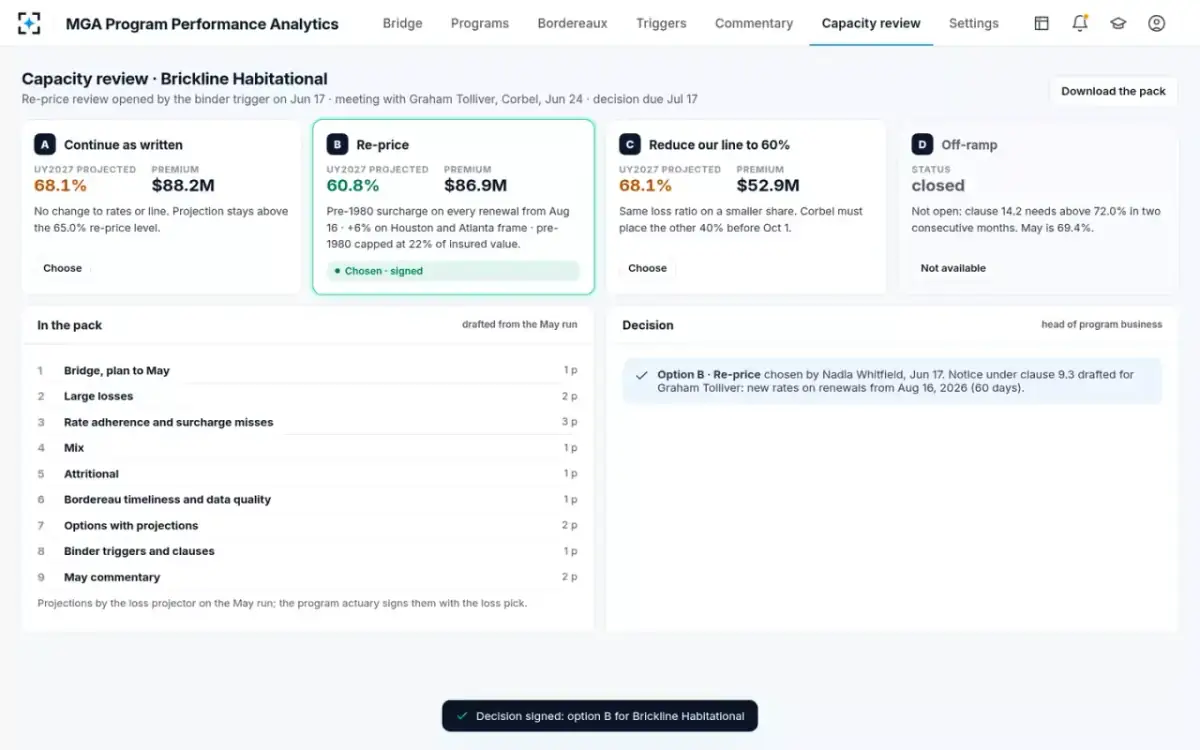
In the sample, the exit clause is a performance trigger written into each binder: the off-ramp opens only after a set number of consecutive months above a set loss ratio. Small Fleet Auto, planned at 62.0%, projected 73.6% in April and 74.8% in May, two months above its 72.0% level, so its off-ramp decision is open. Brickline Habitational, at 69.4% in May, is past its 65.0% re-price level but not its 72.0% off-ramp, so its exit option is shown as closed and the carrier chose to re-price instead.
Each program against its exit level, month by month
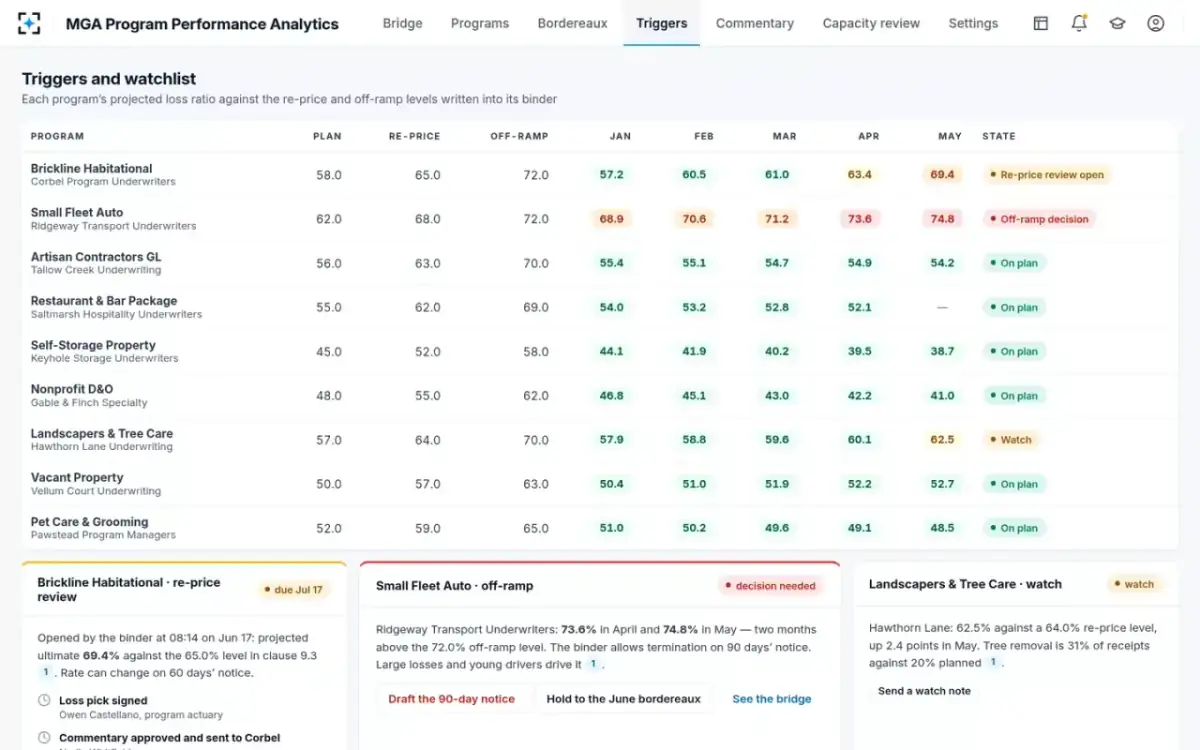
The 'hold to the June bordereaux' option matters as much as the notice. A performance trigger is evidence, not a verdict: two bad months may be two large claims. A carrier that can see the causes, as the bridge shows them, can decide whether to exit, to re-price or to wait one more month, and can write down why.
When exit is not open, the decision is between the other three options
Where MGA Program Performance Analytics fits an exit
The solution's part in an exit starts long before it: each program is tested against its binder's own exit level every month, the off-ramp decision opens only when the clause's condition is met, and every bordereau, check, query and decision is kept as it happened, with the MGA's original files stored as sent. When a carrier decides to exit, the decision paper and the draft notice are already prepared, and the program's data is already in the carrier's hands.
It does not decide to terminate, judge whether cause exists, send the notice or file the regulator's notification; those are the head of program business's and the carrier's counsel's. It cannot recover data an MGA never sent. Who carries those duties at the carrier is the subject of the program administrator guide, and what a carrier is entitled to receive from its MGAs in the first place is covered in the guide to MGA data platforms and the definition of program business. To see exit levels tested on your own binders, start from MGA Program Performance Analytics.
Questions people ask
Can an MGA terminate its contract with the carrier?
If the contract allows it. The model act only requires the insurer's right to terminate for cause, but Florida's statute gives both sides a for-cause right "as provided in the contract", and a binder may also give both sides a right to terminate on notice. The carrier then faces the same run-off and data questions as if it had ended the contract itself.
Does terminating an MGA end its license?
No. The license is the state's to grant and revoke; ending one carrier contract does not affect it. In Texas, though, an MGA license lapses at renewal if the holder is not appointed by any insurer at that time (§4053.055), so losing its only carrier can end an MGA's license there.
What does suspending an MGA's authority mean?
It stops the MGA from binding new business, or from settling claims, while a dispute over the cause for termination is resolved. The model act gives the insurer that right for both underwriting and settlement authority, and New York's rule repeats it.
What happens to the MGA's profit commission after termination?
It is still governed by the contract and, where the MGA could influence the result through reserves or claim payments, by the model act's hold-back: interim profits are not paid until one year after they are earned on property business and five years on casualty, and only once verified. Termination does not speed that up.
Can the carrier take over claims handling when an MGA is terminated?
Yes, subject to the contract. The model act lets the insurer terminate the MGA's settlement authority on written notice for cause or when the contract ends, and the claim files are joint property the carrier may copy. A carrier planning to move claims to its own staff or a third-party administrator should secure the open claims data before the notice.