A program administrator in insurance is either the firm that runs a defined book of business for a carrier, usually a managing general agent (MGA) or program manager that underwrites, issues policies, collects premium and often pays claims under a written agreement, or the person at the carrier who administers those relationships. The two are joined by statute: the NAIC's Managing General Agents Act (Model #225) and the state laws that follow it tell the firm what its contract must contain and tell the carrier what it must check, on a fixed calendar, for every program it runs. The work is hard because the carrier-side duties grow with every program while the team usually does not. Botminds' MGA Program Performance Analytics exists for that seat: it redraws each program's loss ratio, rate, mix and large losses the morning the MGA's bordereaux land, so one person can watch every program every month and keep their own time for the judgments the law leaves to them.
The examples come from fictional sample data in the solution: Harlow Ridge Specialty, a carrier with nine programs and $373.0 million of plan premium, its head of program business, Nadia Whitfield, and Corbel Program Underwriters, the MGA that writes its Brickline Habitational program. The rules are quoted from the model act and the state codes, linked where they appear.
Whether a firm is an MGA is a test of what it does for one carrier, not of what it calls itself.
What is a program administrator in insurance? Two meanings, one relationship
In the market the phrase usually names the delegate: the firm a carrier authorises to write a program, a defined class of business sold through a defined channel, on the carrier's paper. Inside carriers it also names a job: the person, often titled head of program business or program manager, who looks after a portfolio of those firms. Job advertisements use both meanings, which is why the search results for "program administrator insurance" mix firms and vacancies.
The law does not use the phrase at all. It defines the firm by what it does. A September 2026 draft of NAIC's State Licensing Handbook describes an MGA as "an insurance producer authorized by an insurance company to manage all or part of the insurer's business in a specific geographic territory", whose activities "may include marketing, underwriting, issuing policies, collecting premiums, appointing and supervising other agents, paying claims, and negotiating reinsurance" (NAIC State Licensing Handbook, chapter 24 draft). Texas is broader still: it counts anyone an insurer authorises to accept or process policies that other agents produced and sold (Tex. Ins. Code §4053.001; the definition is quoted in the difference between an MGA and a TPA).
So a carrier-side program administrator is, in practice, the person who discharges the insurer's duties under those statutes for each delegate. That is the sense this guide follows, while the next section deals with when the firm on the other side counts as an MGA.
Insurance program administrator vs MGA: the law looks past the name
A program administrator is an MGA in law when it meets the statutory tests, whatever it calls itself, and is not one when it does not. Under Model #225 a firm is an MGA if it manages all or part of an insurer's business and "underwrites an amount of gross direct written premium equal to or more than five percent (5%) of the policyholder surplus as reported in the last annual statement of the insurer in any one quarter or year", together with adjusting or paying claims "in excess of $10,000 per claim" or negotiating reinsurance for the insurer (Model #225 §2D).
The test is relative to the carrier, not to the delegate. A program writing $20 million a year is an MGA for a carrier with $300 million of surplus (6.7%) if it also settles claims above $10,000, and may not be one for a carrier with $500 million (4.0%). Because surplus and premium move, the model makes the carrier re-check: an insurer must check its books every quarter for any producer that has become an MGA, and if one has, both "must fully comply with the provisions of this Act within thirty (30) days" (§5F).
The model also lists who is not an MGA: an employee of the insurer, the US manager of an alien insurer's branch, an underwriting manager under common control whose pay "is not based on the volume of premiums written", and the attorney-in-fact of a reciprocal. Texas draws its own line for licensed agents: an agent is not an MGA unless it takes "50 percent or more of the agent's total annual business or does $500,000 or more of total annual business as measured by premium volume, whichever amount is less" from policies produced by other agents (§4053.002). A carrier with programs in several states keeps a list of which delegates cross which line.
What does a program administrator do at the carrier? The duties the Act assigns
At the carrier, the program administrator makes sure the insurer meets its own statutory duties toward each MGA and that each MGA meets the contract the statute requires. Section 5 of the model act lists the insurer's side; section 4 lists the minimum contract terms the administrator has to police.
The carrier's duties toward each MGA, and how the states vary them
| Duty | Model #225 | How some states differ |
|---|---|---|
| Audited financial statements proving positive net worth | For the two most recent fiscal years (§5A) | New York: an independent financial audit "in a form acceptable to the superintendent" (11 NYCRR §33.6(a)) |
| Actuarial opinion on the MGA's reserves | Every year, where the MGA sets loss reserves (§5B) | New York names a member of the American Academy of Actuaries (§33.6(b)) |
| On-site review of underwriting and claims | "periodically (at least semi-annually)" (§5C) | Florida: "at least annually", and within 6 months of engaging a new MGA (§626.7454(3)); Minnesota: keep "the results of that review" (§60H.05) |
| Notice to the regulator | Within 30 days of entering into or ending a contract (§5E) | Florida and Minnesota: 30 days; Texas also makes the MGA notify the department when its contract ends (§4053.108) |
| Check whether producers have become MGAs | "each quarter" (§5F) | Florida: "on a quarterly basis" |
| Reinsurance binding authority | Rests with an officer of the insurer who is not affiliated with the MGA (§5D) | Same in New York (§33.6(d)) |
The contract side is longer. The MGA must account for every transaction and remit the funds due at least monthly (§4B), hold premium "in a fiduciary capacity", keep no more than three months of estimated claims payments (§4C), keep separate records the insurer may access and copy (§4D), and write within guidelines that fix the maximum annual premium, the basis of rates, the risk types, limits, exclusions, territory, cancellation provisions and maximum policy period (§4F). Each of those is a monthly question for the carrier-side administrator: did the accounts arrive, do the funds tie, is the data usable, and is the business inside the binder.
One person, nine programs: the year in statutory events
Add the duties up for a realistic book and the calendar is full before anyone reads a loss ratio. For nine programs, each run by an MGA that sets reserves, the model act produces about 148 dated events a year that someone at the carrier must receive, check or carry out.
148 statutory events a year for a carrier with nine MGA programs
Events a year under Model #225
- Monthly accounts to check, 108 · 73%
- On-site reviews, 18 · 12%
- Audited statements, actuarial opinions and quarterly producer reviews, 22 · 15%
The monthly accounts dominate the count, and they are the part that scales worst. A semi-annual review can be scheduled and staffed; 108 monthly files, each in the MGA's own layout and each due on its own day, arrive whether or not anyone has time to open them. When they are re-keyed into templates before anyone reads them, the carrier's view of each program runs a quarter behind the business, which is how a missed surcharge is first noticed at the on-site review rather than in the month it was missed.
The count is also a floor. A carrier that writes in Texas also receives each MGA's quarterly account report, which must state "written, earned, and unearned premiums", paid and outstanding losses and loss expenses, "losses incurred but not reported" and management fees (§4053.103). Most binders add their own reports, referral logs and claims files on the triggers in §4I.
What the on-site review must achieve, and why the regulators keep asking
The on-site review is the duty regulators test most, and the statute does not say what it must contain. New York's Department of Financial Services was asked in 2007 what an insurer must do to comply with its semi-annual review rule and answered that the regulation does not spell out what an insurer must do (DFS Office of General Counsel Opinion 07-10-08; quoted in the MGA audit checklist).
New York's lawyers set a standard, not a checklist: the insurer must come away satisfied the MGA is prudent, without giving up its own responsibility.
That standard is about outcomes, so the review is only as good as the evidence the administrator brings to it. Examiners do check that it happened at all. In a limited-scope examination of Topa Insurance Company filed in June 2025, the California Department of Insurance found that the company had not conducted the semi-annual on-site reviews of its MGA that the Insurance Code requires, and had not notified the Commissioner of the MGA's appointment (CDI examination report, 2025). A review that starts from a year of monthly program views, with every exception already listed, is a different meeting from one that starts with a request for files.
The seats around one program, and what each needs to see
The program administrator is never alone with a program, but they are the one person who sees all of them. Around each program sit an underwriter who audits the MGA, an actuary who picks the ultimate loss ratio, an analyst who chases the files, and the MGA's own chief executive. Each needs the same numbers at a different depth.
Five seats around one program in MGA Program Performance Analytics, and what each keeps
Today
The carrier-side program administrator. Reads each program in a quarterly report assembled by hand, two to three months after the business was written.
With agents
Sees every program against its own re-price and off-ramp levels the morning a bordereau lands, with the move explained step by step.
Still theirs: Decides re-price, line size and exit, and signs every notice to an MGA.
Today
Finds a missed surcharge or an out-of-territory risk at the semi-annual on-site review.
With agents
Gets each renewal re-rated on the rate guide and each risk outside the binder as a referral the day the file arrives.
Still theirs: Audits the MGA on site and rules on referrals.
Today
Re-builds the program's loss development from spreadsheets before choosing a loss pick.
With agents
Starts from a projection whose every step drills to claims bordereau rows.
Still theirs: Signs the loss pick and the method behind it.
Today
Re-keys each MGA's files into templates and chases what is missing.
With agents
Sees each file's landing day against the due day and each failed check, with the query already drafted.
Still theirs: Confirms matches and sends queries back to the MGA.
Today
The delegate-side program administrator. Hears about a rate or mix problem at the quarterly meeting, after renewals have gone out.
With agents
Sees the same view of his own program as the carrier, and the signed commentary with its asks.
Still theirs: Runs underwriting, policy issue and claims under the binder.
The asymmetry matters for staffing. The underwriter, actuary and analyst can each be shared across programs; the decision to re-price, cut a line or exit cannot. In the sample, Nadia Whitfield holds that decision for nine programs, and the solution's settings name her as the only person who can sign a notice to an MGA.
Where the job sits in the labor statistics
There is no government occupation code for a program administrator, so there is no official count, wage or outlook for the role. The Bureau of Labor Statistics counts the people around it instead. Insurance underwriters held about 125,600 jobs in 2025, with a median wage of $81,370 in May 2025; 24% work in insurance agencies and brokerages, and BLS expects their employment to fall 4 percent from 2025 to 2035 (BLS Occupational Outlook Handbook, underwriters).
Actuaries move the other way: about 31,200 jobs in 2025, a median wage of $130,000, and employment projected to grow 9 percent from 2025 to 2035, much faster than most occupations (BLS, actuaries). For a carrier building a program team, that is the practical constraint: the analytical seat that signs loss picks is the scarcest one, and a program administrator who needs an actuary to rebuild each program's triangle by hand each quarter is spending the most expensive hours on the least judgment. What a reserving actuary does is set out in its own guide.
Program administrator insurance job description: what to write into it
A useful job description for the carrier-side program administrator lists the statutory duties first and the analytics second, because the duties are what an examiner will ask about. The checklist below is the one the sample carrier's settings imply; the clauses are the model act's.
Eight lines for a program administrator job description, each tied to a duty
- Owns each MGA contract against Model #225 §4 and the state variants
Termination for cause, monthly accounts, fiduciary funds, usable records, the eight underwriting guideline fields and the claims-file triggers.
- Receives and checks every monthly account and bordereau
The §4B accounts are the only monthly evidence the carrier has; lateness and failed checks are themselves performance signals.
- Plans and leads the on-site reviews on the state's clock
Semi-annual under the model and in New York, annual in Florida with a review within six months of a new MGA.
- Commissions the annual actuarial opinion where an MGA sets reserves
Section 5B makes it the insurer's duty, in addition to any other reserve certification.
- Keeps each MGA's audited statements on file
The two most recent fiscal years, showing positive net worth (§5A); New York asks for an audit in a form acceptable to the superintendent.
- Runs the quarterly check on whether any producer has become an MGA
The 5% of surplus test moves with premium and surplus (§5F).
- Watches each program monthly against its plan and binder triggers
Loss ratio against plan, rate against the rate guide, mix, large losses, premium against the binder cap.
- Prepares re-price, line and exit decisions, and files the regulator notices
The 30-day notice on entering or ending a contract (§5E) starts the day the decision is signed.
The last two lines are where the role becomes a portfolio job rather than an audit job. Which MGA KPIs and metrics to watch, and how to value seeing them sooner, is the subject of its own guide, and so is the termination notice and the data a carrier must secure before sending it.
What one person can watch every month, and what has to wait
Monthly, a carrier-side program administrator can watch whatever the bordereaux carry: when each file landed against its due date, whether its rows pass the binder's checks, rate achieved against the rate guide, the mix written against the business plan, large losses against the plan's load, and the projected loss ratio against each binder's re-price and off-ramp levels. Quarterly and annual work, the producer review, the on-site visit, the actuarial opinion, cannot be made monthly, but it can start from a year of monthly evidence instead of a request list.
Nine programs, sorted by how close each is to a binder trigger
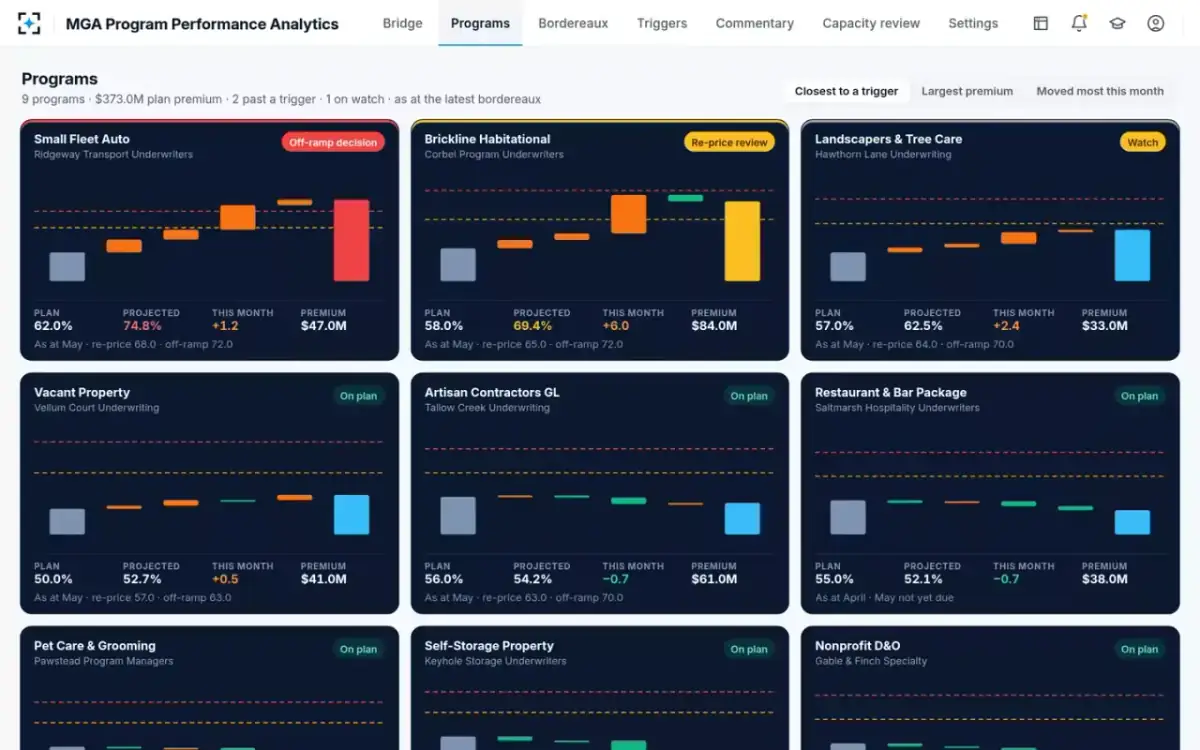
The sort order is the point. A quarterly report is laid out program by program in the same order every time, so the program that crossed its re-price level sits on page seven. A monthly view sorted by distance to each binder's own levels puts it first, because the binder, not the report, defines what matters for that program.
Where MGA Program Performance Analytics fits the program administrator's month, and where it stops
The solution takes the mechanical part of the monthly work: six agents read each MGA's risk, premium and claims bordereaux, map them to one standard, check every row against the binder, re-rate renewals on the rate guide, re-project the ultimate and redraw the program's loss ratio bridge, then draft a commentary with a citation beside every sentence. In the sample, applying Corbel's May bordereaux took 6.8 seconds; the design target is that a program's view moves the same day its bordereau lands.
It stops where the statutes put a person. The agents do not conduct on-site reviews, sign the actuarial opinion, decide a re-price or send a notice; the settings name who signs each of those. They read the MGA's files and never change them: a missing field goes back to the MGA as a query rather than being filled in. And the solution does not decide whether a delegate is an MGA in law, which remains the carrier's and its counsel's call under each state's thresholds.
Plans, triggers and signers, set per program from each binder
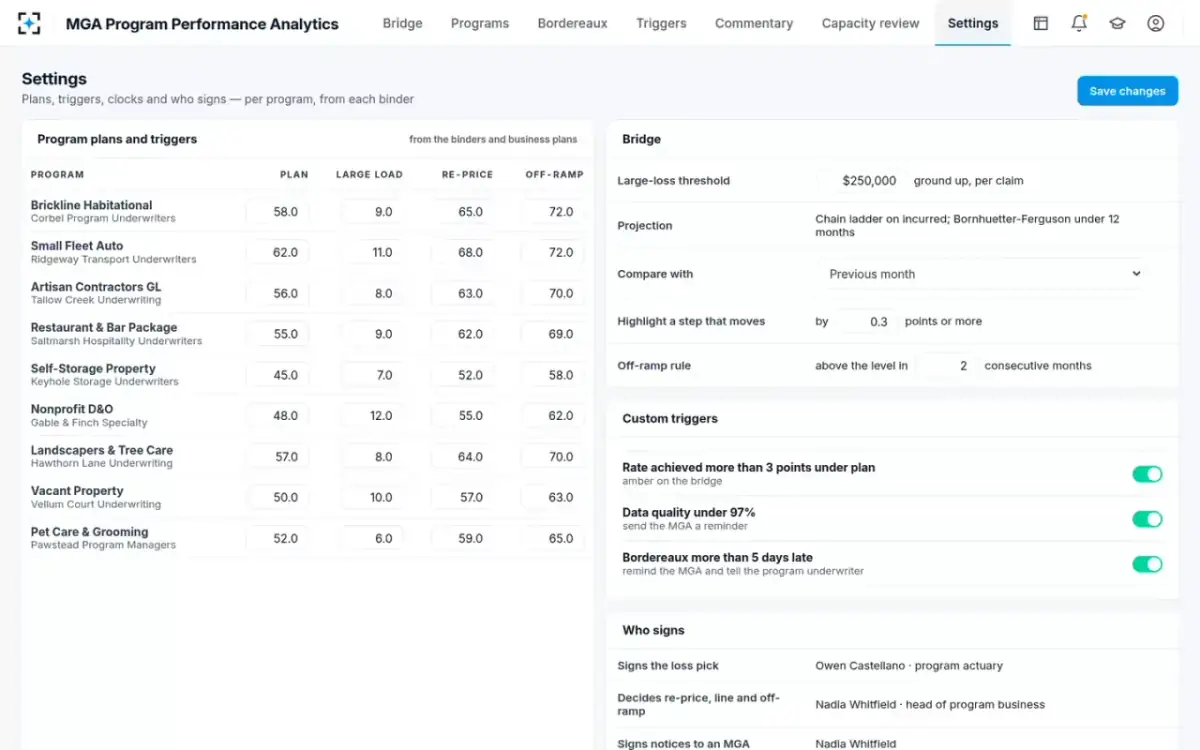
For a reader new to the vocabulary, what program business is, defined from the rules, is the natural next step. To see the bridge, the triggers and the signatures together, start from MGA Program Performance Analytics.
Questions people ask
What is a program manager in insurance?
The title is used on both sides of a program. At an MGA it often means the person who runs one program's underwriting and distribution; at a carrier it is a common title for the person who oversees several MGA programs. Neither is a legal term: the statutes speak of the MGA and the insurer, and Model #225 puts the oversight duties on the insurer, whoever holds the title.
What is an insurance program?
An insurance program is a defined class of business, such as apartment property or small fleet auto, written for a carrier by a delegate under a written agreement with limits on premium, rates, risk types, territory and policy terms. Model #225 §4F lists eight guideline fields the agreement must contain, from "the maximum annual premium volume" to "the maximum policy period".
Does a program administrator need a license?
Where the firm is an MGA, yes. Model #225 §3 bars anyone from acting as an MGA for risks in a state without a producer licence there, and Texas issues a separate MGA license under §4053.051. The carrier-side administrator, as an employee of the insurer, is excluded from the MGA definition.
Can a program administrator appoint sub-agents?
An MGA may appoint producers only once it has made sure each one is licensed for the insurance concerned, and it may not appoint a sub-MGA at all (Model #225 §4M). Texas lets an MGA "appoint or direct" property and casualty agents (§4053.101). A carrier that finds producers below its MGA writing large shares of a program should look at the quarterly MGA test again.
How often must a carrier review its program administrator on site?
At least semi-annually under Model #225 §5C, and in New York and Minnesota. Florida requires at least an annual on-site review, plus one within six months of engaging a new MGA. California's examiners criticised Topa Insurance Company in 2025 for not doing the semi-annual reviews its code requires.
Who is responsible if the program administrator breaks the rules?
The carrier, first. Model #225 §6 says the MGA's acts count as the insurer's own, and that the regulator may examine an MGA as if it were the insurer. If the insurer later fails, §7B lets its receiver sue an MGA that has not materially complied with the act.