A reserving actuary is the actuary who estimates how much an insurer still owes on claims that have already occurred, reported or not, and tests whether the reserves on the balance sheet cover it. Each quarter the reserving actuary takes the latest claim data, arranges it into development triangles by line and accident year, compares how losses actually developed with what the last review expected, projects ultimate losses with several methods, and recommends the numbers a reserve committee books. The hard part is timing: the data arrives weeks after quarter-end, and between reviews nobody compares development systematically. Botminds' Loss Development Monitoring exists for those weeks: it compares actual with expected development every week, for every segment and accident year, and shows the reserving actuary the claims and adjuster notes behind any move.
This guide follows one quarter of the job. The industry figures come from the Bureau of Labor Statistics, the NAIC and the Casualty Actuarial Society; the examples come from a sample casualty book in the solution, with fictional companies, claims and people.
A small profession that answers for the largest liability
31,200
actuary jobs in the United States in 2025, all practice areas
78%
of actuaries employed in finance and insurance
$1.03T
US property and casualty loss and LAE reserves at year-end 2025
9%
projected growth in actuary employment, 2025–35
What is a reserving actuary, and what number do they own?
A reserving actuary owns the estimate of unpaid claims: the case reserves the claim department has set on known claims, plus the development those claims will still show, plus claims incurred but not yet reported. That estimate is the largest liability a property and casualty insurer carries. The NAIC puts the industry's loss and loss adjustment expense reserves at $1.03 trillion at the end of 2025, against policyholders' surplus of $1.27 trillion (NAIC, 2025 Full Year Results). An error of a few percent in the reserve is a large share of an insurer's capital.
The Bureau of Labor Statistics describes the core task in one line among the duties of every actuary: to "Calculate cash reserves needed, based on existing policies and liabilities, in case of payout or claims" (BLS). In property and casualty insurance that work is governed by the Actuarial Standards Board's ASOP No. 43, which covers unpaid claim estimates, and once a year it ends in a signature: under the NAIC's actuarial opinion model law, every property and casualty insurer files an opinion on its reserves from an appointed actuary, backed by an actuarial report and workpapers (NAIC Model #745). The reserving actuary's quarterly work is what that annual opinion stands on.
Reserving actuaries are also the people who explain the number. When a line develops worse than expected, the chief financial officer, the reserve committee, auditors, regulators and reinsurers all ask the same question: which business, which years, and why. The answer has to be specific. NAIC regulators state that putting unusual development down to strengthening or to adverse development is not enough, and that they expect the causes particular to the company (NAIC AOWG, 2026; the guidance is quoted in what reserve strengthening is).
What does a reserving actuary do day to day? Four phases, repeated every quarter
Day to day, a reserving actuary works through four phases that the CAS study text attributes to Ronald Wiser: explore and balance the data, apply estimation techniques, reconcile the methods' different answers, and monitor how the estimates hold up afterwards. The fourth phase is the one the calendar squeezes. Wiser's description of it, as the CAS text quotes him, is the job's best diagnostic: "Deviations of actual development from projected development of counts or amounts are one of the most useful diagnostic tools in evaluating the accuracy of unpaid claim estimates" (Friedland, CAS).
In practice the phases fill a quarter like this. After quarter-end the claim data is extracted, reconciled to the financial statements and triangulated. The actuary adds the new diagonal to each triangle, compares actual with expected development by segment and accident year, and runs the chain ladder, Bornhuetter-Ferguson and other methods. Where an accident year moved, the actuary goes to the claim department to find out why. Then come the selections, the write-up for the chief actuary and the reserve committee, and the committee itself.
The trap is mechanical updating. Two CAS authors who trained actuarial students describe handing a student a prior study to update, "only to have the student do so in a very mechanical way" that did not ask where and why things had changed (Balester & Kirschner, CAS E-Forum). Their remedy starts with the same comparison Wiser put last: what emerged against what the last review expected, worked through on the actual vs expected calculation, cell by cell.
One quarter, two ways: most of the hand-built quarter is waiting, then eight unwatched weeks
- Waiting for data8 d
- AvE, claims, story12 d
- Select5 d
- Between reviews: no systematic comparison8 wk
- Review6 d
- Every segment compared each Monday, flags as they break12 wk
The numbers in that figure are an estimate, but the shape is familiar to anyone who has done the job. Eight days go to waiting for triangulated data. Nine more go to finding the claims that moved and reconstructing what happened from adjuster notes. Then, once the committee has met, development is not compared again until the next quarter-end, which is why an accident year that breaks in the second month of a quarter is usually first seen at the next review.
What do reserving actuaries do between quarterly reviews?
Between full reviews, most reserving actuaries run some form of roll-forward and keep an eye on large-loss reports, but few compare every segment and accident year with its expected development each month. The CAS study text is clear that the comparison belongs there: "Monitoring performance between detailed analyses of unpaid claims is important both for commercial insurers and self-insurers" (Friedland, CAS). What stops it is effort, not principle. Monthly monitoring needs monthly expected development, claim transactions rolled up by segment and age, and someone with time to look.
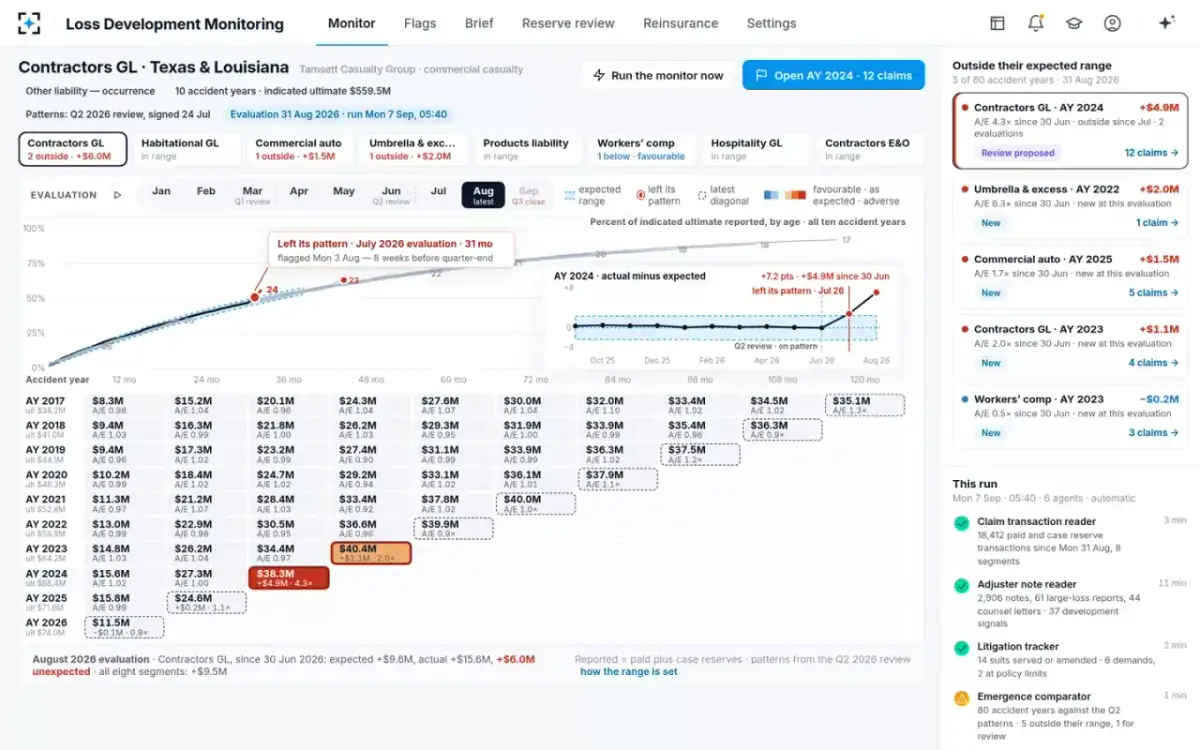
That gap is where a monitor fits. On the sample casualty book, contractors general liability for accident year 2024 sat exactly on its pattern at the June evaluation that the second-quarter review saw. At the July evaluation, at 31 months, it had reported 50.6% of its indicated ultimate against an expected range of 45.3% to 50.2%: $1.9 million more than expected in one month. Loss Development Monitoring flagged it on Monday 3 August, eight weeks before the quarter closed. By hand, the same break would have surfaced on the September diagonal, after the quarter's numbers were drafted.
The monitor the reserving actuary opens on Monday: every cell shaded by actual against expected
Do reserving actuaries talk to claims adjusters?
They should, and the CAS study text makes it part of the method rather than a courtesy. Discussing a change in average case reserves that could reflect new claims staff, new philosophy or simply a different mix of business, it concludes that the actuary should look at more than one diagnostic and that "the actuary returns to the insurer’s claims department for further input regarding his or her observations" (Friedland, CAS). A triangle can show that an accident year moved. Only the claim file says whether it moved because of an expert report, a lawsuit, a settlement policy or a data error.
The difficulty is that the conversation usually happens late and in summary. Large-loss reports usually go to claims leadership rather than to the reserving team, and the adjuster's note recording a plaintiff's expert report is written weeks before the case reserve changes. On the sample book, the note on the largest claim behind the July break came 13 days before its reserve rose from $150,000 to $1.7 million. How that lead time can be measured on an insurer's own closed claims is the subject of the large loss report and the note that comes first.
Five people carry the same accident year, and the reserving actuary decides what it means
Today
Meets adverse development on the new diagonal after quarter-end, then asks claims what happened.
With agents
Sees the cell in the month it breaks, with the claims and note passages behind it.
Still theirs: Every flag: watched, explained, or sent to the reserve review.
Today
Risks meeting the movement for the first time in a committee deck.
With agents
Reads it in a weekly summary with both indications side by side.
Still theirs: What the committee books, and the annual opinion.
Today
Adjusters write it down the day they learn it; reserving reads it a quarter later.
With agents
The signal is marked from the adjuster’s own passage the same week.
Still theirs: Case reserves and claim strategy.
Today
Builds committee evidence by hand from triangles, notes and claim screens.
With agents
Starts from a queue where each item carries its numbers, claims and range.
Still theirs: Checking the evidence and the exhibits.
Today
Tracks claims nearing the retention one by one, apart from reserving.
With agents
Sees every moving claim against its treaty layer, gross and net.
Still theirs: Sending treaty notices.
Reserving actuary vs pricing actuary: the same triangles, opposite directions
A reserving actuary looks backward at claims that have already happened and asks what they will cost; a pricing actuary looks forward at policies not yet written and asks what they should cost. Both use loss development, and many actuaries move between the two, but the deadlines, the readers and the risks differ. The pricing actuary's side of the desk is set out in its own guide.
Reserving and pricing actuaries share methods and answer different questions
| Reserving actuary | Pricing actuary | |
|---|---|---|
| Question | What will claims already incurred cost in the end? | What premium will cover next year’s claims and expenses? |
| Main output | Unpaid claim estimates and the reserve recommendation | Rate indications and rating factors |
| Clock | Quarter-end close, year-end opinion | Filing and renewal cycles |
| Who relies on it | Reserve committee, CFO, auditors, regulators, appointed actuary | Product and underwriting leaders, rate regulators |
| Standard most cited | ASOP No. 43, unpaid claim estimates; ASOP No. 36, opinions | Ratemaking standards and state filing law |
| When it goes wrong | Adverse development charged against current earnings | Inadequate rates or lost business |
The two roles meet at the a priori loss ratio, the expected loss ratio that the Bornhuetter-Ferguson method needs for young accident years. Pricing sets an expectation; reserving tests it against emergence. When a reserving actuary writes that a segment's development is "not in the a priori", the next pricing review should hear about it.
What is a reserve committee, and what does the actuary bring to it?
A reserve committee is the management group, usually chaired by the chief actuary or the CFO, that reviews the actuaries' indications each quarter and decides the reserves the insurer books. The reserving actuary presents the indications, the ranges and the reasons for movement; the committee chooses, and its minutes are the evidence that someone accountable did. NAIC regulators separately expect the appointed actuary to report to the board every year, and they encourage presenting in person so the uncertainty in the estimate is understood, not just the point (NAIC AOWG, 2026).
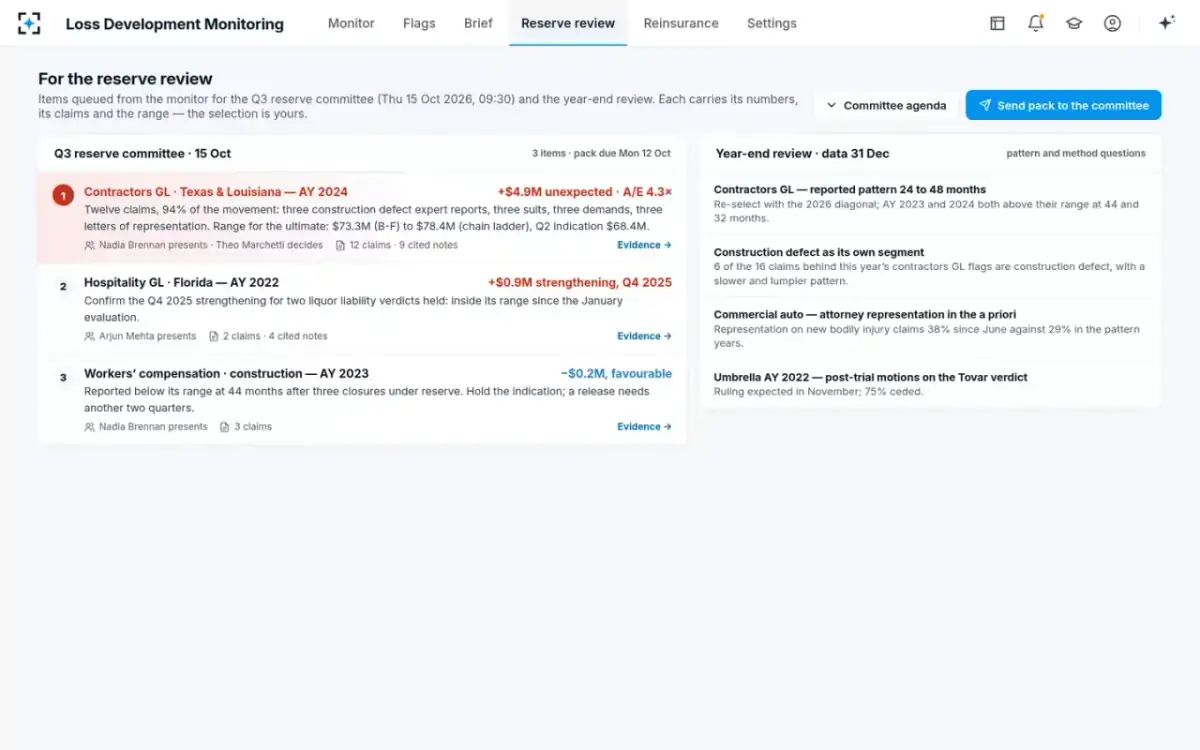
What reaches the committee is the reserving actuary's real product. An item that says "accident year 2024 is up $4.9 million" invites the questions regulators ask: is it one segment or many, one year or several, specific to the company or industry-wide. An item that arrives with the twelve claims, their reserve changes and the passages behind them answers those questions before they are asked. Terms of reference that make those questions standing items are drafted in a separate guide.
The reserve committee queue: each item with its numbers, claims and range
What qualifications does a reserving actuary need?
Most reserving actuaries in US property and casualty insurance hold or are working toward the Casualty Actuarial Society's credentials: associateship (ACAS) and fellowship (FCAS). The BLS notes that actuaries need a bachelor's degree and a series of exams, and that "It may take up to 7 years for an actuary to earn the associate-level certification because of the lengthy preparation required" (BLS). Reserving appears in the exam titles themselves: Exam 5, Basic Ratemaking and Estimation of Claim Liabilities, and Exam 7, Advanced Estimation of Claims Liabilities.
Signing the statutory opinion takes more than a credential. The appointed actuary must meet the qualification standards the NAIC instructions set and document them to the board, and while the opinion itself is public, the actuarial report and workpapers behind it are confidential and go to regulators. Beyond the exams, the skills that separate good reserving actuaries are the unglamorous ones: reconciling data before trusting it, reading a claim file, and explaining a movement to a committee in a sentence that a CFO can repeat.
A triangle can show that an accident year moved. Only the claim file says why, and by the time the triangle shows it, the file has usually known for weeks.
Where Loss Development Monitoring changes the reserving actuary's quarter
Loss Development Monitoring changes the eight weeks between reviews and the four days spent finding claims; it does not change who selects. Six agents read every paid, case reserve and recovery transaction each night, read the adjuster notes, large-loss reports and defense counsel letters, track suits and demands, and compare actual with expected development for every segment and accident year against the last signed review's selected patterns. When a curve leaves its expected range, the emergence comparator marks the evaluation and attributes the unexpected to the claims that moved.
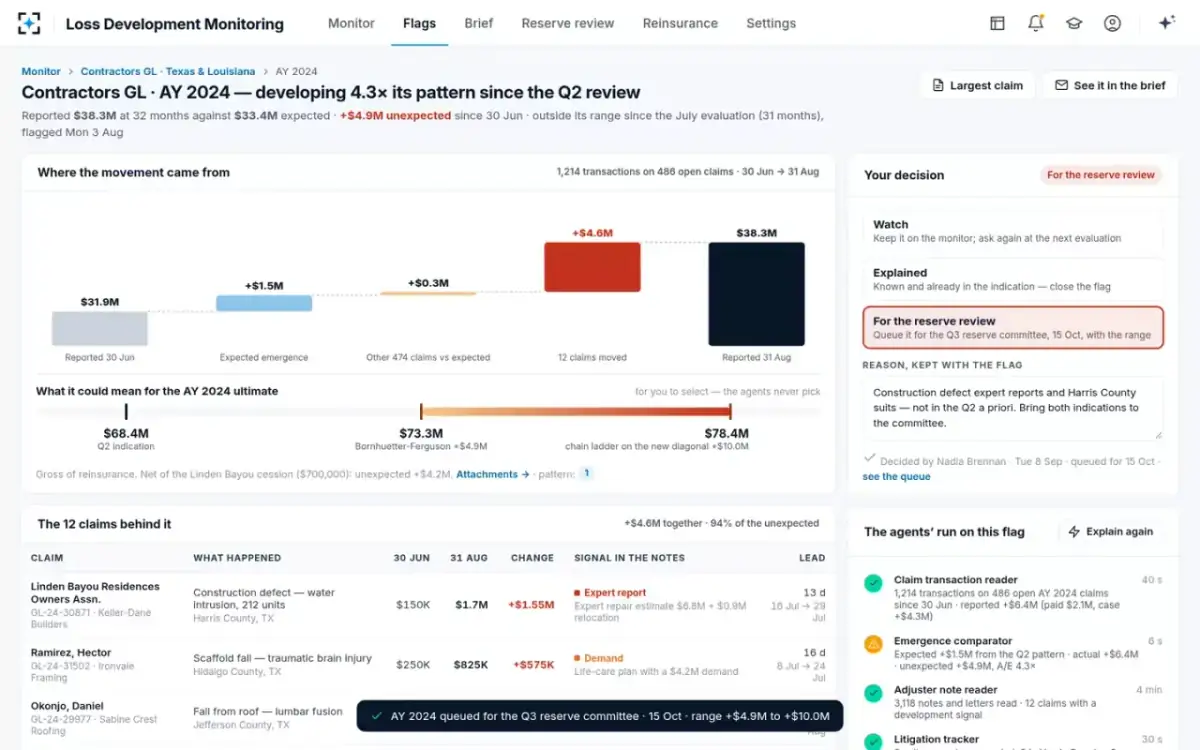
The reserving actuary then decides. Each flag is marked watched, explained, or for the reserve review, with the reason kept beside it; after two monthly evaluations outside the range the agents propose the reserve review, and the actuary can decline. The agents never select an ultimate, never change a selected pattern, never edit a claim or a reserve, and never send anything outside the reserving team. On the sample book the actuary marked accident year 2024 for the third-quarter committee with both indications, $73.3 million Bornhuetter-Ferguson and $78.4 million chain ladder, and the reason in her own words.
The decision stays with the actuary, and keeps its reason
Where it does not fit is equally plain. It is not a reserving system: the quarter's methods, selections and exhibits still live in the actuary's own tools. It needs a claim transaction feed and readable notes, and it compares against patterns someone has already selected and signed. For a book with no claim notes to read, it can still compare development every month, but it cannot say why a cell moved.
Questions people ask
What does a reserving actuary do?
A reserving actuary estimates the unpaid claims an insurer owes, including claims not yet reported, by projecting development triangles with several methods and comparing actual development with what was expected. The work ends each quarter in a recommendation to the reserve committee and each year in the appointed actuary's opinion that NAIC Model #745 requires.
What is the difference between a reserving actuary and a pricing actuary?
Reserving looks backward at claims already incurred and estimates what they will finally cost; pricing looks forward and sets the premium for policies not yet written. Both rely on loss development, and they meet at the expected loss ratio, which pricing sets and reserving tests against emergence.
How many actuaries work in insurance?
The BLS counts about 31,200 actuary jobs in the United States in 2025, 78% of them in finance and insurance, with a median wage of $130,000. It does not publish a separate count for reserving actuaries.
Is reserving a good career for an actuary?
It is the part of property and casualty work closest to the balance sheet and to senior management, since the reserve is an insurer's largest liability and the appointed actuary signs an opinion on it every year. The BLS projects actuary employment to grow 9% from 2025 to 2035, much faster than the average.
What exams cover loss reserving?
In the Casualty Actuarial Society's path, Exam 5 covers basic ratemaking and the estimation of claim liabilities, and Exam 7 covers advanced estimation of claims liabilities. The BLS notes that reaching the associate level can take up to seven years.
Can software do a reserving actuary's job?
Software can do the mechanical part: roll up transactions, compute development and compare it with what was expected, and read claim notes for the events behind a move. Selecting ultimates and signing the opinion remain the actuary's, and the actuarial standards hold the actuary responsible for any model used.