AI in actuarial reserving is most useful, and least risky, where the work is reading and comparing rather than choosing: rolling every paid and case reserve transaction into triangles, reading adjuster notes and counsel letters for the events that move a claim, and comparing every segment's actual development with what the last review expected. Choosing the ultimate stays with the actuary, and the actuarial standards say so: the profession treats an AI model as a model, so the actuary validates its output and answers for relying on it. This guide traces one Monday run of Botminds' Loss Development Monitoring, the six agents it uses and the nineteen minutes they take, to show what that division of labour looks like in practice.
The run below is from a sample casualty book in the solution, with fictional companies, claims and people. The professional and regulatory positions come from the Actuarial Standards Board, the American Academy of Actuaries, the US Treasury and EIOPA, linked where they appear.
One weekly run of Loss Development Monitoring, step by step: most of the time is reading notes
- Transactions3 min
- Notes, reports, letters11 min
- Litigation2 min
- Last 3 steps< 3 min
How is AI used in actuarial reserving?
AI is used in actuarial reserving in three ways: to read unstructured claim text, to monitor development between reviews, and to model claims individually. The first two are reading and comparing; the third is estimation and carries the heavier validation burden. Machine-learning models that reserve claim by claim are a separate subject, covered on the claim side in machine learning in individual claims reserving.
Reading is where language models change what is practical. A casualty book of any size produces thousands of adjuster notes a week, and the events that move reserves, such as a plaintiff's expert report, a letter of representation, a suit served or a policy-limits demand, are written there first. The CAS study text already tells the actuary to take observations back to the claim department; a model that reads every note narrows that conversation to the claims that matter.
Monitoring is where the arithmetic is simple and the effort is not. The CAS text describes the model: compare actual with expected claims by accident year between valuations, with expected derived from the selected ultimate and pattern. It calls building one "a simple exercise" for annual valuations, and then explains why monthly monitoring is harder when patterns exist only annually (Friedland, CAS). Agents remove the effort: the comparison runs every week whether or not anyone has time.
What does an AI reserving tool read? Step 1 to 3 of the run
A reserving tool that explains movement reads three things: the claim transactions, the claim text and the litigation detail. In the sample run, the claim transaction reader rolled 18,412 paid and case reserve transactions since the previous Monday into cumulative reported losses by segment, accident year and month, three minutes of work. It is read-only on the claim system, and its totals reconcile to the general ledger at each month-end, which is the first check an actuary should ask any such tool to pass.
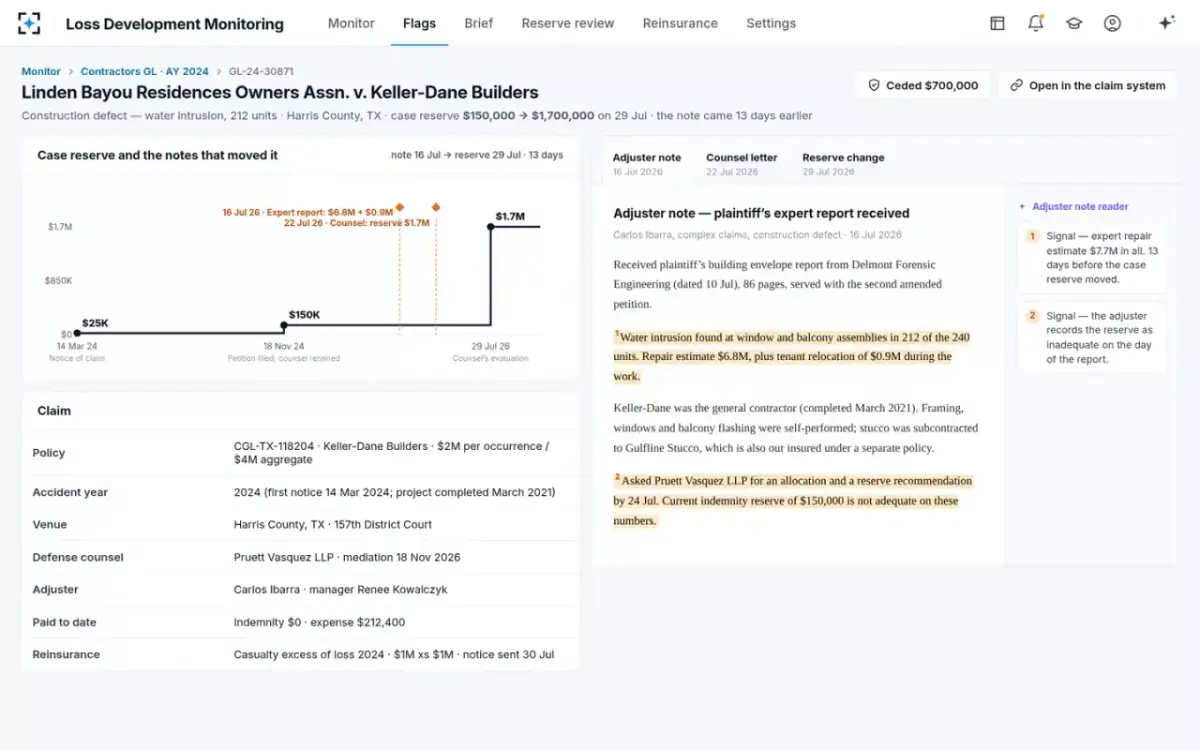
The adjuster note reader took eleven minutes: 2,906 notes, 61 large-loss reports and 44 defense counsel letters, from which it marked 37 development signals. A signal is one of a short list of events the reserving team has switched on, such as an expert report, a letter of representation, a suit served or amended, a demand, a surgery, a verdict or an adjuster recording that the reserve is inadequate. Each signal carries its date, its amount and the passage it came from. The note reader never infers a signal the text does not state and never summarises away an amount.
The litigation tracker took two minutes to update suits, venues, counsel, demands and mediation dates on every open liability claim; that week it found 14 suits served or amended and six demands, two of them at policy limits. It never estimates a verdict. Steps four to six, comparing, matching to treaties and drafting, take under three minutes together, because by then the reading is done.
Six agents in Loss Development Monitoring, each with a line it never crosses, and the people who decide
Agent
Claim transaction readerRolls every paid, case reserve and recovery transaction into reported losses by segment, accident year and month.
Never: edits a claim, a transaction or a reserve.
Agent
Adjuster note readerMarks development signals in notes, large-loss reports and counsel letters, each with date, amount and passage.
Never: infers a signal the text does not state.
Agent
Litigation trackerTracks suits, venues, counsel, demands and mediation dates on open liability claims.
Never: estimates a verdict.
Agent
Emergence comparatorCompares actual with expected development for every cell and marks the evaluation where a curve leaves its range.
Never: changes a selected pattern, ultimate or indication.
Agent
Reinsurance attachment checkerMatches moving claims to treaty layers and shows the unexpected gross, ceded and net.
Never: sends a treaty notice.
Agent
Summary writerDrafts the weekly development summary and the evidence for each reserve review item, both indications side by side.
Never: selects an ultimate or recommends a reserve.
A person decides
Reserving actuaryMarks each flag watched, explained or for the reserve review, with the reason, and sends the summary.
A person decides
Chief actuaryDecides what the reserve committee books.
Can AI select loss development factors or calculate IBNR?
AI can compute loss development factors, indications and IBNR; whether it should select them is a separate question, and in Loss Development Monitoring the answer is no. Computing is arithmetic on a triangle and any reserving tool does it. Selecting is judgment about which years are representative, which changes in claims practice or mix distort the history, and which method to trust for which age, and ASOP No. 43 asks for assumptions that lean neither high nor low on purpose (ASOP No. 43; what that rules out is set out in what regulators say actuarial judgment is not). The standard itself is being reopened: in 2025 the Actuarial Standards Board approved a proposal to revise ASOP No. 43 and reported that a task force was being formed (ASB, 2025 Annual Report).
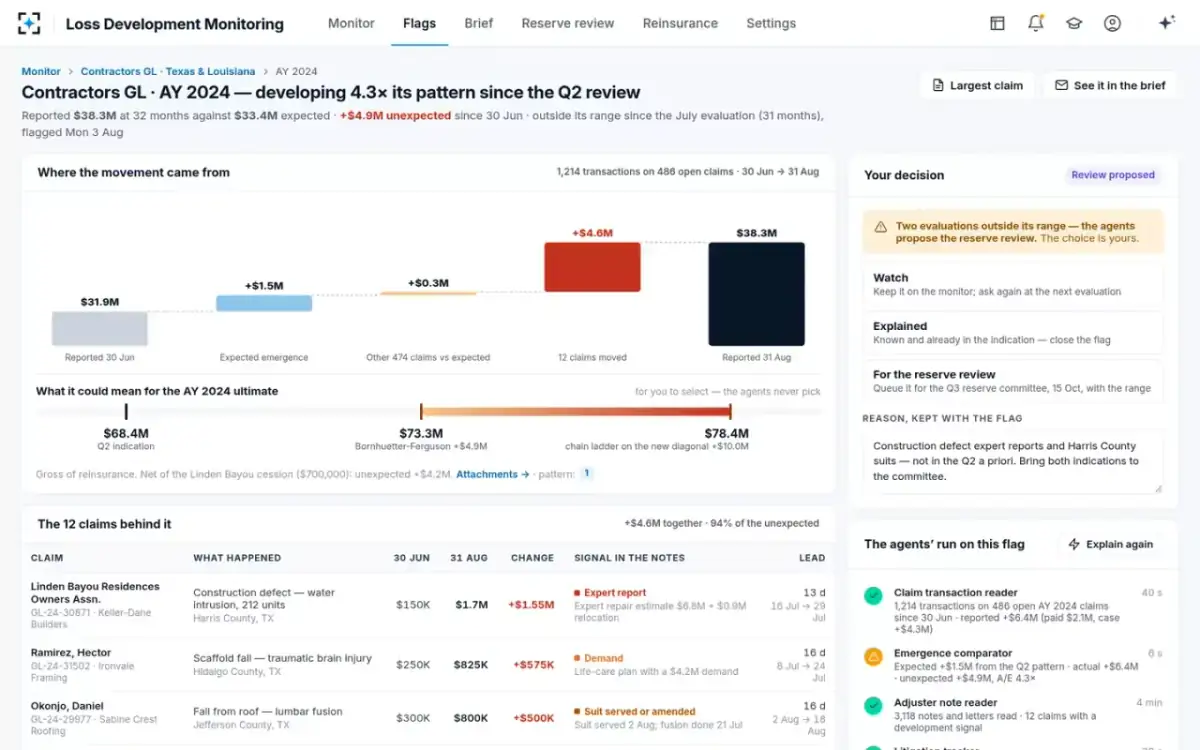
In the sample run, the comparator's job ended with step four. Contractors general liability, accident year 2024, had reported $6.4 million in July and August against $1.5 million expected from the second-quarter pattern: $4.9 million unexpected, an A/E of 4.3. The tool then showed what that could mean for the ultimate, without choosing: $68.4 million at the second-quarter review, $73.3 million by Bornhuetter-Ferguson with the unexpected added, $78.4 million by chain ladder on the new diagonal. How expected is worked out for each cell is set out in actual vs expected, cell by cell.
Step four's output: where the movement came from, and the range for the actuary to select from
Does ASOP 56 apply to AI?
Yes. ASOP No. 56, Modeling, applies to any model an actuary uses, and the American Academy of Actuaries' Committee on Professional Responsibility said in a 2024 paper that generative AI is itself a model, so the standard applies to it (American Academy of Actuaries; how that reads for the data under a reserve study is in AI data validation tools for claims extracts). The paper is non-binding commentary, not a standard, but it reads the standard directly. The standard's own requirement is short: "The actuary should validate that the model output reasonably represents that which is being modeled" (ASOP No. 56, section 3.6.2).
The Academy paper draws the consequence for anyone hoping AI will take responsibility off the actuary's desk: an unvalidated result is no defence, a point taken up for the profession as a whole in will AI replace actuaries. It also says that actuaries are responsible for the decision whether and how to rely on AI tools. A reserving tool that hides its arithmetic, or that summarises a note without showing it, makes that validation impossible.
Validation needs for AI models may surpass those of traditional actuarial models, requiring frequent assessments tailored to the model’s design.
American Academy of Actuaries, Committee on Professional Responsibility, 2024
How do you validate an AI model for reserving?
You validate an AI reserving tool the way you validate any model, split by what it does: reproduce its arithmetic, test its reading against the source text, and backtest its signals on closed history. The Academy paper notes that initial evaluation "mirrors conventional statistical validation processes such as back-testing", and warns validators not to check one AI tool with another that shares its weaknesses (American Academy of Actuaries; the test built on that warning is in actuarial AI software). The checklist below turns that into tests a reserving team can run before the tool's first flag reaches a committee.
Seven validation tests for AI in actuarial reserving, before the first flag reaches a committee
- Reproduce a cell by hand
Pick a hot cell and a quiet one; expected, actual, range and A/E must come out the same from the signed pattern and the transactions.
- Reconcile reported to the general ledger
Month-end totals by segment should tie to the financial statements; a tool that cannot tie is reading different data from the actuary.
- Sample the signals against their passages
Open a set of marked signals and read the cited passage: does it state the event, the date and the amount?
- Sample the notes it did not mark
False negatives matter more than false positives. Read unmarked notes on claims that moved and check nothing was missed.
- Backtest the flags on closed years
Freeze an old triangle, run the comparison forward and count how often a flag preceded adverse development.
- Check the limits are enforced, not promised
Read-only access on claims and reserves, no outbound messages, no write access to selected patterns.
- Keep the validation independent
Do not use a second AI model as the only check on the first; a person reads the passages.
The backtest is the test most teams skip and the most informative. A replay of an actual-versus-expected monitor on the CAS Schedule P research data is worked through in replaying a reserve monitor on closed years, including how often a first-year flag preceded adverse development and how many adverse years it missed.
What does the actuary see after the run? Steps five and six
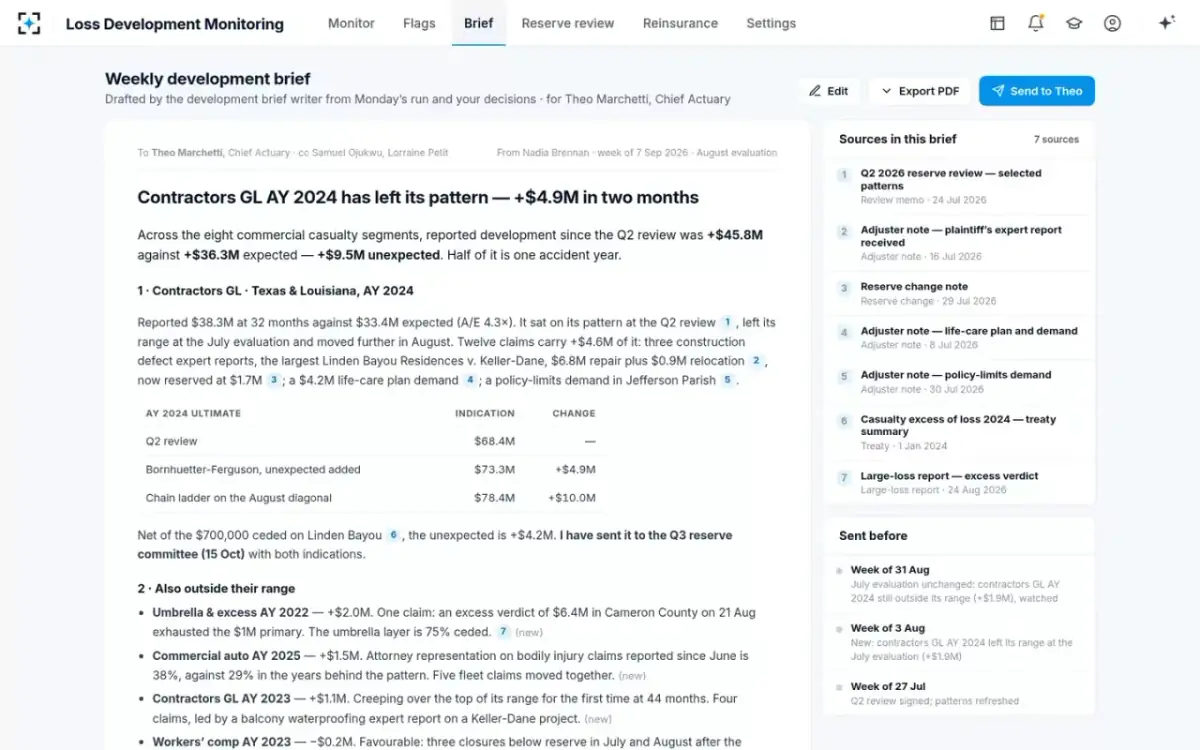
After the comparison, the run does two last things: it matches every moving claim to its treaty layer, and it drafts the week's summary. In the sample run the reinsurance attachment checker took 40 seconds and found the largest claim on the flagged accident year above the $1 million retention of the casualty excess of loss treaty, so $700,000 of the $4.9 million was ceded and the flag stood at $4.2 million net. The summary writer drafted the week for the chief actuary in a minute: across the eight segments, $45.8 million reported since the second-quarter review against $36.3 million expected, half of the unexpected in one accident year, with every figure numbered to its source.
The adjuster's note the reader marked, and the reserve change it led by 13 days
The draft is not sent by the tool. The reserving actuary edits it, adds her decisions and sends it; on the sample book she marked the accident year for the third-quarter reserve committee with both indications. That order matters for governance as much as for accuracy: the person who answers for the reserve is the person who decides what the chief actuary reads.
Will regulators accept AI in reserving?
Regulators have not written a reserving-specific AI rule; they hold the insurer and the actuary to the rules that already apply. In the US, insurers told the Treasury that "state insurance regulators oversee AI use" and pointed to the NAIC's model bulletin on insurers' use of AI systems (US Treasury, 2024). In the EU, the insurance supervisor makes the actuarial function answer for the controls on AI used in its own work, such as the calculation of technical provisions (EIOPA, 2025; quoted in IFRS 17 automation).
For a US reserving team the practical test is the one regulators apply to any reserve support: can the actuary show how a number was reached and why a change was made. A tool whose flags carry their arithmetic and their cited passages produces that support as a by-product. A tool that produces a recommendation without both leaves the actuary to rebuild it.
What AI does in the reserving week, and what stays with people
| Task | Agents in Loss Development Monitoring | People |
|---|---|---|
| Roll transactions into triangles | Every night, reconciled to the general ledger at month-end | Review the reconciliation |
| Read notes, reports, letters | Every week; mark signals with the passage | Spot-check passages; read the claims behind a flag |
| Compare actual with expected | Every cell, every evaluation, with its arithmetic | Set the range and the thresholds |
| Indications | Show Bornhuetter-Ferguson and chain ladder side by side | Select the ultimate |
| Decide what a flag means | Propose the reserve review after two evaluations outside the range | Mark watched, explained or for the reserve review |
| Communicate | Draft the weekly summary and committee evidence | Send it; present it; decide what is booked |
What are the risks of AI in loss reserving?
The risks are the familiar model risks plus one new one: a reading model can be confidently wrong about text. The Academy paper warns that generative AI responses may be "incomplete, out of date, hallucinated, unsuitable for the assignment" (American Academy of Actuaries). In reserving that means a signal that was never in the note, an amount dropped from a summary, or a demand read as a settlement. Each is caught the same way: a signal without a cited passage is not a signal, and every amount travels with the sentence that stated it.
The quieter risk is over-reliance on a monitor's silence. A comparison against a selected pattern only sees movement relative to that pattern; if the pattern itself is wrong in a way that moves slowly, every month can sit inside its range. That is why the range settings, the review trigger and the pattern in use are versioned settings owned by the reserving team, covered in the eight settings that decide a flag, and why the annual review still re-selects patterns from scratch.
What to look for when buying AI for actuarial reserving
Buy for evidence, not for answers. The useful questions are about what the tool shows and what it cannot do: whether every flag carries expected, actual, the range and the A/E; whether every signal links to a passage; whether reported totals tie to the general ledger; whether it is read-only on claims, reserves and patterns; whether thresholds are settings with an audit trail; and whether it can be backtested on your own closed years. A tool that selects ultimates for you is answering a question the actuarial standards leave with you.
Loss Development Monitoring fits a reserving team that already has selected patterns it trusts, a claim system with a transaction feed, and adjuster notes worth reading, and that wants development compared every week with the claims behind each move. It does not replace a reserving system, a stochastic model or the quarterly review, and it does not reserve individual claims. On a book without readable notes it still compares every cell, but the reason behind a move stays a question for the claim department, as it was before. For where it sits among the alternatives, see actuarial reserving software vs a monitor.
The weekly development summary, drafted from the run for the chief actuary
Questions people ask
Can AI replace reserving actuaries?
Not under the current professional framework. The Academy's 2024 paper says actuaries are responsible for the decision whether and how to rely on AI tools, and ASOP No. 56 requires them to validate model output; selecting ultimates and signing the opinion stay with a qualified actuary.
Can AI calculate IBNR?
It can compute IBNR by standard methods, which is ordinary arithmetic on a triangle. Selecting the IBNR the insurer books involves judgment about methods, patterns and changing conditions that ASOP No. 43 assigns to the actuary.
What data does AI need for loss reserving?
For monitoring: paid, case reserve and recovery transactions with accident dates, the selected patterns and ultimates from the last signed review, and, to explain movement, adjuster notes, large-loss reports, counsel letters and litigation detail. Treaty layers let the tool show movement net of reinsurance.
Is generative AI reliable enough to read claim notes?
Only with controls. The Academy warns that generative AI output can be incomplete or hallucinated, so each marked signal should cite its passage and a person should sample both marked and unmarked notes before relying on the reader.
How long does an AI reserving run take?
In the sample run, about nineteen minutes for eight segments and 80 accident years, eleven of them spent reading 2,906 notes, 61 large-loss reports and 44 counsel letters. The comparison itself took a minute.
Do regulators require disclosure of AI use in reserving?
The Academy paper suggests actuaries disclose how they used AI to meet the reliance disclosures in ASOP Nos. 41 and 56. State regulators' expectations for insurers' AI systems are set out in the NAIC's model bulletin and state rules, which apply to the company rather than to the reserving method alone.