Actuarial AI software is any tool that uses AI models to do part of an actuary's work, from projecting reserves to drafting the documents that report them. For the property and casualty year-end, the useful kind drafts the Actuarial Report and the Statement of Actuarial Opinion from a finished reserve analysis, ties every figure to the annual statement and checks the documentation, while the appointed actuary decides and signs. The calendar is what makes it hard to adopt: the opinion is filed with the annual statement by 1 March, the confidential summary is due by 15 March and the report must be available by 1 May, and none of those dates moves for a new tool. Botminds' Actuarial Opinion & Report Automation is that kind of software. The plan below goes live before the first full statement version of the year, and proves the solution on last year's signed report before it touches this year's.
Go live on last year's report in the autumn, not on this year's in February
- Third quartermid-Nov
- Year-end, appointment31 Dec
- Statement versions moveopinion 1 Mar
- 15 Mar
- Report available1 May
- Connect and replay last yearSep to mid-Nov
- Settings and rehearsalNov to Dec
- Live on every versionJan to 1 Mar
- 15 Mar
- Report and peer reviewto 1 May
What is actuarial AI software?
It is a broad label, and it pays to split it before buying. Some actuarial AI software estimates: machine-learning reserving, pricing models, claim-level predictions. Some assists: general-purpose assistants that summarise papers or write code. And some does a bounded production task under the actuary's control, such as reading statement versions, tying a report to them, drafting exhibits and narrative and listing documentation gaps. The year-end opinion belongs to the third kind. The judgement in it, which assumptions, which range, whether the reserves are reasonable, stays with the appointed actuary; what software can take is the mechanical work that fills the last fortnight before filing.
The profession's own guidance draws the same line. The American Academy of Actuaries' professionalism paper on generative AI treats such tools as models subject to ASOP No. 56 and says "Care should be taken to ensure that actuaries are using AI to support responsible actuarial practice, not to replace analysis and decision-making" (Academy, Actuarial Professionalism Considerations for Generative AI, 2024). The question for a buyer is therefore not how much the software can do but how cleanly it separates drafting from deciding. Actuarial AI agents: inside the one that ties the report out shows that separation in one live run.
What are the actuarial opinion filing deadlines?
Three dates for the appointed actuary's documents, set by the instructions and state law, and two more around them that shape the work.
The dates a go-live plan has to respect
| Date | What is due | Source |
|---|---|---|
| 45 days after quarter-end | Quarterly statements for the first three quarters, so the third quarter in mid-November | State law, e.g. Minnesota § 60A.13; Florida rule 69O-137.001 |
| 1 December | Letter of intent for an exemption from the opinion requirement | NAIC instructions ¶1B |
| 31 December | Appointment of the appointed actuary by the board, for the year the opinion covers | NAIC instructions ¶1 |
| 1 March | Annual statement, with the Statement of Actuarial Opinion attached to page 1 | State law, e.g. Minnesota § 60A.13; instructions ¶1 |
| 15 March | Actuarial Opinion Summary to the domiciliary state, or its later date | NAIC summary instructions ¶1 |
| 1 May | Actuarial Report available, or within two weeks of a commissioner's request | NAIC instructions ¶7 |
| 1 June | Audited statutory financial report from the independent CPA | NAIC Model Regulation #205 |
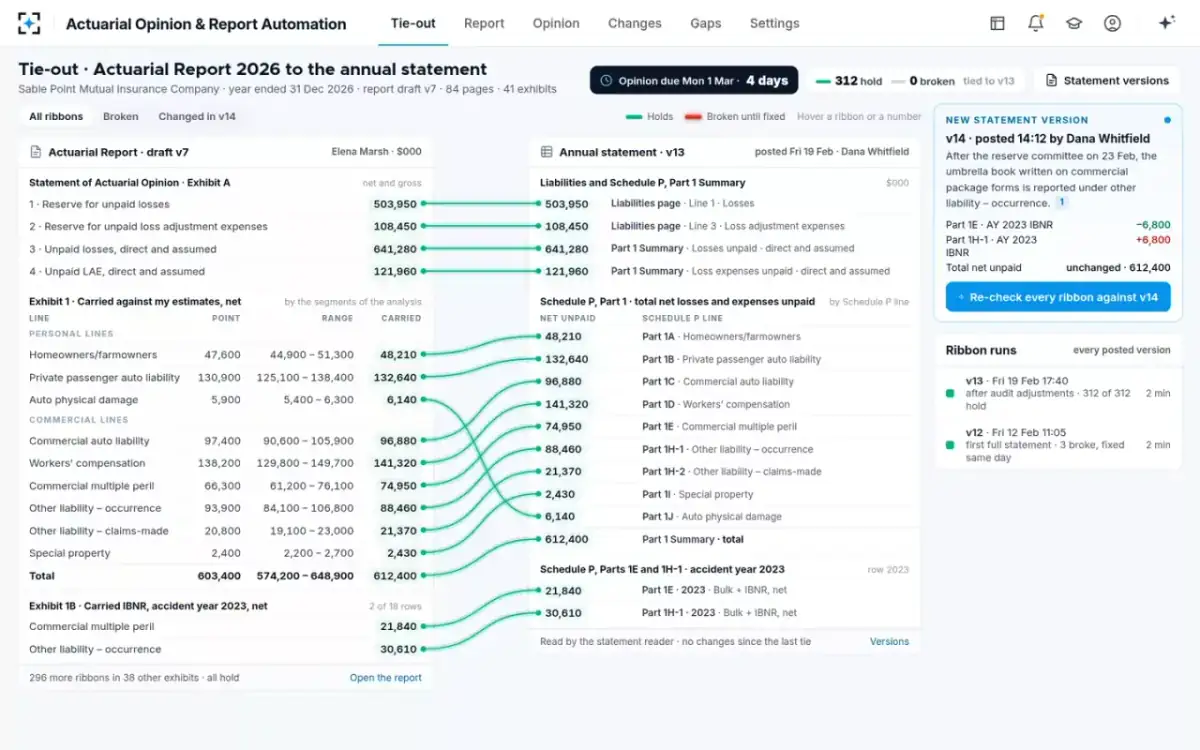
The 1 March date is the one that governs software. Every statement version posted after the first full one can move a number the report and opinion quote; in the solution's sample year-end there were two more, one after audit adjustments and one after a reserve committee. A tool that is still being configured in February will be tested in the worst conditions there are, on the document with the hardest deadline.
When should actuarial AI software go live?
Before the third-quarter statement, so that it is proven by the time the year-end statement starts moving. Working back from 1 March gives a simple sequence.
September to mid-November: connect and replay. Connect last year's statement versions from the annual statement tool, last year's reserve analysis, the signed report and opinion, and the assumption memos. Then rebuild last year's report with the software and compare it with what was signed. This is the step that decides whether to continue. Mid-November to December: settings and rehearsal. Agree the settings the appointed actuary will own: the tie tolerance, the materiality standard basis, the opinion's starting wording, the house style, the peer reviewer. Rehearse on the third-quarter statement and the year-end roll-forward data. Bring the AI governance owner in now, not in February; AI Governance & Model Inventory covers that side, including the state bulletins on insurers' AI use. January to 1 May: live. The solution reads every posted version, keeps the ties and lists what each version breaks; the actuary signs on 1 March and finishes the report and peer review by 1 May.
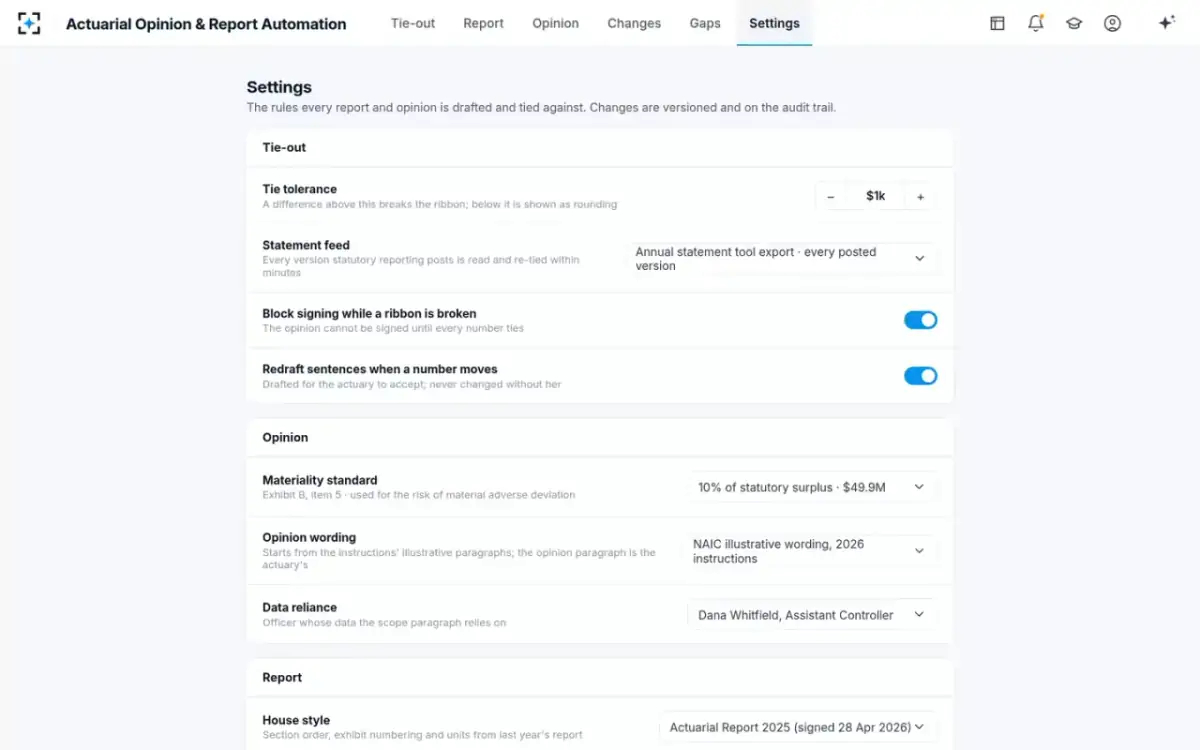
The settings the appointed actuary signs off before year-end
How do you test AI software on an actuarial report?
Replay last year. You already have the best possible test set: a signed report and opinion, the statement versions they were tied to, the reserve analysis behind them and the peer reviewer's comments. Run the software on last year's inputs and compare its output with the documents you signed.
A replay on last year's signed report, in five steps
A person decides
Gather last yearThe signed report and opinion, every statement version posted after the first full one, the reserve analysis and the assumption memos.
Agent
Rebuild and tieThe agents draft last year's exhibits and narrative from last year's analysis and tie every figure to the version that was filed.
Never: look at the signed report while drafting
A person decides
Compare with what was signedEvery figure that differs, every sentence whose meaning differs, every gap listed that the peer reviewer also raised, or did not.
Agent
Replay the late versionsRe-run the tie-out against each statement version in the order it was posted and list what each one broke.
A person decides
Plant errors and decidePlant known errors in the signed opinion and count the catches; then decide whether to run it live this year.
The actuarial standard on models describes this kind of test. ASOP No. 56 asks the actuary to check that a model's output fairly represents what it models (the requirement is quoted in AI in actuarial reserving), and lists among the ways "testing, where applicable, preliminary model output against historical actual results" (ASOP No. 56, section 3.6.2). A replay is exactly that: last year's report is the historical actual. The Academy's generative AI paper makes the same point about drafting.
"Regularly benchmarking AI-generated content against previously validated reports and external standards can help check quality and comprehensiveness and avoid errors from model hallucination or disconnects between training data and current conditions."
American Academy of Actuaries, Actuarial Professionalism Considerations for Generative AI (2024)
The planted-error step guards against the obvious blind spot. The same paper asks: "Could your validation approach have the same blind spot(s) as your tool (e.g., a GenAI tool validating another GenAI tool)?" A replay judged only by the software's own checks has that blind spot. Judge it instead by what a person finds: the differences from the signed report, the peer reviewer's old comments, and ten known errors planted by hand, the way a statement of actuarial opinion example with ten planted errors does.
What to measure on the replay, in your own numbers
- Figures tied to the filed statement version
Every number in last year's report and opinion; any that cannot be tied should be explained, as last year's should have been.
- Figures and sentences that differ from the signed documents
Each difference is either the software's error or one in the signed report. Both are worth knowing.
- What each late statement version broke
Compare with what you remember fixing by hand last February.
- Documentation gaps listed by paragraph
Set them beside the peer reviewer's comments from last year: which did both find, and which only one?
- Planted errors caught
Out of ten, by type: tie, consistency, rules, judgement.
- Hours of the people involved
Your own baseline. No public benchmark exists; ours is an estimate of about three weeks of senior time by hand.
Who needs to be in the room, and what each person brings
Five people, each for a short time, and the plan fails if any one of them is missing in the autumn. The appointed actuary owns the settings and the decision to go live, and is the only person who can say whether a replayed paragraph means what the signed one meant. The reserving actuary supplies the analysis in the form the agents read: selections, triangles, point estimates and ranges by segment and accident year, with the memo behind each change. Statutory reporting supplies every posted statement version as an export and agrees that the statement stays read-only to the software. The peer reviewer reads the replay's differences and last year's comments side by side. And the AI governance owner records the tool, its limits and its controls before it is used on a filed document.
The time each of them gives is front-loaded by design. Most of it falls in October and November, when the year-end has not started and a replay can be stopped without consequence. By February the work is the same as without the software, deciding and signing, minus the hours of making the documents agree. The sample settings show what the appointed actuary is asked to decide once: a $1k tie tolerance with signing blocked above it, redrafts on but never applied without acceptance, a materiality standard of 10% of statutory surplus, the NAIC illustrative wording as the opinion's starting point, last year's signed report as the house style, and a named outside peer reviewer who must see every comment answered before the report is final.
Does ASOP 56 apply to AI tools?
Yes, according to the American Academy of Actuaries: its 2024 professionalism paper treats generative AI as a model, so the modeling standard applies to it. ASOP No. 56 itself has been effective for work performed on or after 1 October 2020 and covers designing, selecting, using and reviewing models. Its practical demands on an AI drafting tool are testing (including reconciling inputs to their source and outputs to prior runs), output validation, and reasonable governance and controls over model risk, which the actuary may rely on others to operate (what that means for a monitor's settings is set out in IBNR software settings). The paper is not itself a standard; the standard is.
Two further obligations matter for drafting. The Academy paper suggests actuaries disclose how they used AI, for example "to perform a search, to summarize information or documents, to develop model inputs and/or outputs, and/or to evaluate results," because ASOP Nos. 41 and 56 require disclosure of reliance on others' models. And on the regulatory side, the U.S. Treasury's 2024 report on AI in financial services recorded insurers' view that state insurance regulators oversee their use of AI (Treasury, December 2024), which is why the governance owner belongs in the plan from November.
Who signs an AI-drafted actuarial report?
The appointed actuary, exactly as before. The instructions require the report to reproduce the opinion's signature details and the date the report was finalized, and nothing in them or in ASOP No. 36 shifts responsibility to a tool. The Academy paper puts the professional position plainly: AI does not make an actuary qualified for work the actuary could not do without it.
In Actuarial Opinion & Report Automation, signature and authorship are kept separate by design. The report drafter never changes a selection, method or judgement and never writes the opinion paragraph; every redraft waits for the actuary to accept or edit it; the documentation reviewer drafts text for a gap but only the actuary closes it; and signing is blocked while any number disagrees with the statement. The signature is logged with the time, the statement version and the report draft it rests on.
The tie-out on the first full statement version, four days before filing
What are the best AI tools for actuaries, and how should you choose?
There is no best tool in general, only the best fit for a task with a deadline and a signer. For the year-end opinion, choose on five things you can test in a replay: whether figures trace to the statement line, whether a late version produces a list of what it broke, whether sentences as well as cells are checked, whether the tool can be stopped from changing a selection or the opinion paragraph, and whether everything it did can be shown to a peer reviewer or examiner afterwards. A tool that writes fluent paragraphs but cannot do the first two will add review time in February rather than remove it.
Actuarial Opinion & Report Automation is a fit where the report is long, the statement moves late and the review is short of time. It is not a reserving tool and does not do the analysis, select assumptions or prepare the confidential Actuarial Opinion Summary. It needs every posted statement version as an export from the annual statement tool, and the reserve analysis with its selections, triangles, point estimates and ranges by segment and accident year; a company that cannot provide those in time for an autumn replay should wait a year rather than start in January. Small insurers exempt from the opinion requirement, under $1,000,000 of premium and reserves, have no use for it. And it sits in the same calendar as its neighbours: the 2026 NAIC annual statement instructions change what this year's opinion and report must say, and the replay is the right moment to load them.
Questions people ask
Can AI write an actuarial report?
It can draft one from a finished reserve analysis: exhibits, narrative, the change from the prior report, comments for the actuary to accept. It cannot take responsibility for it. The appointed actuary selects the assumptions, forms the opinion and signs, and the report must meet ASOP No. 41's test that another qualified actuary could appraise the work.
How long does it take to go live?
Our recommended plan connects and replays from September to mid-November and rehearses through December, so the solution is proven before the year-end statement versions begin. Actual time depends on how quickly last year's statement versions, analysis and signed documents can be assembled.
Is it too late to start in January?
For a live year-end, usually yes: the first full statement version arrives in February and there is no time left for a replay. A safer use of a January start is to run the replay on last year's report in parallel, without relying on the tool for this year's opinion, and go live the following autumn.
Does using AI have to be disclosed in the opinion?
The NAIC opinion instructions, including the 2026 changes, contain no such requirement. ASOP Nos. 41 and 56 require disclosure of reliance on models developed by others where relevant, and the Academy's paper suggests describing how AI was used; the governance owner and the domiciliary state's AI bulletin may add their own expectations.
What do I need to provide for the replay?
Last year's signed Actuarial Report and opinion, every statement version posted after the first full one, the reserve analysis behind the report, the assumption memos, and reinsurer ratings with Schedule F balances for the collectability comment. The peer reviewer's comments are worth adding, as a yardstick.