Under the NAIC annual statement instructions, when the board replaces the appointed actuary who signed the last filed opinion, the insurer must notify its domiciliary insurance department within five business days; within ten business days of that notice it must send the commissioner a letter saying whether there were any disagreements with the former actuary in the preceding 24 months on specified matters; within the same ten days it must ask the former actuary in writing to say whether they agree with that letter; and the former actuary must reply within ten business days of the request, after which the insurer files both letters. The successor then has a second problem the rules only partly solve: signing next year's opinion on reserves built from someone else's methods and judgements. Botminds' Actuarial Opinion & Report Automation helps with that second part by keeping last year's signed report as the house style, and by refusing to explain any change from the prior report without the memo or triangle behind it.
The replacement clock in business days, assuming each step is taken on its last day
- Notify the departmentby day 5
- Disagreements letter and requestby day 15
- Waiting for the reply
- File
- Not yet asked
- Reply to the insurer10 business days
- Done
- Appointed, noticewithin 5 days
- Qualification documentation to the board; read the letters
What happens when an insurer changes its appointed actuary?
Two procedures run at once: one for the actuary leaving and one for the actuary arriving. The working group's 2026 guidance summarises the first: the instructions require "two letters when the Board of Directors replaces an Appointed Actuary," one from the insurer to the domiciliary commissioner and one from the former actuary to the insurer, and the insurer must give both to the commissioner (AOWG 2026, section I.D). The second is the ordinary initial appointment: the board appoints the successor by 31 December of the year the opinion covers, the company notifies the commissioner within five business days, and the new actuary gives the board qualification documentation.
Four parties to a change of appointed actuary, and what each must do
Today
Decides to replace the appointed actuary and must tell the domiciliary department within five business days.
With agents
Writes the disagreements letter for the past 24 months, asks the former actuary to respond, and files both.
Still theirs: The board action, the two letters, and a new appointment by 31 December.
Today
Signed last year's opinion and holds the reasoning behind it.
With agents
Has ten business days from the insurer's written request to say whether they agree with the insurer's letter, and why not.
Still theirs: Professional obligations to courtesy and cooperation with a successor.
Today
Inherits an opinion they did not sign and a range they did not build.
With agents
Reads the letters, the prior report and workpapers, and decides whether this year's methods differ in ways that must be disclosed.
Still theirs: This year's opinion, and a disclosure if the prior work could not be reviewed.
Today
Sees only a new name in next year's identification paragraph, unless the letters arrive.
With agents
Reads the disagreements on the matters the instructions list, and the former actuary's side of them.
Still theirs: The question of why the actuary changed.
How soon must the regulator be told?
Within five business days, in both directions. If the actuary who signed the immediately preceding filed opinion "is replaced by an action of the Board of Directors, the Insurer shall within five (5) business days notify the Insurance Department of the state of domicile of this event" (2025 instructions, paragraph 1, as reproduced in the Academy's practice note). The incoming actuary's initial appointment triggers its own five-business-day notice, with the name and title, and the firm for a consultant; the manner of appointment, meaning who made it and when; and a statement that the person is a qualified actuary, or was approved by the commissioner, and that documentation went to the board.
Two practical points follow from the wording. The clock runs from the board's action, so the minutes date matters. And the rule speaks of replacement "by an action of the Board of Directors"; the instructions do not separately address a resignation. Our reading, and the safe course, is to treat the board's acceptance and the successor's appointment as the action that starts the clock, and to confirm the approach with the domiciliary department.
What is the disagreement letter, and what disagreements must be reported?
It is the insurer's letter to the commissioner, due within ten business days of the replacement notice, stating whether in the 24 months before the replacement there were any disagreements with the former actuary "regarding the content of the opinion on matters of the risk of material adverse deviation, required disclosures, scope, procedures, type of opinion issued, substantive wording of the opinion or data quality." It must cover disagreements resolved to the former actuary's satisfaction as well as those that were not, describe each, and say how it was resolved or that it was not.
Matters a disagreement must concern to be reportable
| Matter | Where it shows in the opinion or report |
|---|---|
| Risk of material adverse deviation | The materiality standard and the yes or no in the relevant comments and Exhibit B, items 5 and 6 |
| Required disclosures | Relevant comments and Exhibit B disclosures, such as reinsurance collectability or IRIS ratios |
| Scope | The scope paragraph and the items listed in Exhibit A |
| Procedures | Methods and the data reconciliation to Schedule P |
| Type of opinion issued | Reasonable, deficient, redundant, qualified or no opinion; Exhibit B, item 4 |
| Substantive wording of the opinion | Any paragraph, including risk factors |
| Data quality | The data reliance paragraph and the report's data section |
Regulators are not asking for every argument. The working group says the analysis "may go through several iterations," and that comments from the insurer on a draft report may prompt changes.
"While state insurance regulators are interested in material disagreements regarding differences between the former Appointed Actuary's final estimates and the insurer's carried reserves, they do not expect notification on routine discussions that occur during the course of the Appointed Actuary's work."
NAIC Actuarial Opinion (C) Working Group, 2026 Regulatory Guidance, section I.D
The Academy's practice note adds a point the instructions leave implicit: it may be appropriate to consider disagreements about the confidential Actuarial Opinion Summary as well, although neither set of instructions says so explicitly. A summary is where a gap between the actuary's estimate and carried reserves is stated in numbers, so it is where a material disagreement would usually first be visible.
Does the former appointed actuary have to respond?
Yes, once asked. Within the same ten business days in which it sends its own letter, the insurer must ask the former actuary in writing for a letter "stating whether the Appointed Actuary agrees with the statements contained in the Insurer's letter and, if not, stating the reasons for which he or she does not agree." The former actuary "shall provide a written response to the insurer within ten (10) business days of such request," and the insurer then furnishes the response to the commissioner "together with its own responses." The structure gives the regulator both sides of any disagreement and makes it difficult for an insurer to describe a contested replacement as routine.
The profession's disciplinary body sees the human side of handovers. Among the requests for guidance the Actuarial Board for Counseling and Discipline answered in 2025 was one "Addressing situations where a former actuary is not providing documents to a successor actuary" (ABCD Annual Summary 2025). The instructions help the successor here: the opinion must assure regulators that the Actuarial Report and workpapers "will be maintained at the Company" for seven years, so last year's report should be in the insurer's hands, not only the former actuary's.
What should a new appointed actuary receive?
Everything needed to answer one question from ASOP No. 36: do this year's assumptions, procedures, methods or models differ from those behind the prior opinion, and are the changes likely to have a material effect on the estimate? The standard asks that question "if the actuary prepared the prior statement of actuarial opinion, or if the actuary is able to review the prior opining actuary's work" (ASOP No. 36, section 3.7). If the new actuary cannot review it, the opinion should say that the prior assumptions, procedures, methods or models are unknown (section 4.3(e)), and the instructions require the same disclosure in the relevant comments and in the report's change-in-estimates exhibit.
The handover file a successor appointed actuary should ask for
- Last year's signed opinion, summary and Actuarial Report
Kept at the company for seven years under the instructions; the summary is confidential and should travel separately from the opinion.
- The workpapers: triangles, selections, ranges, and the Schedule P reconciliation and mapping
Without the mapping, this year's reconciliation starts from nothing.
- The memo behind each assumption change in the last two years
The change from the prior report has to be explained, net and gross if relevant.
- The disagreements letter and the former actuary's response
The Academy notes that newly appointed actuaries typically request and review this correspondence before starting.
- The materiality standard, its basis, and last year's risk factors
A change in either is visible to every reader of the public opinion.
- The peer reviewer's comments and how they were answered
They show where the last report was weakest.
- Board minutes recording the last presentation
The report must say how and when the analysis was presented.
- The data reliance officer and the data definitions
ASOP No. 23 asks the actuary to consider comparing current data with the data used in the prior analysis.
Data deserves its own attention in a handover. ASOP No. 23 says that an actuary who reviews data should also consider comparing it with the data used in the prior analysis, and should consider asking for the prior data if it is not to hand (ASOP No. 23, section 3.3; quoted in ASOP 23 data quality). A successor who never saw the prior data cannot do that comparison well, and a change of claim system in the same year, which the working group names as a reason data may not reconcile to Schedule P, makes it harder still.
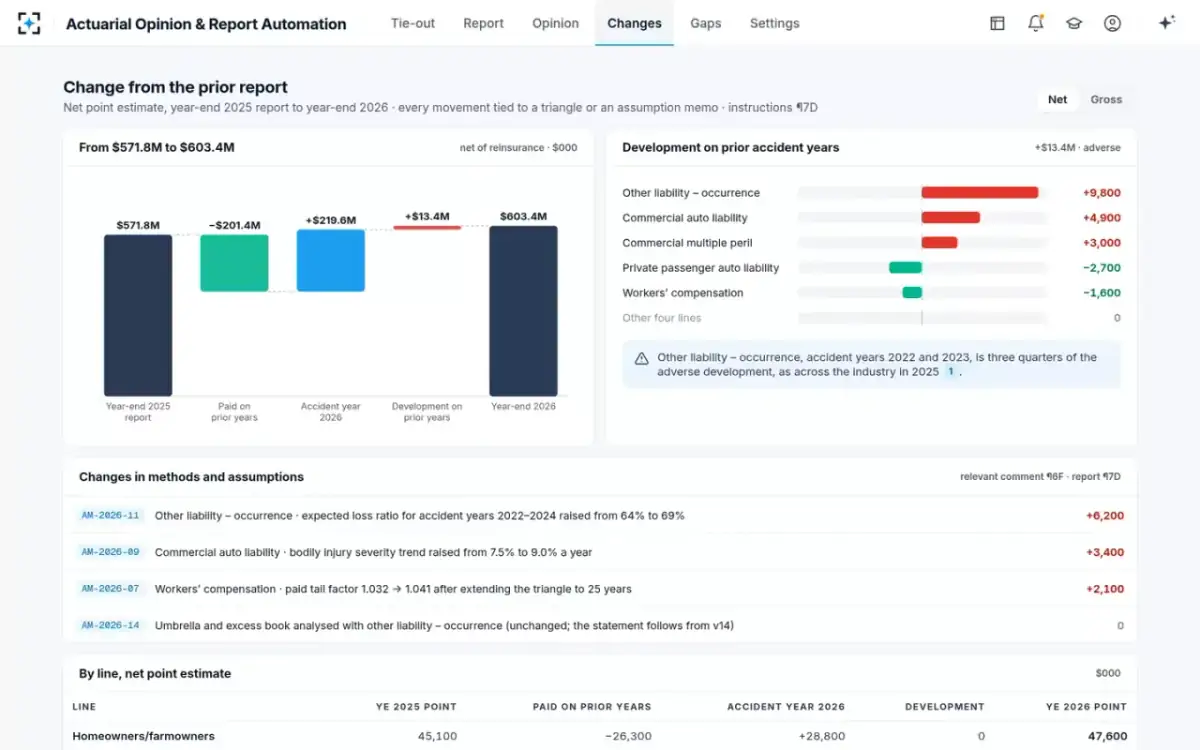
The change from the prior report, every movement tied to a memo
Does a new appointed actuary need qualification documentation?
Yes. Since the 2024 instructions, qualification documentation goes to the board only at initial appointment, and a replacement is an initial appointment for the new actuary. The working group's guidance describes what it should show: a résumé, how the actuary meets each part of the qualified actuary definition, three or more years of relevant responsible experience, and the year's continuing education, 15 hours or more, partly in interaction with other professionals (the full list is in appointed actuary responsibilities). The board documents its review; within a group, a subsidiary's board can acknowledge the parent board's review in its minutes. The rest of the role is set out in appointed actuary responsibilities.
For year-end 2026, the documentation also has to reflect the revised definition of Accepted Actuarial Designation, which now specifies four courses for FSAs under the SOA's new pathway and renames CAS Exam 7; the 2026 NAIC annual statement instructions cover the change.
Can an appointed actuary be appointed after year-end?
Normally no: the instructions require the board to make the appointment by 31 December of the year the opinion covers (the wording is quoted in appointed actuary responsibilities). The Academy's practice note answers the exception: under extraordinary circumstances, such as illness of the prior appointed actuary, a new actuary may be appointed after year-end, and companies would typically tell the regulator why. A late change compresses the successor's first year into January and February, when the statement is already moving.
Where the handover goes wrong, and what the solution keeps
Handovers usually fail on the documents, not the rules. The letters can be written in a week; the successor's real problem is a report whose exhibits were pasted, whose assumption changes were explained from memory, and whose ties to the statement existed only in the predecessor's spreadsheet. The successor then has two choices: rebuild the prior year to understand it, or disclose that the prior work could not be reviewed.
Actuarial Opinion & Report Automation keeps the things a successor needs to inherit. Every number in the signed report and opinion carries a link to its statement version, schedule, line and column; every change from the prior report cites the memo or triangle behind it, as in the sample year-end, where the net point estimate moved from $571.8 million to $603.4 million with each of four method and assumption changes tied to a memo; every statement version, redraft, acceptance and signature stays on the activity trail, and the report and workpapers are kept for seven years, the period the instructions set; and the last signed report becomes the house style for the next. It does not write the disagreements letter or the notices, and it cannot substitute for the former actuary's reasoning where that reasoning was never written down.
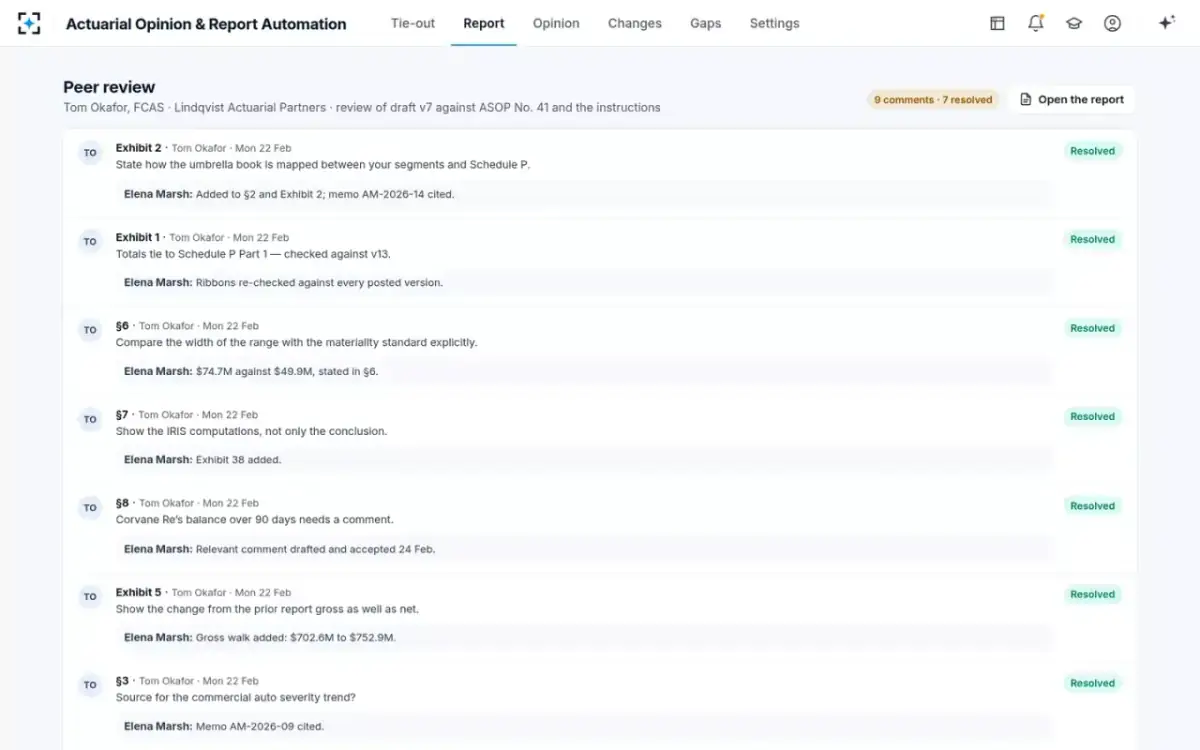
A peer review trail the next actuary can read
Questions people ask
Can the board replace the appointed actuary at any time?
The instructions do not restrict when; they attach procedures to the replacement. The insurer must give notice within five business days, send the disagreements letter within ten more, and obtain the former actuary's response, and a successor must still be appointed by 31 December for the year-end opinion.
Does a change of consulting firm count as a change of appointed actuary?
The appointed actuary is a person, named in the notice and the identification paragraph, so a change of individual is what matters. The initial appointment notice for a consultant must include the firm's name as well as the individual's name and title.
Are the disagreement letters public?
They are letters to the domiciliary commissioner, not part of the public opinion, and whether a department would release them depends on its state's law. The change itself becomes visible when next year's public opinion names a different actuary and appointment date.
Does a reappointment each year trigger these steps?
No. Once the initial notice is given, no further notice is needed for the same person unless the board stops appointing or retaining the actuary or the actuary no longer qualifies. The Academy notes that where an appointment is specific to a year-end, reappointment would normally be necessary, but that is not a replacement.
What if the new actuary disagrees with last year's reserves?
The new opinion reflects the new actuary's own range and conclusions. Material changes in assumptions or methods are described in the relevant comments and in the report's change-in-estimates exhibit, and development since last year is explained there, not in the disagreements letter, which concerns the former actuary and the insurer.