The risk of material adverse deviation is the chance that an insurer's reserves turn out to be too low by more than an amount that would matter to the people relying on them. Every appointed actuary must state, in the Statement of Actuarial Opinion and in Exhibit B, item 6, whether there are significant risks and uncertainties that could cause it, and must disclose the materiality standard, the dollar amount of deviation they judge material, and its basis. ASOP No. 36 turns the question into a test: if carried reserves plus the materiality standard still fall inside the actuary's range of reasonable estimates, the actuary should find that a significant risk exists. It is harder than it sounds because the test only sets a floor; the actuary may find a significant risk even when the test does not require it, and the regulators want company-specific reasons either way. Botminds' Actuarial Opinion & Report Automation keeps the range, the carried amount and the materiality standard tied to the statement while the actuary writes the conclusion, which is the actuary's alone.
The RMAD test on one axis: range, carried reserve and materiality standard
A · Sample year-end, as carried
- Range of reasonable estimates: $574.2M to $648.9M
- Carried: $612.4M
- Plus materiality standard $49.9M: $662.3M
Carried plus materiality, $662.3M, is above the high end, $648.9M. The test does not require a finding; the sample actuary still found a significant risk, as ASOP No. 36 allows.
B · Same range, carried $25M lower
- Range of reasonable estimates: $574.2M to $648.9M
- Carried: $587.4M
- Plus materiality standard $49.9M: $637.3M
Carried plus materiality, $637.3M, falls inside the range. ASOP No. 36 says the actuary should find a significant risk of material adverse deviation.
What is the risk of material adverse deviation?
It is a judgement about the downside of the reserves, made against a threshold chosen in advance. ASOP No. 36 asks the actuary to "determine whether there are significant risks and uncertainties that could result in material adverse deviation," weighing quantitative and qualitative factors "to assess whether there are significant risks that could result in future outcomes being greater than what is provided for in the total reserves within the scope of the statement of actuarial opinion by more than the materiality standard" (ASOP No. 36, section 3.11).
Three things are worth separating in that sentence. The reserves are the total in scope, not line by line, although the actuary may also comment by line. Deviation means outcomes worse than what is carried, not worse than the actuary's point estimate. And material is defined by the actuary's own materiality standard, disclosed in dollars, so two actuaries with the same range can reach different conclusions if they chose different standards. The NAIC instructions add the reporting: the relevant comments must identify the materiality standard and its basis, disclose it in U.S. dollars in Exhibit B, and "explicitly state whether or not he or she reasonably believes that there are significant risks and uncertainties that could result in material adverse deviation" (2025 instructions, paragraph 6B, as reproduced in the Academy's practice note).
When does a significant risk of material adverse deviation exist?
ASOP No. 36 says the actuary should find one when carried reserves plus the materiality standard are still inside the range of reasonable estimates. In plain words: if the reserves could prove short by the full material amount and the result would still be an outcome the actuary considers reasonable, a material shortfall is a reasonable possibility, and the answer is yes.
"However, the actuary may find that a significant risk of material adverse deviation exists even when the sum of the materiality standard and the total reserves within the scope of the statement of actuarial opinion exceeds a range of reasonable estimates."
ASOP No. 36, section 3.11 (2024)
The second sentence is what makes the test a floor rather than a formula. The NAIC working group puts the same point in its own terms: "RMAD should likely exist when the sum of the materiality standard plus the carried reserves is within the range of reasonable estimates. Regardless, the Appointed Actuary should support the conclusion of whether RMAD exists" (AOWG 2026, section II.I.3). The Academy's practice note gives the mirror image as illustrative wording for a "no" conclusion: the actuary observes that the difference between the high end of the range and the carried reserve is less than the materiality standard, then considers the risks and concludes they would not reasonably be expected to cause material adverse deviation.
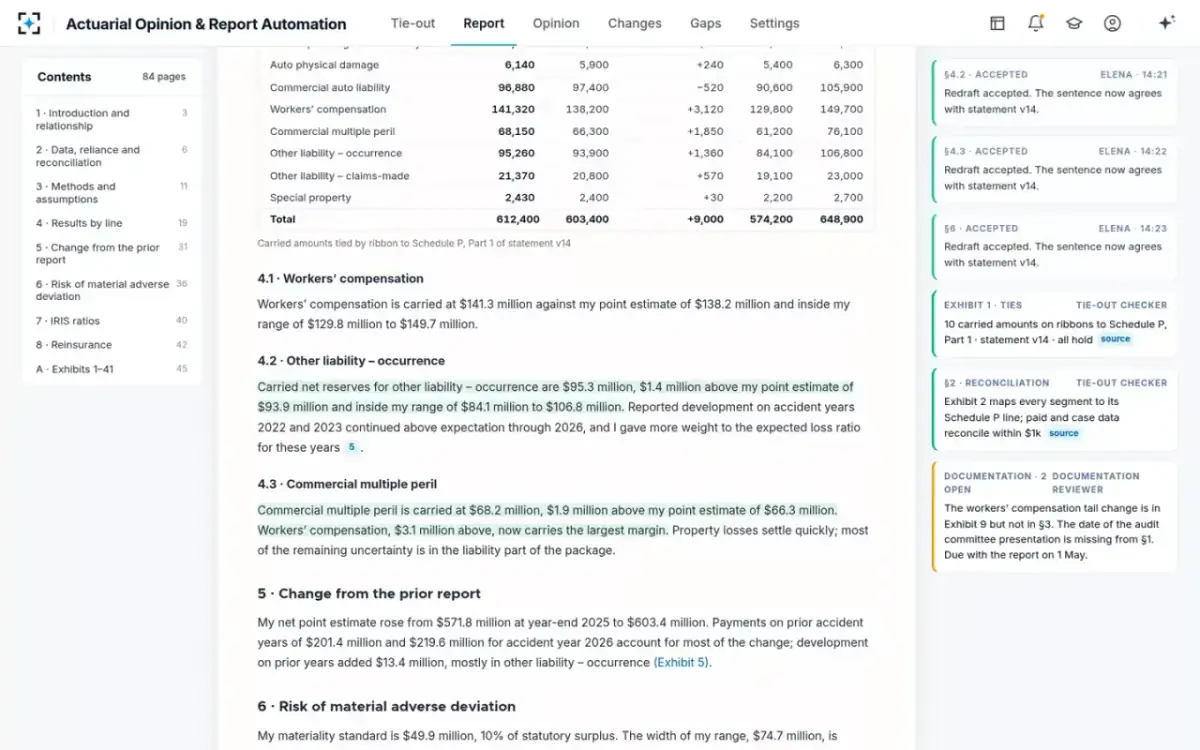
The sample year-end on the axis above shows the judgement at work. Carried net reserves of $612.4 million plus a $49.9 million standard come to $662.3 million, above the $648.9 million high end, so the test does not require a finding. The sample actuary nonetheless concluded there are significant risks, noting in the report that the range, $74.7 million wide, is wider than the standard, and pointing to other liability, occurrence, for accident years 2022 and 2023. That is a defensible "yes" outside the test, and it is the kind regulators want supported in the report. In the Academy's practice note, approximately one-third of statements of actuarial opinion conclude that a risk of material adverse deviation exists.
How is the materiality standard chosen?
By the actuary, for the opinion's purpose and users. ASOP No. 36 asks the actuary to consider "the financial metrics that the actuary believes are relevant to the intended users" and how changes in reserves would affect them, and gives as an example for a statutory opinion an amount "that would trigger a regulatory action for the company" (section 3.10). The standard is used to decide the risk conclusion; the standard itself notes it may not suit other materiality questions in the reserve evaluation.
Common bases for a materiality standard, and what each measures
| Basis | What it measures | Where it comes from |
|---|---|---|
| Percentage of statutory surplus | How much of the policyholders' cushion a shortfall would consume | ASOP No. 36 §3.10; Academy practice note |
| Percentage of net reserves | The shortfall relative to the liability being opined on | ASOP No. 36 §3.10; Academy practice note |
| Amount that drops surplus below minimum capital | The shortfall that breaks a legal minimum | ASOP No. 36 §3.10 |
| Amount that moves risk-based capital to the next action level | The shortfall that would trigger regulatory action, assuming no change in authorized control level | Academy practice note §5.2 |
| Multiples of net retained risk | The shortfall relative to the largest loss the company keeps | Academy practice note §5.2 |
| Upper limit of reserve-development reinsurance | The point beyond which protection stops | Academy practice note §5.2 |
How the choice of standard changes the answer
The choice changes the answer. In the sample configuration the standard can be set at 10% of statutory surplus ($49.9 million), 5% of net reserves (about $30.6 million on $612.4 million) or a fixed $50.0 million. At 5% of reserves, carried plus the standard would be $643.0 million, inside the $648.9 million high end, and the test would require a "yes" on the same range. That is why regulators ask for the basis, not just the number.
Same range, same carried reserve, three standards: the ASOP No. 36 test gives two answers
| Materiality standard | Amount | Carried plus standard | Against the high end, $648.9M | What the test says |
|---|---|---|---|---|
| 10% of statutory surplus | $49.9M | $662.3M | Above | No finding required; the actuary may still find a significant risk |
| A fixed $50.0M | $50.0M | $662.4M | Above | No finding required |
| 5% of net reserves | $30.6M | $643.0M | Inside | The actuary should find a significant risk |
Regulators have their own screen for this. The Academy's practice note describes a bright-line indicator in the NAIC Financial Analysis Handbook for companies subject to risk-based capital: if 10% of net loss reserves is greater than total adjusted capital minus company action level capital (twice authorized control level), and the actuary has not addressed material adverse deviation, the financial analyst should pursue comments. For a company with $500 million of net loss reserves, it is triggered whenever total adjusted capital sits less than $50 million above company action level capital. The note suggests actuaries consider the test when choosing a standard, and explain a "no" when it is triggered.
What are company-specific risk factors?
They are the particular conditions at this company that could make its reserves wrong, as opposed to risks every insurer shares. The instructions ask for "the major factors, combination of factors or particular conditions underlying the risks and uncertainties," and exclude "general, broad statements about risks and uncertainties due to economic changes, judicial decisions, regulatory actions, political or social forces, etc." They do not require an exhaustive list (paragraph 6A).
The working group adds two expectations. The actuary should discuss company-specific risk factors "regardless of the RMAD conclusion," and if there are none, should say so; and the factors should be described as they exist before the company's controls or mitigation, although risk management may still affect the conclusion. Good examples name a line, a set of accident years, a program, a claims-practice change, a reinsurance gap or a concentration. The sample's comment does this: other liability, occurrence, accident years 2022 and 2023.
What a risk of material adverse deviation comment should contain
- The materiality standard in dollars and its basis
In the text and in Exhibit B, item 5, and the two must agree.
- An explicit yes or no
In the text and in Exhibit B, item 6. "Not applicable" is for a 0% intercompany pool member only.
- The company-specific factors considered
Named, not generic; stated even if the conclusion is no, or a statement that there are none.
- The quantitative and qualitative factors behind the conclusion
ASOP No. 36 section 4.2(h) requires them to be disclosed.
- Net, and gross if different
The conclusion in Exhibit B is on net reserves; a different gross conclusion needs its own relevant comment.
- Support in the Actuarial Report
Extended comments on trends that indicate the presence or absence of risks, under paragraph 7E.
Is RMAD assessed net or gross of reinsurance?
Net, as the primary answer. ASOP No. 36 says that when the opinion covers both direct and assumed reserves and reserves net of recoverables, the actuary "should assess the risk of material adverse deviation on a net of recoverables basis," and may also comment on the direct and assumed basis, where the conclusion can differ. The working group says Exhibit B's materiality standard and conclusion "should pertain to the net reserves," and that a different gross conclusion needs a relevant comment explaining it. A gross standard may reasonably be different: the Academy's practice note suggests a gross standard based on the size of gross reserves, since gross changes do not necessarily move surplus or risk-based capital.
For intercompany pools, each statutory entity other than a 0% member files its own opinion with its own standard. The working group allows a pool-wide standard divided in proportion to each member's share where nothing unusual applies, and says "It is not appropriate to use the entire amount of the materiality threshold for the pool as the standard for each individual pool member."
The adverse deviation sentences redrafted after a late statement change
What changed in ASOP 36 in 2024?
The Actuarial Standards Board adopted a revised ASOP No. 36 in March 2024, effective for opinions issued on or after 1 October 2024, and much of the revision is about this topic. Its transmittal memo explains why: when the standard was last revised in 2010, the NAIC required a comment only if there was a significant risk of material adverse deviation; the NAIC "now requires the actuary to always comment on the RMAD." The 2024 text added guidance on determining a materiality standard (section 3.10), expanded the guidance on material adverse deviation (section 3.11), added guidance for opinions covering both direct and assumed and net reserves, and expanded the required disclosures to include the factors the actuary considered.
The revision also widened the standard's scope to "other reserves," such as unearned premium for long-duration contracts and premium deficiency reserves, and to actuaries reviewing an opinion. A peer reviewer of the risk comment is now expected to follow the standard as far as practicable. Other standards around it are moving too: the board approved a project to revise ASOP No. 43 on unpaid claim estimates in 2025, and a third exposure draft of a revised ASOP No. 41 went out for comment in March 2026 and has not been adopted (ASOP 41 summary compares it with the current text).
What should the board know about RMAD?
The board should hear the actuary's view of the downside, not only the point estimate. The working group's guidance wants directors told three things: whether the actuary sees that risk, where it comes from, and what size of shortfall the actuary treats as material (appointed actuary responsibilities quotes it), because the balance sheet shows management's single number, and a single number cannot show how far the outcome could vary. It strongly encourages an in-person presentation. Appointed actuary responsibilities covers the board reporting duty in full.
For a director, three questions do most of the work. Where does carried sit in the actuary's range? How big is the range compared with the materiality standard? And which named lines or years would cause a material shortfall if they went wrong? In the sample year-end the answers are $9.0 million above the point estimate, a range wider than the standard by $24.8 million, and other liability, occurrence, for 2022 and 2023.
The signed opinion's risk comment, as filed
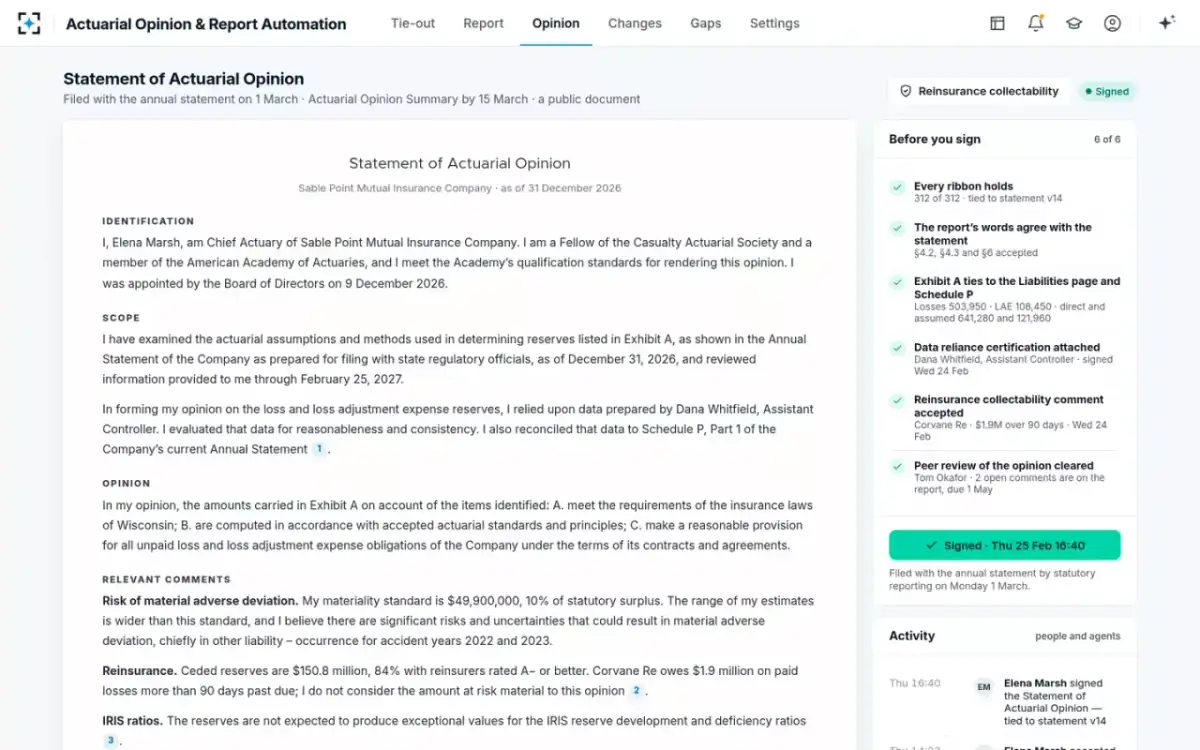
The risk comment is also where an opinion most often contradicts itself, a paragraph that says yes beside an Exhibit B that says no, which is one of the ten errors planted in the statement of actuarial opinion example.
Questions people ask
What is a reasonable range of reserve estimates?
Under ASOP No. 36, a range of estimates "that could be produced and that the actuary considers reasonable," consistent with the applicable standards and the stated basis of the reserves. Reserves inside it make a reasonable provision; below its minimum they are deficient, and above its maximum redundant.
Does a "yes" on RMAD mean the reserves are inadequate?
No. A reasonable opinion and a significant risk of material adverse deviation can go together; the first says carried reserves are inside the range, the second that a material shortfall is a reasonable possibility. The Academy's practice note puts the share of opinions with a "yes" at approximately one-third.
Can mitigation remove the risk?
It can affect the conclusion. The working group expects risk factors to be described before mitigation, but accepts that risk management may change the RMAD conclusion, and the Academy's practice note gives illustrative wording for retroactive reinsurance that would reduce the effect of adverse development on surplus.
What materiality standard do most actuaries use?
We found no public survey that reports the split. Percentage of surplus and percentage of reserves are the bases ASOP No. 36 and the Academy's practice note list first; a risk-based capital action level is the alternative that ties the standard most directly to regulatory action.
Is RMAD the same as a provision for adverse deviation?
No. A provision for adverse deviation is a margin built into a reserve or an assumption; the risk of material adverse deviation is a disclosure about whether carried reserves could prove short by a material amount. An explicit risk margin in carried reserves is part of the stated basis an actuary identifies under ASOP No. 36.