In summary, ASOP 41, Actuarial Communications, is the Actuarial Standards Board's standard for everything an actuary communicates about actuarial work, in every practice area, for communications issued on or after 1 May 2011. Its core documentation requirement is one sentence: the actuarial report should identify "the methods, procedures, assumptions, and data used by the actuary with sufficient clarity that another actuary qualified in the same practice area could make an objective appraisal of the reasonableness of the actuary's work" (ASOP No. 41, section 3.2). Around it sit rules on clarity, the responsible actuary, reliance, responsibility for assumptions, the information date and changed results. A third exposure draft of a revised standard was released in March 2026 and has not been adopted. For a reserving actuary the test is concrete: could a peer reviewer, an auditor's actuary or a state examiner rebuild the reason for each pick from what you wrote? Botminds' Actuarial Assumption Management exists to keep that answer yes after the author has moved on.
The objective appraisal test, applied to one reserve pick
- The value is stated where the report says it is
The selected factor, trend or loss ratio, and the cell or exhibit it lives in, at the version the report used.
- The method is named and reproducible
Which averages, fits or benchmarks were computed, with what weights, so another actuary gets the same indication.
- The data is identified
The extract or triangle and its valuation date, so the indication can be recomputed on the same numbers.
- The reason for the selection is written, not labelled
Why the pick differs from the indication, in words that name what the actuary saw.
- Alternatives and sensitivity are visible
What a reasonable alternative would have given, where it is material.
- Responsibility is clear
Who selected it, and whether any input was set by someone else and relied on.
- Changes are explained
If the pick or its method changed since the last report, what changed and why.
- A held pick says where its support is
“Consistent with the prior year” points to the paragraph that supports it, and that support still holds.
ASOP 41 in summary: what the standard requires, section by section
ASOP 41 is short, four sections in all, and general: it applies to "actuaries issuing actuarial communications within any practice area". Practice-area standards such as ASOP No. 43 for property and casualty unpaid claim estimates add their own disclosures and refer back to it. The table summarises the current text, adopted in December 2010.
ASOP 41 summary: the sections a reserving actuary uses most
| Section | What it requires | What it means for a reserve pick |
|---|---|---|
| 3.1.1–3.1.3 Form, clarity, timing | Form, content and language appropriate to the intended users; issued within a reasonable time | Write the memo for the reviewer who did not attend the meeting |
| 3.1.4 Responsible actuary | Identify the actuary responsible, and the extent they are available to explain | Each pick carries the name of whoever selected it |
| 3.2 Actuarial report | State findings and identify methods, procedures, assumptions and data clearly enough for an objective appraisal | Another reserving actuary can rebuild the indication and the reason |
| 3.3 Specific circumstances | Content may be limited by constraints, but the actuary must be ready to justify limiting it | A short memo is acceptable only if the support exists elsewhere and is named |
| 3.4.3 Reliance on other sources | Define the extent of reliance, for example whether reasonableness checks were applied | Industry benchmarks, claims data and plan loss ratios used as given are disclosed as such |
| 3.4.4 Responsibility for assumptions and methods | Identify the party responsible for each material assumption and method | A loss ratio set by management or pricing says so |
| 3.4.5 Information date | Communicate the date through which information was considered | Data valuation date and review date for each analysis |
| 3.5 Material differences | A later communication with materially different results makes clear the earlier ones are no longer valid and explains why | A changed pick explains the change |
| 3.8 Retention | Consider retaining enough for any recurring project that another actuary could assume the assignment | The reserve study survives a change of author |
| 4.1.3 Disclosures | Intended users, scope, qualification, risk, limitations, conflicts, reliance, information date, subsequent events, documents comprising the report | The memo’s opening page |
What is an objective appraisal under ASOP 41?
An objective appraisal is a judgment by another qualified actuary about whether your work was reasonable, made from the report alone. The test is not agreement. Two careful actuaries can select different factors from the same triangle and both be reasonable; the CAS study note on reserving techniques notes that different actuaries' selections from the same data are likely to differ. The test is whether the reviewer can see what you did and why, without asking you.
"… with sufficient clarity that another actuary qualified in the same practice area could make an objective appraisal of the reasonableness of the actuary's work as presented in the actuarial report."
ASOP No. 41, section 3.2
Three words carry the weight. Qualified in the same practice area means the reader knows reserving, so you need not explain a chain ladder, but they do not know your book: what changed in claims handling, why the industry tail got more weight this year. Objective means the appraisal should not depend on trusting you. As presented means the report and the documents it names, not what sits in your head or a colleague's inbox. ASOP 41 lets a report span several documents, and "Where an actuarial report for a specific intended user comprises multiple documents, the actuary should communicate which documents comprise the report." A workbook, a memo and committee minutes can together be the report, if the report says so.
What are the ASOP 41 documentation requirements for a reserve pick?
ASOP 41 does not list required documents; it sets the standard the documentation must meet. For a single pick, that standard breaks into the eight checks at the top of this page. The first four are reproduction: value, method, data, reason. The next two are context: alternatives, and who is responsible. The last two are time: what changed, and whether a held pick still has support.
The reserving standard fills in specifics. ASOP No. 43 asks the actuary to weigh how sensitive the estimate is to reasonable alternative assumptions and to tell the principal when the effect would be material; to disclose, in an updated estimate, changes in assumptions, methods or models believed to have a material impact, with the reasons; and, on documentation itself, to "consider the intended purpose or use of the unpaid claim estimate when documenting work, and should refer to ASOP No. 41" (ASOP No. 43, sections 3.6.2, 4.2 and 3.8). The guide to the actuarial memo template for a reserve selection writes those requirements out as a memo for one tail factor.
Workpapers sit under the same test from a different direction. ASOP No. 56, which covers models including the selection workbook, says documentation should be prepared "in a form such that another actuary qualified in the same practice area could assess the reasonableness of the actuary's work" (ASOP No. 56, section 3.7). The memo and the workbook face one test: a peer must be able to follow them.
What must an actuarial report disclose?
Section 4.1.3 lists ten items an actuarial report should disclose "unless the actuary determines that it is inappropriate to do so": the intended users; the scope and purpose; the acknowledgement of qualification; cautions about risk and uncertainty; limitations on use; conflicts of interest; information relied on without assuming responsibility; the information date; subsequent events; and, if appropriate, the documents that make up the report. Section 4.1.2 adds a rule many reserving teams break without noticing: every actuarial document should carry its date and subject, with a modifier such as a version number or a time of day that makes the description unique.
That last rule is where many reserve files fail an appraisal: a workbook saved forty times under one name cannot be tied to the memo that cites it. ASOP No. 43 adds the reserving dates. An unpaid claim estimate should disclose its accounting date, its valuation date and its review date, and the standard gives the form: "This unpaid claim estimate as of December 31, 2005 was based on data evaluated as of November 30, 2005 and additional information provided to me through January 17, 2006."
Is actuarial judgment enough documentation? What regulators add
No. ASOP 41 asks for a reason another actuary can appraise, and state regulators reading appointed actuaries' reports say plainly that the label is not the reason: NAIC's Actuarial Opinion Working Group treats the phrase "actuarial judgment" as insufficient support on its own, and singles out expected loss ratio selections as the assumption that most often needs fuller documentation. The guide on what regulators say actuarial judgment is not sets out that guidance and five related beliefs.
The regulators also tie their expectations to this standard by name. "A well-prepared and well-documented Actuarial Report that complies with ASOP No. 41, Actuarial Communications, can provide a foundation for efficient reserve evaluation during a statutory financial examination" (NAIC Actuarial Opinion (C) Working Group, 2026 Regulatory Guidance). The law behind it is NAIC Model #745: an Actuarial Report and underlying workpapers "shall be prepared to support each Actuarial Opinion", and its drafting note lets the commissioner fine the company or order poorly documented workpapers redone (NAIC Model #745; what follows an inadequate report is in actuarial report template). Banks face the same question about qualitative adjustments to credit loss allowances; the guide on CECL Q-factor documentation shows the parallel.
Is ASOP 41 being revised? The 2026 third exposure draft
Yes, and the revision is still a draft. The Actuarial Standards Board approved a third exposure draft of a revised ASOP 41 in December 2025, exposed it on 2 March 2026 and took comments until 1 June 2026; the board's site still listed it as an ongoing exposure draft in October 2026 (ASB, ongoing exposure drafts). The first exposure draft was released in June 2022 and drew 38 comment letters; the second, in December 2024, drew 28. Until a revision is adopted, the 2010 text applies; the draft proposes an effective date four months after adoption.
ASOP 41 today and in the 2026 third exposure draft
Current text (2010, in force): In section 3.2, for the actuarial report
Third exposure draft (Dec 2025, not adopted): Kept, as a required disclosure in section 4.2(f): data, assumptions, methods and models described for an objective appraisal
Current text (2010, in force): The set of actuarial documents relevant to specific findings
Third exposure draft (Dec 2025, not adopted): A communication in written or other recorded form to support a statement of actuarial opinion
Current text (2010, in force): One list in section 4.1.3
Third exposure draft (Dec 2025, not adopted): Split: any communication (4.1) and actuarial reports (4.2), with a rule for omitting some (4.3)
Current text (2010, in force): Section 3.5: say the earlier results are no longer valid, and why
Third exposure draft (Dec 2025, not adopted): Section 4.2(j): disclose that a prior opinion is no longer valid, with an explanation
Current text (2010, in force): Section 3.4.4, three choices
Third exposure draft (Dec 2025, not adopted): Section 4.2(i): source, why another party set it, extent reviewed, and a statement on reasonableness
Current text (2010, in force): Section 3.8 asks the actuary to consider retaining enough for a successor
Third exposure draft (Dec 2025, not adopted): Removed from this standard: the board says it covers communications, not work papers
Current text (2010, in force): Communications issued on or after 1 May 2011
Third exposure draft (Dec 2025, not adopted): Four months after adoption
The detail that matters for documentation is in the board's response to comments. One commenter objected to removing guidance on file documentation and records retention; the reviewers replied that "this standard relates to actuarial communications, not actuarial work papers" (ASOP 41 third exposure draft, appendix). If the draft is adopted as written, the successor-file sentence in section 3.8 goes, and the expectation that a reserve file survives its author will rest on ASOP No. 43, ASOP No. 56, the NAIC instructions and the company's own governance. The objective appraisal test stays.
How do you document a change in assumptions under ASOP 41?
Say that the earlier result no longer holds, and say why. Section 3.5 requires that a later communication with materially different results "make it clear that the earlier results or opinion are no longer valid and explain why they have changed". In a reserve study that applies to the selections that drive the change: the factor moved, the weight on the industry benchmark changed, the expected loss ratio was revised in committee. ASOP No. 43 asks for the changes and their reasons without requiring the effect of each to be measured, but regulators reviewing the Actuarial Report expect the change in estimates to be explained by accident year and segment where fluctuations are significant.
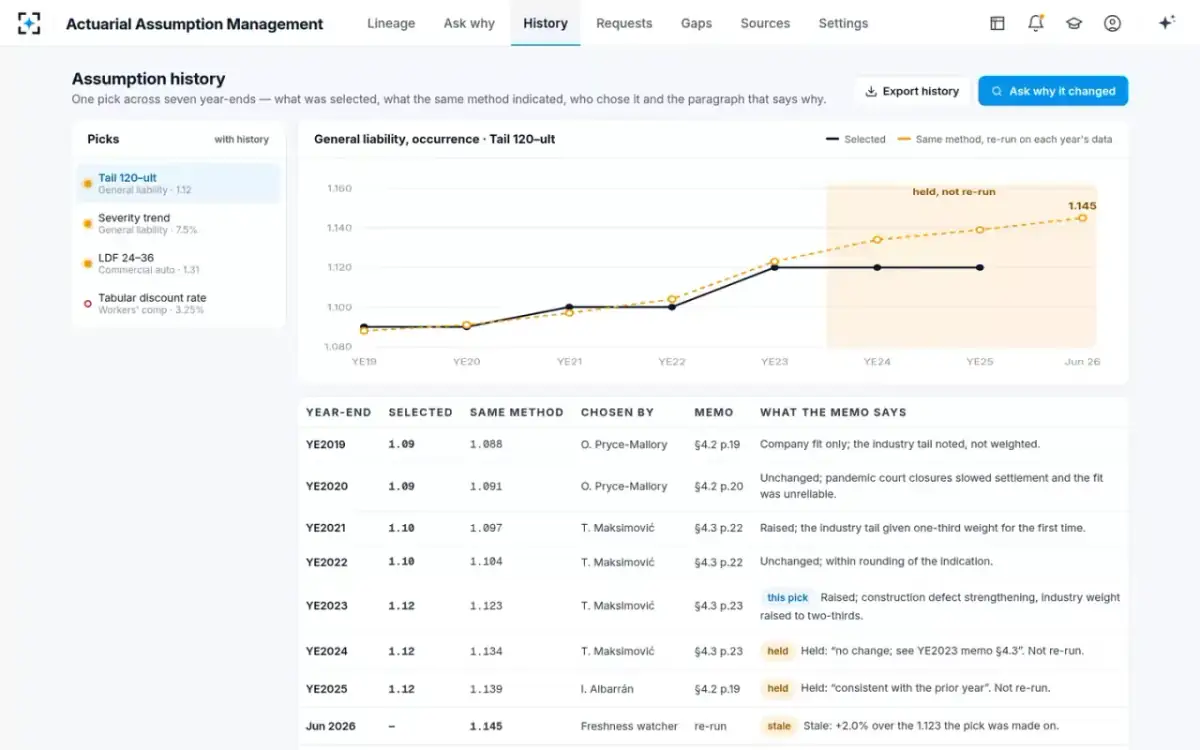
The harder case is the change nobody made: a pick held while the data under it moved. The memo says nothing changed, and in the memo's terms that is true. On the data, the same method may now indicate something else, and the next reviewer will ask why that was not disclosed. What an unsupported change costs, in time and money, is worked through in change in actuarial assumptions: what an unsupported change costs.
One pick across seven year-ends: selected against what the same method indicated
Scoring a reserve file against the appraisal test
The checklist becomes useful when it is run across a file rather than on one pick. Take the 18 key picks on a fictional insurer's commercial lines book as they run through Actuarial Assumption Management, out of 1,284 picks in all. Each pick is scored on whether its value, method, data and written reason can be followed to a source, and whether its own method, re-run on the newest data, still lands within the company's threshold.
Eighteen key picks scored against the appraisal test
18 key picks
- Supported (13) · 72%
- Stale on new data (3) · 17%
- No written support (2) · 11%
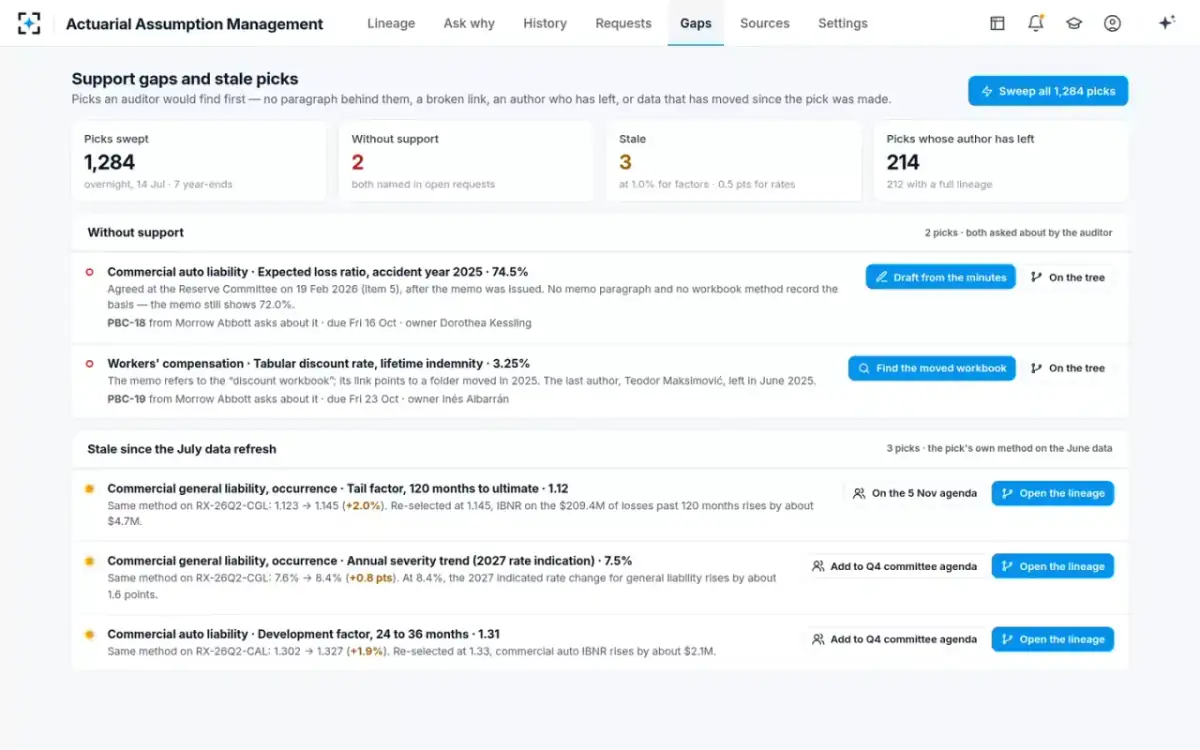
The two picks without support fail on the fourth check, the written reason. One is a commercial auto expected loss ratio of 74.5% agreed in reserve committee after the memo was issued; the memo still shows 72.0%. The other is a workers' compensation discount rate whose memo points to a workbook in a folder that was moved. The three stale picks pass the first six checks and fail the last: the support was sound when written, but the data has moved past it.
The picks that would fail an appraisal first, and who owns each
Where Actuarial Assumption Management fits in an ASOP 41 review
The solution does not write your reasons and does not judge whether a pick is reasonable; that is the actuary's and the reviewer's work. It does the part of an appraisal that is retrieval. Every pick is linked to its workbook cell at the version the memo used, to the memo paragraph, the data cut, the committee decision and any peer review, so a reviewer starts from the evidence. Held picks are re-run on their original method when data refreshes, which turns the eighth check from a matter of trust into a number. Picks with no paragraph are reported as gaps, with the line's owner named.
When the appraisal is external, from an auditor's actuary or an examiner, the same links draft the answer, one claim per sentence, each with its passage, for the appointed actuary to read and sign. The guide on the PBC request list for the reserve audit follows one such request from arrival to signature.
Questions people ask
When did the current ASOP 41 take effect?
For actuarial communications issued on or after 1 May 2011. The current text was adopted in December 2010 and superseded a version adopted in March 2002, which itself grew out of an Academy interpretative opinion from 1981.
Does ASOP 41 apply to emails and spreadsheets?
Yes, when they are actuarial communications. The current standard defines an actuarial document as an actuarial communication "in any recorded form (such as paper, e-mail, spreadsheets, presentations, audio or video recordings, web sites, and court or hearing transcripts)". Notes taken by someone other than the actuary are not actuarial documents.
Can an actuarial report be several documents?
Yes. ASOP 41 says a report "may comprise one or several documents" in different formats, and where it does, the actuary should say which documents make it up. A reserve memo can point to the selection workbook and committee minutes as part of the report, provided it names them.
Does ASOP 41 require a reason for every selection?
It requires the assumptions and methods to be identified clearly enough for an objective appraisal, which in reserving means the reason for any material selection must be followable. ASOP 43 adds disclosure of material changes and their reasons, and NAIC regulators expect a descriptive rationale for appointed actuaries' assumptions.
Who is responsible for an assumption someone else set?
The actuary, unless the communication says otherwise. Under section 3.4.4, where a communication is silent, "the actuary who issued the communication will be assumed to have taken responsibility" for each assumption or method. A loss ratio taken from the plan or from pricing should be disclosed as such, with the actuary's view of its reasonableness.
What is the difference between ASOP 41 and ASOP 43?
ASOP 41 governs how any actuary communicates findings in any practice area. ASOP 43 governs how property and casualty unpaid claim estimates are made and adds reserving disclosures, including the accounting, valuation and review dates; it refers back to ASOP 41 for documentation. In its 2025 annual report the ASB said it had approved a proposal to revise ASOP 43 and that a task force was being formed.