An assumption register is a list of the assumptions a piece of work depends on, each with an owner and a status. In project management it is a log of things the plan takes for granted, reviewed as risks. In loss reserving it should be something more exact: one row for every selected development factor, tail, trend, expected loss ratio and discount rate, linked to the workbook cell and memo paragraph that support it, with who chose it, when, whether its own method still lands near it on today's data, and how much reserve rides on it. Kept that way, the register answers an auditor's question and briefs the person who inherits the line in the same breath. Botminds' Actuarial Assumption Management builds and maintains that register from the memos, workbooks and minutes a reserving team already has.
An assumption register for reserving, filled in: seven rows from a sample book
| Pick | Value | Method and weights | Support | Author | Fresh? | Status |
|---|---|---|---|---|---|---|
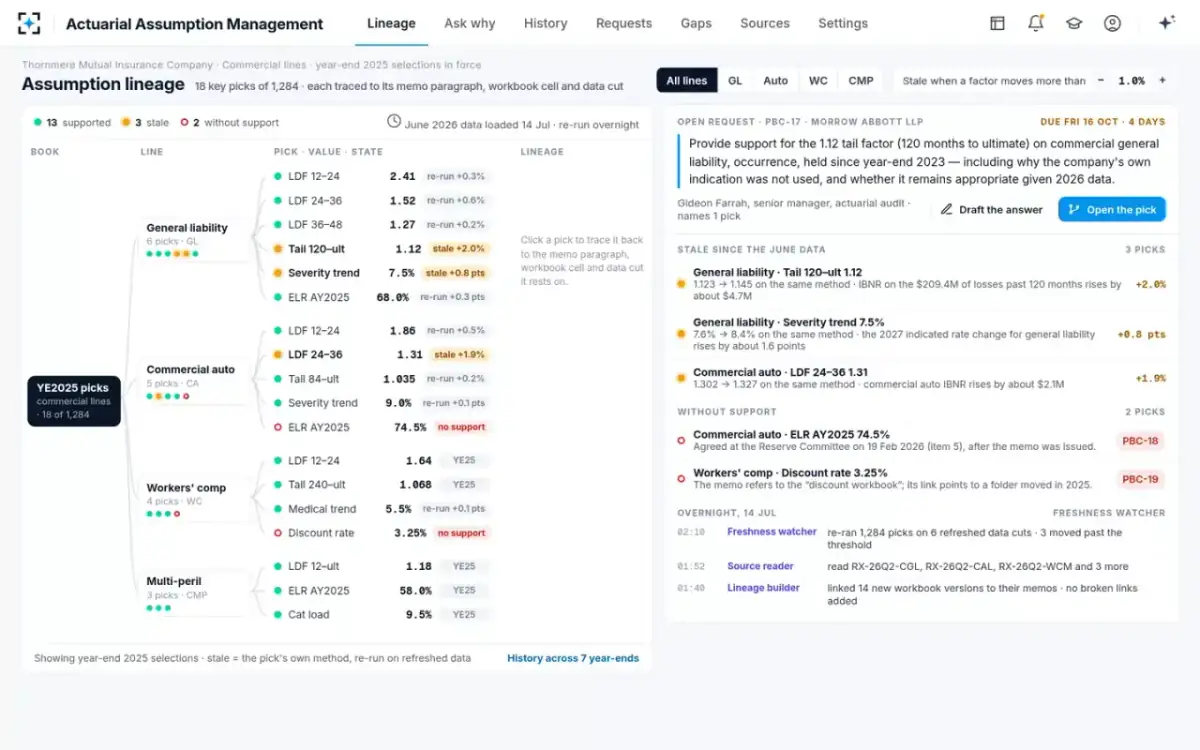
| GL occurrence tail, 120 months to ultimate | 1.12 | ⅓ company inverse power fit, ⅔ industry tail | Tail tab F42; memo §4.3 p.23; committee 21 Feb 2024 | Selected YE2023; author since left | Re-run 1.145, +2.0%, about +$4.7M IBNR | Stale |
| GL severity trend | 7.5% | As written in the workbook | Workbook and memo of the year selected | Named in the workbook | Re-run 8.4%, +0.8 points against 7.6% | Stale |
| Commercial auto development, 24–36 months | 1.31 | Five-year average | Workbook and memo of the year selected | Named in the workbook | Re-run 1.327, +1.9% against 1.302, about +$2.1M | Stale |
| GL expected loss ratio, accident year 2025 | 68.0% | As written in the workbook | Workbook and memo | Named in the workbook | Re-run +0.3 points | Supported |
| Commercial auto expected loss ratio, accident year 2025 | 74.5% | None written | Committee minute, 19 Feb 2026; memo shows 72.0% | Agreed in committee, not written up | Cannot re-run | No support |
| Workers’ compensation tabular discount rate | 3.25% | In the “discount workbook” | Memo link points to a folder moved in 2025 | Since left | Cannot re-run | No support |
| Workers’ compensation tail, 240 months to ultimate | 1.068 | As written in the workbook | Workbook and memo | Named in the workbook | Within threshold | Supported |
What is an assumption register?
An assumption register is a controlled list of the assumptions behind a piece of work, each with enough attached that someone else can check it and know when to revisit it. The minimum is the assumption, its value, its owner and its status. What separates a useful register from a spreadsheet nobody opens is the link to evidence: a row that says "tail factor 1.12, owner: reserving" tells an auditor nothing; a row that opens cell F42 and section 4.3 of the year-end 2023 memo tells them almost everything.
The actuarial standards set the bar the register is built to meet. ASOP No. 56 asks that model documentation let a peer in the same practice area assess the work's reasonableness (ASOP No. 56, section 3.7), and among its model tests lists reconciling each run's output to the prior run after changes in data, assumptions or formulas (section 3.6.1; quoted in actuarial AI agents). A reserving register is that reconciliation, kept one pick at a time.
How is an actuarial assumption register different from a project register?
A project register records what is believed so that its risk can be managed; a reserving register records what was chosen so that its support can be shown. The difference shows up in every column.
Project assumption register and reserving assumption register, column by column
Project assumption register: A statement the plan relies on, such as “vendor delivers by March”
Reserving assumption register: A selected value: a factor, trend, loss ratio or discount rate, by line, segment and age
Project assumption register: Optional, often a note
Reserving assumption register: Required: the workbook cell at the right version and the memo paragraph
Project assumption register: Confirmed or not, by a date
Reserving assumption register: Its own method re-run on each new data cut
Project assumption register: Tens of rows
Reserving assumption register: Hundreds or thousands; the sample book has 1,284
Project assumption register: Closed when the project ends
Reserving assumption register: Carried across year-ends; held picks keep their history
Project assumption register: Project team, steering group
Reserving assumption register: Reserving, appointed actuary, model validation, auditors, examiners
Project assumption register: Risk rating
Reserving assumption register: Reserve effect in dollars when the pick moves
What should an assumption register include?
Ten columns, each answering a question a reviewer will ask. Pick: line, segment, development age or accident year. Value: as booked. Method and weights: how the value was derived, in enough detail to re-run. Cell: workbook, version, tab and cell. Paragraph: memo, section and page. Data: the extract and its valuation date. Decision: the committee minute or sign-off that accepted it. Author and date: who selected it, at which year-end, and whether they are still with the company. Freshness: the latest re-run of its own method and the move.Effect: the reserve effect of the move.
Two of those columns come straight from ASOP No. 41. A communication "should identify the party responsible for each material assumption and method" (ASOP No. 41, section 3.4.4), which is the author column; and every actuarial document should carry a date, a subject and a modifier, such as a version number, that makes it unique (section 4.1.2), which is the version in the cell column. ASOP No. 43 supplies the data column: an unpaid claim estimate discloses its valuation date (ASOP No. 43, section 4.1).
The register covers every kind of selection, including the ones that are not loss development. Discount rates are a current example: the Actuarial Standards Board adopted a revised ASOP No. 20, now titled Analysis of Property/Casualty Cash Flows, Including Discounting, in December 2025, effective for work issued on or after 1 June 2026. It asks the actuary to "select discount rates that are appropriate for the intended purpose" by a risk-free approach, a portfolio approach or rates provided by another party, and to assess the latter "for reasonableness" (ASOP No. 20, section 3.4.1). A discount-rate row should say which.
How do you know an assumption is stale?
Re-run its own method on the newest data and measure the move. Not a new method, not the reviewer's preferred method: the method and weights written in the original workbook. If the result moves past a threshold the company has set in advance, the pick is stale. It is not wrong; it is a pick whose support no longer describes today's data, and someone must either re-select it or write why it stands.
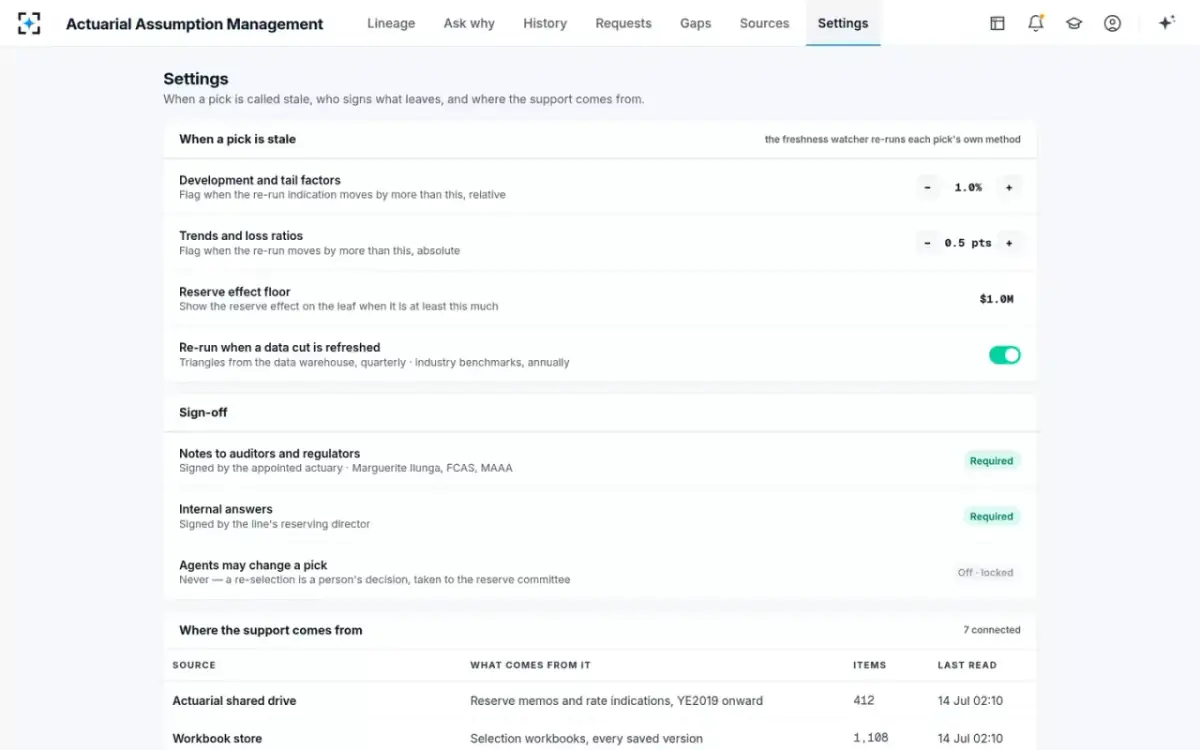
The thresholds should be set by type. A relative threshold suits factors, where a 1% move in a tail is material on a long-tailed line; an absolute threshold suits trends and loss ratios, where half a point is the natural unit. In the sample, the tail moved 2.0% and the auto development factor 1.9%, both over a 1.0% threshold; the severity trend moved 0.8 points against a 0.5-point threshold. ASOP No. 43 is the reason the check is not optional: it asks the actuary to weigh whether chosen methods are still appropriate even when deciding to keep them (section 3.6.1).
The register as a tree: every key pick, its value and its state
Who owns the assumption register?
Each line's reserving lead owns that line's rows; the appointed actuary owns what the register says to the outside world; model validation and internal audit are its heaviest readers. A register owned by a governance team alone goes stale, because the people who can close a gap are the people who made the picks.
Who works the assumption register, and what each keeps
Today
Rebuilds the support for a pick each time someone asks, often for picks made by a predecessor.
With agents
Sees every pick on the line with its state, and closes gaps from a drafted request.
Still theirs: every selection and re-selection
Today
Relies on line memos and asks for summaries before signing.
With agents
Reads the stale and unsupported rows before the opinion, and signs what goes to auditors and regulators.
Still theirs: the opinion and the signature
Today
Samples picks each spring and rebuilds their history by hand.
With agents
Reads each pick against what the same method indicated, year by year.
Still theirs: the review findings and recommended triggers
Today
Asks for support pick by pick through request lists.
With agents
Receives signed notes with the original pages and cells attached.
Still theirs: the audit conclusion
Today
Sees totals and a few highlighted changes.
With agents
Sees which picks are stale and what each would move, before deciding.
Still theirs: the booked reserve
How do you link assumptions to a reserve report?
By making the memo paragraph a column, not a cross-reference somebody has to search for. Each row should open the paragraph that explains the pick, and the paragraph should open the row. When the actuarial report spans several documents, ASOP No. 41 asks the actuary to "communicate which documents comprise the report", and the register is the simplest way to show that list for each pick.
Regulators reading an appointed actuary's roll-forward ask the question the link answers. NAIC's working group says they should be able to see why the ultimate loss selections changed between the analysis date and year-end and how those changes reached the final estimates (NAIC AOWG 2026 guidance). A register that holds both the analysis-date and the year-end value of each pick, with the paragraph for the change, answers it directly. The guide to the actuarial memo template sets out what that paragraph should contain.
What happens to assumptions when the author leaves?
Nothing, if the register was kept; a scramble, if it was not. A departing actuary's picks stay on the books, often for years, and every question about them lands on someone who did not make them. The register turns the departure into a filter: show me every pick whose author has left, and which of those lack a full lineage.
1,284 picks by author status, in one sample book
All picks
- Author still here · 83.3%
- Author left, full lineage · 16.5%
- Author left, gaps · 0.2%
The useful number is the small one. Most departed authors leave enough behind; a few picks do not survive the departure. Those few are the ones to close while someone who remembers is still reachable. The guide on actuarial knowledge management software covers what a team brings to build the register in the first place.
How often should assumptions be reviewed?
Every reserve review, plus whenever something they rest on changes. A calendar alone is too slow for some picks and too frequent for others. Triggers are better, and most can be set in advance.
Triggers that should reopen a row in the assumption register
- A data cut refreshes
Re-run each pick’s own method; review any move past the threshold.
- An industry benchmark is republished
Every pick weighting the benchmark gets a re-run.
- Claims practice changes
ASOP 43 names changes in claims personnel’s practices among the changing conditions to consider.
- Reinsurance changes
Also named in ASOP 43; net picks may need re-selecting.
- A rate filing or program revision takes effect
Expected loss ratios and on-level factors are affected.
- The committee changes a pick after the memo
The row needs the minute and a paragraph.
- The memo’s own reopening condition is met
A selection that says when it should be revisited should be revisited then.
- The author leaves
Confirm every row they own has a full lineage.
Registers, model inventories and the banking model risk guidance
Model risk teams arriving from banking will recognise the register as a cousin of the model inventory. The federal banking agencies' model risk guidance was replaced on 17 April 2026: SR 26-2 and OCC Bulletin 2026-13 superseded SR 11-7, and our guide on whether a customer risk rating model is a model under SR 26-2 explains what changed. That guidance is written for banks. For insurers' reserving work the governing texts are the actuarial standards, chiefly ASOP No. 56, which expects model risk to be kept in check by governance and controls, operated by the actuary or by others the actuary relies on (section 3.6.4; quoted in IBNR software settings), and state insurance regulation.
European insurers face a more explicit allocation. EIOPA's 2025 opinion on AI governance puts the controls on AI systems in the actuarial area with the actuarial function, giving coordination of technical provisions as an example (EIOPA, Opinion on AI governance and risk management). A register that shows which picks an automated process touched, and that none was changed by it, is the kind of control that allocation implies.
The register's rules, set in advance: thresholds, sign-off and sources
How Actuarial Assumption Management keeps the register current
The solution builds the register from what exists and keeps it current without anyone typing rows. Agents read every memo by paragraph and every workbook by cell and version, link each pick to its paragraph, data cut, committee minute and peer review, and match it across year-ends. When a data cut refreshes, they re-run each pick's original method and weights and mark it stale past the company's threshold, with the reserve effect shown above a floor the company sets. A sweep finds picks with no paragraph, a broken workbook link or an author who has left, and drafts a request to the line's owner.
It does not own the register's contents. Agents never select, re-select or propose a value; a stale pick stays as it is until a person takes it to the reserve committee. It does not set thresholds or decide materiality; those are settings. And it does not replace the reserving tools that produce the picks. When the questions come, the register is where the answer starts; how a single question becomes a signed note is followed in the guide on the PBC request list for the reserve audit.
Questions people ask
Is there an assumption register template for reserving?
The ten columns on this page are one: pick, value, method and weights, cell, paragraph, data, decision, author and date, freshness, and reserve effect. A spreadsheet can hold them for a small book; the hard part is keeping the cell and paragraph links current as workbooks are re-saved and memos replaced.
Should pricing assumptions be in the same register?
Where they feed reserving, yes. Expected loss ratios and trends are often shared between pricing and reserving, and a move in one affects the other: in the sample, a 0.8-point move in the general liability severity trend would raise the line's 2027 indicated rate change by about 1.6 points.
How many assumptions does a reserving register hold?
One row per selected value, so it scales with lines, segments, development ages and accident years. The fictional sample commercial lines book has 1,284 picks for one year-end. Flagging a short list of key picks, 18 in the sample, helps committees focus without dropping the rest.
What is the difference between a stale assumption and a wrong one?
A stale assumption is one whose own method, re-run on new data, now indicates a different value by more than a set threshold. It may still be right, for a reason the original memo gave or a new one. A wrong assumption is one that was not reasonable on what was known; staleness is the prompt to decide which.
Do auditors expect an assumption register?
No standard requires one by name. Auditors and examiners do expect the support behind each material selection, and ASOP 21 asks the responding actuary to be ready to discuss the data, methods, assumptions and the rationale for each judgment. A register is the fastest way to have that support ready.