An AI for actuarial documentation tool is useful when it does one thing reliably: connect each assumption an actuary selected to the evidence that supports it, and say plainly when there is none. Reserve selections are already documented, in memo paragraphs, workbook cells, committee minutes and peer review notes. What fails is retrieval, when an auditor or regulator asks why a factor was chosen three year-ends ago. A tool that drafts fluent new explanations makes that worse, because it produces support nobody wrote. Botminds' Actuarial Assumption Management takes the other route: agents read every source by paragraph and by cell, link each pick to them, and draft answers in which every sentence carries its passage. This guide follows one tail factor through the agents, shows what each may never do, and lists the tests a chief actuary should run before relying on any such tool.
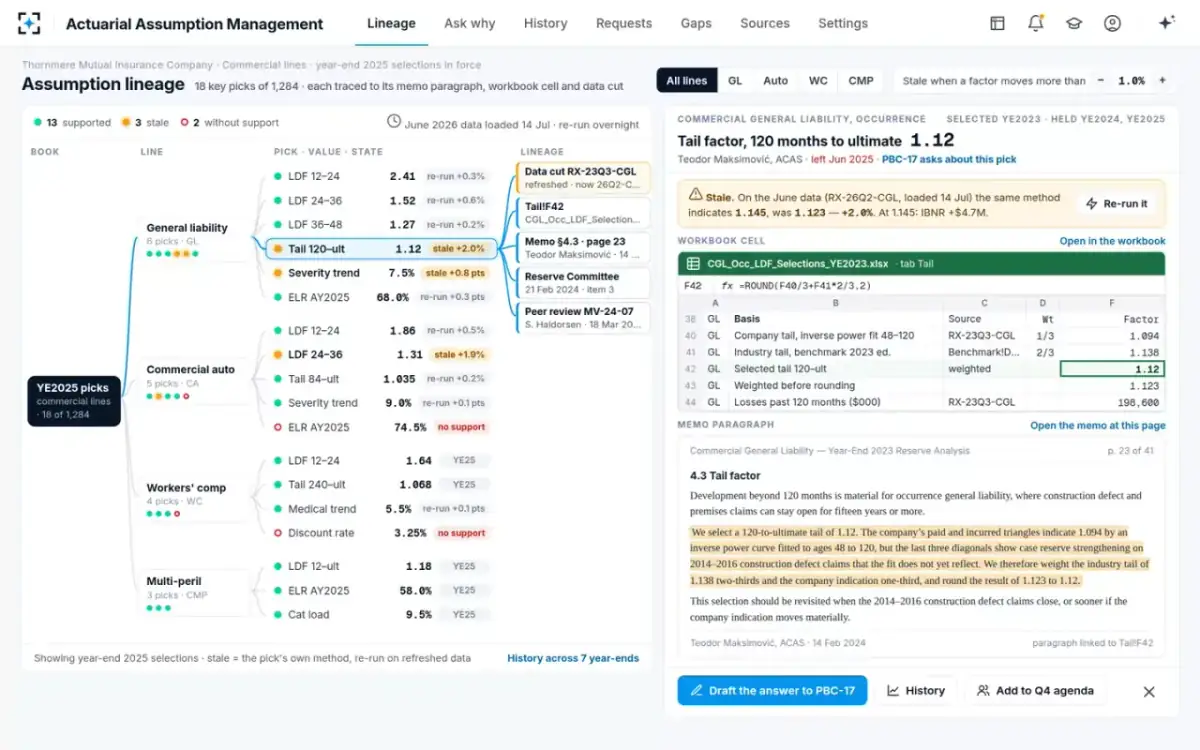
Assumption lineage for one pick: a general liability tail factor of 1.12
| Link | What it holds | Question it answers |
|---|---|---|
| Pick | Tail 120 months to ultimate, commercial general liability, occurrence: 1.12 | What was selected? |
| Workbook cell | Tail tab, cell F42: =ROUND(F40/3+F41*2/3,2), the version linked from the memo | How was it computed? |
| Inputs | Company inverse power fit 1.094 (ages 48–120), industry tail 1.138, weighted one-third and two-thirds: 1.123 | From what? |
| Memo paragraph | Year-end 2023 reserve analysis, section 4.3, page 23 of 41 | Why this weight? |
| Data cut | The triangles extracted in the third quarter of 2023 | On which data? |
| Committee minutes | Reserve committee, 21 February 2024, item 3 | Who accepted it, and with what condition? |
| Peer review | Model validation note, 18 March 2024, finding 2 of 5 | Was it checked? |
| Later year-ends | Held at year-end 2024 and 2025 “by reference to the 2023 memo”, not re-run | Is it still supported? |
Can AI document actuarial assumptions? Only by finding what was written
AI can document actuarial assumptions in the narrow sense that matters to an auditor: it can locate, quote and link the documentation that already exists. It should not author the rationale. An assumption's support is the reasoning of the actuary who chose it, on the data and conditions they saw. A model that writes a plausible reason after the fact has produced a description, not support, and the profession's standards treat the two very differently.
The regulators' bar is explicit. NAIC's Actuarial Opinion Working Group expects appointed actuaries to support each assumption with a described reason, not a label (NAIC Actuarial Opinion (C) Working Group, 2026 Regulatory Guidance; the guide on what regulators say actuarial judgment is not quotes it in full). A reason is described when it says what the actuary saw and why it moved the pick: in the example above, case reserve strengthening on a group of construction defect claims that the curve fit had not yet absorbed. Only the person who saw it can supply that sentence. Software can make sure it is never lost.
What is assumption lineage? One tail factor, traced end to end
Assumption lineage is the chain from a selected value back to everything that produced and justified it: the cell, its formula and inputs, the data cut, the memo paragraph, the decision that accepted it and the review that tested it. It is the reserving equivalent of an audit trail, but organised around the pick rather than the transaction, and it has to run across year-ends, because a factor selected once is often held for years.
Take the tail factor in the opening figure, from a fictional insurer's commercial lines book as it runs through Actuarial Assumption Management. The sample book holds 1,284 picks; this one was selected at year-end 2023 by an actuary who left in June 2025. The lineage answers the auditor's three standard questions in order. What was selected and how: the cell and its formula. Why the company's own indication was not used alone: the memo paragraph. Whether it still holds: the later year-ends, which show it was held twice without a re-run.
The workbook cell and the memo paragraph, open side by side
How does AI find the support for an assumption? By paragraph and by cell
It reads everything, keeps the location of each statement, and searches by meaning rather than file name. In the sample, one auditor's question triggered a search of 2,316 documents across seven year-ends; 31 passages from 11 of them were read, and the answer was drafted from those. The search is only as good as what it can cite, so the reader keeps a page and paragraph for every memo sentence and a tab and cell for every workbook value.
Two details separate a dependable reader from a demonstration. The first is versions: a selection workbook is saved dozens of times, and the reader must open the version the memo links to, not the latest save, or it will cite a number that was never signed. The second is sources outside the actuarial department. Committee minutes, audit answers and claims bulletins hold support that memos only refer to; a tool that reads memos alone will report gaps that are not gaps, and miss real ones.
One question answered: seven steps, every sentence cited
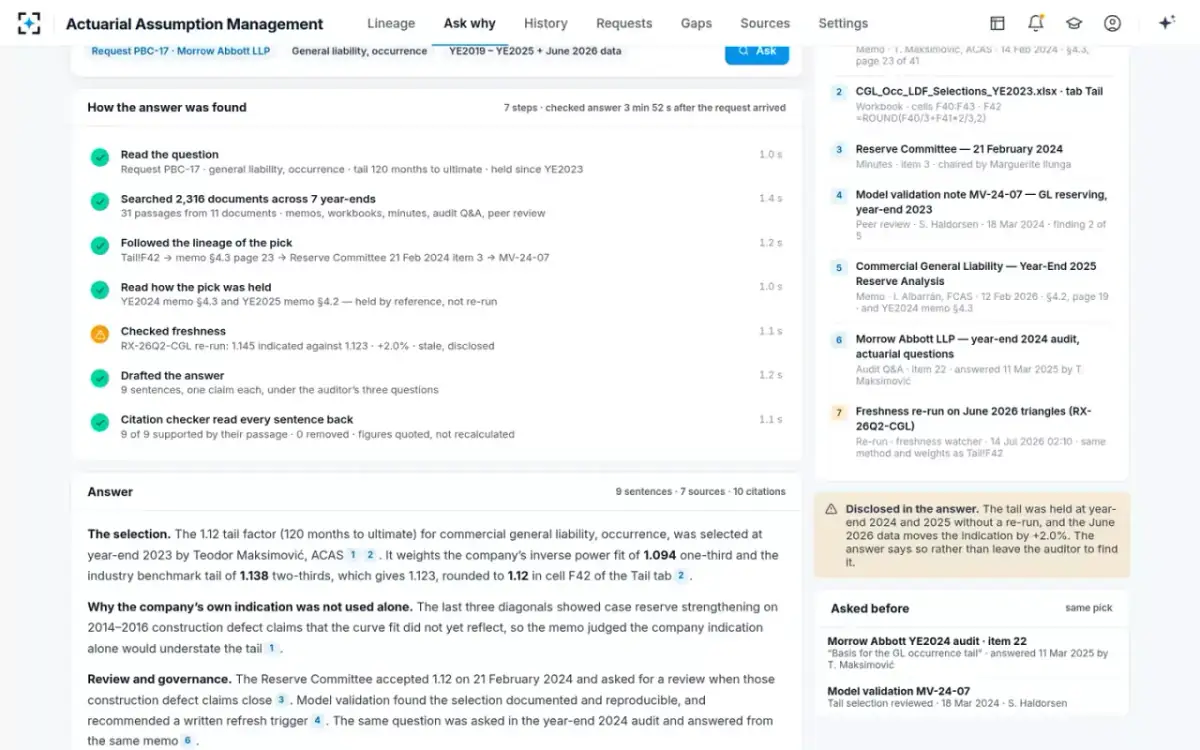
Six agents behind each traced pick, and the line each never crosses
The work splits into six narrow jobs, and the limits matter more than the jobs. A documentation tool earns trust from the things it is built to refuse: changing a number, inferring a reason, adding a source after the fact, rounding a figure it quotes.
The agents in Actuarial Assumption Management, each with a line it never crosses
Agent
Source readerReads memos, workbooks, minutes, audit answers and peer review notes, keeping page, paragraph, tab and cell.
Never: Writes to a source, or reads a workbook at any version but the one the memo links
Agent
Lineage builderLinks each pick to its cell, memo paragraph, data cut, minutes and review, and matches it across year-ends.
Never: Infers a reason for a pick with no paragraph: that is a gap
Agent
Freshness watcherWhen data refreshes, re-runs each pick’s original method and weights, and marks it stale past the threshold.
Never: Changes a pick, proposes a new one, or uses any method but the original
Agent
Support researcherDrafts an answer to a “why” question, one claim per sentence, each with its passage.
Never: Keeps an uncited sentence, or rounds or recalculates a figure
Agent
Citation checkerReads each sentence back against its passage and removes anything the source does not say.
Never: Adds a source; every removal is written down
A person decides
Appointed actuaryReads each sentence beside its passage and signs what goes to an auditor or regulator.
Never: Signs a summary instead of the cited note
Does ASOP 56 apply to generative AI used on reserving work?
The American Academy of Actuaries' Committee on Professional Responsibility says it does: generative AI is a model, so the modeling standard applies (Academy, Actuarial Professionalism Considerations for Generative AI, 2024). The paper is non-binding commentary, but it reads the standards plainly. ASOP No. 56, effective for work performed on or after 1 October 2020, requires the actuary to check that a model's output fairly represents what it models (ASOP No. 56, section 3.6.2; the validation tests for reserving tools are in AI in actuarial reserving).
"Actuaries are responsible for any actuarial services that they provide, including the decisions whether and how to rely upon AI tools."
American Academy of Actuaries, Committee on Professional Responsibility
For a documentation tool, validation has a precise meaning: every sentence it produces must be checkable against a passage a person can open. That is why the design above keeps the passage beside each sentence and quotes figures rather than recalculating them. The Academy paper also suggests disclosing how AI was used, such as for searching, summarising documents, building model inputs or outputs, or evaluating results (the disclosure is quoted inactuarial AI software). A support note drafted this way can say exactly that: the search and the draft were done by agents, the judgments are the cited actuaries', and the signature is the appointed actuary's.
Responsibility does not move, as the Academy's sentence above says. ASOP No. 41 adds that a communication should say who is responsible for each material assumption and method (section 3.4.4), which is one more reason the tool must keep the author of each pick attached to it.
Can AI change an actuarial selection? Why the answer has to be no
It can, technically; it should not, and a well-built tool makes it impossible. A selection is a professional judgment for which a named actuary takes responsibility. When software re-selects, the responsibility becomes unclear, and the documentation stops describing a decision anyone made.
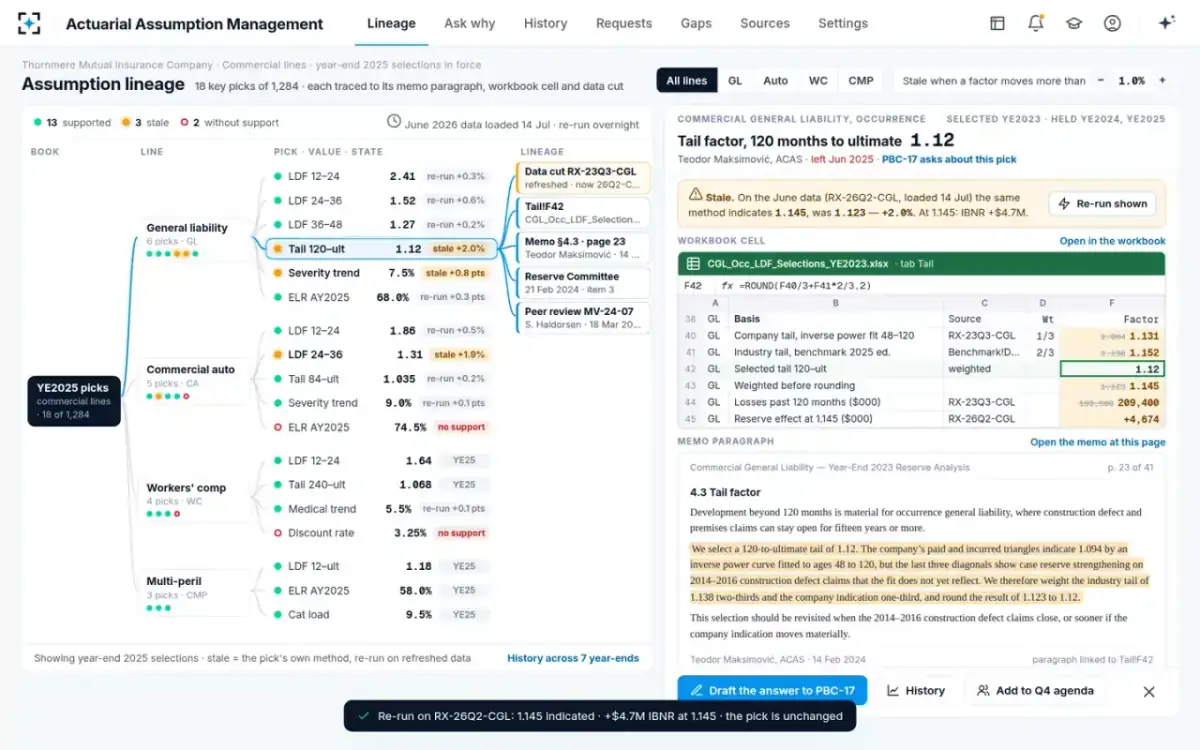
The freshness check shows where the line falls. When the June 2026 triangles loaded in the sample, the watcher re-ran the tail's own formula and weights on the new data: the company fit moved to 1.131 and the 2025 industry tail to 1.152, so the same method now indicates 1.145, 2.0% above the 1.123 the pick was made on, worth about $4.7 million of IBNR. The pick was marked stale and shown with its own cells beside the original. It was not changed. Whether to re-select is on the reserve committee's agenda, where it belongs.
The pick's own method on new data: a stale flag, and the pick unchanged
How do you audit AI-generated actuarial documentation?
By testing what it cites, not how it reads. A reviewer should be able to take any sentence, open its passage and confirm the passage says it; take any figure and find it, unrounded, in the source; and take any pick the tool calls supported and see the paragraph. The Academy paper warns against one trap in particular: a validation that shares the tool's blind spots, such as one AI tool checking another (actuarial AI software quotes it). An automated citation check is a first filter, not the validation. The appointed actuary reading each sentence beside its passage is.
Tests to run on any AI for actuarial documentation tool before relying on it
- Seed known gaps
Remove the memo paragraph behind three picks in a copy of last year’s file. The tool should report three gaps, not three reasons.
- Check every citation on a sample
Open the passage for each sentence of ten answers. Count sentences the passage does not support; the target is zero.
- Check figures are quoted, not recomputed
Compare each number in an answer with its source cell, digit for digit.
- Test workbook versions
Pick a factor whose workbook was saved after the memo was signed. The tool should cite the signed version.
- Re-run a held pick by hand
Re-perform one freshness re-run in the workbook and compare it with the tool’s cells.
- Read the removal log
Every sentence the checker removed should be visible with its reason.
- Confirm it cannot write
Ask for a re-selection. The tool should refuse, and the setting should be locked off.
- Test sources outside the memo
Ask about a pick that was revised in committee after the memo. The answer should cite the minutes.
Writer or lineage builder: what to look for when buying
Most AI products pitched at actuarial documentation are writers: they generate memo text, summarise workbooks or draft responses. That can save typing on new work. For the documentation that gets examined, the useful question is whether the tool can show where each sentence came from, and what it does when the answer is nowhere.
Two kinds of AI for actuarial documentation, compared on what an auditor tests
AI writer: A prompt or a workbook
AI lineage builder: The memos, workbooks, minutes and reviews that already exist
AI writer: New prose describing the selection
AI lineage builder: Links from each pick to its cell, paragraph, data and decision, and answers quoted from them
AI writer: Gets a plausible one
AI lineage builder: Is reported as a gap for its owner to close
AI writer: Often restated or rounded
AI lineage builder: Quoted from the source cell
AI writer: Sees the file it was given
AI lineage builder: Matches the same pick across every year it was held
AI writer: No view
AI lineage builder: Re-runs the pick’s own method and flags a move
AI writer: The prose, against their own knowledge
AI lineage builder: Each sentence, against its passage
The insurer's own AI governance applies either way. Insurers told the U.S. Treasury in 2024 that their AI is governed by state insurance regulators (U.S. Treasury, AI in Financial Services, December 2024). The NAIC's model bulletin on insurers' use of AI is tracked state by state in our NAIC AI model bulletin adoption map. In the EU, EIOPA's 2025 opinion puts the controls inside the function: the actuarial function answers for the controls on AI used in its own area (EIOPA, Opinion on AI governance and risk management; quoted in IFRS 17 automation).
Where an AI documentation tool like Actuarial Assumption Management fits, and where it does not
It fits where the support exists but is hard to reach: a book with years of memos, selection workbooks, minutes and audit answers, and a steady flow of questions about them from auditors, examiners, model validation and new actuaries. It also fits where picks are held from year to year, because the freshness re-run turns "consistent with the prior year" into a tested statement. The guide on actuarial knowledge management software lists what a team brings to start.
It does not fit as a reserving engine. It does not fit curves, select factors, compute IBNR or produce the Statement of Actuarial Opinion; those stay in your reserving tools and with your actuaries. It cannot supply support that was never written: where a pick has no paragraph, it finds the closest existing evidence, such as committee minutes, and drafts a request for the owner of the line to confirm. And it does not decide what leaves the building. Notes to auditors and regulators are signed by the appointed actuary, and internal answers by the line's reserving director. For how the same discipline applies to the most leveraged pick in a reserve study, see what a tail factor selection tool should keep beside the factor.
Questions people ask
Can AI write an actuarial memo?
It can draft one, but the rationale for each selection has to come from the actuary who made it. ASOP No. 41 wants every material assumption to have a named owner, and a drafted reason has none. A tool that drafts from existing passages, with each sentence cited to the actuary's own words, helps; one that invents reasons does not.
What sources can an AI documentation tool read?
Anything the support lives in: reserve memos, selection workbooks at every saved version, committee minutes, audit and exam answers, peer review notes, data extracts and actuarial team email. In the fictional sample, 2,354 sources since year-end 2019 are read by paragraph and by cell, with read-only access to each.
Who is responsible when AI documents actuarial work?
The actuary. The Academy's 2024 professionalism paper says actuaries are responsible for their services "including the decisions whether and how to rely upon AI tools". A sound design keeps the author of each pick attached to it and has the appointed actuary sign anything that goes to an auditor or regulator.
Does an AI documentation tool need to be validated like a model?
Yes, if an actuary relies on it. The Academy reads generative AI as a model under ASOP No. 56, which requires checking that the output fairly represents what it models. For a documentation tool, that means sampling answers and checking each sentence and figure against its source.
Can the tool tell us a held assumption has gone stale?
Only by re-running the pick's own method on new data. In the sample, a tail held at 1.12 was re-run on June 2026 triangles and indicated 1.145, a 2.0% move against a 1.0% default threshold, so it was flagged stale. The pick itself was left for the reserve committee to decide.