A change in actuarial assumptions is a revision to one of the inputs an actuary selected to estimate a liability: a development or tail factor, a trend, an expected loss ratio, a discount rate, or the method that combines them. In accounting terms it is a change in an accounting estimate, recognised in the period of the change and disclosed with its nature and amount; it is not an error. In reserving it is routine. Every year-end moves some picks. What costs money is a change, or a refusal to change, that the company cannot support when an auditor, an examiner or an enforcement lawyer asks why. Botminds' Actuarial Assumption Management exists for that question: it keeps each pick linked to the cell, memo paragraph and data behind it, and re-runs the pick's own method when data refreshes, so a change, or the absence of one, can be explained in minutes. This guide sets out the rules and prices the consequences.
The cost of rebuilding the support for one assumption, by step
What is a change in actuarial assumptions?
The phrase is used in two places, and the rules overlap. In pension and employee benefit accounting, IAS 19 defines actuarial assumptions as "an entity's best estimates of the variables that will determine the ultimate cost of providing post-employment benefits", requires that they "shall be unbiased and mutually compatible", and treats "the effects of changes in actuarial assumptions" as one source of actuarial gains and losses (IAS 19, paragraphs 8, 75 and 76). That is the sense most search results use.
In property and casualty reserving, the assumptions are the selections behind the unpaid claim estimate, and ASOP No. 43 notes that they "may be implicit or explicit and may involve interpreting past data or projecting future trends" (ASOP No. 43, section 3.6.2). A change can be explicit, such as a tail factor raised from 1.10 to 1.12, or implicit, such as shifting weight from the company's own curve fit to an industry benchmark. Both change the estimate; only the first shows up in a list of selected factors.
Is a change in assumptions a change in accounting estimate?
Yes, unless it corrects an error. Under IAS 8, "The effects on an accounting estimate of a change in an input or a change in a measurement technique are changes in accounting estimates unless they result from the correction of prior period errors" (IAS 8, paragraph 34A). A change in estimate is recognised prospectively, in the period of the change and any future periods it affects, and the entity "shall disclose the nature and amount of a change in an accounting estimate that has an effect in the current period" (paragraphs 36 and 39). A correction of an error is different: it reaches back into prior periods.
Change in estimate or correction of an error: why the support decides which one you have
Change in accounting estimate: New information, new developments or more experience changed the best estimate
Correction of a prior period error: Information that was available, or should have been, was not used or was misused
Change in accounting estimate: Recognised prospectively, in the current and future periods
Correction of a prior period error: Corrected in the prior periods affected
Change in accounting estimate: Nature and amount of the change
Correction of a prior period error: Nature of the error and the correction for each period
Change in accounting estimate: Support written at the time, showing the earlier pick was reasonable on what was known
Correction of a prior period error: Evidence that what was known was not reflected
Change in accounting estimate: A tail raised because three new diagonals show development the old fit missed
Correction of a prior period error: A tail left unchanged although a documented re-run already showed it moving
The row that matters is the fourth. Whether a revision is an ordinary change in estimate or something worse turns on what was known, and when. IAS 8 says that a change in estimate "does not relate to prior periods and is not the correction of an error" because it comes from "new information, new developments or more experience". A company that can show what its actuaries knew at each year-end, and why they selected what they did, can show that a later change was new information. A company that cannot is arguing from memory.
Do changes in actuarial assumptions need to be disclosed?
Yes, at three levels. In the financial statements, the nature and amount of a material change in estimate. In the actuarial communication, under the reserving standard:
"In the case when the unpaid claim estimate is an update of a previous estimate, the actuary should disclose changes in assumptions, procedures, methods or models that the actuary believes to have a material impact on the unpaid claim estimate and the reasons for such changes to the extent known by the actuary."
ASOP No. 43, section 4.2(b)
And to regulators, in the Actuarial Report that supports the Statement of Actuarial Opinion. NAIC's Actuarial Opinion Working Group expects the appointed actuary "to discuss any significant change in the Appointed Actuary's total estimates from the prior Actuarial Report", and adds that an explanation is also needed for significant fluctuations within accident years or segments (NAIC Actuarial Opinion (C) Working Group, 2026 Regulatory Guidance). A total that nets a raised tail in one line against a lowered trend in another does not meet that bar.
The standard asks for the reasons "to the extent known by the actuary". That qualifier protects an actuary who inherits a pick and cannot learn why it was made. It does not protect the company, which is expected to know. The guide on the ASOP 41 documentation test shows what a reader must be able to follow for each pick.
The change nobody made: holding a pick while the data moves
The most common unsupported change is the absence of one. A factor selected at one year-end is held at the next with the words "consistent with the prior year", then held again. Each memo is accurate. Meanwhile new diagonals arrive, and the method that produced the pick, if anyone re-ran it, would now indicate something else. The standard anticipates this.
"The actuary should consider the appropriateness of the chosen methods or models, even when the decision is made not to change from the previously applied methods or models."
ASOP No. 43, section 3.6.1
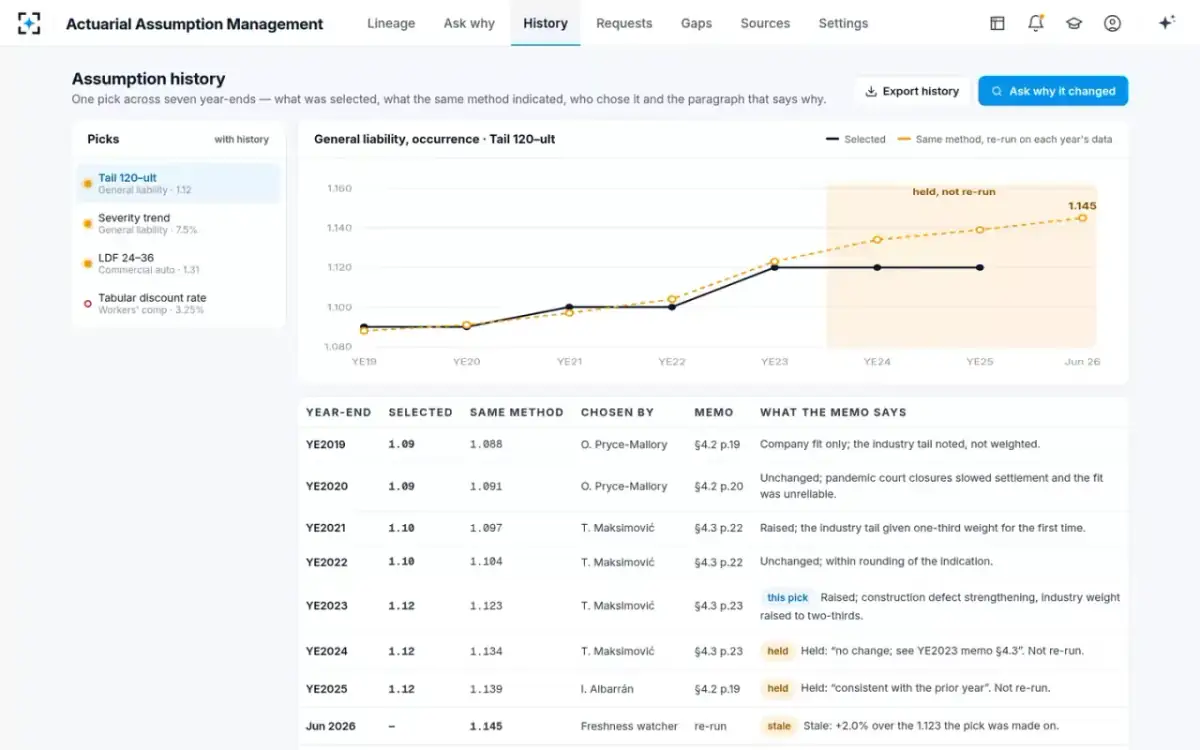
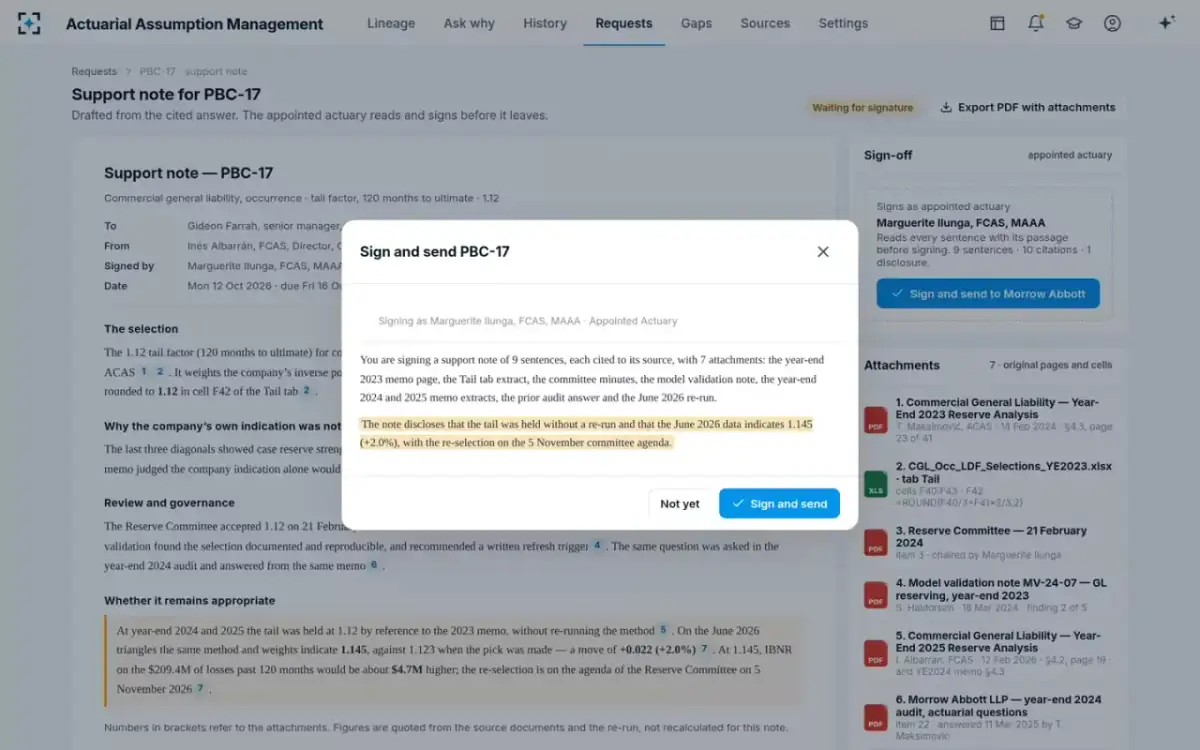
Take a fictional insurer's commercial lines book as it runs through Actuarial Assumption Management. Its general liability tail of 1.12 was selected at year-end 2023, when the selected method indicated 1.123. It was held at year-end 2024, when the same method indicated 1.134, and again at year-end 2025, at 1.139, without a re-run either time. When the June 2026 triangles loaded, the method indicated 1.145, a 2.0% move from the indication the pick was made on and worth about $4.7 million of IBNR. None of those years contains an error in the memo. All of them contain a question the memo cannot answer: was the hold a decision, or an omission?
Selected against indicated, year by year: where a hold became a gap
What does an unsupported assumption change cost? Five consequences
The costs climb a ladder. Most unsupported changes stop at the first or second rung, which is why they are tolerated. The upper rungs are rare, and they are where the absence of contemporaneous support is decisive.
What an unsupported change in actuarial assumptions costs, from rework to enforcement
| Consequence | Who imposes it | What it costs | The rule behind it |
|---|---|---|---|
| Rework to rebuild the support | Your own team | An estimated 20 hours per question by hand, more where the author has left | ASOP 21: be “appropriately responsive” to the auditor and examiner |
| Extended audit testing | The independent auditor and its actuary | More requests, more fieldwork, and a harder conversation about the estimate | Model #205: annual CPA audit, the accountant’s actuary tests the reserves management set |
| A regulator’s own actuary, at your expense | The domiciliary commissioner | The fee of a qualified actuary engaged to review the opinion and rebuild the report or workpapers | Model #745, where the report or workpapers are missing or unacceptable |
| Restatement | The company, with its auditor | Prior periods reopened if the change was an error rather than new information | IAS 8 and its statutory and US GAAP counterparts |
| Enforcement | The SEC, for public companies | Penalties, injunctions and individual liability | Antifraud, reporting, books-and-records and internal-controls provisions |
The middle rung is written into model law. Where an insurer fails to provide a supporting Actuarial Report or workpapers, or the commissioner finds them unacceptable, the commissioner may hire a qualified actuary, at the company's expense, to review the opinion and prepare the missing report or workpapers (NAIC Model #745; the section is quoted in actuarial report template). The other side of the same coin is in the regulators' guidance: a well-documented report can shorten a financial examination and save the company money (the risk-focused examination process explains how).
What happened in the SEC AmTrust reserve case?
In June 2020 the SEC charged an insurer, AmTrust Financial Services, and its former chief financial officer with failing to disclose how the company's loss reserves were estimated. According to the complaint, the company disclosed its general actuarial process but not that the CFO's consolidated adjustments departed from the actuarial estimates without properly considering them, and it kept too little support for management's best estimate (SEC Litigation Release No. 24838; the release is read line by line intop side entries meaning). The company and the CFO settled without admitting or denying the allegations.
SEC v. AmTrust: what undocumented judgmental adjustments to reserves led to
$300M+
judgmental adjustments by the end of 2015, across all reporting segments, as alleged
$10.3M
civil penalty agreed by the company
$75,000
civil penalty agreed by the former CFO, plus $140,000 disgorgement and $22,499 interest
The lesson for reserving teams is narrow and important. The charges did not say a judgmental adjustment is wrong. They said the company "failed to disclose the specific factors or assumptions supporting" the adjustments and did not keep the documentation for management's best estimate. The adjustments may have had reasons; what was missing was the written support connecting them to the actuarial analysis. An older SEC case shows the other direction: in 2009 the SEC alleged that Bancinsurance's president knew of more than $1 million of reinsurance claims before the company filed its annual report and did not ensure they reached the finance team or the auditors, so reserves were understated (SEC Litigation Release No. 21300). Known information that never reached the estimate is the mirror image of an estimate that moved without written support.
What is management's best estimate, and who approves a change in reserving assumptions?
Management's best estimate is the reserve the company books. The appointed actuary's estimate, often a central estimate with a range, is the actuarial view of it, and the two can differ. NAIC Model #205 is explicit that the auditor's actuary tests the reasonableness of reserves only after management has set them (NAIC Model #205). The Actuarial Opinion Summary, NAIC's regulators note, exists "to show a comparison between the company's carried reserves and the Appointed Actuary's estimates".
So a change in reserving assumptions has two owners. The actuary who selects the factor owns the actuarial change and its disclosure under ASOP 43. Management, usually through a reserve committee, owns the booked estimate and any difference from the actuary's. Both need written support, and they need to point at each other: the committee minute that accepts a pick should cite the memo paragraph, and the memo should say when the committee changed something after it was written. In the sample book, a commercial auto expected loss ratio raised to 74.5% in committee after the memo still showing 72.0% was issued is exactly the kind of pick an auditor finds first.
How do auditors test a change in assumptions?
They ask the responding actuary to walk through it. ASOP 21 lists what that actuary should be ready to discuss (quoted in the PBC request list for a reserve audit), including the methods, assumptions and judgments and the reasons for each, the source of any assumption the responding actuary did not set, and circumstances that had or may have a significant effect, such as "trends in experience" and "changes in the entity's policies or procedures, or in valuation bases" (ASOP No. 21, sections 3.5.4 and 3.5.5). The reviewing actuary, in turn, must document its procedures and findings.
In practice the test of a change has three parts: re-perform the indication on the data the actuary used, compare the selection with it, and read the stated reason against what the data and claims department show. A held pick gets the same test with one more step: re-run on current data. Each part is quick when the workbook version, the data cut and the memo paragraph are linked, and slow when they must be found. The PBC process around it is mapped in the PBC request list for the reserve audit.
The arithmetic: minutes to keep the support, days to rebuild it
The economics are lopsided. Writing the reason for a pick and linking it to its cell costs minutes when the actuary selects it, because the reason is in their head and the workbook is open. Rebuilding it three year-ends later costs an estimated 20 hours, and it may be impossible if the author has left; in the sample book, 214 picks have an author who is no longer with the company. The stakes are not small: industry loss and loss adjustment expense reserves reached $1.03 trillion at year-end 2025, and other liability occurrence was the line with the largest adverse development that year, $7,278 million (NAIC, 2025 property and casualty industry analysis).
Signing a note that discloses a held pick, before the auditor finds it
Where Actuarial Assumption Management fits when assumptions change
The solution reduces the cost of each rung by keeping the support where the question will land. Every pick is linked to its cell at the signed workbook version, its memo paragraph, its data cut, the committee minute and any peer review, and matched across year-ends so a reviewer sees each year's selection beside its own indication. When a data cut refreshes, each pick's original method and weights are re-run, and a move past the company's threshold, 1.0% for a factor or half a point for a trend or loss ratio by default, marks the pick stale with its reserve effect.
It does not make the change. Agents never select, re-select or propose a value; a re-selection is a person's decision, taken to the reserve committee, and the setting that would allow otherwise is locked off. It does not decide whether a revision is a change in estimate or an error; that is for the company and its auditor. What it changes is the evidence available when they decide. For the register that holds those picks, one row each, see the assumption register for reserving.
Questions people ask
Is a change in reserving method a change in assumptions?
For disclosure, ASOP 43 treats them together: changes in "assumptions, procedures, methods or models" with a material impact must be disclosed with their reasons. Under IAS 8, a change in a measurement technique is also a change in accounting estimate unless it corrects an error; a change in measurement basis is a change in accounting policy.
Do you have to quantify the effect of each change?
Not under ASOP 43, which says it "does not require the actuary to measure or quantify the impact of such changes". The financial statements are different: IAS 8 requires the nature and amount of a change in estimate with a current-period effect, and NAIC regulators expect significant changes in the appointed actuary's estimates explained, including within accident years or segments.
What triggers a review of a held assumption?
A data refresh, a change in claims practice or reinsurance, or a condition the original memo named. ASOP 43 lists changes in reinsurance programs and in claims personnel's practices as examples of changing conditions to consider. A practical trigger is a re-run of the pick's own method moving past a set threshold.
Can a held assumption be a reserve error?
It can become one if information showing it was wrong was available and ignored. The test is what was known at the time, which is why a dated re-run and a written decision to hold, or a documented reason to hold, matter more than the hold itself.
Who should sign off on a change in reserving assumptions?
The actuary responsible for the analysis selects and documents it; management, usually through a reserve committee, decides the booked reserve. Notes explaining changes to auditors and regulators are typically signed by the appointed actuary, who also reports to the board on the risk of material adverse deviation.