An a priori loss ratio is the expected ratio of ultimate losses to earned premium that an actuary selects for an accident year before, or independently of, that year's own claims experience. It is the input to the expected claims method, the anchor of the Bornhuetter-Ferguson method and the reason those methods are stable when a year is too young for development factors to be trusted. It is built from history restated to today's rates and cost levels, pricing indications and plan, and it is the reserving pick NAIC regulators most often ask to see documented. This guide builds one line by line, shows how much of the reserve rests on it at each age, and sets out the support each line of the build needs. Botminds' Actuarial Assumption Management keeps that support linked to the selected ratio, including the committee decisions that change it after the memo is written.
An a priori loss ratio built line by line: history restated to today's rates and costs
| Accident year | Developed ultimate loss ratio | ÷ On-level factor | × Trend to 2025 | Adjusted loss ratio |
|---|---|---|---|---|
| 2020 | 64.0% | 1.170 | 1.338 | 73.2% |
| 2021 | 66.5% | 1.125 | 1.262 | 74.6% |
| 2022 | 70.2% | 1.082 | 1.191 | 77.3% |
| 2023 | 71.8% | 1.040 | 1.124 | 77.6% |
| 2024 | 73.0% | 1.000 | 1.060 | 77.4% |
| Average, 2020–2024 | 69.1% unadjusted | 76.0% | ||
| Average, 2022–2024 | 77.4% | |||
| Selected for accident year 2025 | 77.0%, with the reason written |
What is an a priori loss ratio?
It is the expected loss ratio for an accident year, selected from information other than that year's reported or paid claims. A priori means "before": before the year's own claims have developed enough to speak for themselves. The CAS study note on reserving states the key assumption of the expected claims technique this way: "the actuary can better estimate total unpaid claims based on an a priori (or initial) estimate than from claims experience observed to date" (Friedland, Estimating Unpaid Claims Using Basic Techniques, CAS).
Expected ultimate losses are the a priori loss ratio times earned premium. For commercial insurers this is the usual approach, and the study note is frank about what it rests on: such an approach "implicitly relies on the accuracy of policy pricing and underwriting". The terms vary: expected loss ratio, ELR, initial expected loss ratio, a priori. The selection is the same, and so is the documentation problem.
Why regulators question the expected loss ratio most
Because it is a judgment with the most leverage and, often, the least written support. NAIC's Actuarial Opinion Working Group, which reads appointed actuaries' reports for state regulators, names it directly in its guidance on support for assumptions.
"The selection of expected loss ratios could often benefit from expanded documentation. When making their selection, Appointed Actuaries should consider incorporating rate changes, frequency and severity trends, and other adjustments needed to on-level the historical information."
NAIC Actuarial Opinion (C) Working Group, 2026 Regulatory Guidance
The next sentence of the guidance is the one that explains the build in the opening table: "Historical loss ratio indications have little value if items, such as rate actions, tort reform, schedule rating adjustments, or program revisions, have materially affected premium adequacy" (AOWG 2026 guidance). An average of raw historical loss ratios mixes years written at different rates and paid at different cost levels. In the illustration it understates the current expectation by almost seven points.
Where does the expected loss ratio come from?
From four sources, usually more than one at once, and each needs its own support.
The company's own history, restated: developed ultimate loss ratios for mature accident years, on-levelled for rate changes and trended for loss costs, as in the opening table. Pricing: the rate indication or the permissible loss ratio behind the rates actually charged, which is the most current view of the business but carries the pricing actuary's assumptions with it. Plan: the loss ratio in the business plan, which may embed targets as well as expectations. Industry benchmarks: useful for new lines or thin data, provided they are adjusted to the book.
ASOP No. 56 sets the order of preference for assumptions used as model inputs: "actual experience properly modified to reflect the circumstances being modeled", then "other relevant and sufficiently reliable experience, such as industry experience that is properly modified", then future expectations, then other sources (ASOP No. 56, section 3.1.6). For an a priori, "properly modified" is the on-level and trend work. If a plan or pricing loss ratio is used as given, ASOP No. 41 asks the actuary to identify the party responsible for each material assumption (section 3.4.4).
The pricing loss ratio and the reserving a priori: same number, different questions
Pricing loss ratio: What rates should we charge for policies written next year?
Reserving a priori loss ratio: What will losses on this accident year ultimately cost, as a share of premium earned?
Pricing loss ratio: Policy year, prospective rates
Reserving a priori loss ratio: Accident year, premium actually earned at the rates actually charged
Pricing loss ratio: The indicated rate change is achieved
Reserving a priori loss ratio: Rate changes as filed and earned, including any not achieved
Pricing loss ratio: Pricing actuary
Reserving a priori loss ratio: Reserving actuary, who may rely on pricing and should say so
Pricing loss ratio: New trend data, competitive pressure
Reserving a priori loss ratio: A trend that moves, a rate change not achieved, a committee override after the memo
How do you select an a priori loss ratio?
Build it, then choose. The build has five steps, and each produces a number another actuary can recompute. Start with developed ultimate loss ratios for years mature enough to trust. Divide each by an on-level factor that restates its earned premium at current rates. Multiply each by a trend factor that brings its losses to the cost level of the year being estimated. Adjust for anything else that changed the relation of premium to loss: tort reform, a program revision, a shift in mix, a change in reinsurance. Then compare the result with the pricing indication and the plan, and select.
The selection is where judgment enters, and where the documentation usually stops. In the illustration, the five-year adjusted average is 76.0%, the three most recent years average 77.4%, and 77.0% is selected. The memo needs one more sentence: why 77.0% and not 76.0% or 77.4%. The CAS study note shows how ordinary such judgment is; its own worked example selects "expected claim ratios of 75% for accident years 1998 through 2002 and 65% for accident years 2003 through 2007" because of a change visible in the data, and says so.
What is on-leveling, and how do rate changes affect the a priori?
On-leveling restates historical earned premium as if today's rates had applied throughout. The study note describes it for its example insurer: "We require all premiums for each calendar year 2000 to 2007 to be restated as if 2008 rates were effective in each respective year." Without it, a year written at lower rates shows a higher loss ratio than the same exposure would produce today, and the a priori is overstated; a year written before rate cuts shows the reverse.
Rate changes affect the a priori twice. A filed increase raises the premium the loss ratio is divided by, so the expected loss ratio for business written after it should fall, other things equal. And because premium earns over the policy term, an increase effective mid-year affects two accident years. Both effects belong in the on-level factor, and the factor's support is the rate filing history with effective dates. Reinsurance actuaries face the parallel task of restating a cedant's history to today's terms; the guide on the as if loss ratio covers it.
How is the a priori used in Bornhuetter-Ferguson?
It supplies the expected unreported losses. The Bornhuetter-Ferguson method splits ultimate losses into what has been reported and what is still expected, and takes the expected part from the a priori. The study note gives its key assumption: "unreported (or unpaid) claims will develop based on expected claims". Brosius's credibility reading makes the weights explicit: the credibility given to the year's own experience is one divided by the cumulative development factor, so the a priori gets the rest.
How much of a Bornhuetter-Ferguson estimate rests on the a priori at each age
That is why regulators look so hard at this pick. At twelve months, three-quarters of the estimate in the illustration is the a priori; at 24 months, half. For the youngest accident years of a long-tailed liability line, the reserve is largely an expected loss ratio times earned premium. The study note warns of the corresponding weakness: the estimate for the latest years "is heavily dependant on the actuary's judgment when determining the expected claims, actual claims emergence for these years may be ignored to some extent."
How do you document an expected loss ratio selection?
One line of support per line of the build, plus the selection and its owner. The checklist turns the regulators' sentence into items a reviewer can tick.
Documenting an a priori loss ratio: the support each line of the build needs
- Developed ultimate loss ratios
Which accident years, which development factors, at what valuation date; why immature years are included or excluded.
- On-level factors
The rate changes used, with filing references and effective dates, and how they were earned.
- Trend
The frequency and severity trends, their source and fit period, and the trend period for each year.
- Other adjustments
Tort reform, program or schedule-rating changes, mix and reinsurance changes, each quantified or explained.
- Pricing and plan comparison
Which indication or plan, dated, and whether it was relied on as given or reviewed.
- The selection and its reason
The selected ratio, and one sentence on why that value among the indications.
- Changes after the memo
If the committee changed the ratio, the minute that did so, linked from the memo.
- The test against emergence
Reported loss ratio to date against the selection, each quarter.
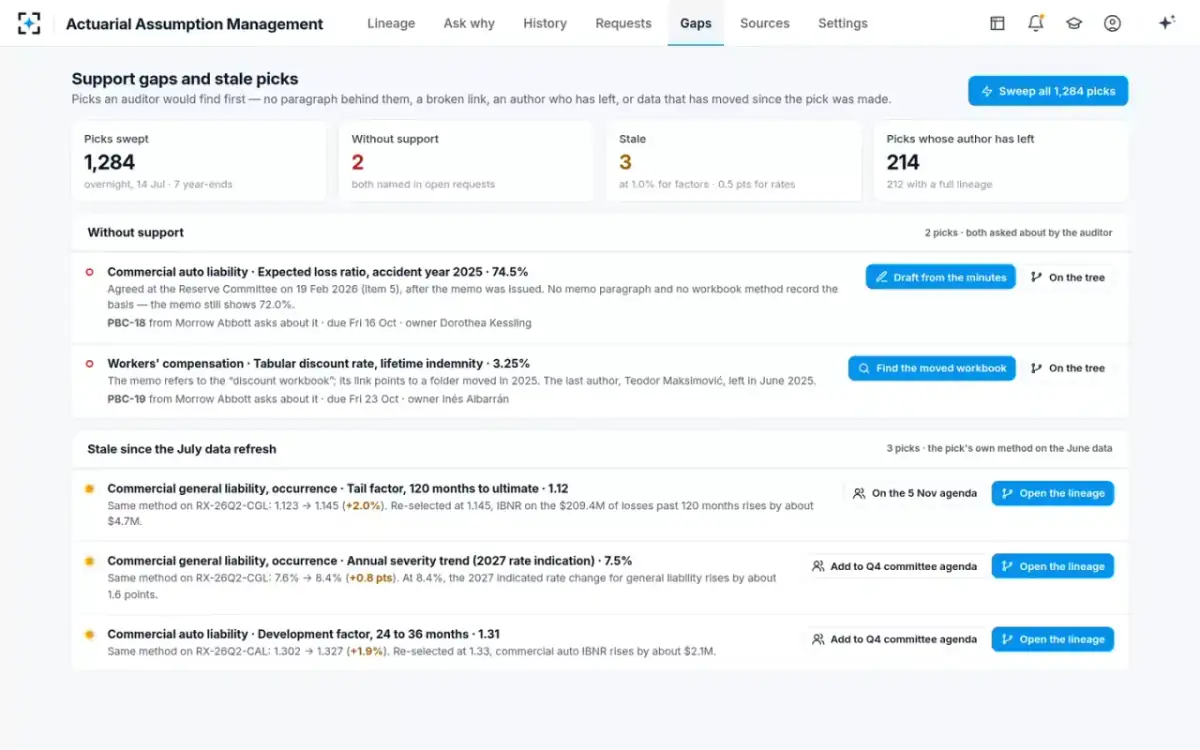
The seventh item is the one most often missed. Take a fictional insurer's commercial lines book as it runs through Actuarial Assumption Management: its commercial auto expected loss ratio for accident year 2025 was raised from 72.0% to 74.5% at a reserve committee meeting after the memo had been issued. The memo still says 72.0%; the workbook has no method for 74.5%; the support is a line in the minutes. It is one of two picks in the sample with no written support, and the auditor has asked about it.
The expected loss ratio agreed after the memo, flagged as a gap
How often should the a priori be updated?
At least at each full reserve review, and whenever its inputs move: a new rate filing, a revised trend, a change the committee makes. Between reviews, test it. The study note gives the simplest test: "compare the reported claim ratio to date to the selected claim ratio". If the reported ratio for a young year already exceeds the a priori, the selection is too low, because the expected claims method will not respond on its own: "The projected value of ultimate claims will only change if the actuary changes the expected claim ratio assumption."
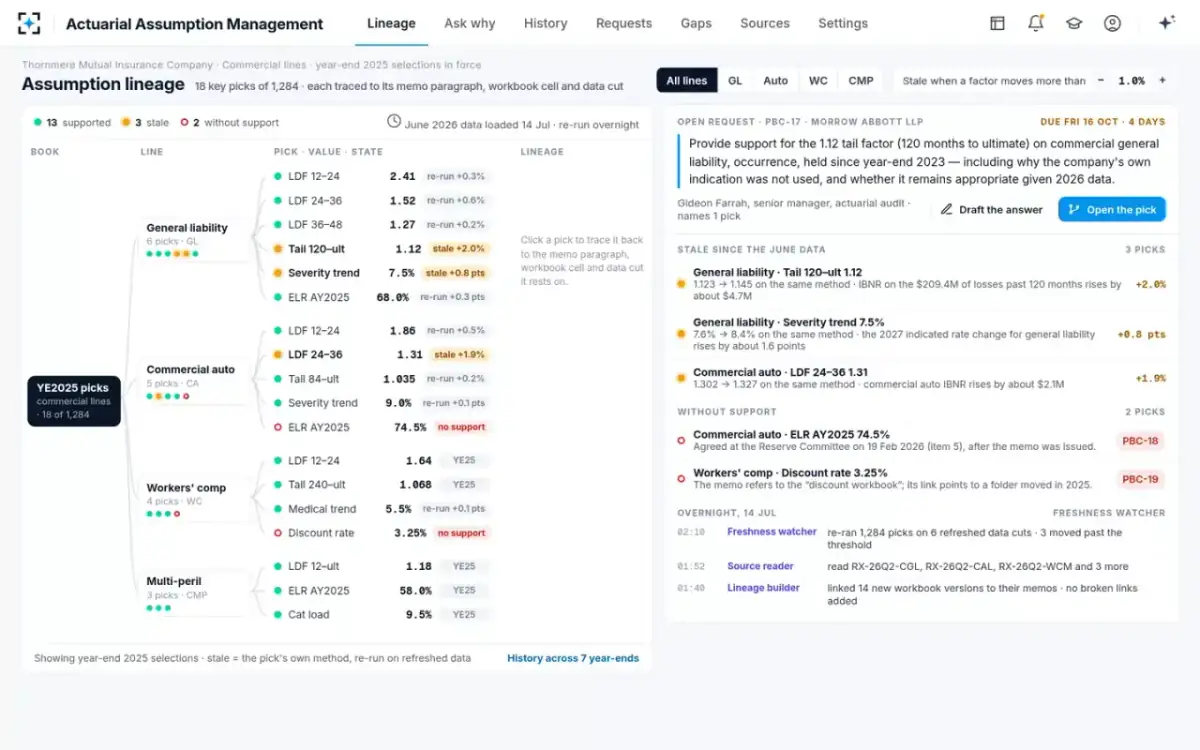
Trend is the input that moves most quietly. In the sample book, the general liability severity trend was selected at 7.5%; when the June 2026 data loaded, the same method indicated 8.4%, a move of 0.8 points against the 7.6% the pick was made on, and enough to move the line's 2027 indicated rate change by about 1.6 points. A trend that feeds an a priori should carry the same freshness check as the a priori itself. The guide on the assumption register for reserving shows how to track both on one row each.
Keeping the a priori’s support attached with Actuarial Assumption Management
The solution keeps the a priori's support where a reviewer will look for it. Each expected loss ratio is linked to its workbook cell at the version the memo used, to the memo paragraph, the data cut and, where it was changed after the memo, the committee minute. Trends and loss ratios carry a freshness setting: by default a re-run of the pick's own method that moves it by more than half a point marks it stale, with the reserve effect shown once it passes the company's floor. A ratio with no paragraph at all is reported as a gap, with the line's owner named.
It does not select the a priori, build the on-level factors or fit the trends; those stay with the reserving and pricing actuaries and their tools. Agents never change a pick or propose one. And when an auditor asks why the expected loss ratio is what it is, the answer is drafted one claim per sentence, each with its passage, for the appointed actuary to sign. How that drafting works, and its limits, is set out in AI for actuarial documentation.
Every key pick on one tree, expected loss ratios included
Questions people ask
Is the a priori loss ratio the same as the expected loss ratio?
In reserving, yes: both name the loss ratio selected before a year's own claims are relied on. Some actuaries reserve "a priori" for the initial estimate fed into Bornhuetter-Ferguson and use "expected loss ratio" more broadly. The CAS study note uses "expected claim ratio" for the same idea.
What is the formula for expected losses from an a priori loss ratio?
Expected ultimate losses equal the a priori loss ratio times earned premium. The expected claims estimate of unpaid losses is that amount less paid losses; in Bornhuetter-Ferguson, expected unreported losses are expected ultimate losses times one minus one over the cumulative development factor.
Should the a priori come from pricing or from reserving history?
Often both, with the reason for the weight written down. Pricing is the freshest view but carries the pricing actuary's assumptions; restated history is the company's own evidence. If a pricing or plan ratio is used as given, ASOP 41 asks the communication to identify who is responsible for it.
How does the Cape Cod method differ?
The Cape Cod method derives the expected loss ratio from the data itself, using reported losses and premium adjusted for development, rather than selecting it externally. It removes one judgment and adds dependence on the development pattern; the derivation, like a selected a priori, should be documented and on-levelled.
What happens to the a priori if rates were cut?
The expected loss ratio for business written after the cut should rise, other things equal, because the same losses are divided by less premium. On-level factors capture this; a raw historical average does not, which is why regulators say historical indications have little value when rate actions have affected premium adequacy.