Actuarial knowledge management software is software that keeps the reasoning behind actuarial work findable and reusable: why each development factor, tail, trend, expected loss ratio and discount rate was selected, where that reason is written, and whether it still holds. In a reserving department the knowledge already exists, spread across reserve memos, selection workbooks, committee minutes, peer review notes, audit answers and email. The problem is that it is organised by file and by year, while questions arrive about a pick, often years later and after its author has left. Botminds' Actuarial Assumption Management organises that material around the picks themselves. This guide is for the head of reserving deciding whether to start: what you need to bring, what each input unlocks, how long the first weeks take, and where the software fits beside the reserving tools you already run.
What you bring to start actuarial knowledge management, and what each input unlocks
- Last year’s signed reserve memos and Actuarial Report
Unlocks the picks themselves: every selected factor, trend and loss ratio, with the paragraph that explains it.
- The selection workbooks, every saved version
Unlocks the cell behind each pick, its formula and weights, and the version the memo actually used.
- Two or more earlier year-ends of the same
Unlocks history: the same pick across years, when it changed, and when it was held.
- The data cuts or triangles each analysis used
Unlocks re-runs: the pick’s own method on new data, and a stale flag when it moves.
- Reserve committee minutes and decision logs
Unlocks the picks agreed after the memo was issued, which the memo alone will miss.
- Peer review and model validation notes
Unlocks what was checked, by whom, and what they recommended.
- Past audit and exam requests with the answers given
Unlocks the questions that recur, and a test set for the first drafted answers.
- Actuarial team email, by thread
Unlocks support that never reached a memo, flagged for the owner to confirm before it is relied on.
What is actuarial knowledge management?
Actuarial knowledge management is the practice of keeping an actuarial function's reasons, not just its results, where the next person can find and check them. For reserving it has a precise target. The profession's communication standard asks that a report identify methods, assumptions and data clearly enough for a qualified peer to make an objective appraisal (ASOP No. 41, section 3.2), and the modeling standard asks the same of the documentation behind a model (ASOP No. 56, section 3.7). Knowledge management is what makes that test pass in year five, not just in the week the memo was signed.
It is narrower than a document library and deeper than search. A shared drive can hold every memo and still fail the test, because the unit people ask about is a pick, and a pick's support is split across files. The question "why is the general liability tail 1.12?" needs the cell, the paragraph, the data, the committee decision and the review, from whichever year the pick was made. Underwriting teams face a similar problem with their guidelines; the underwriting knowledge management system guide covers that side.
Why actuarial knowledge walks out of the door
Because actuaries move, and their reasons move with them unless they were written where the next person looks. The U.S. Bureau of Labor Statistics counts about 31,200 actuary jobs in 2025 and projects about 1,500 openings a year over the next decade, adding that "Many of those openings are expected to result from the need to replace workers who transfer to different occupations or exit the labor force, such as to retire" (BLS,Occupational Outlook Handbook, Actuaries).
A small profession with steady turnover
31,200
actuary jobs in the United States in 2025
1,500
openings a year projected over the decade, many to replace leavers and retirees
9%
projected employment growth, 2025 to 2035, much faster than average
The standards already ask for successor-proof files. The current ASOP No. 41 says "An actuary should consider retaining sufficient information for any recurring project so that another actuary could assume the assignment" (section 3.8). A reserve study is the textbook recurring project. The 2026 draft revision of ASOP 41 proposes to drop guidance on work papers from that standard, as the ASOP 41 summary explains, which leaves the expectation resting more on company governance than on the communications standard. In the fictional sample book used below, 214 of 1,284 picks were made by someone who has since left.
What do you need to implement an assumption library?
Less than most teams expect, and nothing new. The checklist above is the full list, and the first two items are enough to begin: the signed memos and Actuarial Report for one year-end, and the selection workbooks behind them. From those two, every pick on the book can be listed with its value, its cell and the paragraph that explains it.
The other inputs widen the view. Earlier year-ends show history, which is where held picks show up. Data cuts allow re-runs. Committee minutes catch the selections changed after the memo was signed; in the sample, a commercial auto expected loss ratio raised in committee from the memo's 72.0% to 74.5% exists nowhere else. Audit and exam answers show which questions recur. Email is last, because support found only in a thread should be confirmed by the line's owner before anyone relies on it.
Nothing on the list has to be cleaned first. Data quality still matters for the reserving analysis itself, where ASOP No. 23 asks the actuary to review data and consider comparing it with the data behind the prior analysis (ASOP No. 23; the standard is read section by section in ASOP 23 data quality), but an assumption library reads documents as they are and reports what it cannot link.
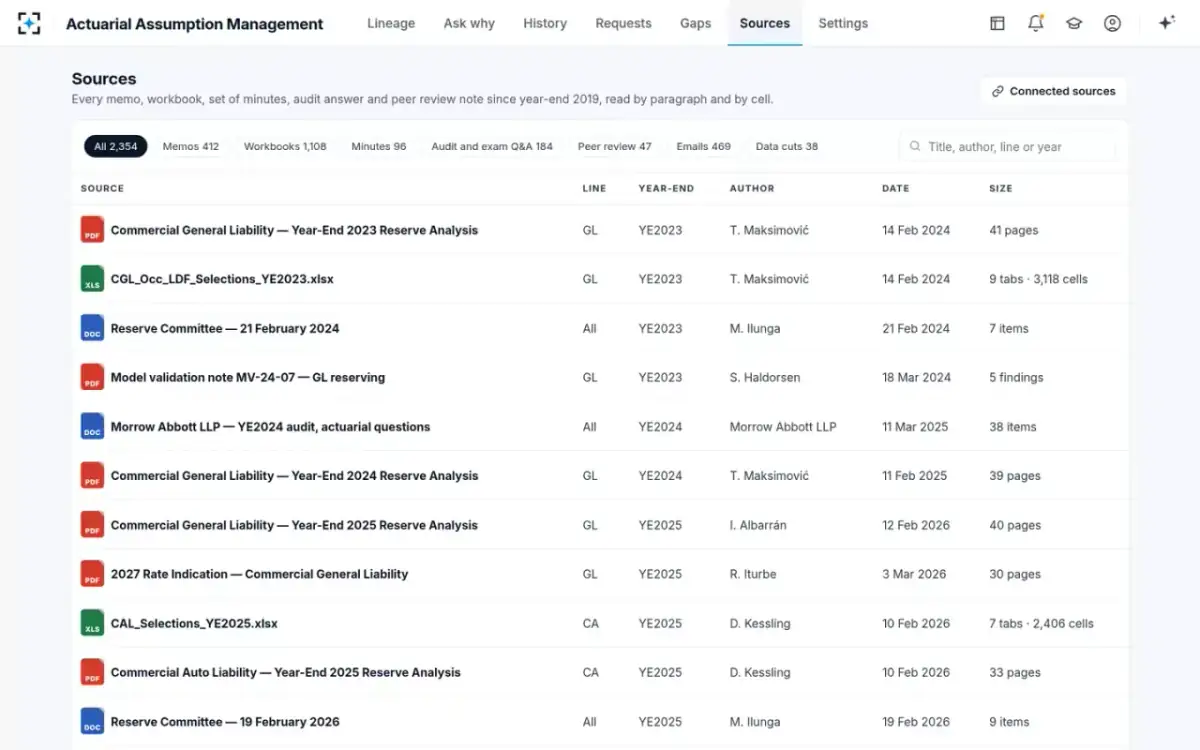
What a reserving department's support is made of: 2,354 sources in one sample book
Sources since year-end 2019
- Workbooks · 47.1%
- Emails · 19.9%
- Memos · 17.5%
- Audit and exam Q&A · 7.8%
- Minutes, peer review, data cuts · 7.7%
Can old reserve workbooks be indexed?
Yes, and the versions are the point. A selection workbook is saved many times between first draft and sign-off, and often again afterwards. Indexing the latest save is easy and wrong: the number an auditor asks about is the one in the version the memo was written from. A useful index reads every saved version, keeps the tab and cell of each selected value with its formula, and links the memo to the version it describes.
In the sample, the general liability tail of 1.12 lives in cell F42 of the Tail tab, with the formula =ROUND(F40/3+F41*2/3,2): one-third of the company's inverse power fit of 1.094, two-thirds of the industry tail of 1.138, rounded from 1.123. Because the formula and its inputs are kept, the same calculation can be re-run on new data without anyone reconstructing it. That is what turns an old workbook from an archive into a method.
Every memo, workbook, set of minutes and audit answer, read by paragraph and by cell
How do you capture knowledge before an actuary leaves?
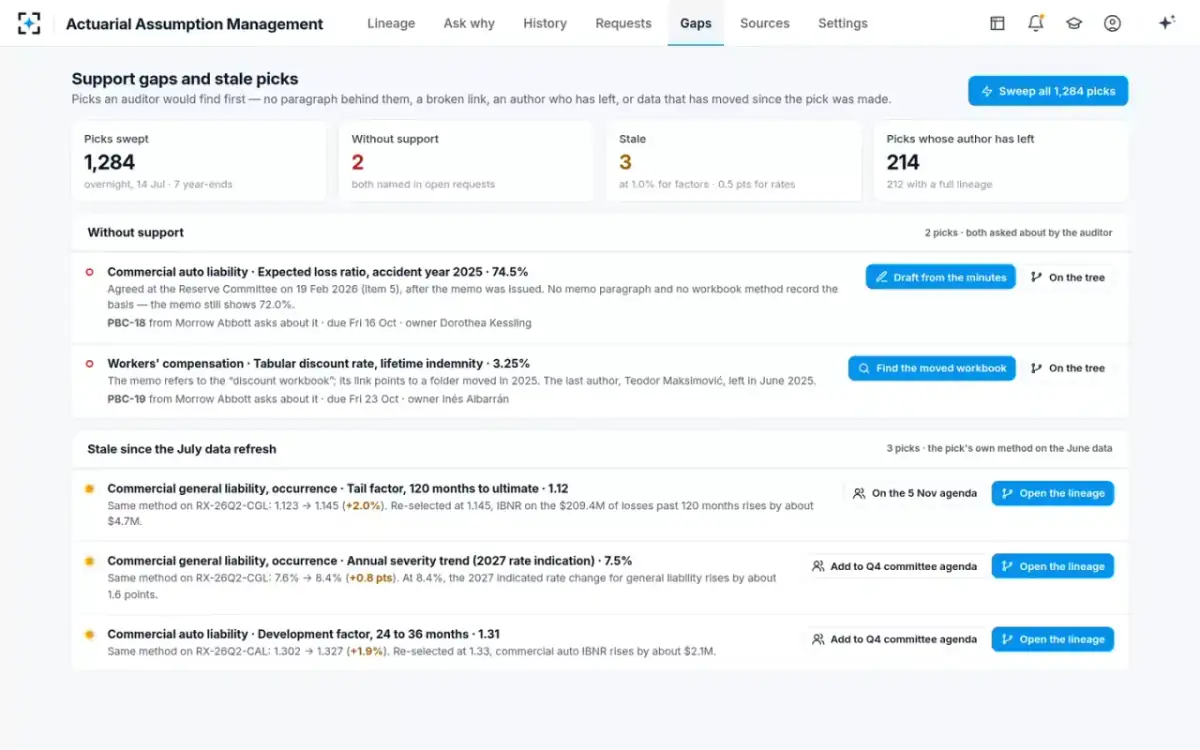
Not with an exit interview alone. By the time someone hands in notice, the useful question is not "what do you know?" but "which of your picks have no written support?", and that can be answered before the conversation. A sweep of every pick for a missing paragraph, a broken workbook link or an author who has left turns a vague handover into a short list of specific gaps, each with its owner.
In the sample, the sweep covered 1,284 picks: 214 had an author who had left, and 212 of those already had a full lineage, from cell to memo to data to minutes. Two picks had no support at all. That is the useful shape of the problem: most departed authors left enough behind, and a handful did not. A handover should spend its hours on the handful. The CAS study note on reserving techniques shows why some support will never be in a memo: the questions an actuary should put to claims management include a request for the field bulletins of recent years that describe changes in claims procedures (Friedland, CAS). Those bulletins belong in the library too.
The handover list: picks with no paragraph, a broken link, or an author who has left
How long does it take to set up actuarial documentation software?
The work is mostly connecting sources and checking links on one line before widening. No published study measures implementation time for this category, so the plan below is a suggested sequence for a first line of business, not a benchmark. Its last step is the honest test: answer last year's audit questions from the library and compare the drafts with what was actually sent.
A suggested first eight weeks for actuarial knowledge management on one line
- ConnectWk 1
- Read one year-end; list picksWk 2–3
- Owners check linksWk 4–5
- Add earlier years; re-runWk 6–7
- Replay auditWk 8
Does it work with existing reserving tools?
It should sit beside them, not replace them. Reserving is done in spreadsheets, commercial reserving software or in-house code, and none of that needs to change. A knowledge layer reads what those tools produce, workbooks and exports, and the documents around them, and writes nothing back. The table sets out the division of labour.
What actuarial knowledge management software does, and what stays with your reserving tools
| Task | Reserving tools and actuaries | Actuarial Assumption Management |
|---|---|---|
| Build triangles, fit curves, compute indications | Yes | No |
| Select factors, trends, loss ratios | Yes, by a named actuary | Never: the setting is locked off |
| Write the memo and the Actuarial Report | Yes | No; it links them to the picks |
| Find the support for a pick from any year | By hand, through the shared drive | Links cell, paragraph, data, minutes and review |
| Re-run a held pick on new data | Only if someone remembers to | On every data refresh, with the pick’s own method |
| Answer an auditor’s or examiner’s question | Drafted from scratch | Drafted with every sentence cited, for the appointed actuary to sign |
| Find picks with no support | When someone asks | Swept overnight, with the owner named |
Who should own the assumption library?
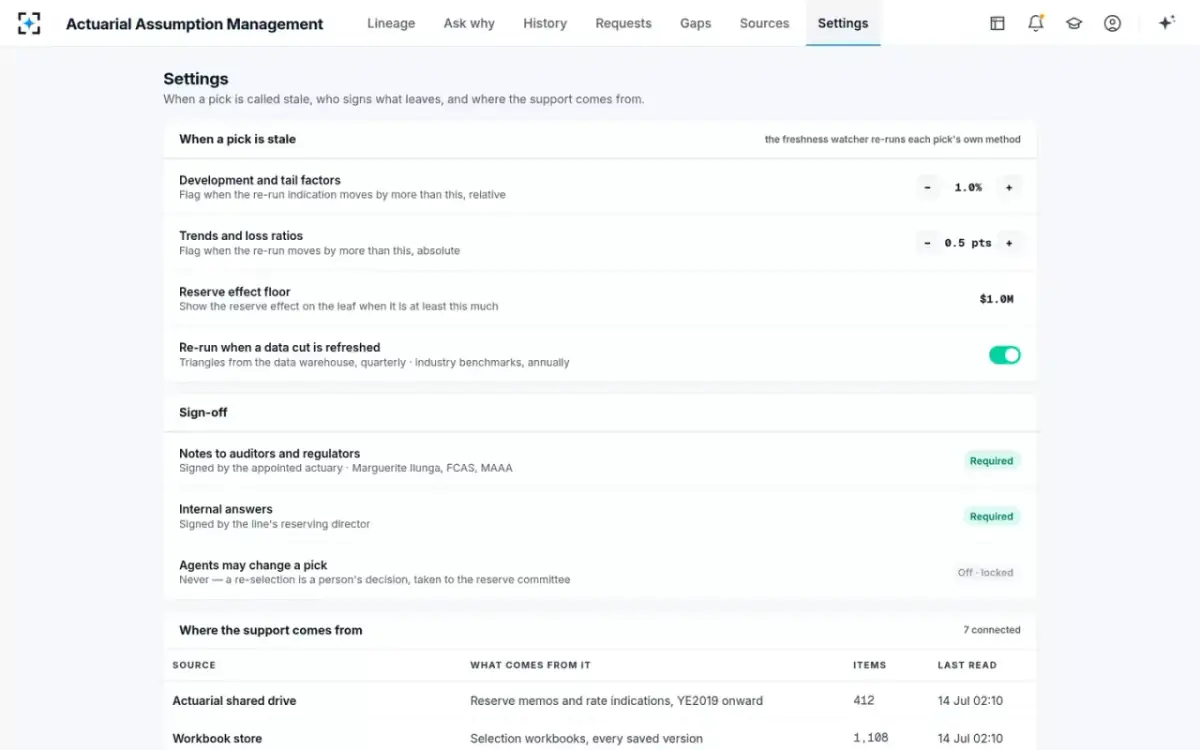
The people who own the picks. Each line's reserving director owns that line's picks and closes their gaps; the appointed actuary owns what is sent to auditors and regulators; model validation reads the history to plan its reviews; IT owns the connections to the shared drive, workbook store and email archive. In the solution's settings, internal answers are signed by the line's reserving director and notes to auditors and regulators by the appointed actuary.
Ownership matters because the library's value is that it is trusted, and trust depends on someone answering for each link. NAIC's regulators expect appointed actuaries to "be able to clearly identify why the Appointed Actuary made changes in the ultimate loss selections and how those changes were incorporated into the final estimates" in a roll-forward, and that reader is helped by a library whose every link has an owner (NAIC AOWG 2026 guidance). The guide to the assumption register for reserving sets out the columns that make ownership visible.
Your rules: what makes a pick stale, who signs, and where the support comes from
What to ask before buying actuarial knowledge management software
A demonstration on a vendor's tidy sample proves little. Ask for a trial on one of your own lines, and put six questions to it.
Does it cite the version? Pick a factor whose workbook was saved after the memo was signed and see which version it opens. Does it find the committee change? Ask about a pick revised in committee after the memo; the answer should cite the minutes, not the memo. Does it report gaps or fill them? Remove a paragraph from a copy of the file and see whether the pick is reported as unsupported or acquires a plausible reason.Can it re-run a held pick? It should use the method and weights written in the original workbook and show its own cells beside the original. Can anything it says be checked? Every sentence of a drafted answer should open its passage, and figures should match their source cells exactly. Who can change a pick? The only right answer is a person, through your reserve committee.
Then measure the replay. Take last year's actuarial PBC requests, have the tool draft answers, and compare them with what was sent: which drafts cite the same support, which find support the team missed, and which report gaps the team papered over. That comparison is the closest thing to a benchmark a reserving function will get.
Where Actuarial Assumption Management fits in a reserving team’s toolkit
It fits a reserving function with several year-ends of memos and workbooks, a regular flow of questions from auditors, examiners, model validation and new staff, and picks that are often held from one year to the next. It fits best where authors have moved on, because that is where retrieval costs the most. The way its agents trace and cite is described in AI for actuarial documentation.
It does not fit as a substitute for writing things down. Where a pick was never explained anywhere, the software reports a gap and drafts a request for the owner; it does not invent a reason. It is not a reserving engine and does not select, fit or compute reserves. And it does not change governance by itself: thresholds, sign-off and retention are the company's settings, and a re-selection is always a person's decision, taken to the reserve committee.
Questions people ask
What software do actuaries use to document assumptions?
Mostly the tools they reserve in: spreadsheets, word-processed memos and the document stores around them. Commercial reserving software keeps selections and sometimes notes, but rarely the committee minutes, audit answers and email that hold the rest of the support. Knowledge management software links those sources to each pick.
Does an assumption library need clean data to start?
No. It reads documents as they are and reports what it cannot link, such as a workbook link pointing to a moved folder. The reserving data used in the analysis is a separate matter, governed by ASOP No. 23's review and consistency expectations.
Can it read email?
Yes, if connected, and it should treat email differently from memos. Support found only in a thread is flagged for the line's owner to confirm before it is cited in an answer to an auditor or regulator. In the fictional sample, 469 of 2,354 sources are emails.
How many picks does a reserving department have?
It depends on the number of lines, segments, development ages and year-ends. The fictional sample commercial lines book used on this page has 1,284 picks for one year-end, of which 18 are flagged as key picks. Counting your own, by line, is a useful first step before choosing a tool.
Is actuarial knowledge management the same as model risk management?
No, though they meet. Model risk management governs the models and their validation; knowledge management keeps the reasons for the selections those models use. Model validation teams are among the main readers of an assumption library, because it shows each pick against what the same method indicated, year by year.