An underwriting knowledge management system is the set of tools that keeps a carrier's underwriting rules (the manual, appetite memos, bulletins, binding authority and state exception pages) in one place, current, and answerable when an agent or underwriter asks. Whether it pays is decided by three numbers, each of which a desk can read from its own inbox before go-live: the median time from an agent's question to a cited answer, the share of questions answered two different ways, and the number of risks bound on a revision that was no longer in force. Everything else, the hours saved and the referrals avoided, follows from those three. Botminds' Underwriting Guidelines Assistant keeps every question with its verdict, the passage it rested on and the revision, so the three numbers come out of the same log the desk works from.
The three numbers on a sample desk, before and during the solution
4.1h
for the underwriting inbox to answer an agent, before the solution
7s
median to a cited answer in the sample run
23
questions answered two ways in the 30 days before
4
risks bound on a superseded roof rule in the eight days after it changed
What is an underwriting knowledge management system?
It is less a library than a control: the place where the carrier's eligibility rules live as one current text, with every revision dated, and where every answer given from them can be traced back. A shared drive of PDFs is a library. A system manages knowledge when it can say which version of a rule was in force on a given day, who has been told, which printed copies still carry the old text, and what agents asked that no rule answers.
The distinction matters for the business case because a library's benefit is convenience, which is hard to price, while a control's benefit is fewer wrong answers, which is not. The KPIs below are all control measures. Each one has a formula, a place to read the baseline, and an owner who can act on it.
Which KPIs show an underwriting knowledge management system is paying?
Three primary KPIs carry the business case and four secondary ones explain movements in them. Answer time prices the agent's wait and the desk's hours. Answers given two ways prices consistency, and the regulatory exposure that comes with inconsistency. Risks bound on a stale rule prices the most expensive failure: business the carrier had decided not to write, written anyway.
The KPI tree for an underwriting knowledge management system, with formulas
Return on the system
hours returned + stale binds avoided + quotes kept − running cost
Answer time
median minutes from question received to cited answer sent
Read it fromTimestamps on the underwriting inbox, chat and call notes
Sample desk4.1 hours by the inbox before; 7 seconds in the sample run
Answers given two ways
questions with the same details answered with different verdicts or clauses ÷ questions answered
Read it fromRe-ask a month of answered questions; group by topic, state and revision
Sample desk23 in the 30 days before the solution
Risks bound on a stale rule
policies bound under a superseded revision ÷ policies bound in the window after a change
Read it fromBound policies since each bulletin, against the revision in force on their quote dates
Sample desk5 Florida quotes on the old roof rule, 4 bound
What moves them
Refer share
Refer answers ÷ all answers
257 of 1,286 (20%)
Gap questions
questions referred only because no guideline answers
36 in a month
Referral cycle time
referral sent to underwriter decision, in business hours
target 4 h (setting)
Stale copies in circulation
places agents read a rule that still show a superseded revision
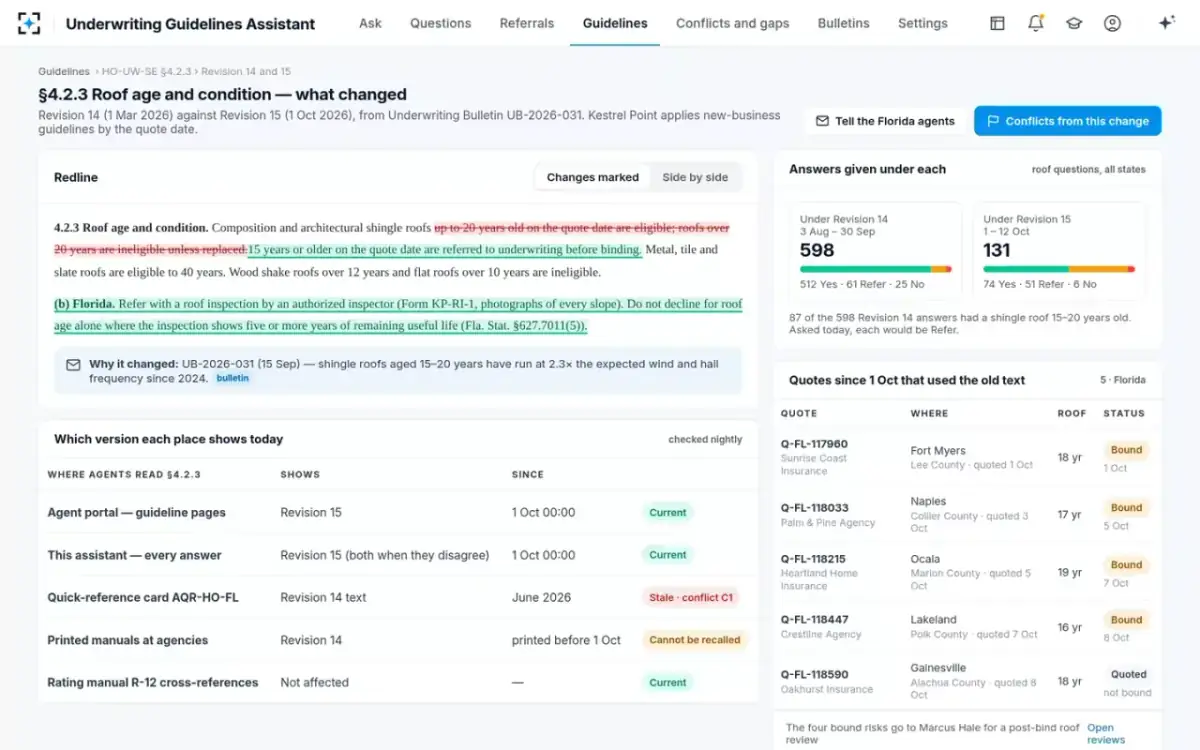
2 for the roof rule
The secondary KPIs are diagnostic. A rising refer share can mean the guidelines got stricter, which is fine, or that the system cannot find passages it should, which is not. Gap questions show where the manual is silent: on the sample desk, 36 questions in a month were referred only because no guideline spoke to them, 14 about leased solar panels. Stale copies in circulation is the leading indicator for stale binds: when the roof rule changed, two places agents read it, the June quick-reference card and the printed manuals, still carried the old text.
Answer time: measure it from the desk's own inbox
Answer time is the median elapsed time from the moment an agent's question reaches the desk to the moment a cited answer goes back. Use the median, not the mean: one question that sat over a weekend will drag an average for a month. Read it from the timestamps the desk already has: the inbox's received and replied times, chat logs, and call notes where a callback was promised.
Two adjustments keep it honest. Count to the cited answer, not the first reply, because "looking into it" is not an answer. And split it into queue time and handling time, because they have different fixes. On the sample desk the estimate was about two and a half hours of queue before anyone opened the question and about an hour and a half of finding, checking and writing; a knowledge system attacks the second, and routing attacks the first.
The desk's month on one screen: volume, verdicts, answer time
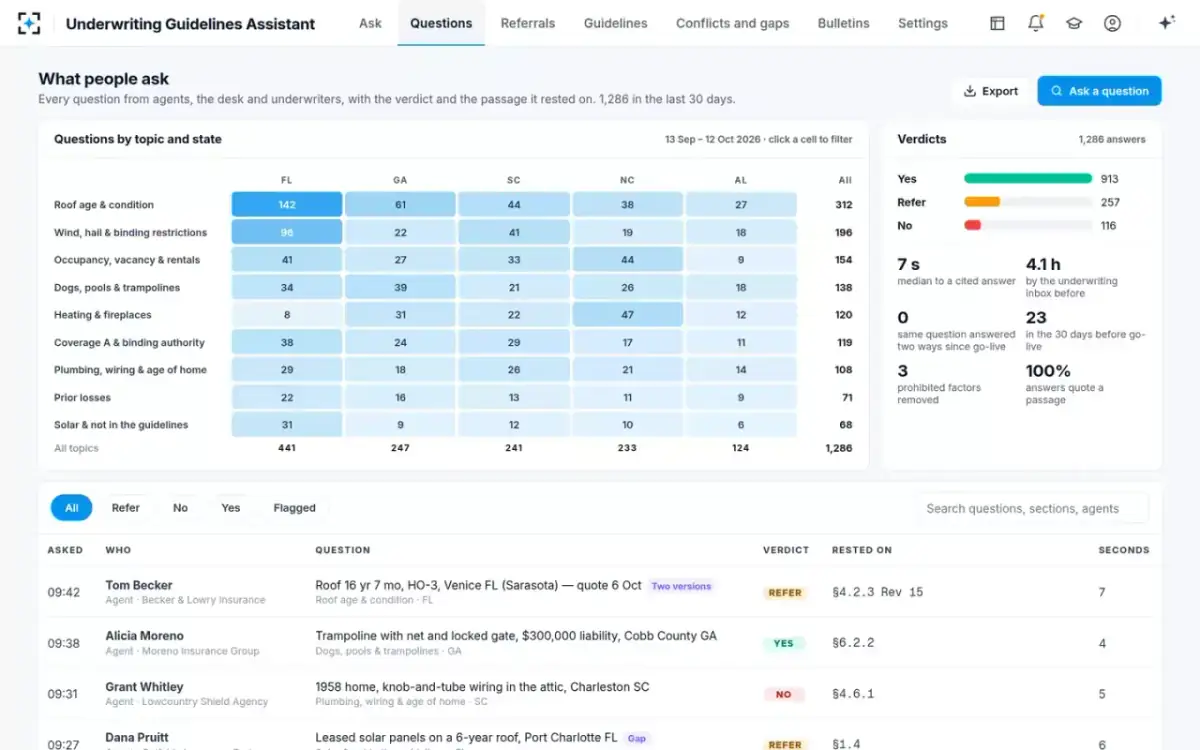
Answers given two ways: the consistency KPI
Count a question as answered two ways when two questions with the same deciding details, in the same state, under the same revision, received different verdicts or rested on different clauses. The numerator needs grouping: roof questions by covering, age band and state; dog questions by breed and state. The denominator is all questions answered in the period.
The baseline is the hardest of the three to read before go-live, because nobody wrote down the clause behind a phone answer. The practical method is to sample: take 40 to 60 answered questions from a month, re-ask them of two underwriters independently, and count disagreements, the test set out in one question, two answers. On the sample desk the count was 23 in the 30 days before the solution. After go-live the number should be read from the log: the same details and revision with two different answers should be close to impossible, and each one found is a defect with a cause.
The consistency KPI also has a regulatory reading. Market conduct examiners check that a carrier's underwriting practices are not unfairly discriminatory and that it follows the law and its own guidelines when it selects risks (NAIC examination standards, chapter 20). A falling count of two-way answers is the evidence a carrier would want to show.
Risks bound on a stale rule: the KPI that finds money
A stale-rule bind is a policy bound under a revision of the guidelines that had already been replaced on its quote date. It is the most expensive failure on the list, because it puts on the books exactly the risk the carrier had decided to stop writing, usually for a loss reason. Count it after every bulletin: take each policy bound since the change, look up the revision in force on its quote date, and compare the verdict that revision gives with what happened.
On the sample carrier the roof rule changed on 1 October, referring shingle roofs of 15 years or more that the old text had allowed to 20. In the next eight days five Florida quotes with shingle roofs of 16 to 19 years went through without a referral and four were bound, in Fort Myers, Naples, Ocala and Lakeland. The carrier's own reason for the change was that those roofs had run at 2.3 times the expected wind and hail frequency since 2024. All four went to the senior underwriter for a post-bind roof review. Multiply the stale binds by the carrier's expected excess loss on that class and the KPI has a dollar value; that number belongs to the actuarial team, not to the vendor.
Where agents read the rule, and which version each place shows
What an hour on the underwriting desk costs
Price desk time at what the people answering questions cost, and say which people they are. The Bureau of Labor Statistics puts the 2025 median pay of an insurance underwriter at $81,370 a year, or $39.12 an hour, across 125,600 jobs (BLS Occupational Outlook Handbook). That is wages before benefits and overhead, for underwriters in every line; agent support specialists on a personal lines desk may cost less, senior underwriters more. Use the carrier's own loaded rates where they exist.
The arithmetic is then plain. Suppose a desk answers 1,000 eligibility questions a month and spends 15 minutes of hands-on time on each: that is 250 hours, or $9,780 a month at the BLS median wage before benefits. If an assistant leaves two minutes of review per answer, the hands-on time falls to about 33 hours. Those inputs are illustrative; put in the desk's own count and its own measured handling time. The BLS also projects underwriter employment to fall 4% from 2025 to 2035 and gives the reason: "Automated underwriting software allows workers to process applications quickly, reducing the need for underwriters." For a desk that is short of experienced people, hours returned are capacity for referrals rather than a cut.
The return on a guidelines assistant, written as a sum
Desk hours returned
questions × (minutes by hand − minutes reviewing) ÷ 60 × loaded hourly cost
Hands-on time only. Queue time costs the agent, not the desk.
Head of underwriting
Stale binds avoided
stale-rule binds per change × changes per year × expected excess loss per bind
Read the binds from the log; price the loss on the class the change was made for.
Actuarial
Quotes kept
questions answered late × share of those quotes lost × average premium × margin
Only if the carrier can show quotes lost to waiting; otherwise leave it at zero.
Distribution
Running cost
licence + loading the guidelines + guideline owner's review time
Include the hours to approve fixes the system proposes; they are real work.
Finance
Agent help desk insurance companies run: reading the volume
The volume on an agent help desk sets the scale of every KPI, so read its shape before reading any benefit. The sample carrier's desk takes questions by phone, chat, email and portal, and the shape that matters is by topic and by state, because that is where rules change and where answers diverge.
One month of agent questions on the sample desk, by state
A desk like this one should expect the KPIs to move first in its largest state, and should set the baseline there. Florida had a third of the questions, a roof statute that limits the manual and, that month, a binding suspension and a roof rule change within days of each other. If answer time, two-way answers and stale binds do not improve in Florida, they will not improve anywhere.
Measuring the KPIs: from baseline to the first monthly report
- Baseline from the inbox4 wk
- Shadow: assistant answers, desk compares4 wk
- Live, every answer sampled2 wk
- Live, sampled weekly6 wk
Underwriting knowledge management software: what to put in the contract
Put the KPIs in the contract as things the software must report, not as results the vendor promises. A vendor can promise that every answer carries a passage and a revision; it cannot honestly promise that a carrier's stale binds will fall by a percentage, because that depends on how many bulletins the carrier issues and how fast its agents read them.
What an underwriting knowledge management contract should require the software to report
- Every answer kept with its passage, revision and verdict
Without it, none of the three KPIs can be read after go-live.
- Answer time split into queue and handling
So the carrier can see whether routing or knowledge is the bottleneck.
- Two-way answers detected, not just counted
Same details, same revision, different verdict: listed with both answers.
- Stale-rule binds after each change
Bound policies since a bulletin, against the revision in force on each quote date.
- Places that still show a superseded rule
Portal pages, cards, printed manuals, rating cross-references.
- Gap questions grouped by topic
What agents ask that no guideline answers, and how underwriters answered the referrals.
- Export of the full log
In a format the carrier keeps, for its own analysis and for examiners.
Where these KPIs mislead
Each KPI can be gamed, and each has a partner that catches the game. Answer time falls if the system answers fast and wrong; pair it with the agreement score against adjudicated answers. Two-way answers fall to zero if the system refers everything; pair it with the refer share. Stale binds fall if bulletins stop being issued; pair it with the count of changes, so a quiet quarter is not mistaken for a better one.
The last caution is about attribution. If a carrier tightens its appetite in the same quarter it deploys a guidelines assistant, referrals will rise and quotes will fall for reasons that have nothing to do with the software. Baseline before go-live, change one thing at a time where possible, and read the KPIs by state and topic rather than as one number. How a carrier earns agents' trust while those numbers settle is the subject of insurance knowledge base software agents trust, and the full desk is on the Underwriting Guidelines Assistant page.
Questions people ask
What is underwriting knowledge management software?
Software that keeps a carrier's underwriting rules (manual, appetite memos, bulletins, binding authority, state exceptions) current and answerable, with every revision dated. The useful test is whether it can say which version of a rule was in force on a given quote date and show every answer given from it.
What are examples of an insurance knowledge base?
An agent portal's guideline pages, a searchable underwriting manual, a quick-reference card and a desk's shared answers are all knowledge bases. They differ in whether they carry revision dates and state exceptions, and whether an answer given from them can be traced to a passage.
What does an agent help desk at an insurance company do?
It answers producers' questions about eligibility, forms, binding authority and service by phone, chat, email and portal. On the sample carrier's desk that meant 1,286 questions in a month across five states, a fifth of which ended as referrals to an underwriter.
How should a carrier handle underwriting desk calls from agents?
Log each one with the question, the answer, the clause it rested on and the time taken, the same as an email. Phone answers are where two-way answers hide, and in Texas an oral practice used to accept or reject applications counts as an underwriting guideline.
Is there an insurance knowledge base template?
The structure that works for eligibility is one entry per rule: the section text, its revision and effective date, the states it applies to, the state law that overrides it, the bulletin that last changed it and the questions people asked about it. Templates without the dates cannot answer which version applied.