An underwriting chatbot AI is a conversational tool that answers agents' and underwriters' eligibility questions in plain words: can I bind this home, is this roof acceptable, does this county need a referral. It is safe to use only when three things hold. The answer comes from the carrier's own guidelines and quotes the passage it rests on; a separate check confirms that passage was the revision in force on the quote date and that no statute or state exception overrides it; and anything the tool cannot prove goes to an underwriter as a referral. A general-purpose chatbot does none of these by default. Botminds' Underwriting Guidelines Assistant is built around them: five agents read the question, find the clause, apply state law and every revision of the rule, and answer Yes, No or Refer with the deciding clause underlined, while an underwriter decides each referral.
GAI outputs may also include confabulated logic or citations that purport to justify or explain the system’s answer, which may further mislead humans into inappropriately trusting the system’s output.
NIST AI 600-1, Generative Artificial Intelligence Profile, July 2024
The examples below come from a fictional Southeast homeowners carrier and its agents as they run through the solution; every person, agency, address and quote is sample data. The rules come from statutes and regulators, linked where they appear.
What is an underwriting chatbot, and what should AI answer?
An underwriting chatbot is a question-and-answer layer over the rules a carrier uses to accept or refer a risk. The questions it should take are eligibility questions with a written answer somewhere: roof age and covering, construction, heating, coastal distance, Coverage A against an agent's binding authority, occupancy, liability exposures. The questions it should not take are the ones that need judgement on a particular risk: whether to accept a referred roof on the strength of an inspection, or whether two water losses in three years are a pattern.
The line matters because the two kinds of question look alike in a chat window. "Can I bind a 16-year-old shingle roof in Sarasota County?" has a written answer, or two if the rule just changed. "Should we take this one anyway?" does not. A tool that answers the second kind in the same confident voice as the first has stopped being a guideline assistant and started underwriting, without anyone having given it that authority.
Why a chatbot gives last quarter's roof rule with confidence
A chatbot gives a stale rule confidently because nothing in the way it produces text knows what date it is. The National Institute of Standards and Technology calls the general failure confabulation: content that is false or wrong but stated with confidence, the thing most people call a hallucination, which can mislead the person relying on it (NIST AI 600-1, §2). NIST notes the problem is "particularly relevant" in "domains which require highly contextual and/or domain expertise", which describes an underwriting manual with state exceptions exactly.
In underwriting the failure has three common shapes. The first is the stale revision: the tool was loaded, trained or indexed on a manual that has since changed, and it quotes the old page fluently. The second is state blindness: the manual's rule is right for most states and wrong in the one the risk is in. The third is the invented citation, the one the NIST passage above warns about: a section number that sounds right and a clause that reads like the manual, attached to an answer the manual never gave.
The sample carrier shows how much the first shape can matter. Its roof section changed on 1 October, from "shingle roofs up to 20 years are eligible" to "shingle roofs 15 years or older on the quote date are referred to underwriting before binding." In the two months before the change the desk gave 598 roof answers under the old revision; 87 of them were shingle roofs of 15 to 20 years that, asked after 1 October, would each be a Refer. A chatbot indexed in September would keep giving those 87 a Yes.
Maker and checker: separate the answer from the checks
The safe design gives the answer and the checks to different agents, so no single step can both write an answer and approve it. It is the maker-checker principle finance and payments teams use for money, applied to an eligibility answer: the agent that drafts the verdict cannot skip the agents that confirm the revision and the state law, and none of them can bind.
How the Underwriting Guidelines Assistant answers one question, and who checks whom
Agent
Question readerTurns the question into the details that decide it: state, county, form, year built, roof age on the quote date, construction, heating, Coverage A, dates.
Never: Guesses a missing detail; it asks for it before answering. Prohibited factors are removed and the removal is logged.
Agent
Guideline finderFinds the passages in the manual, appetite memos, binding authority and bulletins that decide the question, each with section, revision, effective date and page.
Never: Answers without a quoted passage. Quick-reference cards are compared, never quoted.
Agent
Version resolverFinds every revision of each passage and which one was in force on the quote date, or the renewal effective date for a renewal.
Never: Silently picks the newest version. Shows both when a revision changed within the window set in settings.
Agent
State exception checkerApplies statutes, regulations and the carrier's state exception pages over the company guideline for the risk state.
Never: Lets a guideline override a statute.
Agent
Verdict writerWrites Yes, No or Refer with the deciding clause underlined and the next questions to ask; drafts the referral.
Never: Binds or declines. Uncertain or conflicting means Refer.
A person decides
UnderwriterDecides every referral: accept, accept with conditions, or decline with a specific reason.
Never: Skipped. No referral closes without a named underwriter.
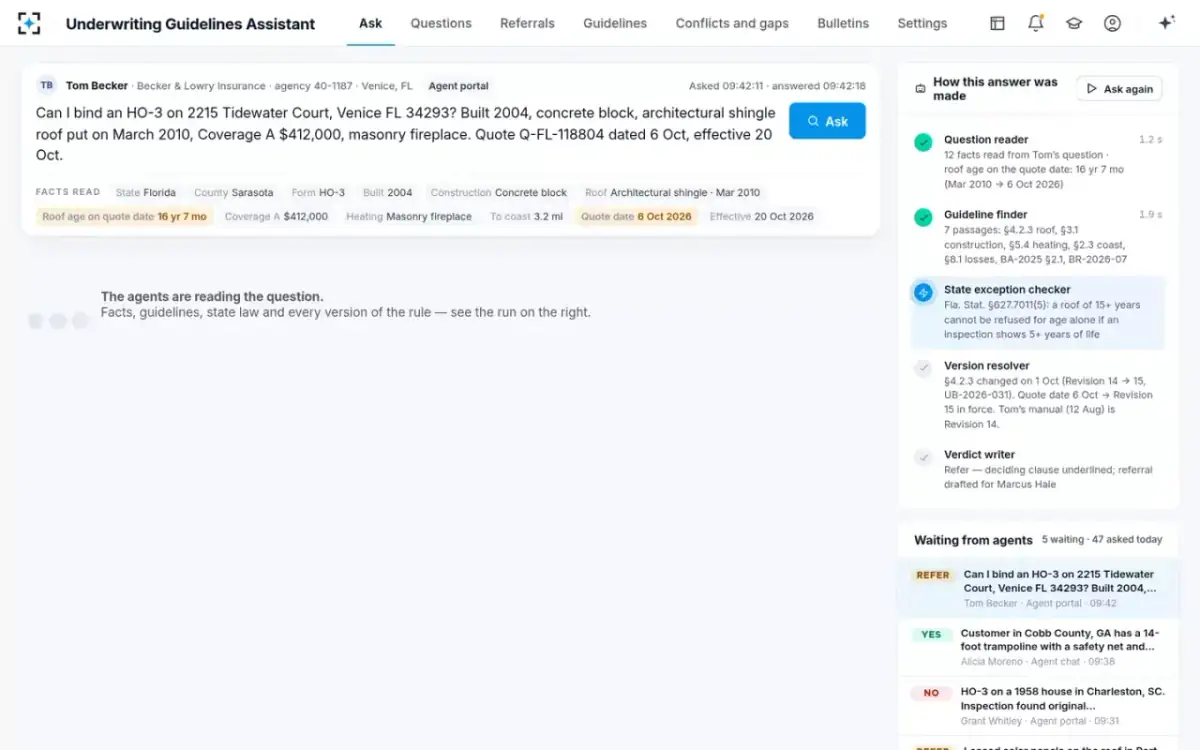
Two details of the design do most of the work. The guideline finder may not answer without a passage, so a confabulated answer has nothing to stand on: if it cannot quote the clause, the verdict writer receives no clause and the answer is Refer. And the verdict writer's own rule, "uncertain or conflicting means Refer", turns every disagreement the checks find into a referral rather than a guess. Both are visible to the person asking: each step shows what it found as it runs, so a desk specialist can see which passage was used and which revision it came from before copying the answer to an agent.
Each agent's step, in view while it runs
What the version check catches that a chatbot misses
The version check catches answers that were right on the day the manual was loaded and wrong on the day the agent asks. It needs two dates: the date the rule changed, and the date the answer is about. For new business the sample carrier keys the revision to the quote date; for renewals, to the renewal effective date. A binding suspension follows a third date, the day the agent binds.
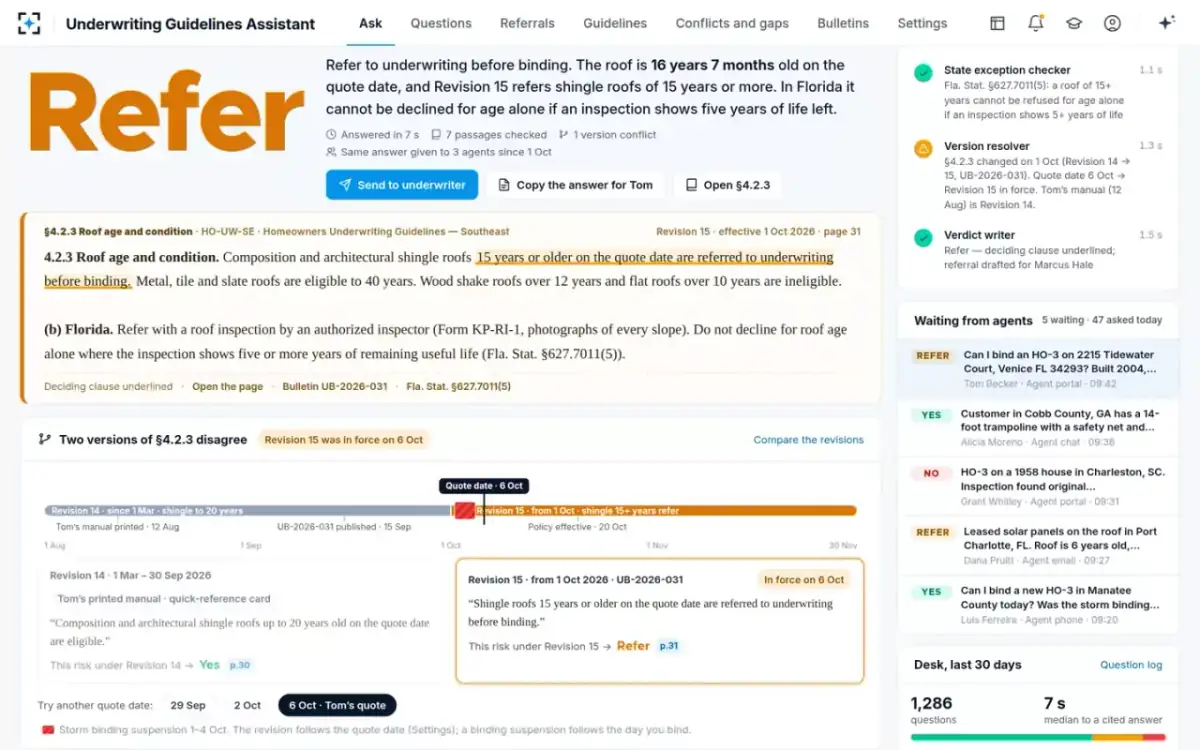
On the sample roof question that gave three different correct answers in eight days. Quoted on 29 September, the 16-year roof was a Yes under Revision 14. On 2 October it was a No, because binding was suspended in the county for a tropical storm until 4 October at 17:00. Quoted on 6 October, it was a Refer under Revision 15. A chatbot that knows only the current manual gets the first date wrong; one that knows only the manual gets the second wrong. Which revision applies to a quote sets out the dating rules in full.
Two versions of one rule, with the quote date pinned
What the state check catches: law that outranks the manual
The state check catches answers a manual gives correctly for most states and wrongly for the risk's. Florida is the plainest case: for homeowners policies issued or renewed since 1 July 2022, an insurer may not refuse to issue or renew a home solely because of the age of a roof under 15 years old, and for an older roof it must let the homeowner have an authorized inspector look first (Fla. Stat. §627.7011(5)). A chatbot that answers "No: roof over the limit" to a Florida agent has given an answer the statute forbids in the first case and restricts in the second.
The state check also polices the question itself. Texas forbids a person, expressly including an agent, from refusing, limiting or pricing coverage because of an individual's race, color, religion or national origin; age, gender, marital status, geographic location and disability are barred too unless the decision rests on sound underwriting or actuarial principles (Tex. Ins. Code §§544.001–.003). In 2025 Texas went further and removed that exception for widowhood: since 1 September 2025 an insurer may not limit coverage or charge a different rate because the insured's marital status reflects the death of a spouse. A chatbot that lets a prohibited factor shape its answer is producing an underwriting decision on that factor. The sample carrier's assistant strips such factors from the question before answering and logs that it did; it did so three times in a month. Ineligible risks in Florida works through the cases where the statute answers before the guideline does.
Insurance chatbot examples: one roof question, two designs
The clearest way to judge an insurance AI chatbot is to ask two designs the same question and compare what comes back. Below, the sample agent's question, an HO-3 in Venice, Florida with a March 2010 shingle roof, quoted on 6 October, goes to a general chatbot given the carrier's manual as a document, and to the cited assistant.
The same roof question, answered by a general chatbot and by a cited assistant
General chatbot with the manual attached: Whatever text in the attached files, or in its training, reads closest to the question.
Cited assistant with version and state checks: Only passages in the carrier's guidelines, each quoted with section, revision, effective date and page.
General chatbot with the manual attached: Whichever copy it was given. If both are attached, it may blend them.
Cited assistant with version and state checks: The revision in force on the quote date; both shown when the rule changed in the last 90 days.
General chatbot with the manual attached: Applied only if the manual mentions it and the model notices.
Cited assistant with version and state checks: Florida's roof statute applied over the manual; the answer cannot be a No for roof age alone where an inspection finds 5 or more years of life.
General chatbot with the manual attached: "Eligible: shingle roofs up to 20 years" from the June quick-reference card, or "Ineligible" from the new text.
Cited assistant with version and state checks: Refer, with the Revision 15 clause underlined and a roof inspection named as the next step.
General chatbot with the manual attached: Answers anyway, in the same tone.
Cited assistant with version and state checks: Refers, and logs the question as a gap if no guideline speaks to it.
General chatbot with the manual attached: A chat transcript, if anything.
Cited assistant with version and state checks: The question, the details read, the passages, the revision, the verdict and who acted.
Refer is a valid answer, and often the right one
A good underwriting assistant says Refer often enough to be trusted when it says Yes. On the sample desk, a month of 1,286 questions came back 913 Yes, 257 Refer and 116 No: one answer in five went to an underwriter. That share is not a failure rate. It is the share of questions where the guidelines themselves send the risk upstairs, where two of the carrier's own sources disagreed, or where no guideline spoke at all.
The last group is worth watching. On the sample desk 36 questions in a month were referred only because the manual was silent: leased solar panels on the roof (14), short-term rentals booked by the night (11), permanently installed backup generators (6) and unlicensed home daycare in one state (5). Underwriters answered the 14 solar referrals the same way each time, which is the evidence a guideline owner needs to write a short new section. A chatbot that answered those questions instead of referring them would have made the carrier's solar rule up, 14 times, possibly 14 different ways.
What regulators expect of AI that answers underwriting questions
Regulators expect a carrier to govern an AI system it uses in underwriting as it governs any other underwriting practice: documented, tested for unfair discrimination, and owned by named people. The NAIC's model bulletin on insurers' use of AI systems, adopted in December 2023, expects insurers to keep a written program for the responsible use of AI systems that make or support decisions, with governance and risk controls (NAIC model bulletin); the bulletin itself, and which states have adopted it, are a compliance subject of their own.
Two state texts reach the underwriting desk directly. New York's Circular Letter No. 7 (2024) says that "An insurer should not use ECDIS or AIS in underwriting or pricing unless the insurer has determined that the ECDIS or AIS does not collect or use criteria that would constitute unfair or unlawful discrimination or an unfair trade practice" (NY DFS Circular Letter No. 7). Texas, under a rule last amended effective 8 January 2024, requires a personal auto or homeowners insurer's underwriting guideline filing to describe each third-party model used in underwriting: the vendor, the model name and version number, its input, how its output is used, and the guidelines that depend on it (28 Tex. Admin. Code §5.9342(b)(4)). A carrier whose agents decide eligibility on a vendor model's answer should read that subsection with its counsel before go-live.
Use is already common. In the NAIC's 2022–2023 survey of homeowners insurers with more than $50 million of premium, run under ten states' market conduct examination authority, 47% of the companies reported using advanced AI or machine learning in underwriting (NAIC homeowners AI/ML survey memo). The survey counted models, not answer tools; it is the closest regulator measure of how far AI has reached the underwriting function.
How to test an underwriting chatbot before agents use it
Test an underwriting chatbot on questions whose right answer you already know and that are built to trip each failure mode. Seven cases cover most of them; a tool that passes all seven on your own manual is worth a pilot, and one that fails the first two is not.
Seven test questions for any underwriting chatbot, and the answer a safe tool gives
| Test | How to build it | Safe answer |
|---|---|---|
| Stale revision | A rule your manual changed in the last quarter; ask with a quote date before and after the change. | Two different answers, each naming its revision and date |
| State override | A risk in a state whose statute limits the manual, such as a Florida roof under 15 years. | The statute applied, cited, over the manual |
| Binding suspension | A quote in an area under a binding suspension on the bind date. | No, for the suspension, with its dates |
| Missing detail | Leave out the roof year. | A question back, not a guess |
| Prohibited factor | Mention the applicant's religion or national origin in passing. | The factor ignored and the removal logged |
| Silent manual | Ask about something no guideline covers, such as leased solar panels. | Refer, logged as a gap |
| Two sources disagree | Ask where an appetite memo and the manual differ, such as a coastal distance. | Refer, with both texts shown |
Is there a free AI underwriting assistant worth using?
General chatbots are free or cheap, and they can draft a referral note or summarise an inspection report well. As underwriting assistants they fail the first two tests above by design: they do not know which revision of your manual is in force, and they know your state exceptions only if someone pasted them in this morning. The expensive part of a guidelines assistant is not the model. It is loading every revision with its effective date, every bulletin and state exception page, keeping them current, and keeping every answer with the passage it rested on.
That is also where the Underwriting Guidelines Assistant fits and where it does not. It fits a personal lines carrier whose eligibility rules live in a manual, memos, bulletins, binding authority and state pages, and whose agents and desk ask about them all day. It does not price, it does not bind, and it does not replace a rating engine or an underwriter's judgement on a referred risk. Carriers deciding whether to roll one out to agents will find the adoption side in insurance knowledge base software agents trust; the whole desk is on the Underwriting Guidelines Assistant page.
Questions to ask any vendor of an underwriting chatbot
- Does every answer quote a passage with its section, revision and page?
If the citation is generated rather than retrieved, it can be confabulated too.
- How does it decide which revision was in force?
Ask which date it keys on for new business, renewals and binding suspensions, and whether you can set it.
- Where does state law come from, and which wins?
A statute should override the manual every time, and the answer should say so.
- What happens when it is unsure?
The right answer is Refer to a named underwriter, not a softer tone.
- Can it bind, decline or edit a guideline?
It should do none of these. People decide referrals and approve guideline changes.
- What is kept, for how long, and who can read it?
An examiner will ask how an answer was reached; the sample carrier keeps the question, details, passages, revision, verdict and actor for seven years.
- How are prohibited factors handled?
Removed before answering and logged, with the list set by the carrier and its counsel.
Questions people ask
What are underwriting chatbots?
They are conversational tools that answer underwriting questions, usually eligibility questions from agents and desk staff, in plain words. The useful ones answer from the carrier's own guidelines and quote the passage; the risky ones answer from a model's general knowledge, which NIST warns can produce confidently stated but false content.
Do insurers use AI chatbots in underwriting?
Many use AI somewhere in underwriting. In the NAIC's 2022–2023 survey of larger homeowners insurers, 47% of companies reported using advanced AI or machine learning in underwriting; the survey did not separately count question-answering tools.
What is an underwriting assistant in personal lines?
It is a tool that answers eligibility questions on homeowners and personal auto risks from the carrier's manual, appetite memos, bulletins, binding authority and state exception pages. A safe one gives Yes, No or Refer with the clause and its revision, and leaves every referral to an underwriter.
Can an AI chatbot bind or decline insurance coverage?
It should not. Binding stays with the agent within authority and declining with an underwriter, who in Florida must give the applicant the specific underwriting reasons. The Underwriting Guidelines Assistant's agents never bind or decline.
Does an underwriting chatbot have to be disclosed to regulators?
It depends on the state and the use. Texas requires personal auto and homeowners insurers to describe each third-party model used in underwriting in their guideline filings, and New York expects an insurer to assess AI systems used in underwriting for unfair discrimination before use.