The agent underwriting questions to ask before quoting a home are the eight or nine details an eligibility rule turns on: the roof covering and the date the whole roof was last replaced, construction, heating, distance to the coast, Coverage A against the agent's binding authority, losses in the last five years, how the home is occupied, and liability exposures such as a pool, a trampoline or a dog. Asked up front, with the document that proves each one, most quotes are answered at the first pass. Asked late, each missing detail turns into a question to the underwriting desk, and the question waits: on an inbox, on whoever knows the manual, on whether last month's bulletin changed the rule. Botminds' Underwriting Guidelines Assistant answers that question from the carrier's own guidelines in plain words, quotes the clause it rests on with its revision, applies state law, and sends to an underwriter only what needs one.
The examples come from a fictional Southeast homeowners carrier, Kestrel Point Mutual, its independent agents and its personal lines desk, as they run through the solution. Every person, agency, address and quote is sample data. The rules quoted come from statutes and regulators, linked where they appear.
Most of an agent's wait is queue, not judgement
4.1h
for the underwriting inbox to answer an agent, on the sample desk before the solution
1,286
questions from agents, the desk and underwriters in 30 days on the sample desk
20%
of those answers were Refer: 257 sent on to an underwriter
125,600
insurance underwriters employed in the US in 2025
Which underwriting questions should an agent ask before quoting a home?
Ask the questions the manual's eligibility sections are organised around, and ask for the paper that settles each one. On the sample desk, a month of questions from agents fell into nine topics, led by roof age and condition (312 of 1,286), wind and hail restrictions (196), occupancy and rentals (154), and dogs, pools and trampolines (138). Those topics are the agent's checklist, because they are where the answers change.
Agent underwriting questions to ask on a homeowners quote, and what settles each
| Ask the customer | Why the answer can change eligibility | What settles it |
|---|---|---|
| What is the roof covering, and when was the whole roof last replaced? | Roof rules are usually set by covering and age. Florida counts a roof's age from the last time all of its surface was built or replaced, not from a partial repair. | The permit or invoice for the full replacement |
| How is the house built, and when? | Construction class and year built decide wind and fire rules, and older homes trigger wiring and plumbing questions. | County property data, an appraisal, or the prior declarations page |
| How is it heated? Any wood stove, insert or fireplace? | Solid-fuel heating often needs proof of how it was installed. | Installer's certificate or a building official's approval |
| How far is it from the coast? | Coastal bands and binding restrictions are drawn in miles or feet from the shore. | A mapped distance, not the customer's estimate |
| What would it cost to rebuild? | Coverage A above the agent's binding authority goes to an underwriter whatever else is true. | A replacement-cost estimate |
| Any losses in the last five years? | Loss history is a common reason for referral or refusal. | The loss history report the carrier pulls |
| Who lives there, and is it ever rented? | Seasonal, vacant and short-term rental use are often written differently or not at all. | The owner's statement, and any rental listing |
| Pool, trampoline, dog, home business? | Liability features are where carriers' rules differ most. | Photos, the breed, the business licence |
Two of those rows produce most of the waiting. The roof question is the one most often answered from memory ("about fifteen years") when the rule turns on a month: a shingle roof put on in March 2010 is 16 years 7 months old on a 6 October 2026 quote and 16 years 6 months on a 29 September one, and on the sample desk that difference crossed a revision of the rule. The Coverage A question is the one most often skipped, because it feels like pricing rather than eligibility. Homeowners insurance application questions and answers that pass works through each answer with the document an agent should have in hand.
Who waits on whom when an agent asks the underwriting desk
An agent's question waits on the desk, the desk waits on the manual, and the manual waits on the last bulletin. On the sample desk the whole chain took about four hours, and on Botminds' estimate almost all of it was queue: the inbox held the question for roughly two and a half hours before anyone opened it. The thinking, once someone had the right page, took minutes.
Who waits on whom for one roof question, in minutes
The agent waits on the underwriting inbox
An email or a voicemail sits until someone on the desk picks it up
With the solutionnone: the question is read as it arrives
The desk waits on the manual
Finding the section that decides it, in the manual, an appetite memo or the binding authority
With the solutionseconds
The desk waits on the state and the bulletins
Checking whether a statute, a state exception page or a recent bulletin changes the answer
With the solutionseconds
The desk waits on the revision history
Working out which revision was in force on the quote date
With the solutionseconds
The agent waits on the reply
Writing the answer back, with the page it rests on
With the solutionabout a minute
The order matters more than the total. The longest edge is the first one, and it is pure queue: nobody is looking at the question. The three middle edges are search, and they are where answers go wrong, because a person in a hurry stops at the first section that seems to apply. The last edge is the one agents notice, because the reply often arrives without the page it rests on, so the agent cannot tell the customer why.
What does "referred to underwriter" mean for the agent?
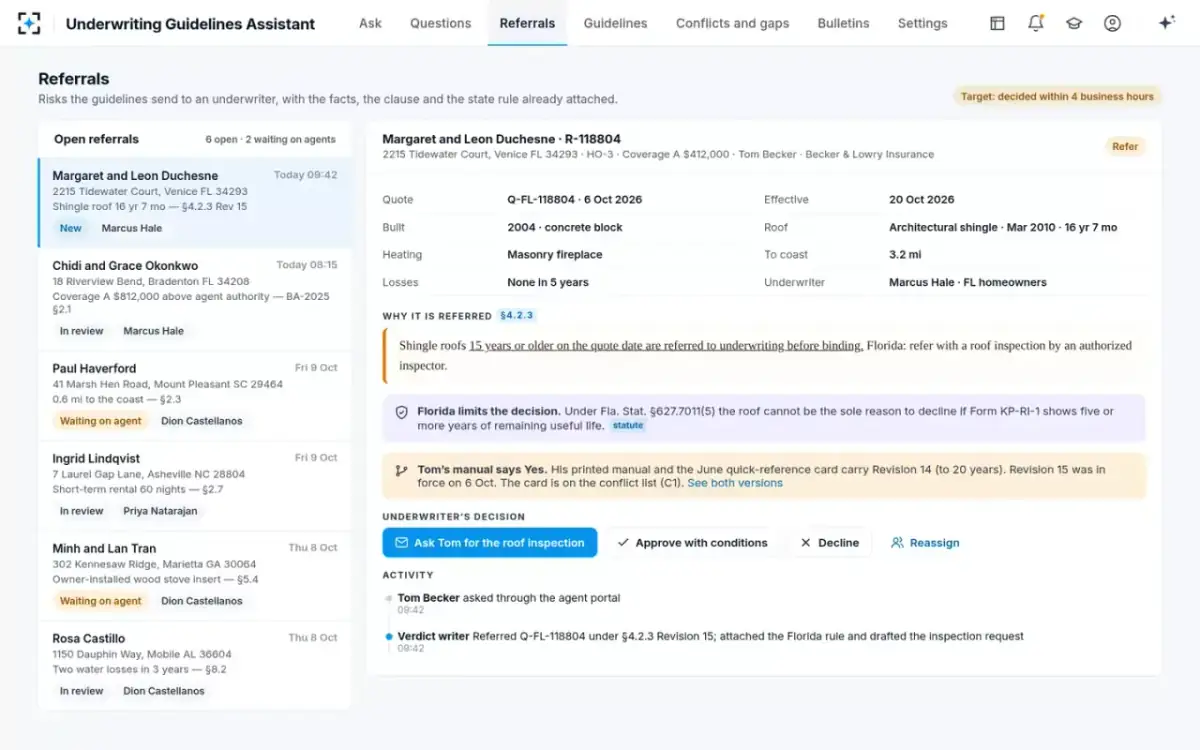
"Referred to underwriter" means the agent may not bind the risk on its own authority: the guidelines send it to an underwriter, who decides whether to accept it, accept it with conditions, or decline it. A referral is not a decline. It is a statement that something in the risk sits outside what the agent's authority or the manual's plain rules allow, and that a named person will decide.
The Bureau of Labor Statistics puts the relationship plainly: "Underwriters are the main link between an insurance company and an insurance sales agent" (BLS Occupational Outlook Handbook). A referral is where that link carries weight. An agent should expect three things from one: a reason tied to a clause, a list of what would change the answer, and a time by which it will be decided. On the sample desk the routing rule sends Florida homeowners risks up to $1 million of Coverage A to one senior underwriter, with a target of a decision within four business hours.
If the answer is no, the reason has to be specific. Florida requires a denied application to come with the specific reasons for the denial, including the underwriting reasons, and when a carrier refuses a homeowners or private passenger auto applicant on adverse underwriting information it must say what that information was (Fla. Stat. §627.4091). An agent who is told only "underwriting declined" has been given less than the law expects the carrier to give the customer.
A referral that arrives already worked up
Why an agent's answer counts as an underwriting guideline
What the desk tells an agent on the phone is, in at least one state, part of the carrier's underwriting guidelines. Texas defines an underwriting guideline as "a rule, standard, guideline, or practice, whether written, oral, or electronic, that is used by an insurer or its agent to decide whether to accept or reject an application" for personal auto or residential property cover (Tex. Ins. Code §38.002(a)(4)), and requires every such insurer to file its guidelines with the Department and update the filing each time they change.
That definition reaches the agent twice: the rule the agent applies is a guideline, and so is the practice of answering an agent's question a particular way. A desk where two people answer the same question two ways is applying two guidelines, and at most one of them matches the filing. Are underwriting guidelines public record? follows what Texas does with the filings once it has them.
Market conduct examiners look at the same channel from the carrier's side. Among the general examination standards in the NAIC Market Regulation Handbook is this one: "Regulated entity communications to producers are in compliance with applicable statutes, rules and regulations" (NAIC examination standards, chapter 20). A quick-reference card mailed to appointed agents, an email from the desk and a portal page are all communications to producers. If one of them still carries a rule the carrier withdrew, the examiner is reading the old rule.
Where the hours go on one roof question
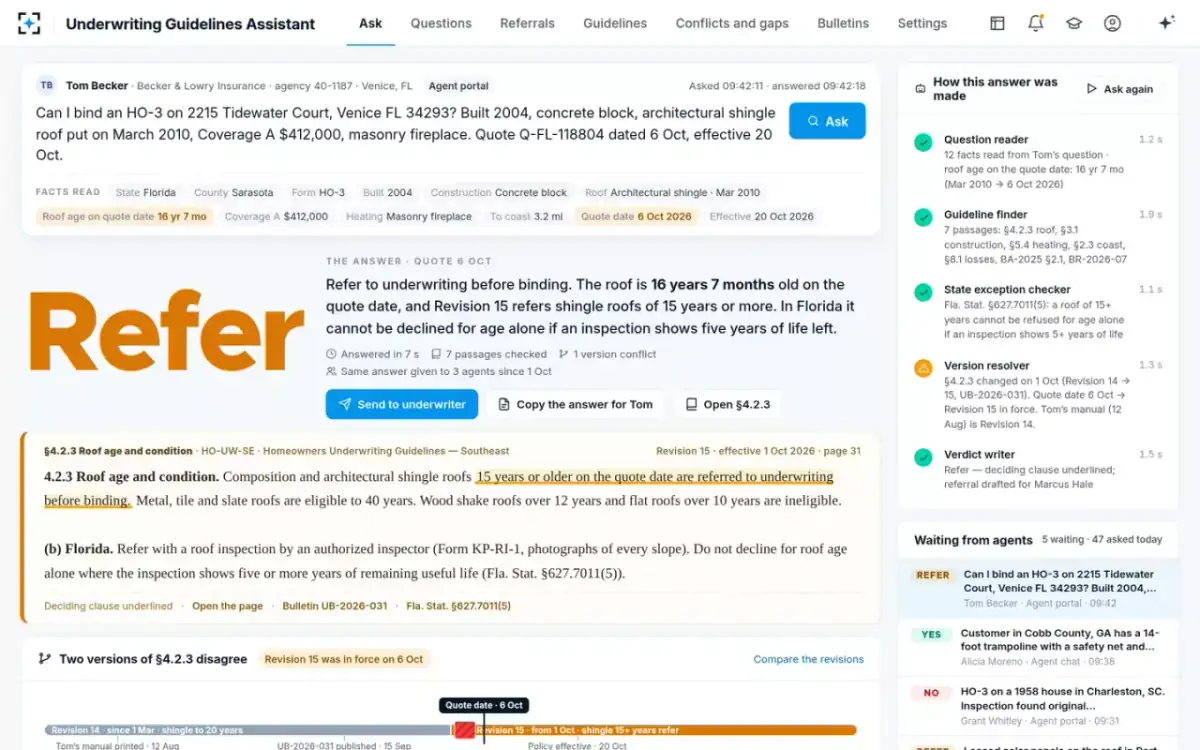
The hours go to the inbox, not to judgement. Take the sample question that opened Monday 12 October: Tom Becker, an independent agent in Venice, Florida, has a customer on the phone and an HO-3 quote on a 2004 concrete block house with an architectural shingle roof from March 2010, Coverage A of $412,000 and a masonry fireplace. He wants to know whether he can bind it.
Before the solution, that question went to the underwriting inbox. Someone opened it after a couple of hours, found the roof section, checked whether Florida's roof statute applied, noticed or did not notice that the roof section had changed on 1 October, and wrote back. With the solution, the agent asks through the portal in the same words. Five agents answer: one reads the question into the details that decide it, one finds the passages, one applies state law, one works out the revision in force, and one writes the verdict. In the sample run they took seven seconds, checked seven passages and found one conflict between versions.
The agent's question, the details read from it, and the deciding clause
The people in the chain, and what each one waits for
Five people touch an eligibility question, and each one is waiting on someone else for a different thing. The agent waits for a yes he can bind on. The desk specialist waits for the right page. The underwriter waits for the details to be rebuilt before he can decide. The guideline owner waits, often without knowing it, for someone to notice that a printed card still carries last quarter's rule.
Who carries one eligibility question, before and after
Today
Quotes from a printed manual and a quick-reference card, and calls the desk when they disagree with the portal.
With agents
Asks in plain words through the portal and gets the verdict, the clause and both versions of a rule that changed.
Still theirs: The customer conversation and the decision to bind within authority.
Today
Answers calls, chats and emails across five states, hunting the page while the agent holds.
With agents
Reads the verdict, the clause and the state rule on one screen and copies the answer with its page.
Still theirs: Judgement on what to tell the agent next.
Today
Gets referrals as phone messages and rebuilds the details before deciding.
With agents
Gets each referral with the details, the clause, the state rule and a drafted request to the agent.
Still theirs: Every referral decision: accept, accept with conditions, decline.
Today
Learns a card is stale when risks the company stopped writing have been bound.
With agents
Sees each night where two sources disagree, what it affected and a proposed fix.
Still theirs: Approval of every change to the guidelines.
Today
Does not yet know which version of a guideline to trust.
With agents
Reads the manual page with its revisions and what others asked about it.
Still theirs: Learning the judgement behind the rules.
What is an insurance agent's binding authority, and why it changes the question?
An agent's binding authority is the written limit on what the agent may commit the carrier to without asking: which forms, which states, which property types, and up to what Coverage A. It changes the agent's question because the same risk can be a yes for one agent and a referral for another. On the sample carrier, Tom's quote at $412,000 sat inside his $750,000 authority; another sample referral that morning, a Bradenton home at $812,000, went to the underwriter for that reason alone.
Authority is also bounded in time. A carrier can suspend binding in an area when a storm threatens, and a suspension follows the day the agent binds, not the day the quote was written. On the sample desk a binding suspension covered Sarasota County from 1 to 4 October; the same quote asked on 2 October would have been a no for that reason. The revision of the manual, by contrast, followed the quote date, a difference which revision applies, quote date or bind date takes apart.
Questions an agent should ask the desk, not only the customer
The best agents ask the desk four questions the customer cannot answer: which revision applies, whether state law changes it, what document would settle it, and who will decide. Each one shortens the next exchange, and each one is a fair thing for an agent to expect in writing.
Six questions to put to the underwriting desk about any eligibility answer
- Which section and revision is this answer based on?
If the desk cannot name the page, the agent cannot explain it to the customer or check it next month.
- Was that revision in force on my quote date?
Manuals change on a date. A printed copy older than the latest bulletin may be quoting a withdrawn rule.
- Does a statute or a state exception change it?
In Florida, roof age alone cannot be the reason to refuse a roof under 15 years old, whatever a manual says.
- Is binding suspended where this risk is?
A suspension follows the bind date, so a yes on Monday can be a no on Tuesday.
- What document would turn this Refer into a Yes?
A roof inspection, an electrician's certificate, a replacement-cost estimate: name it, and the referral can close in one round.
- Who decides, and by when?
A referral should carry a named underwriter and a target time, not a place in a queue.
Where the Underwriting Guidelines Assistant fits, and where it stops
The solution takes the waiting and the searching out of an agent's question; it does not take the decision. Its agents never bind, never decline and never change a guideline. Where no passage answers a question, it refers the question and logs it as a gap: on the sample desk, 36 questions in a month were referred only because the manual was silent, 14 of them about leased solar panels.
It also works the other way round. Every question asked is kept with its verdict and the passage it rested on, so the guideline owner can see what agents ask that the manual does not answer, and which printed copies are still being read. That is where most of the hours come back: not from answering faster, but from answering once, the same way, from the page that is in force. Where each rule lives maps the sources an answer has to draw on, and the Underwriting Guidelines Assistant shows the whole desk.
Questions people ask
What are agent underwriting questions and answers?
They are the eligibility questions an agent asks the customer, and then the carrier, before binding: roof, construction, heating, coast, Coverage A, losses, occupancy and liability features. The answers come from the carrier's underwriting guidelines, and in Texas the definition of a guideline expressly includes oral practices used by an insurer or its agent.
What underwriting questions are asked for home insurance?
The core set covers the roof and when it was fully replaced, construction and year built, heating, distance to the coast, rebuilding cost, losses in recent years, occupancy and rental use, and liability exposures such as pools, trampolines and dogs. On the sample desk, roof questions alone were 312 of 1,286 in a month.
What does underwriting referral mean?
A referral means the risk falls outside what the agent may bind and goes to an underwriter to decide. It is not a decline: the underwriter can accept, accept with conditions such as an inspection, or decline with a specific reason, which Florida requires to be given to the applicant.
How long should an underwriting referral take?
There is no legal clock for an eligibility referral; it is a carrier service standard. The sample carrier routes Florida homeowners referrals to a named underwriter with a target of four business hours, against the 4.1 hours its inbox took just to answer a question before the solution.
Can an independent agent bind a policy without asking underwriting?
Yes, within the binding authority the carrier has granted: the forms, states, property types and Coverage A limit written into the agency agreement, and only while binding is not suspended in the area. Anything outside it is a referral.