Homeowners insurance application questions and answers fall into eight groups: the roof and when it was last fully replaced, the year built and construction, heating, distance to the coast, the cost to rebuild, losses in recent years, how the home is occupied, and liability features such as a pool, a trampoline, a dog or a home business. On the sample carrier's desk, the open referrals came from the same few answers: a roof past the carrier's age limit, a wood stove, a rental, a loss history, a rebuilding cost above what the agent may bind. The answer that passes first time is the accurate one, given with the document that proves it: a permit for the roof, an installer's certificate for the stove, a replacement-cost estimate for Coverage A. In Florida, what an applicant says on the form is a representation, and a wrong answer matters when it is material. Botminds' Underwriting Guidelines Assistant reads the answers an agent gives into the details a carrier's guidelines turn on, and says Yes, No or Refer with the clause.
Any statement or description made by or on behalf of an insured or annuitant in an application for an insurance policy or annuity contract, or in negotiations for a policy or contract, is a representation and not a warranty.
Fla. Stat. §627.409(1), Representations in applications
The worked application below is sample data from a fictional Southeast homeowners carrier and an agent in Venice, Florida, as they run through the solution; every person, address and quote is fictional, and the referral triggers are that carrier's sample manual, not any real carrier's rules.
What questions are on a homeowners insurance application?
A homeowners application asks about four things: the property, how it is used, what could cause a liability claim, and its history. The property questions are the year built, construction, roof covering and age, heating, wiring and plumbing, and the distance to the coast or to fire protection. Use covers owner occupancy, seasonal use, rentals and vacancy. Liability covers pools, trampolines, dogs, home businesses and daycare. History covers losses in the last few years and prior insurance.
Every carrier writes its own form, but the questions exist for one reason: each answer maps to a section of the carrier's underwriting guidelines. That is why the same application can be a quick yes for one carrier and a referral for another, and why an agent who knows which sections an answer touches can predict the result before submitting.
Which application answers send it to an underwriter?
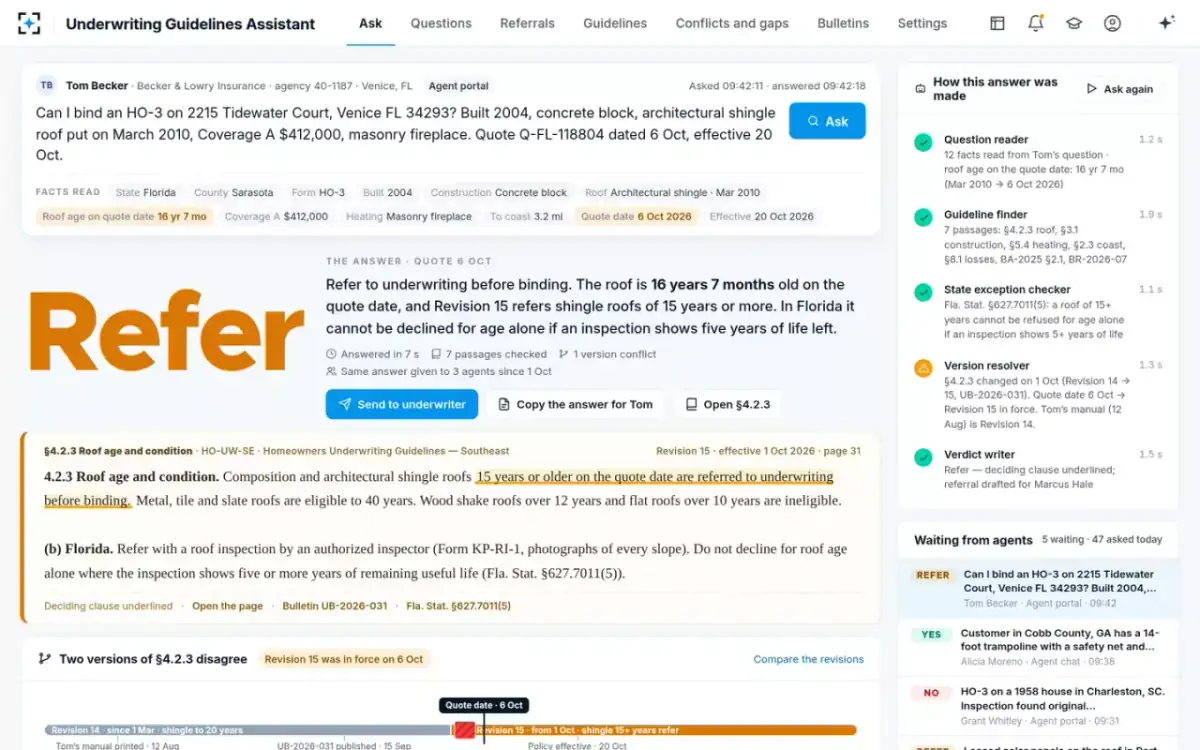
On the sample carrier, eight answers decide most of the outcome, and on the worked application one of them triggered a referral. The agent's question about a 2004 concrete block house with an architectural shingle roof from March 2010 was read into the details the manual turns on; seven of the eight passed, and the roof, 16 years 7 months old on the quote date, was referred.
An annotated homeowners application: the answers, and what would have made each a referral
Roof covering, and date last fully replaced
Answer on this quoteArchitectural shingle, March 2010
What triggers a referralShingle roofs 15 years or older on the quote date are referred; in Florida, with an inspection
Refer
Year built and construction
Answer on this quote2004, concrete block
What triggers a referralOlder homes trigger wiring and plumbing questions
Pass
Heating
Answer on this quoteMasonry fireplace
What triggers a referralA wood stove or insert needs proof of how it was installed
Pass
Distance to the coast
Answer on this quote3.2 miles
What triggers a referralInside the coastal band, referred
Pass
Coverage A (rebuilding cost)
Answer on this quote$412,000
What triggers a referralAbove the agent's $750,000 binding authority, referred
Pass
Losses in the last five years
Answer on this quoteNone
What triggers a referralTwo water losses in three years, referred
Pass
Occupancy and rental use
Answer on this quoteOwner-occupied
What triggers a referralShort-term rental, referred; nightly rentals not addressed by the manual
Pass
Pool, trampoline, dog, home business
Answer on this quoteNone
What triggers a referralTrampoline with a net inside a locked enclosure eligible; dog breed list applies
Pass
The pattern is worth noticing: the passing answers were all specific. Not "about four miles" but 3.2; not "a few hundred thousand" but $412,000; not "the roof is fairly new" but March 2010. The referral, too, was a precise one, because the roof date was precise: the manual's rule turns on the roof's age on the quote date, and in Florida the inspection that follows is set by statute. A vague answer would have produced a vaguer referral, and a phone call to find out.
Roof year: the date of the last full replacement, with the paper
Answer the roof question with the date the whole roof was last replaced and the covering, and attach the permit or invoice. Florida's statute counts a roof's age from the last date all of its surface was built or replaced to the building code then in force, or, where a roof was replaced in parts, from the start of the partial replacement that eventually covered all of it (Fla. Stat. §627.7011(5)). A repair to one slope does not make the roof newer.
Getting the month right matters more than it seems. The sample roof was 16 years 6 months old on a 29 September quote and 16 years 7 months on 6 October; under the carrier's old rule, both passed, and under its new one, effective 1 October, both would be referred. In Florida a roof of 15 years or more cannot simply be refused on age if an authorized inspector finds five or more years of useful life left, so the next document after the permit is often the inspection report. Ineligible risks in Florida sets out the inspector rules.
Prior claims: what counts as a loss, and what does not
Answer the loss question with paid claims, by date and cause, because that is what the carrier's loss history report will show. A Florida insurer that refuses homeowners cover because of a loss underwriting history or a consumer report must identify it, where applicable, and tell the applicant of the federal right to a copy of the report (Fla. Stat. §627.4091(5)). An applicant who disagrees with the report can ask for a copy and check it.
Not every contact with an insurer is a loss, and some states say so in law. Texas forbids a home or auto insurer to "use an underwriting guideline based solely on whether a consumer inquiry has been made by or on behalf of the applicant or insured" (Tex. Ins. Code §544.553). Texas also limits the use of past water and mold claims: a properly remediated appliance-related water claim, inspected and certified, cannot be used to refuse or price cover unless there have been three or more such claims in three years, and remediated mold damage with a certificate or an independent inspection cannot be the basis of an underwriting decision. On the sample carrier, two water losses in three years sent an Alabama application to the underwriter.
Occupancy, rentals and vacancy: answer for how the home is really used
Answer the occupancy question for how the home is used through the year, not on the day of the application. Owner-occupied, seasonal, rented long-term, rented by the night and vacant are different risks, and carriers write them on different forms or not at all. On the sample carrier a short-term rental of 60 nights a year was referred to the underwriter; nightly rentals were one of four gaps the manual did not address, asked about 11 times in a month.
The rental question is where applications change most after binding. A homeowner who starts letting the house on a booking site after the policy is issued has changed the risk, and Florida's cancellation rule after the first 60 days allows cancellation for a substantial change in the risk covered (Fla. Stat. §627.4133(2)(b)). The safer course is to tell the agent before the first booking.
Pools, trampolines, dogs and wood stoves: the liability and heating questions
Answer liability questions with the safety features, because a control can change the answer. On the sample desk a trampoline with a safety net inside a locked enclosure, on a Georgia home with $300,000 of liability cover, was a Yes in four seconds under the carrier's liability section. Dogs are answered by breed, because breed lists differ: the sample carrier's portal listed eleven restricted breeds against nine in its own manual, one of seven conflicts its overnight check found.
Heating questions turn on installation. A masonry fireplace was eligible as it stood; an owner-installed wood stove insert on a Georgia home went to the underwriter, and the referral waited on the agent. The document that settles it is an installer's certificate or a building official's approval; on the sample carrier, one state exception page accepted the second where the manual asked for the first, another conflict for the guideline owner.
The agent's question read into the details the guidelines turn on
Wiring and plumbing in an older home
Answer wiring and plumbing questions for what is in the walls now, with the electrician's or plumber's paperwork for anything replaced. Older homes are asked about knob-and-tube wiring and polybutylene supply lines in particular. The sample carrier's manual makes knob-and-tube wiring ineligible unless fully replaced and certified by a licensed electrician, and polybutylene supply lines ineligible unless fully replaced with documentation; a 1958 Charleston home with knob-and-tube wiring in the attic was a No.
Age alone is a different matter. The NAIC's model Unfair Trade Practices Act lists as unfair discrimination refusing, cancelling or limiting cover on a residential risk "solely because of the age of the residential property" (NAIC Model Act 880), language states may or may not have adopted. A carrier that asks about the year built is entitled to ask what the age implies, wiring, plumbing, roof, and to answer on that. "Built 1958" is a question; "knob-and-tube in the attic" is the answer that decides it.
What happens if you answer a homeowners application wrong?
It depends on whether the wrong answer mattered. In Florida, a misrepresentation, omission or incorrect statement on an application can defeat recovery under the policy only if it was fraudulent or material to the acceptance of the risk, or if the insurer, knowing the true facts, in good faith would not have issued the policy, would not have issued it at the same premium or in as large an amount, or would not have covered the hazard that caused the loss (Fla. Stat. §627.409(1)). An honest mistake about something that would not have changed the decision does not void the cover.
Timing matters too. Once a Florida residential policy has been in force for 60 days, the insurer may cancel only for listed reasons, among them a material misstatement, nonpayment, a failure to meet within 60 days underwriting requirements it set before cover began, or a substantial change in the risk (Fla. Stat. §627.4133(2)(b)). Examiners test the carrier's side of the same rule: the NAIC's underwriting standards include that rescissions are not made for misrepresentations that were not material (NAIC examination standards). For the applicant the practical lesson is simple: an answer given with the document is never the answer that causes this problem.
The same application, answered from memory and answered from the documents
From memory: "About fifteen years, I think."
With the document in hand: Architectural shingle, fully replaced March 2010: permit attached.
From memory: The market value, or the mortgage balance.
With the document in hand: A replacement-cost estimate: $412,000.
From memory: "One small claim, years ago."
With the document in hand: The dates and causes on the loss history report.
From memory: "A fireplace."
With the document in hand: Masonry fireplace; or wood stove insert with the installer's certificate.
From memory: "We live there."
With the document in hand: Owner-occupied all year; no short-term rentals.
From memory: A referral and a call back for details.
With the document in hand: A verdict on the first pass, or a referral that names exactly what is needed.
How to get a yes the first time
A first-time yes comes from answering each question with the precise value and the document behind it, and from knowing which sections each answer touches. On the sample desk a month of 1,286 questions came back mostly Yes; the referrals and declines clustered on the answers above.
What a month of eligibility questions came back as, on the sample desk
Documents to have in hand before answering a homeowners application
- Roof permit or invoice for the last full replacement
With the covering and the month. In Florida, a roof inspection report if the roof is 15 years or older.
- Replacement-cost estimate
For Coverage A, not the market value or the loan balance.
- Loss history
Paid claims by date and cause; ask for the report if a carrier refers or refuses on it.
- Any recent inspection report on the home
If one exists, have it ready; a carrier may ask for it.
- Electrician's and plumber's paperwork
For any wiring panel, knob-and-tube or polybutylene replacement.
- Heating installation certificate
For a wood stove or insert: installer's certificate or building official's approval.
- Rental and occupancy details
Nights rented per year, how bookings are made, and any vacancy.
- Photos of the pool fence, trampoline net, and the dog
On the sample desk, a netted trampoline inside a locked enclosure was a Yes.
For the carrier, the same lesson runs the other way: an application read against the guidelines as it arrives, with the missing detail asked for before an answer is given, removes most of the call-backs. The Underwriting Guidelines Assistant's question reader never guesses a missing detail; it asks. The agent questions that sit behind an application are covered in agent underwriting questions to ask, and how often two people would answer the same application differently in one question, two answers. The Underwriting Guidelines Assistant page follows the sample roof question from the portal to the underwriter.
Questions people ask
Is there a homeowners insurance application questions PDF?
Each carrier writes its own application, so there is no single form to download. The questions cluster in the same eight groups everywhere: roof, construction, heating, location, rebuilding cost, losses, occupancy and liability features.
What is on a homeowners insurance application form?
The applicant's details, the property's address, year built, construction, roof, heating, wiring and plumbing, protective devices, distance to the coast, the coverage limits requested, losses in recent years, prior insurance, occupancy and liability exposures. Each answer maps to a section of the carrier's underwriting guidelines.
What questions should I ask about homeowners insurance before applying?
Ask how the carrier counts roof age and what inspection it accepts, whether it writes your heating, rental use or liability features, what documents it will want, and, if it refers or refuses, what the specific reason is. In Florida a refusal must state the specific underwriting reasons.
What are basic homeowners insurance questions an agent will ask?
When the roof was last fully replaced, what it is made of, how the house is built and heated, how far it is from the coast, what it would cost to rebuild, whether there have been claims, who lives there and whether it is rented, and whether there is a pool, trampoline, dog or home business.
Does a misrepresentation on a Florida homeowners application void the policy?
Only if it was fraudulent or material, or if the insurer in good faith would not have issued the policy, or not at the same premium or amount, had it known the truth. An immaterial mistake does not defeat recovery under Fla. Stat. §627.409.