Insurance knowledge base software for underwriting is a tool that holds a carrier's eligibility rules and answers questions from them; whether it works is decided less by its search than by whether agents and underwriters trust it enough to stop using everything else. Agents keep their printed manuals and quick-reference cards until the new tool has been right, cited and faster for several weeks running, and they abandon it after one confident wrong answer. So the rollout plan is a trust ladder: run it in shadow beside the desk, let the desk answer with it, open it to agents while the desk samples its answers, and only then withdraw the printed copies. Each rung has a measure that earns the next one. Botminds' Underwriting Guidelines Assistant is built for that ladder: every answer quotes the passage with its section and revision, the answer rules are settings with a version history, and the desk can compare its answers with the assistant's before agents ever see one.
The trust ladder: four rungs, the measure that earns each, and what knocks it back
1Shadow
The desk answers as it always has; the assistant answers the same questions silently.
Moves up whenAgreement with the guideline owner's settled answers at least matches two underwriters' agreement with each other; no answer without a passage.
Knocked back byAny confident answer the passage does not support.
2The desk answers with it
Agent support specialists send the cited answer, edited or not.
Moves up whenShare of answers sent unchanged rises; every edit is logged with its cause.
Knocked back byEdits that change the verdict, not the wording.
3Agents ask it, the desk samples
Agents ask through the portal; the desk reviews a sample of Yes answers each week.
Moves up whenSampled answers hold up; fewer agents re-ask the desk the same question by phone.
Knocked back byA wrong Yes found in the sample, or a rise in repeat calls.
4Retire the printed copies
The carrier withdraws quick-reference cards and old manuals.
Moves up whenNo place agents read a rule still shows a superseded revision.
Knocked back byA stale copy found in circulation after a change.
The examples come from a fictional Southeast homeowners carrier, its agents and its personal lines desk as they run through the solution; every person, agency, address and quote is sample data. Where a figure is a plan rather than a measurement, it says so.
What should insurance knowledge base software do for underwriting?
For underwriting, a knowledge base has to do four things a general help-centre tool does not. It has to hold every revision of a rule with its effective date, so it can answer as of a quote date. It has to carry state law and state exception pages above the manual, so the answer for Florida is not the answer for Georgia. It has to say Refer when the rules do not settle the question, rather than offering the nearest article. And it has to keep every answer with the passage it rested on, so the desk, the guideline owner and an examiner can see how it was reached.
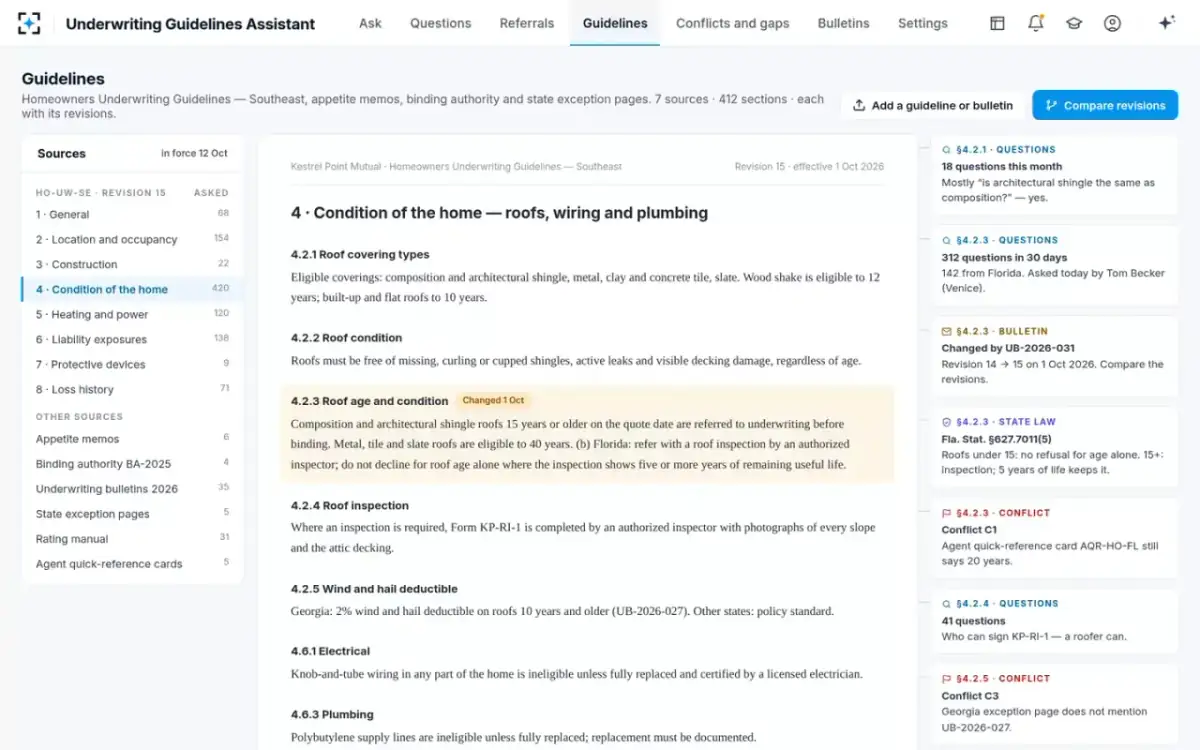
The fourth is the one that builds trust, because it lets people check. An agent who can open the page the answer came from does not have to take the answer on faith. An underwriter who can see that the assistant used Revision 15 of the roof section, effective 1 October, page 31, can disagree with the clause instead of with the machine. A tool that only returns an answer asks for trust; one that returns the passage lets people give it.
Why do agents keep their printed manuals?
Agents keep printed manuals because the manual has never been confidently wrong in a way they could not see. It may be out of date, but its date is printed on it, and an experienced agent knows roughly how old it is. A new tool has no track record, answers in the same voice whether it is right or not, and is one bad answer away from being ignored.
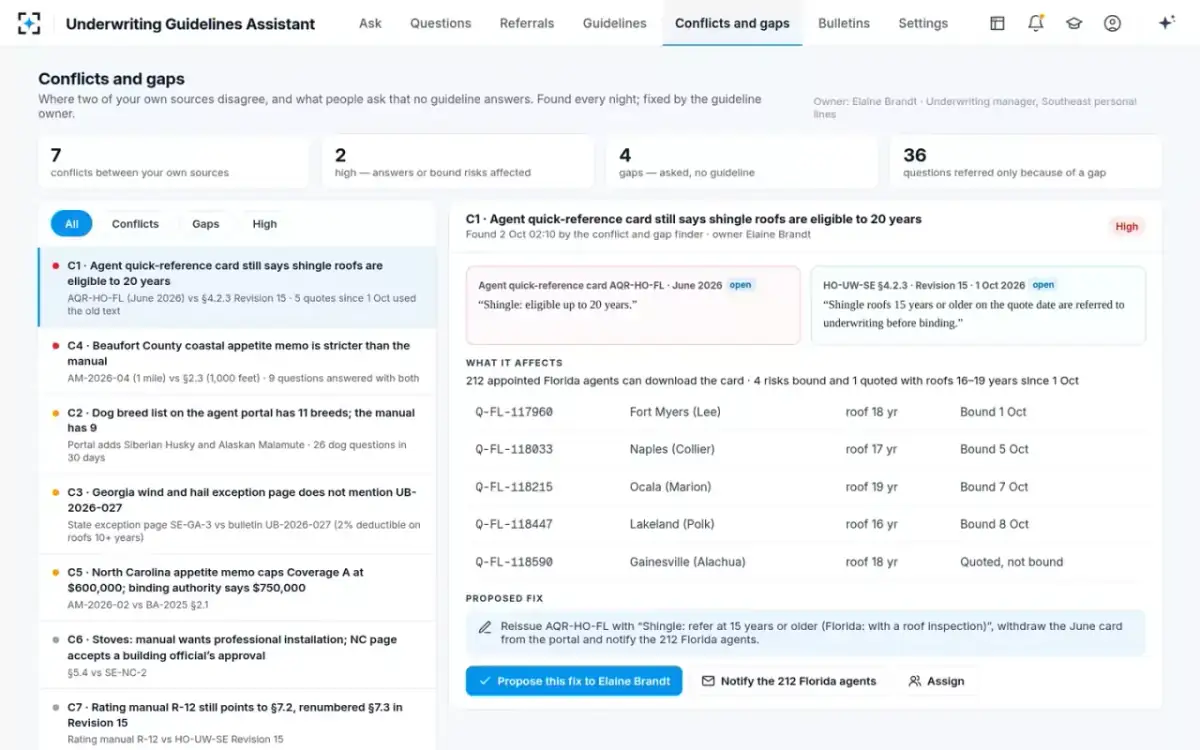
The printed copy's weakness is invisible to the agent, though. On the sample carrier, the roof section changed on 1 October; the portal and every answer from the assistant showed the new text that day, but the agents' printed manuals and the June quick-reference card still said shingle roofs were eligible to 20 years, and 212 appointed Florida agents could download that card. Five Florida quotes in the next eight days used the old text, and four were bound. The agents who quoted them were not careless. They trusted the copy they had, and the copy was wrong.
The manual as the assistant reads it, with its revisions and what people asked
The trust ladder: shadow, the desk, agents, then retire the copies
Climb one rung at a time, and let a measure, not a calendar, decide when to move. The first rung costs nothing in risk: the assistant answers the same questions the desk is answering and nobody acts on its answers. The guideline owner compares them with what the desk said and settles every disagreement against the text in force. The rung is passed when the assistant agrees with the settled answers at least as often as two of the carrier's own underwriters agree with each other, and when it has given no answer it could not support with a passage.
The second rung puts the assistant in the desk's hands. Agent support specialists read the verdict, the clause and the state rule on one screen and send the answer to the agent, editing it where they disagree. Every edit is logged with its cause. Edits to wording are fine; edits that change the verdict are the measure, and they should be rare and falling before the third rung.
The third rung opens the portal to agents, with the desk sampling a share of Yes answers each week. Yes is the answer to sample because a wrong Yes binds a risk; a wrong Refer costs only time. The quiet measure on this rung is repeat contact: an agent who gets an answer from the portal and then rings the desk to ask the same question is telling the carrier he does not trust it yet. The fourth rung is the only one that ends something: the carrier withdraws its quick-reference cards and old manuals, and the measure is that no place agents read a rule still shows a superseded revision.
Who has to trust it, and what each one checks first
Five groups of people have to trust a guidelines tool before it changes how the desk works, and each one checks something different first. Win the wrong group and the rollout stalls: agents will not use a tool their underwriters dismiss, and underwriters will not accept referrals from a tool their manager has not signed off.
Who has to trust the knowledge base, and what each one tests it on
Today
Trusts the printed manual and the voice on the desk phone.
With agents
Trusts the portal once its answers have matched the desk's for a few weeks and come with the page.
Still theirs: Checks first: does the answer name the page, and does it hold when the desk is asked?
Today
Is the human knowledge base, hunting pages while agents hold.
With agents
Sends cited answers and edits the ones that need it.
Still theirs: Checks first: how often would I have changed the verdict?
Today
Rebuilds every referral from a phone message.
With agents
Receives referrals with the details, the clause and the state rule attached.
Still theirs: Checks first: are the referrals it sends real ones, and does it refer when it should?
Today
Hears about a stale card after risks have been bound on it.
With agents
Sees conflicts between sources each morning, with a proposed fix to approve.
Still theirs: Checks first: does it ever change a guideline without me? It must not.
Today
Reconstructs how an answer was given from emails, if at all.
With agents
Reads the question, the passages, the revision and who acted.
Still theirs: Checks first: are prohibited factors removed, and is every answer kept?
Too much trust is also a failure
A rollout can fail in the other direction: people stop reading the passage and copy the verdict. NIST names both risks in its generative AI profile. Experts "may be unnecessarily “averse” to GAI systems, and thus deprive themselves or others of GAI’s beneficial uses," and, as reliability grows, people "may over-rely on GAI systems", which NIST treats as automation bias: deferring to the machine too readily (NIST AI 600-1, §2.7).
The ladder handles both. Aversion is answered with evidence, the shadow comparison and the sampled answers. Over-reliance is answered by keeping the sampling on after go-live, at a lower rate, and by watching one number in particular: answers the desk sends unchanged on a topic where the rules just changed. If that figure stays at 100% through a bulletin, people have stopped reading. The design helps too. On the sample carrier, when a revision changed within 90 days of the quote date, the answer shows both versions side by side, which makes a changed rule hard to miss.
What is a knowledge base, and why search is not enough for eligibility?
A knowledge base is a structured collection of information that people, or software, can query for answers: help articles, policies, procedures, a manual. For eligibility it is not enough to find the right article, because the right article can be the wrong version, can be overridden by state law, or can conflict with a memo. The difference shows best side by side.
A searchable knowledge base and a cited guidelines assistant, on eligibility questions
Searchable knowledge base: A list of articles or pages that match the words in the question.
Cited guidelines assistant: A verdict (Yes, No, Refer) with the deciding passage quoted and underlined.
Searchable knowledge base: The current page, usually; older versions archived or overwritten.
Cited guidelines assistant: The revision in force on the quote date, with both shown if the rule changed recently.
Searchable knowledge base: Found only if the agent searches for it.
Cited guidelines assistant: Applied over the manual for the risk state, and named in the answer.
Searchable knowledge base: Two pages that disagree both appear; the reader picks one.
Cited guidelines assistant: The question is referred and the conflict goes on the guideline owner's list.
Searchable knowledge base: Search terms and page views.
Cited guidelines assistant: The question, the details, the passages, the revision, the verdict and who acted.
Searchable knowledge base: Forms, service procedures, product descriptions: questions with one current answer.
Cited guidelines assistant: Eligibility and referral questions, where the answer depends on date, state and source.
A twelve-week rollout for insurance knowledge base software
A rollout that respects the ladder takes about a quarter for one state and line, and most of it is evidence-gathering, not configuration. The plan below is illustrative, for a carrier starting with homeowners in one state; the rungs move when their measures hold, so the weeks can stretch.
An illustrative twelve weeks from loading the guidelines to retiring the cards
- Load the guidelines2 wk
- Shadow the desk3 wk
- Desk answers with it3 wk
- Agents ask, desk samples3 wk
- Cards out1 wk
The one scheduling rule worth keeping is to let a real bulletin land during the shadow or desk weeks. A tool that has only ever answered from a stable manual has not been tested on the failure that matters most. On the sample carrier, the October roof change would have been that test: 87 of the 598 roof answers given under the old revision had shingle roofs of 15 to 20 years and would each have become a Refer.
Where the carrier's own sources disagree, found overnight
Training new underwriters on the same answers
A guidelines tool trusted by the desk becomes, quietly, the training manual for the next underwriter, and that raises the standard it has to meet. Examiners look at training too: one of the NAIC's general examination standards reads "Regulated entity internal producer training materials are in compliance with applicable statutes, rules and regulations" (NAIC examination standards, chapter 20). A trainee who learns the roof rule from an answer that cites the statute and the revision learns it the way an examiner would read it.
On the sample desk the trainee is in a second month on the job and does not yet know which version of a guideline to trust. The manual page shows its revisions, the bulletin that changed each section and what other people asked about it in the margin. That is a better apprenticeship than a binder, and it ties the trainee's habits to the same text the agents see.
Questions to ask a vendor about adoption, not just features
Most knowledge base demonstrations show search. Ask instead how the tool earns trust and how it shows when it should not be trusted. The answers separate a tool that can climb the ladder from one that will be abandoned after its first wrong Yes. How the same log turns into a business case is covered in the KPIs that pay, and how to test answers before agents see them in underwriting chatbot AI.
Adoption questions for insurance knowledge base software
- Can it run in shadow beside the desk?
Answering the same questions with nobody acting on its answers, and reporting agreement with the guideline owner's settled answers.
- Does every answer show the passage, its revision and its page?
People trust what they can check. An answer without a page asks for faith.
- Can the desk edit an answer before it goes out, and is the edit logged with a cause?
Edits are the second rung's measure; without a cause they teach nothing.
- Can you sample its answers by verdict and topic?
Sampling Yes answers on recently changed rules catches the costly errors first.
- Does it show both versions when a rule has just changed?
It protects against over-reliance exactly when it matters.
- Does it find the places that still show an old rule?
Cards, portal pages and printed manuals: retiring them is the last rung.
- Who can change a guideline or an answer rule?
Only named people, with every change saved as a new version.
The Underwriting Guidelines Assistant fits the carrier that already has the guidelines, revisions and bulletins and needs agents and the desk to answer from them consistently. It is not a general service knowledge base for billing or claims questions, and it does not replace the manual: it reads it, revision by revision.
Questions people ask
What is an insurance knowledge base template?
For eligibility rules, a useful template has one entry per rule with the section text, revision and effective date, the states it applies to, any statute or state page that overrides it, the bulletin that last changed it, and the questions asked about it. Without dates and state overrides it cannot answer as of a quote date.
What are examples of insurance knowledge bases?
Underwriting manuals, agent portal guideline pages, quick-reference cards, appetite guides, claims and service procedure libraries and internal FAQs. For underwriting, the test is whether an answer from it can be traced to a dated passage.
What is a knowledge base?
A structured collection of information that people or software query for answers, such as articles, policies and procedures. An underwriting knowledge base adds what eligibility needs: revision dates, state overrides and a log of what was answered from it.
Why do agents call a dedicated helpline instead of using the portal?
Usually because the portal's answers have not earned their trust: no page cited, no sign of which version applied, or one wrong answer they remember. Repeat calls after a portal answer are the clearest measure of that, and they should fall as the portal climbs the trust ladder.
How long does it take for agents to trust a new underwriting tool?
There is no standard figure; trust follows evidence rather than time. A plan that shadows the desk, then lets the desk answer with the tool, then opens it to agents with sampling, usually needs at least one real rule change along the way to prove the version check.