Homeowners underwriting guidelines from 2024 apply to a quote only if that revision was in force on the date the carrier's rules key on. For new business that is usually the quote date; for renewals, the renewal effective date; a temporary binding suspension follows the day the agent binds. The newest revision is not automatically the right one, and the 2024 PDF on someone's desktop is not automatically wrong: an answer that does not say which date it used is how risks get bound on a rule that had already changed, or refused under one that had not yet started. Law works the same way, and several homeowners rules changed between 2022 and 2027 with transition dates of their own. Botminds' Underwriting Guidelines Assistant finds every revision of each passage, picks the one in force on the date set in its settings, and shows both versions when the rule changed recently.
Homeowners rules that changed on a date, and the date each keys on
1 Jul 2022
Florida roof-age limits apply to homeowners policies issued or renewed on or after this date
8 Jan 2024
latest amendment to Texas's underwriting guideline filing rule took effect
1 Sep 2025
Texas bar on treating widowed insureds differently took effect, for policies issued or renewed from then
$400,000
Citizens dwelling value from which flood cover is required, for policies effective on or after 1 Jan 2026
Which homeowners underwriting guidelines apply: 2024, 2025 or 2026?
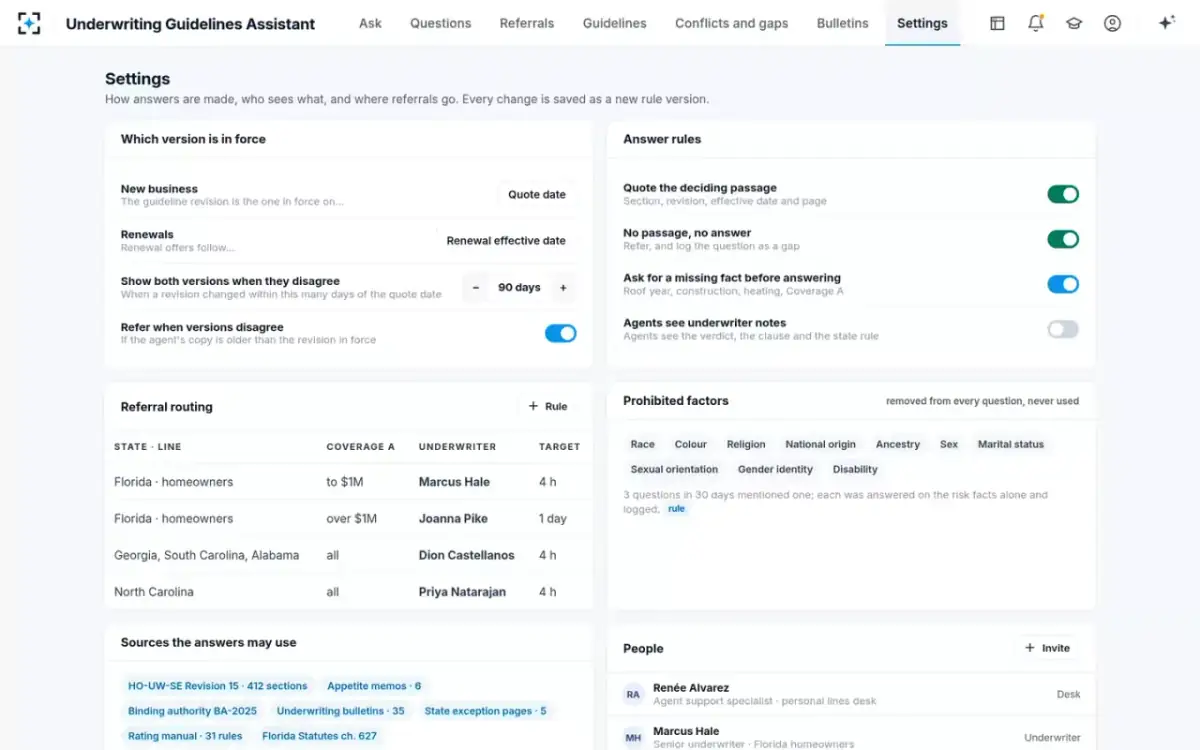
The revision in force on the controlling date applies, whatever year is printed on the cover. A carrier's homeowners manual is revised by number and effective date: Revision 14 from 1 March, Revision 15 from 1 October, and so on, with bulletins amending sections in between. A quote made on 29 September is answered from Revision 14 even if someone asks about it in November, and a quote made on 6 October is answered from Revision 15 even if the agent's printed copy says otherwise.
Searches for "homeowners underwriting guidelines 2024" or "2023" are really asking for the version that applied to a particular quote or policy, often after the fact: a decline being challenged, a renewal being re-underwritten, an examiner's file review. The answer to all of them is the same procedure: fix the controlling date, then find the revision in force on it, then check whether a statute in force on that date changes the result.
Quote date, effective date or bind date: which one decides?
Each carrier chooses, and the choice should be written down; the common pattern is the quote date for new business, the renewal effective date for renewals, and the bind date for binding suspensions. The quote date protects the agent and the customer: a quote given under one rule is not overturned because the manual changed the next morning. The renewal effective date keeps a renewal on the rules for the term it starts. A binding suspension is different in kind, because it exists to stop new commitments in an area for a few days, so it follows the day the agent tries to bind.
Legislatures use the same logic. When Texas barred insurers in 2025 from treating widowed insureds differently, the act said its change "does not apply to an insurance policy that is delivered, issued for delivery, or renewed before the effective date of this Act," and that such a policy "is governed by the law as it existed immediately before the effective date" (Texas S.B. 1238, section 2). A carrier's revision rule is the same sentence, applied to its own manual.
The settings that decide which revision is in force
One roof, three answers in eight days
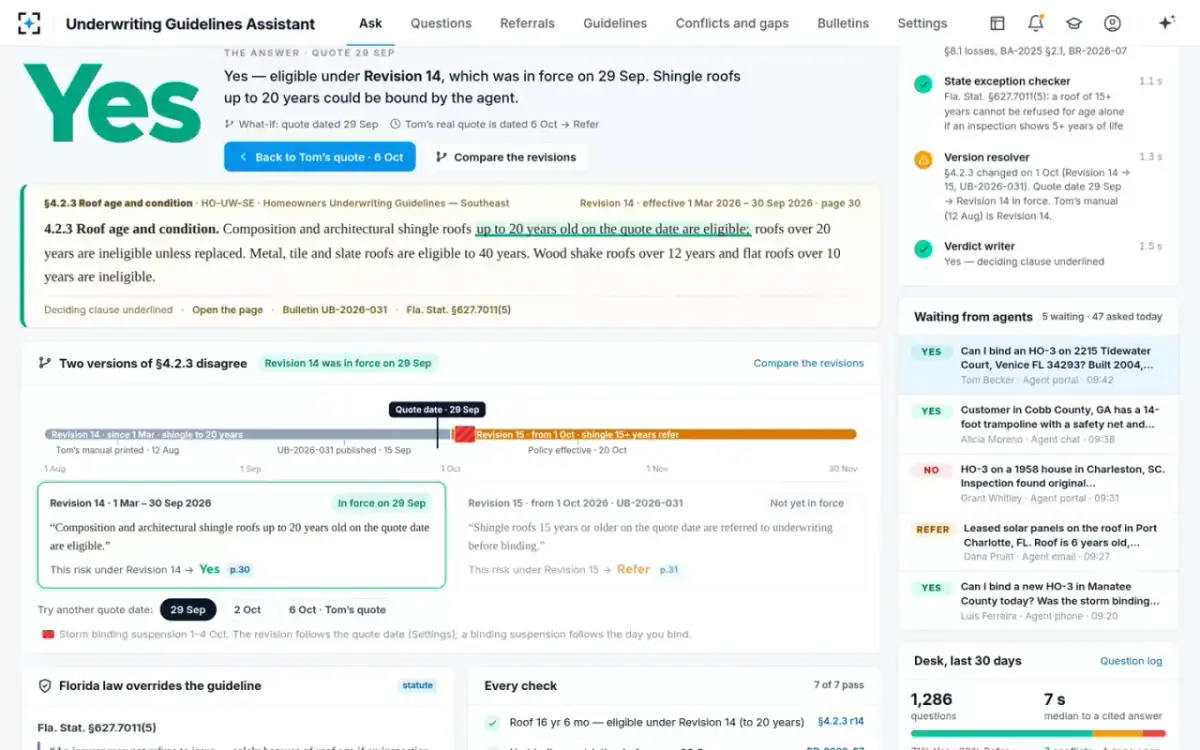
The sample carrier's roof rule shows why the date has to be on every answer. Its section 4.2.3 allowed shingle roofs up to 20 years under Revision 14. Bulletin UB-2026-031, published on 15 September, replaced it from 1 October with Revision 15: shingle roofs 15 years or older on the quote date are referred to underwriting before binding. In between, a tropical storm led the carrier to suspend binding in Sarasota County from 1 to 4 October.
One 16-year roof in Venice, Florida, against the rule's revisions and the binding suspension
Section 4.2.3 in force
- Revision 14: shingle to 20 years
- Revision 15: shingle 15+ referred
Binding in Sarasota County
- Suspended 1–4 Oct
Dates on this quote
- 112 Aug Agent's printed manual (Revision 14)
- 215 Sep Bulletin UB-2026-031 published
- 329 Sep Quote date: Yes under Revision 14
- 42 Oct Quote and bind: No, binding suspended
- 56 Oct Quote date: Refer under Revision 15
- 620 Oct Policy effective date
Asked with a quote date of 29 September, the answer was Yes under Revision 14, and all seven checks passed. Asked on 2 October it was No, for a reason that had nothing to do with the roof: binding was suspended. Asked with the agent's real quote date of 6 October, it was Refer under Revision 15, with Florida's roof statute attached. All three answers were right. A desk that answers without a date gets at most one of them right, and cannot say which.
Section 4.2.3 before and after 1 October, on the same roof
Revision 14 (1 March to 30 September): "Composition and architectural shingle roofs up to 20 years old on the quote date are eligible."
Revision 15 (from 1 October): "Shingle roofs 15 years or older on the quote date are referred to underwriting before binding."
Revision 14 (1 March to 30 September): Roofs over 20 years ineligible unless replaced.
Revision 15 (from 1 October): Referred, with a roof inspection in Florida.
Revision 14 (1 March to 30 September): Eligible to 40 years.
Revision 15 (from 1 October): Unchanged.
Revision 14 (1 March to 30 September): Yes, page 30.
Revision 15 (from 1 October): Refer, page 31.
Revision 14 (1 March to 30 September): Not applicable.
Revision 15 (from 1 October): The carrier's bulletin: shingle roofs of 15 to 20 years had run at 2.3 times the expected wind and hail frequency since 2024.
Homeowners underwriting guidelines in Florida: the dates that matter
Florida's homeowners rules carry their own dates, and an answer has to respect them as well as the carrier's. The roof-age limits came from the 2022 special session: CS/SB 2-D passed the Senate 30–9 and the House 95–14 (Florida Senate bill summary), and the statute applies the roof subsection to homeowners policies issued or renewed from 1 July 2022 (Fla. Stat. §627.7011(5)(e); the rule is read branch by branch in the Florida roof age rule). A Florida refusal to renew for roof age in 2021 was judged by the old law; one in 2023 by the new.
Citizens Property Insurance Corporation, Florida's insurer of last resort, runs on a statutory calendar. Its flood insurance requirement phases in by dwelling replacement cost and policy effective date: $600,000 or more from 1 January 2024, $500,000 or more from 1 January 2025, $400,000 or more from 1 January 2026, and every other personal lines residential risk from 1 January 2027, with homes in FEMA's special flood hazard areas brought in earlier, in 2023 (Fla. Stat. §627.351(6)(aa)). An answer about a Citizens risk in 2025 and the same risk in 2026 can differ for no reason except the date.
Homeowners rules that changed from 2022 to 2027, and the date each one keys on
| Rule | What changed | Keys on |
|---|---|---|
| Fla. Stat. §627.7011(5) | No refusal to issue or renew solely for the age of a roof under 15 years; an inspection allowed before requiring replacement of an older roof | Policies issued or renewed on or after 1 July 2022 |
| Fla. Stat. §627.351(6)(aa) | Citizens requires flood cover, phased in by dwelling replacement cost ($600,000, $500,000, $400,000, then all) | Policy effective dates from 1 January 2024 to 1 January 2027 |
| Fla. Stat. §627.351(6)(c)5.a | A Citizens primary-residence renewal with a private offer is ineligible unless that offer is more than 20% above the Citizens premium | Policies renewing on or after 1 April 2023 |
| CDI Bulletin 2023-7 | California insurers must file new or changed underwriting guidelines publicly before implementing them | Implementation, from 21 December 2023 |
| 28 Tex. Admin. Code §5.9342 | Home and auto guideline filings, with a redline and a description of third-party data and models; last amended effective 8 January 2024 | Filing not later than 10 days after use |
| Tex. Ins. Code §544.002(d) | No refusal, limit or different rate because the insured is widowed, notwithstanding the underwriting exception | Policies delivered, issued or renewed on or after 1 September 2025 |
Underwriting guidelines for homeowners insurance in 2024: the rules about the rules changed too
The biggest 2024 change in many carriers' homeowners guidelines was not to any eligibility rule but to how guidelines must be handled. In California, the Commissioner's bulletin of 21 December 2023 told insurers that they "shall publicly submit the required information in an appropriate filing prior to implementation" of changes to underwriting guidelines and other rating information, and warned that failing to file a guideline before using it could bring enforcement, restitution and penalties (CDI Bulletin 2023-7). The practical effect is that a California guideline's effective date can no longer run ahead of its filing.
In Texas, the guideline filing rule was last amended with effect from 8 January 2024. The rule requires a filing within 10 days of use, a redline of each change, and a description of every third-party data set and model the guidelines rely on (28 Tex. Admin. Code §5.9342). A redline is a dated account of exactly the kind this page argues for: what the rule said, what it says now, and from when. Are underwriting guidelines public record? covers who can read those filings.
Homeowners underwriting guidelines 2023 and earlier: when an old revision still governs
An old revision governs whenever the question is about a decision made while it was in force: a decline being appealed, a complaint, a market conduct file review, a renewal compared with the original application. Answering those questions from the current manual is the mirror image of the stale-card error, and just as wrong. Carriers need to keep every superseded revision, with its dates, for as long as they keep the decisions made under it.
Examiners have a related standard about timing. Among the NAIC's property and casualty underwriting standards is that underwriting, rating and classification rest on information gathered at or near inception, not near expiry or after a claim (NAIC examination standards, chapter 21). The information has a date as well as the rule. An answer that pairs the details as they stood on the controlling date with the revision in force on that date is the one an examiner can follow.
How stale copies keep an old revision alive
Stale copies are the most common way an old revision outlives its date. On the sample carrier, when the roof rule changed, the portal and every assistant answer showed Revision 15 from midnight on 1 October. The June quick-reference card still showed Revision 14, and so did the agents' printed manuals, which could not be recalled. Five Florida quotes dated on or after 1 October used the old text; four were bound, in Fort Myers, Naples, Ocala and Lakeland, and went to the senior underwriter for a post-bind roof review.
The assistant's defence is to answer only from dated passages and to compare copies against them. Quick-reference cards are compared, never quoted; when a revision changed within 90 days of the quote date, the answer shows both versions and says which applied, so an agent holding the old card sees why it is wrong. The overnight conflict check put the June card on the underwriting manager's list on 2 October, with a proposed fix to reissue it and notify the 212 Florida agents who could download it. How the same check works for chatbots generally is in underwriting chatbot AI.
Move the quote date and the answer changes with the revision
A checklist for dating every eligibility answer
Every eligibility answer should carry its dates in the same way a filing carries its effective date. The checklist below is what the desk, the guideline owner and an agent can each ask of any answer, whether it came from a person or a tool. Ineligible risks in Florida applies it to the cases where the statute answers first.
Dating a homeowners eligibility answer
- Name the controlling date
Quote date for new business, renewal effective date for renewals, bind date for a binding suspension, unless the carrier's written rule says otherwise.
- Name the revision in force on that date
Section, revision number, effective date and page, not "the current manual".
- Check for a bulletin published but not yet effective
A rule announced on 15 September and effective 1 October does not govern a 29 September quote.
- Check the law in force on the same date
Statutes carry their own transition clauses: issued or renewed on or after a date.
- Show both versions when the rule changed recently
The sample carrier uses 90 days; an agent holding an old copy needs to see the difference.
- Keep superseded revisions with their dates
For as long as decisions made under them can be challenged or examined.
- List the copies still in circulation
Cards, portal pages and printed manuals that show a superseded revision, and who can withdraw them.
Questions people ask
Where can I find homeowners underwriting guidelines from 2023?
A carrier keeps its superseded revisions; ask for the one in force on the quote or renewal date in question. In Texas, filed home guidelines and their redlines can be requested from the Department of Insurance, and in California underwriting rules filed with rate applications are open to inspection.
What are the homeowners underwriting guidelines in Florida?
Each carrier sets its own, within Florida law. The statute limits them: no refusal to issue or renew solely for the age of a roof under 15 years for policies issued or renewed since 1 July 2022, and an inspection must be allowed before an older roof has to be replaced.
What changed in Florida homeowners underwriting in 2024?
For Citizens, the flood insurance requirement reached homes with a dwelling replacement cost of $600,000 or more for policies effective on or after 1 January 2024, stepping down to $500,000 in 2025 and $400,000 in 2026. Private carriers' guideline changes are their own, made by revision and bulletin.
Do new eligibility guidelines apply to my existing policy?
Generally not mid-term: under the sample carrier's settings, a renewal is answered from the revision in force on the renewal effective date. Changes in law carry their own transition clauses, such as Texas's 2025 widowhood rule, which applies only to policies delivered, issued or renewed from 1 September 2025.
Which date decides which underwriting guidelines apply to a quote?
The carrier's written rule decides; the common choice is the quote date for new business. The sample carrier lets the guideline owner choose among the quote date, the policy effective date and the bind date, and saves every change to that setting as a new version.