Ineligible risks for homeowners insurance in Florida are, in the first place, whatever a carrier's own underwriting guidelines say: roofs past a certain age, certain wiring and plumbing, risky liability exposures, homes too close to the coast for its appetite. But Florida law answers some eligibility questions before any guideline does, and where it speaks the guideline loses. A homeowners insurer may not refuse to issue or renew a policy solely because a roof is under 15 years old; for an older roof it has to let the homeowner have an authorized inspector assess it first. Citizens Property Insurance Corporation's eligibility limits are written into statute. And any refusal must come with the specific underwriting reasons. So the right order for an eligibility check in Florida is law first, guideline second. Botminds' Underwriting Guidelines Assistant is built that way: its state exception checker applies Florida's statutes over the carrier's manual before the verdict is written, and a statute always wins.
The order of an eligibility check in Florida: law first, guideline second
- 1
Does a statute forbid the answer the guideline gives?
Roof age alone, under 15 years
State law
- 2
Does a statute set eligibility directly?
Citizens: value limits, flood cover, the 20% rule
State law
- 3
Is binding suspended where the home is, on the bind date?
A storm suspension for the county
Carrier bulletin
- 4
What does the guideline in force on the quote date say?
The roof, wiring, heating and liability sections
Carrier manual and memos
- 5
May this agent bind it?
Coverage A against binding authority
Binding authority
- 6
If the answer is no, what is the specific reason?
In writing, with the underwriting reason
State law
The examples on this page use a fictional Southeast homeowners carrier and its Florida agents as they run through the solution; every person, agency, address and quote is sample data. The law is quoted from the 2026 Florida Statutes on the Florida Senate's site.
What makes a home an ineligible risk for homeowners insurance in Florida?
A home is ineligible when the carrier's guidelines in force on the quote date exclude it and no Florida law stops them from doing so. Carriers set their own lists, and they differ: the sample carrier's manual, for instance, makes knob-and-tube wiring and polybutylene supply lines ineligible unless fully replaced, wood shake roofs over 12 years and flat roofs over 10 ineligible, and refers shingle roofs of 15 years or more. A different carrier may write some of those homes and refuse others.
What is common to every carrier is the law above the list. Florida's statutes limit what a carrier may refuse a home for, set the eligibility of the state's insurer of last resort directly, and govern how a refusal is communicated. An eligibility answer that checks the carrier's list but not the law is an answer about some other state.
Can you get homeowners insurance with a 20-year-old roof in Florida?
Often yes, and the law shapes how. For a roof less than 15 years old, a Florida homeowners insurer may not refuse to issue or renew a policy solely because of the roof's age. For a roof of 15 years or more, the insurer must let the homeowner have the roof inspected, at the homeowner's expense, before requiring its replacement as a condition of issuing or renewing; and if the inspection shows five or more years of useful life remaining, the insurer may not refuse solely because of the roof's age (Fla. Stat. §627.7011(5)). A 20-year-old roof in good condition can therefore pass on an inspection; one that the inspector gives less than five years can still be refused.
Three details of the statute decide real cases. The inspector must be approved by the insurer and be a licensed home inspector, a certified building code inspector, a licensed general, building, residential or roofing contractor, a licensed engineer or architect, or someone else the insurer recognises as qualified. The roof's age runs from the last date all of its surface was built or replaced, so a partial repair does not reset the clock. And the subsection does not apply to mobile home policies, and does not stop an insurer refusing for other lawful reasons, such as the roof's condition.
Florida's roof statute applied over the manual, with every other check
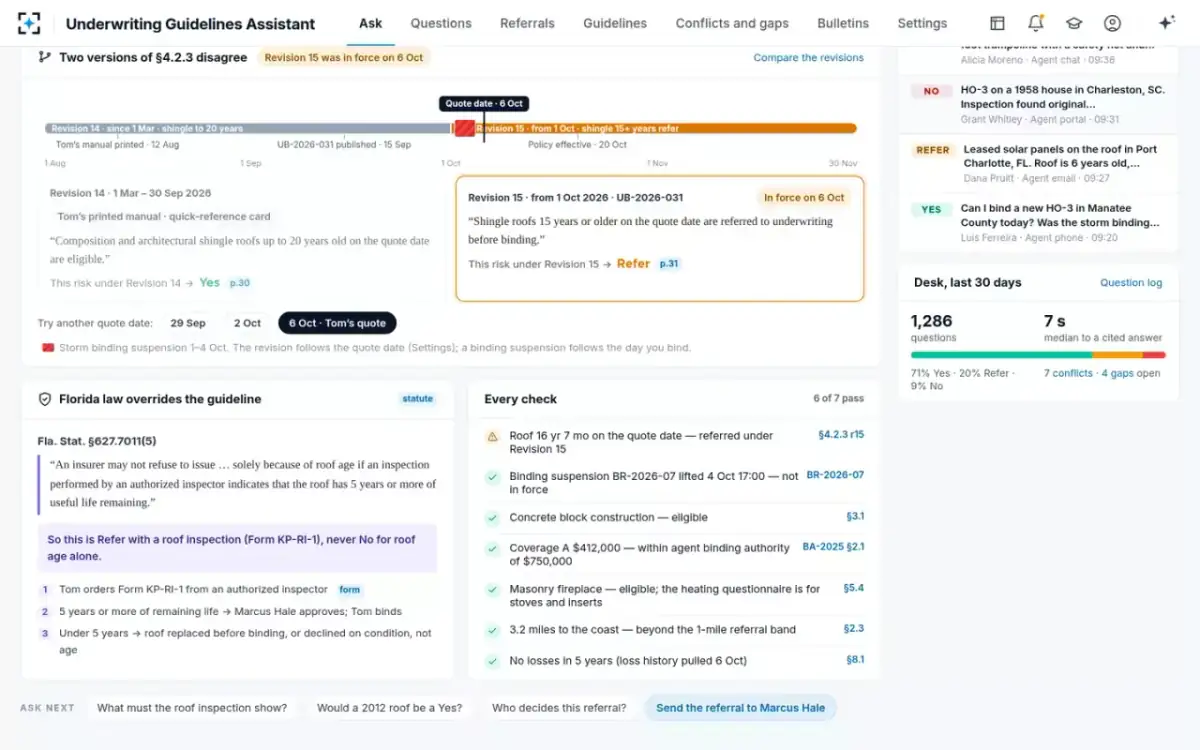
When the guideline answer and the statute answer differ
The useful way to see "law first" is case by case: what a manual would say on its own, and what the answer becomes once Florida law is applied. The cases below are the ones that come up most on a Florida desk.
The guideline answer and the statute answer, case by case
What a manual alone might say: Ineligible: roof over the limit.
What Florida law makes it: Not a refusal for age alone: under 15 years, age cannot be the sole reason. Condition or another lawful reason may still decide.
What a manual alone might say: Ineligible, or replace the roof.
What Florida law makes it: An inspection by an authorized inspector must be allowed first; five or more years of life and age alone cannot be the reason.
What a manual alone might say: Refer or decline under the manual.
What Florida law makes it: The manual governs: the roof subsection does not apply to mobile home policies.
What a manual alone might say: Eligible if the carrier would write it.
What Florida law makes it: Not eligible for Citizens above $700,000, except up to $1 million in counties the regulator finds lack competition.
What a manual alone might say: Silent on flood.
What Florida law makes it: Flood cover required from $400,000 for policies effective on or after 1 January 2026; Citizens may deny cover if it is refused.
What a manual alone might say: "Does not meet underwriting guidelines."
What Florida law makes it: Must state the specific reasons, including the specific underwriting reasons.
Two of those rows are traps rather than rules. The mobile home row shows that law first does not mean law always: where a statute excludes a policy type, the manual is back in charge. And the first row shows that the roof statute does not make an old roof acceptable; it removes age as the sole reason. A roof with active leaks or missing shingles can be refused at any age, on its condition, and the reason given should say so. The sample carrier's manual has a separate condition section for exactly that.
Citizens underwriting guidelines in Florida: the limits the statute sets
Citizens' eligibility is unusual because much of it is in the statute rather than a manual. The law tells Citizens to use its manual for the type of policy, but on objective terms: it "shall determine the type of policy to be provided on the basis of objective standards specified in the underwriting manual and based on generally accepted underwriting practices" (Fla. Stat. §627.351(6)(c)5.a). The outer limits are set by statute.
Citizens eligibility limits written into Florida statute
| Limit | The rule | Statute |
|---|---|---|
| Dwelling value | A structure with a dwelling replacement cost of $700,000 or more "is not eligible for coverage by the corporation"; up to $1 million is eligible in counties where the regulator finds a lack of competition. | §627.351(6)(a)3 |
| Private offer (new applicants) | A primary residence offered cover by an authorized insurer at its approved rate is not eligible unless that premium is more than 20% above Citizens' premium for comparable cover. | §627.351(6)(c)5.a |
| Private offer (renewals) | For renewals on or after 1 April 2023, the same more-than-20% test applies to a private offer received at renewal. | §627.351(6)(c)5.a |
| Flood insurance | Required as a condition of cover, phased in by replacement cost: $600,000 (2024), $500,000 (2025), $400,000 (2026), all others (2027); earlier in FEMA special flood hazard areas. | §627.351(6)(aa) |
| Wind-borne debris region | Homes insured at $750,000 or more need opening protections to Florida Building Code new-construction standard. | §627.351(6)(a)5.a |
| Coastal construction | New or substantially enlarged major structures seaward of the coastal construction control line, or in the Coastal Barrier Resources System, under permits applied for after 1 July 2015, are not eligible. | §627.351(6)(a)5.b |
| Unrepaired damage under FIGA | A risk may not be found ineligible solely for unrepaired covered damage on a claim with the Florida Insurance Guaranty Association, for up to 24 months. | §627.351(6)(mm) |
For an agent placing a home that private carriers have declined, those limits decide the next move before any manual is opened. A home with a $720,000 dwelling replacement cost, outside a low-competition county, cannot go to Citizens at all; a $450,000 home can, but only with a flood policy for a 2026 effective date; and a homeowner holding a private offer 15% above Citizens' premium is, for a primary residence, not eligible to choose Citizens instead.
Eligibility guidelines for homeowners insurance in Florida: where the carrier still decides
Outside the areas the law occupies, the carrier decides, and its guideline in force on the quote date is the answer. Florida's roof statute says so in terms: it does not limit an insurer's ability to reject or nonrenew on the grounds that a structure does not meet underwriting criteria for replacement cost or law and ordinance cover, "or for other lawful reasons" (Fla. Stat. §627.7011(6)(c)). Wiring, plumbing, heating, roof condition, occupancy, liability exposures and loss history all remain the carrier's to set, within the general rules against unfair discrimination.
That is where most of a Florida desk's questions sit. On the sample desk, Florida produced 441 of a month's 1,286 questions, a third of the total, and 142 of them were about roofs. The rest were about wind and binding restrictions, occupancy, liability features, heating and Coverage A against the agent's authority, all guideline questions answered from the manual once the law had been checked.
Florida asks a third of the sample desk's questions
Questions by state, 30 days (1,286)
- Florida · 34%
- Georgia · 19%
- South Carolina · 19%
- North Carolina · 18%
- Alabama · 10%
Saying no in Florida: the specific reason the law requires
When the answer is no, Florida requires it to come with reasons that mean something. A denial of an application must state the specific reasons, including the specific underwriting reasons, and when an insurer refuses homeowners or private passenger auto cover because of adverse underwriting information it must "Provide to the applicant specific information regarding the reasons for the refusal to insure." (Fla. Stat. §627.4091). Notices of nonrenewal and cancellation carry the same duty, and residential nonrenewals generally need at least 120 days' written notice, with listed exceptions (Fla. Stat. §627.4133).
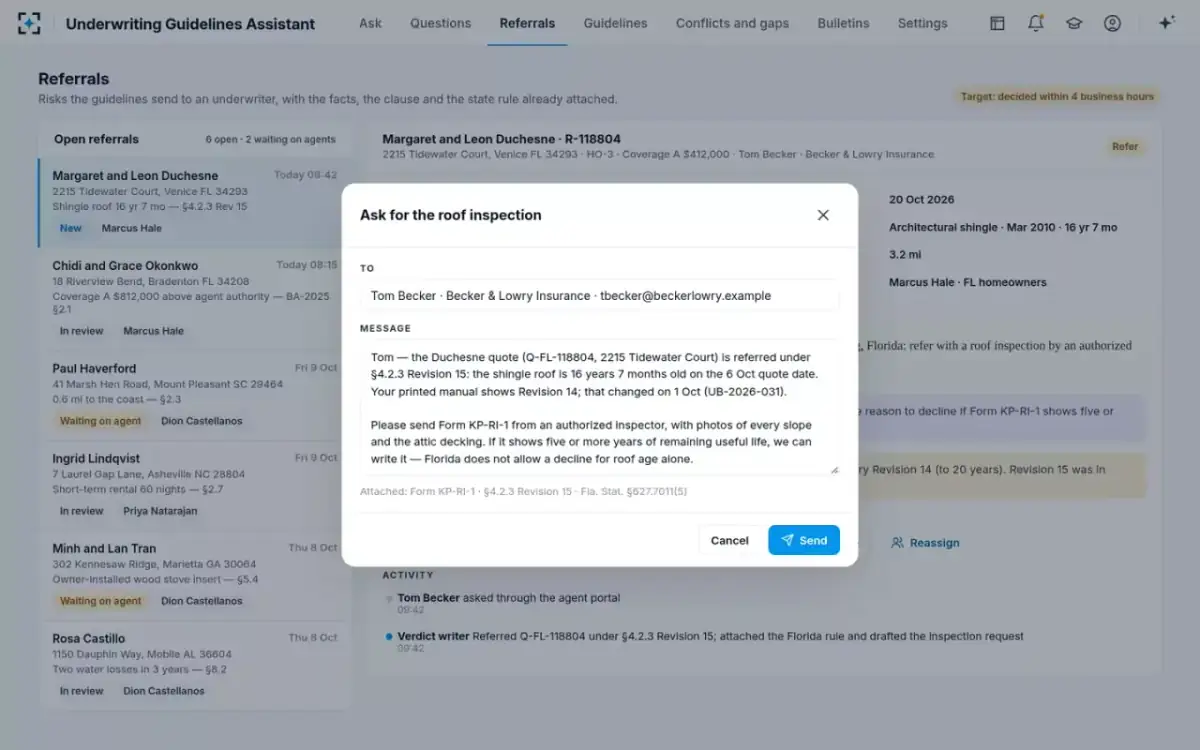
A specific reason is easy to give when the answer was made from a cited passage and hard when it was made from memory. On the sample carrier every referral reaches the underwriter with the clause and the Florida rule already attached, so the reason for any decline starts from a cited passage and the inspection result rather than from recollection. Homeowners insurance application questions and answers covers the applicant's side of the same exchange.
The underwriter's request for the inspection the statute calls for
Who is writing homeowners policies in Florida?
More carriers than a few years ago, on the regulator's count. In May 2026 Florida's Office of Insurance Regulation announced that "we now have 20 new companies writing property coverage" in the state since its legislative reforms, bringing "more than $850 million in new capital" (Florida OIR, 20 May 2026). The Office's own site carries the market share reports and the list of companies taking policies out of Citizens.
More carriers means more manuals, and more manuals means more ways for an agent to get one answer from one company and another from the next. The law above them is the same for all of them. A Florida agent who checks the statute first knows which part of each carrier's answer is negotiable and which is not, before comparing the rest. Which revision applies covers the dates on which Florida's own rules changed.
A Florida eligibility checklist, law first
Checking a Florida homeowners eligibility answer
- Is the roof under 15 years old?
Then age alone cannot be the reason to refuse to issue or renew. Look for condition or another lawful reason.
- Is it 15 years or older?
Allow an inspection by an authorized inspector, at the homeowner's expense, before requiring replacement; five or more years of life and age alone cannot be the reason.
- Is it a mobile home policy?
The roof subsection does not apply; the guideline governs.
- Is the applicant going to Citizens?
Check replacement cost against $700,000, the flood requirement for the policy effective date and the 20% rule on private offers.
- Is binding suspended in the county on the bind date?
A suspension follows the day the agent binds, not the quote date.
- Which guideline revision was in force on the quote date?
Answer from it, and show both versions if it changed recently.
- If the answer is no, is the reason specific?
With the underwriting reason and, for adverse underwriting information, what that information was.
The Underwriting Guidelines Assistant runs this order on every Florida question: the state exception checker applies the statutes and the carrier's Florida exception page, the version resolver finds the revision in force on the quote date, and the verdict writer refers whenever the law and the guideline leave the answer open. People decide every referral.
Questions people ask
What are ineligible risks for homeowners insurance?
They are homes a carrier's guidelines exclude, commonly for roof age or condition, outdated wiring or plumbing, liability exposures, occupancy such as vacancy or short-term rental, location or loss history. Each carrier sets its own list within state law, so a home ineligible with one carrier may be written by another.
What are the eligibility guidelines for homeowners insurance in Florida?
Each carrier's own, limited by Florida statute: no refusal solely for the age of a roof under 15 years, an inspection allowed for older roofs, and specific written reasons for any refusal. Citizens' eligibility limits, such as the $700,000 replacement-cost ceiling, are in the statute itself.
What are Citizens' underwriting guidelines in Florida?
Citizens has its own underwriting manual, but the statute sets its outer limits and requires the policy type to be decided on objective standards in that manual. Key statutory limits are the $700,000 replacement-cost ceiling, the flood insurance requirement and the rule that a private offer within 20% of Citizens' premium makes a primary residence ineligible.
Can a Florida insurer refuse a home because of the roof's age?
Not solely for the age of a roof under 15 years, for policies issued or renewed since 1 July 2022. For an older roof the insurer must allow an inspection first, and cannot refuse solely for age if the inspector finds five or more years of useful life.
How many companies are writing homeowners insurance in Florida?
Florida's Office of Insurance Regulation publishes residential market share reports that list the active writers. In May 2026 it said 20 new companies had begun writing property coverage in the state since its legislative reforms.