Are underwriting guidelines public record? In Texas, for personal auto and residential property insurance, largely yes: every insurer must file its underwriting guidelines with the Texas Department of Insurance, update the filing whenever they change, and the statute makes them subject to the state's Public Information Act. In California, underwriting rules filed with a rate application must be open to public inspection even if the insurer marks them confidential or trade secret, and the Department expects changes to be filed publicly before they are used. In other lines and other states the answer depends on the state's law, and in Texas the guidelines for other lines are expressly confidential. A public filing changes the job of the desk that answers agents' questions: the answers have to match the text on file, revision by revision. Botminds' Underwriting Guidelines Assistant answers only from that text, quoting the section and revision, which is the habit a public filing demands.
Texas Insurance Code Section 38.002 does not make your guidelines confidential. They are subject to open records requests.
Texas Department of Insurance, Underwriting guidelines, page updated 6 April 2026
Are underwriting guidelines public record, and why does it vary?
Underwriting guidelines are an insurer's rules for deciding whether to accept or reject an application and how to classify the risks it accepts. Whether the public can read them is a question of state law, because insurance is regulated state by state, and states have made different choices. Some treat guidelines as part of what a regulator needs to judge a rate or police discrimination, and open them up; others treat them as an insurer's working method, filed or not, and keep them private.
Texas and California give the clearest answers, by different roads. Texas has required home and auto insurers to file their guidelines since 2003 and makes the filings subject to its public records law, while keeping other lines confidential. California reached openness through Proposition 103's rule that information filed with a rate application is public. Texas releases guidelines on request; California makes them part of the public rate filing.
What Texas requires insurers to file
Texas requires every insurer writing personal automobile or residential property insurance to file a complete copy of its underwriting guidelines and keep the filing current. The statute's words are direct: "Each insurer shall file with the department a copy of the insurer's underwriting guidelines. The insurer shall update its filing each time the underwriting guidelines are changed." (Tex. Ins. Code §38.002(b)). The definition is wide: a guideline is any rule, standard or practice, written, oral or electronic, that the insurer or its agent uses to accept or reject an application or to classify an accepted risk for rating. The Texas Windstorm Insurance Association, the FAIR Plan and the auto insurance plan are covered too.
The Department's rule fills in the mechanics. The filing is due "Not later than 10 days after use," it must include a redline marking every change, and under the current rule, last amended with effect from 8 January 2024, it also describes each third-party data set and model used in underwriting: the vendor, the model name and version, its inputs, how its output is used and which guidelines depend on it (28 Tex. Admin. Code §5.9342). An oral or electronic guideline has to be written down for the filing. Filings go through SERFF, the national electronic filing system.
Substance is regulated as well as filing. The guidelines "must be sound, actuarially justified, or otherwise substantially commensurate with the contemplated risk" and may not be unfairly discriminatory (§38.002(e)). A public filing is how anyone outside the insurer can check.
How a Texas homeowners or auto guideline reaches the public
- 1
Insurer
Files a comprehensive set of its personal auto or homeowners underwriting guidelines with TDI through SERFF, not later than 10 days after use.
§38.002(b); 28 TAC §5.9342(a)
- 2
Insurer
Refiles every time the guidelines change, with a redline showing the changes and a description of each third-party data set and model used in underwriting.
§38.002(b); §5.9342(b)
- 3
TDI and OPIC
May review the filings; the Office of Public Insurance Counsel may obtain a copy; either may publish a summary that does not identify the insurer.
§38.002(c), (d)
- 4
Any member of the public
Asks TDI for an insurer's filed guidelines under the Public Information Act, which the statute says applies.
§38.002(f); Gov. Code ch. 552
- 5
Attorney General
Rules when the insurer marked the filing confidential; the insurer may argue against release first. In 2014 the AG ordered residential property guidelines released.
TDI Bulletin B-0021-15; OR2014-00209
Are underwriting guidelines public information in Texas, or confidential?
For personal auto and homeowners, public information. Section 38.002(f) says the guidelines "are subject to Chapter 552, Government Code", the Public Information Act, and the Department reads that as meaning they are not confidential. Insurers tested it. In 2014 the Attorney General issued an open records letter ruling that residential property underwriting guidelines are not made confidential by section 38.002 and ordered the Department to release the guidelines requested (TDI Commissioner's Bulletin B-0021-15).
That does not make every page automatic. If a company marks its personal auto or homeowners guidelines confidential when it files, the Department says it will keep referring requests for them to the Attorney General, notify the company and give it the chance to argue why its information should not be released. The default, though, is disclosure, and it is the insurer that has to argue for withholding.
Why other lines stay private in Texas: section 38.003
Texas treats every other line the opposite way. For guidelines outside personal auto and residential property, section 38.003 says: "Underwriting guidelines are confidential, and the department or the office of public insurance counsel may not make the guidelines available to the public." Access inside the Department is limited to people with a need to know, and the guidelines may still be used as evidence in an enforcement case under a protective order.
Texas splits underwriting guidelines into two regimes
§38.002: personal auto and residential property: Every insurer files, and refiles on every change (TDI's rule: within 10 days of use).
§38.003: every other line: Filed only on request, except workers' compensation, which is filed under its own chapter.
§38.002: personal auto and residential property: TDI, OPIC and, through the Public Information Act, the public.
§38.003: every other line: TDI and OPIC only, limited to staff with a need to know.
§38.002: personal auto and residential property: No. The Attorney General ordered release in 2014.
§38.003: every other line: Yes, by statute.
§38.002: personal auto and residential property: TDI or OPIC may publish a summary that does not identify the insurer.
§38.003: every other line: The same.
§38.002: personal auto and residential property: Sound, actuarially justified or commensurate with the risk; not unfairly discriminatory.
§38.003: every other line: Not set out in this section.
Are underwriting guidelines public record in California?
Yes, when they are filed with a rate application, and in California they are expected to be. The Department's General Counsel answered the question directly in a 2018 legal opinion: underwriting rules provided with a rate application "must be available for public inspection pursuant to Insurance Code section 1861.07 regardless of whether such underwriting rules are marked "confidential," "proprietary," or "trade secret."" (CDI General Counsel opinion, 10 August 2018). The reasoning runs through Proposition 103: section 1861.07 makes all information provided to the Commissioner under the rate approval article public, and the California Supreme Court has read that to exclude a trade secret exemption.
The same opinion notes that, as a general rule, insurers file their underwriting rules with every Proposition 103 rate application, and that when an insurer marked them confidential the Department released them on a member of the public's request after giving the insurer a chance to respond. In December 2023 the Commissioner made the timing explicit: insurers must publicly file new or changed underwriting guidelines, along with rates, rating rules and forms, before implementing them, and a failure to file a guideline before using it "may result in an administrative enforcement action against the insurer leading to restitution and/or penalties" (CDI Bulletin 2023-7). The bulletin's definition of underwriting guidelines reaches eligibility and renewal rules, rules that restrict writing by ZIP code or county, and the systems and algorithms behind them.
Texas and California: how each makes homeowners underwriting guidelines public
| Question | Texas | California |
|---|---|---|
| Which guidelines | Personal auto and residential property (other lines confidential) | Property and casualty lines under Proposition 103 prior approval |
| When filed | Not later than 10 days after use, and on every change | With each rate application, and publicly before implementing any change |
| What is filed | The complete guidelines, a redline of changes, third-party data and models | Underwriting, eligibility and renewal guidelines, including geographic restrictions and algorithms |
| Open to the public? | Yes, under the Public Information Act | Yes, under Insurance Code §1861.07 |
| If marked confidential | Referred to the Attorney General, who ordered release in 2014 | Released after notice; trade secret marking does not exempt |
| Main authority | Ins. Code §38.002; 28 TAC §5.9342; Bulletin B-0021-15 | Ins. Code §§1861.05(b), 1861.07; GC opinion 2018; Bulletin 2023-7 |
Are underwriting guidelines public or private in other states?
Outside these two states, check the state's own filing law; the answer is not uniform, and this page does not survey it. The useful questions to put to a department are the same everywhere: does the state require underwriting guidelines to be filed at all, for which lines, are they filed as part of a rate filing or separately, and does the state's public records law, or its insurance code, exempt them.
Whatever the public can see, the regulator sees the guidelines in a market conduct examination. The NAIC's examination standards test whether an insurer follows its own guidelines in selecting risks and whether its rejections and declinations are unfairly discriminatory, and examiners cannot test either without reading the guidelines (NAIC examination standards). For an insurer, "private" usually means private from competitors and the public, never from its regulator.
How to find an insurance company's underwriting guidelines online
Start with the state's public filings and, where they are not posted, ask. In California, the Department points consumers to a public SERFF Filing Access portal for rate, rule and form filings, and underwriting rules filed with a rate application are part of the public filing. In Texas, ask the Department for the insurer's filed personal auto or homeowners guidelines under the Public Information Act.
Finding a carrier's homeowners underwriting guidelines
- Identify the exact company, not the group
Groups file one set for several companies but must say which guidelines apply to each.
- California: search the public filing portal for the company's homeowners rate filings
Look in the filing for the underwriting or eligibility guidelines.
- Texas: make a public information request to TDI
Ask for the company's current residential property underwriting guideline filing, and the redline of the latest change.
- Expect a delay if the filing was marked confidential
In Texas the request goes to the Attorney General for a ruling before release.
- Elsewhere: ask the department whether guidelines are filed at all
And under which law a member of the public can ask for them.
- For one decision, ask for the specific reason instead
Florida requires a denial of an application to state the specific underwriting reasons; a reason tied to a rule is often more useful than the whole manual.
What a public filing means for the underwriting desk
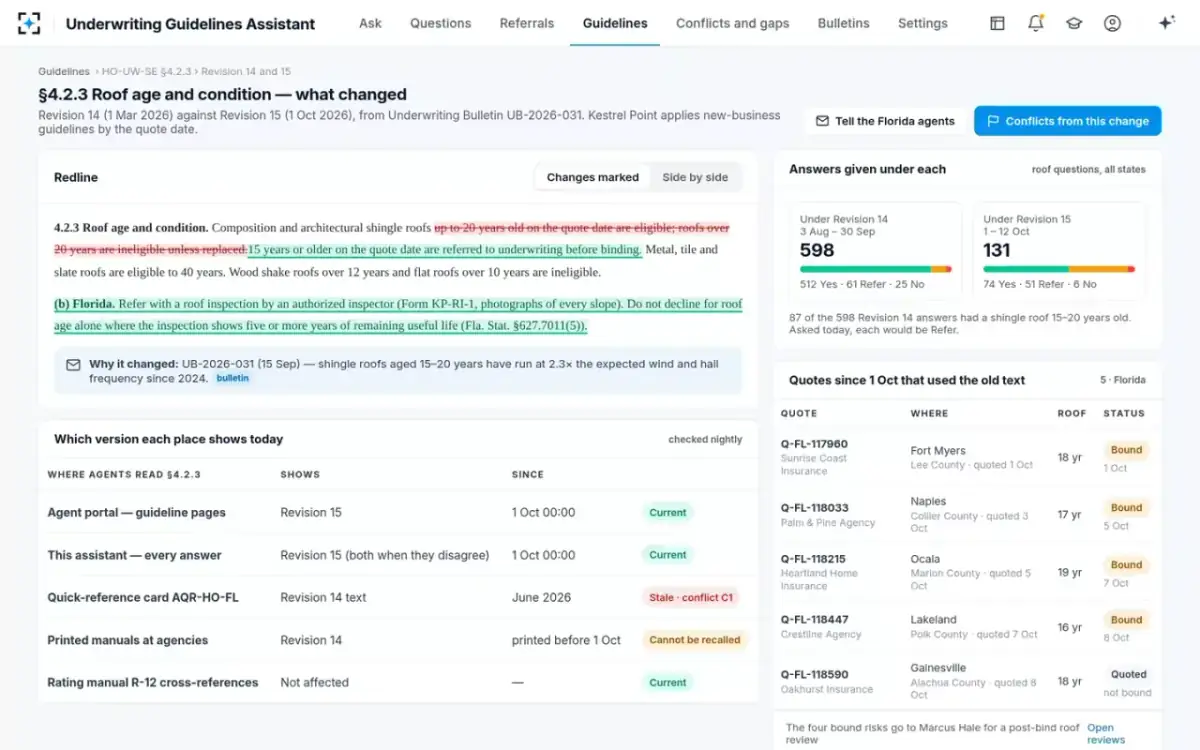
A public filing turns the desk's answers into something anyone can compare with the text on file. If the filed guideline refers shingle roofs of 15 years or more and an agent was told by phone that 17 years was fine, the carrier applied a rule it did not file. In Texas that phone answer was itself an underwriting guideline, because the definition includes oral practices, and the Department's rule requires oral guidelines to be written down for the filing.
So the desk needs three things the filing implies. One current text, with every earlier revision dated, so an answer can be matched to the version in force on the quote date. A redline of every change, which Texas requires in the filing anyway. And a log of answers that shows which revision each one rested on, so a two-way answer is caught on the desk, not in a complaint. The sample carrier's screens below show what that looks like on a roof rule that changed on 1 October; which revision applies explains the dating, and where each rule lives covers the other sources an answer draws on.
A redline of the change, and which places still show the old text
What a public summary can tell a consumer, and what it cannot
Texas lets the Department or the Office of Public Insurance Counsel publish a summary of an insurer's guidelines "in a manner that does not directly or indirectly identify the insurer". A summary of that kind can show what rules are common in a market, for example how many insurers set a roof age limit, but it cannot tell a homeowner what one company will do with one house.
For that, the consumer's better tool is the reason the law requires on a decision. Florida requires a denial of an application, and every cancellation or nonrenewal notice, to state the specific reasons, including the specific underwriting reasons. A carrier whose desk answers from a cited guideline can give that reason in one line, with the section it rests on; one that answered from memory has to reconstruct it. The Underwriting Guidelines Assistant's answers carry the clause for exactly this reason, and the Underwriting Guidelines Assistant page shows how they are kept.
Questions people ask
Are underwriting guidelines public information?
In Texas, homeowners and personal auto guidelines are subject to the Public Information Act, and the Attorney General ordered residential property guidelines released in 2014. In California, underwriting rules filed with a rate application are open to public inspection even if marked trade secret. Other states differ.
Are underwriting guidelines public or private?
Both, depending on the state and the line. Texas keeps guidelines for lines other than home and auto confidential by statute, while opening home and auto. Regulators can always see them in a market conduct examination.
What are underwriting guidelines in insurance?
They are an insurer's rules for accepting or rejecting applications and classifying accepted risks for rating, such as roof age limits, construction and heating rules, coastal restrictions and liability exposures. Texas defines them to include written, oral and electronic rules and practices used by the insurer or its agent.
Do insurers have to file underwriting guidelines with the state department of insurance?
In some states. Texas requires personal auto and residential property insurers to file them within 10 days of use and on every change; California expects them with rate applications and before any change is implemented. Other states' rules differ, so ask the state's department.
How do I get a Texas insurance company's underwriting guidelines?
Make a public information request to the Texas Department of Insurance for the company's filed personal auto or residential property guidelines. If the company marked them confidential, TDI refers the request to the Attorney General and the company may argue against release.