A personal lines underwriting guidelines PDF is a carrier's manual for homeowners or personal auto eligibility, by line and state, and it is the document most agents and underwriters reach for first. It is also only one of five places an eligibility rule actually lives. Appetite memos narrow what the carrier wants to write this quarter; the agent's binding authority sets what each agent may commit to; underwriting bulletins change the manual from a stated date; and statutes and state exception pages override all of them in the risk's state. A PDF that answers from the first source alone gives a right answer for last quarter, or for another state. Mapping every rule to its source, with its revision and date, is what stops one question getting two answers. Botminds' Underwriting Guidelines Assistant reads all five sources, quotes the passage that decides each question, and answers Yes, No or Refer.
One manual, many sources, on a sample carrier
412
sections in the sample homeowners manual, Revision 15
35
underwriting bulletins in the same year
6
appetite memos and 5 state exception pages beside it
7
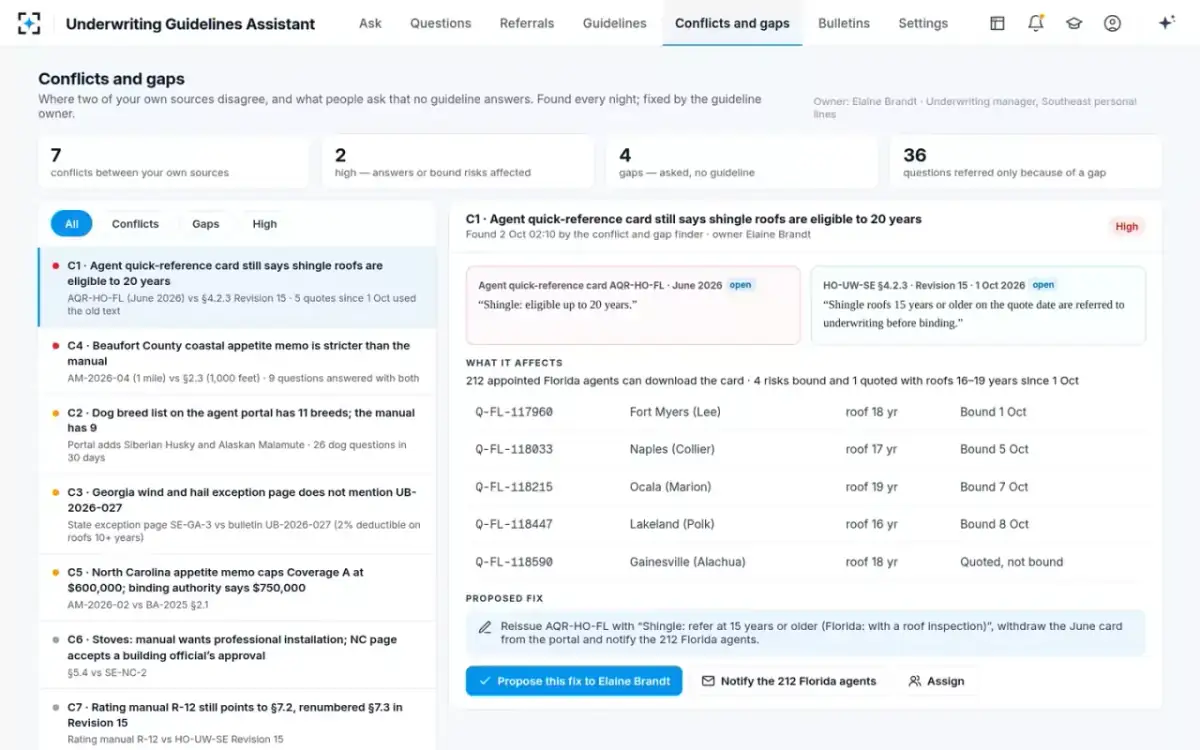
conflicts between the carrier's own sources, found in one overnight check
Is there a personal lines underwriting guidelines PDF that answers every question?
No single PDF answers every eligibility question, even for one carrier, because the manual is only one of the documents the answer depends on. A carrier's underwriting manual is its own document, usually shared with appointed agents through a portal, and the copies that circulate as PDFs are snapshots of it on the day they were saved. The other four sources change on their own schedules, often faster than the manual.
Public copies do exist in some states, because some regulators require guidelines to be filed and open them to the public. Texas requires personal auto and homeowners insurers to file theirs, and California expects underwriting rules with every rate application, open to inspection; are underwriting guidelines public record? explains how to find them. Even a filed copy is a snapshot: it is right for the dates it covers and silent on memos and authority that were never part of the filing.
The five places an eligibility rule lives
An eligibility answer draws on five kinds of document, and each one has a different owner, a different update cycle and a different way of going wrong. The manual sets the standing rules. The appetite memo narrows them, usually by geography and usually for a season. The binding authority decides who may say yes. The bulletin changes any of the others from a date. And state law sits over all four.
Agents add a sixth layer that is not a source at all: copies. Quick-reference cards, portal summaries, saved PDFs and the desk's own memory are all derived from the five, and they are where most stale answers come from, because nobody is responsible for recalling them. On the sample carrier the overnight check found seven places where two of the carrier's own documents disagreed, from the roof card to a dog breed list on the portal with eleven breeds against the manual's nine.
A rule-by-source map for personal lines eligibility, with the error each source tends to cause
Underwriting manual
What it decidesEligibility by line and state: roof, construction, heating, wiring, liability exposures.
Sample exampleRoof section changed on 1 October; the June printed copies still carry the old text.
The error it tends to causeThe stale copy: answering from a revision that has been replaced.
Appetite memo
What it decidesWhere and what the carrier wants to write now, often by county or ZIP.
Sample exampleA county memo stops new business within 1 mile of the coast; the manual's band is 1,000 feet.
The error it tends to causeThe forgotten override: a memo stricter than the manual that only some people know.
Binding authority
What it decidesWhat each agent may bind without asking: forms, states, property types, Coverage A.
Sample exampleOne state's memo caps Coverage A at $600,000; the agents' authority says $750,000.
The error it tends to causeEligible but not bindable: a yes on the risk, a no on who may commit to it.
Underwriting bulletin
What it decidesA change to any of the above from a stated date, or a temporary restriction.
Sample exampleA 2% wind and hail deductible on roofs 10 years and older in one state, from 1 September.
The error it tends to causeThe orphan change: a bulletin no state exception page or card picked up.
Statute and state exception page
What it decidesWhat the law requires or forbids in the risk state, over every other source.
Sample exampleFlorida: no refusal for roof age alone under 15 years; an inspection for older roofs.
The error it tends to causeThe overridden answer: a manual rule the state does not allow.
Read down the last column and the case for mapping is plain. Each error is invisible to someone answering from one document. The desk specialist with the manual open cannot see the memo; the agent with the card cannot see the bulletin; the underwriter who knows the bulletin cannot see that the state exception page never picked it up. The answer has to be assembled from all five, and the assembly is where people disagree.
Which source wins when two disagree?
The law wins first, then the most specific dated instruction in force on the relevant date, then the standing manual, and a copy never wins. In practice: a statute or regulation in the risk state overrides every company document; a bulletin in force on the quote date overrides the manual text it amends; an appetite memo narrows the manual where it applies; the binding authority decides who may bind but does not make an ineligible risk eligible; and a card or saved PDF is evidence of what someone was told, not a rule.
That order is ours, and each carrier writes its own; what matters is that it is written. Where two company sources conflict and the order does not settle it, the safe answer is a referral with both texts shown, and a note to the guideline owner. The sample carrier's assistant does exactly that: on the coastal memo that was stricter than the manual, it referred the questions and put the conflict on the underwriting manager's list rather than choosing a distance.
Seven conflicts between the carrier's own sources, found overnight
Personal lines underwriting guidelines for Florida: the statute sits on top
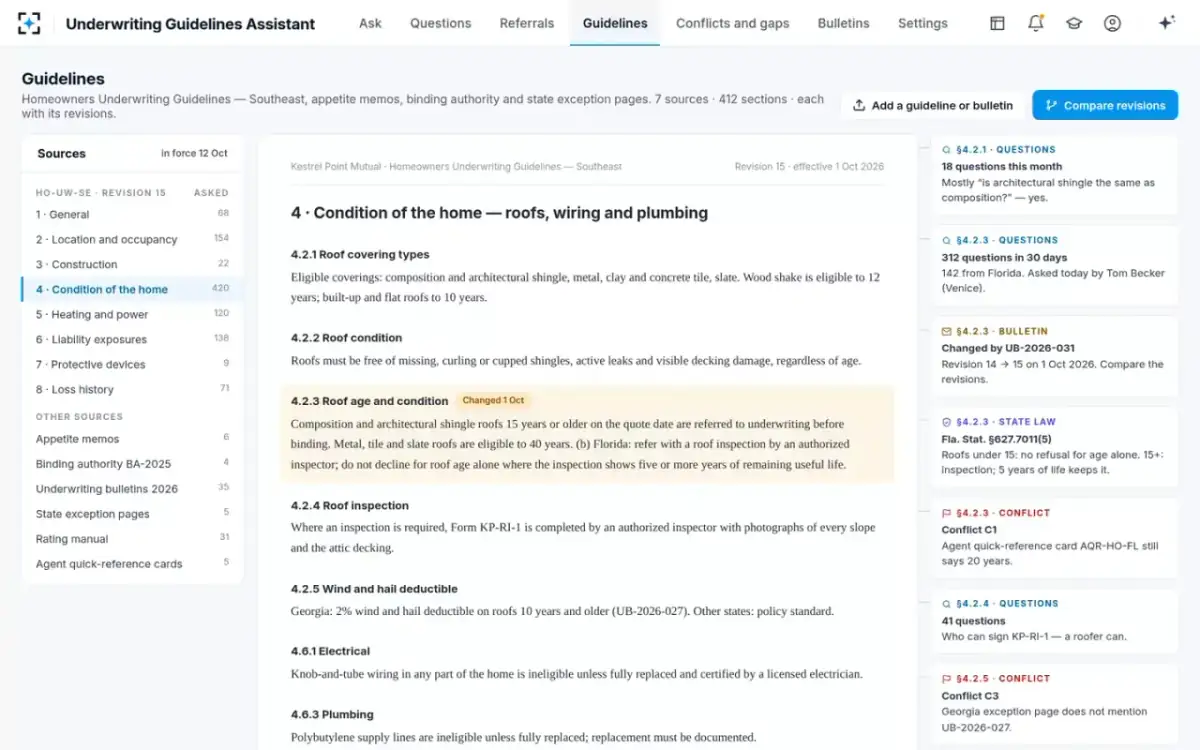
In Florida the statute answers several eligibility questions before any manual does, so a Florida guideline is only as good as its state exception page. The roof is the familiar case: for homeowners policies issued or renewed since 1 July 2022, a carrier may not refuse to issue or renew solely because of the age of a roof under 15 years, and for an older roof it must let the homeowner have an authorized inspector assess it first (Fla. Stat. §627.7011(5)). A manual that says "ineligible over 15 years" is not wrong everywhere; it is wrong in Florida unless the state page tells the reader how the statute changes it.
Florida's insurer of last resort shows the opposite pattern: a statute that sends eligibility to a manual. Citizens Property Insurance Corporation must determine the type of policy a risk gets from objective standards set out in its underwriting manual, while the statute itself sets the outer limits, such as the replacement-cost ceiling above which a home is not eligible (Fla. Stat. §627.351(6)). Ineligible risks in Florida works through the cases where law answers first.
Personal lines underwriting guidelines in California: eligibility rules a regulator reads
California requires insurers to keep written eligibility guidelines for every line they sell, and treats them as part of the rate review. The Department's General Counsel, citing title 10 of the California Code of Regulations, describes the duty to "maintain eligibility guidelines for every line of insurance offered for sale to the public" and the rule that "An insured or applicant who meets the eligibility guidelines shall qualify to purchase the insurance." (CDI General Counsel opinion, 2018).
The Department's 2023 bulletin widened what counts. For rate filing purposes, underwriting guidelines include any criteria, systems, manuals or algorithms used to restrict writing in a ZIP code, county or territory, and any rules or procedures "used by an insurer, agent, broker, or underwriter" to decide whether to accept, inspect, cancel, non-renew or re-underwrite a risk (CDI Bulletin 2023-7). That definition reaches four of the five sources on the map above. A California appetite memo that stops new business in a county is, for the Department, an underwriting guideline to be filed before it is used.
What the sample carrier's answers may draw on, by source
Why the PDF goes stale the day a bulletin takes effect
A saved PDF goes stale because it cannot learn: the bulletin that changes it is a separate document, and nothing connects the two in the agent's downloads folder. On the sample carrier, the roof bulletin was published on 15 September and took effect on 1 October. The portal changed that morning. The agents' printed manuals, printed before 1 October, could not be recalled, and the June quick-reference card stayed on the portal for 212 appointed Florida agents to download.
Texas has a rule that shows how regulators think about this. Its filing rule for home and auto guidelines says that "an oral or electronic underwriting guideline must be converted to written form" for the filing (28 Tex. Admin. Code §5.9342(d)). The point generalises: whatever the desk actually applies is the guideline, whether it lives in the manual, a memo, a card or someone's head, and a carrier that cannot produce it in writing, by date, cannot show an examiner which rule it applied. Examiners test exactly that, whether the carrier follows its own guidelines in selecting risks (NAIC examination standards).
A saved guidelines PDF and a source-mapped guideline, on the same roof question
The saved PDF: The manual as it stood on the day it was saved.
The source-mapped guideline: Every section with every revision, its effective date and the bulletin that changed it.
The saved PDF: Not included; they are separate documents.
The source-mapped guideline: Linked to the sections they narrow, by state and date.
The saved PDF: Sometimes a line in the text; often a separate page.
The source-mapped guideline: Applied over the section for the risk state, and shown in the margin.
The saved PDF: Unchanged, and still being read.
The source-mapped guideline: The new revision in force from its date; the old one kept, marked superseded.
The saved PDF: Nobody, until a risk is bound on it.
The source-mapped guideline: The guideline owner, from the overnight conflict check.
Personal lines underwriting guidelines 2024 and after: keep the revision with the rule
Searches for a "2024" or "2026" guidelines PDF are really asking which revision is current, and the honest answer is that it depends on the quote date. A rule is not just its text; it is its text plus the dates it applies to. Keep the two together and an answer can be dated; separate them, as a saved PDF does, and nobody can say which rule governed a quote made last month. Which revision applies sets out the dating rules for new business, renewals and binding suspensions.
The manual page with its sources in the margin
What a source-mapped guideline changes for agents and the desk
For the agent, mapping means one answer with the page, the revision and the state rule, instead of a PDF and a phone call. For the desk, it means the specialist answering an agent sees the memo and the bulletin beside the manual text, rather than remembering them. For the guideline owner, it means conflicts arrive as a list each morning, with what each one affected, rather than as a bound risk.
The Underwriting Guidelines Assistant is built on that map. Its guideline finder searches the manual, memos, binding authority and bulletins and quotes each passage with section, revision, effective date and page; quick-reference cards are compared against them, never quoted. Its state exception checker applies statutes and state pages over the company text. And its conflict and gap finder compares every source each night and proposes fixes for the underwriting manager to approve. The Underwriting Guidelines Assistant page shows it on the sample carrier's roof question.
Questions people ask
Where can I find personal lines underwriting guidelines for 2024?
A carrier's current guidelines are usually on its agent portal for appointed agents. Public copies of filed guidelines can be requested in Texas, and California's rate filings include underwriting rules open to inspection; any copy is right only for the dates its revision was in force.
What is in an insurance underwriting guidelines PDF?
Typically the carrier's eligibility rules by line and state: property and construction requirements, roof, heating, wiring and plumbing rules, occupancy, liability exposures, loss history and referral triggers. Memos, binding authority, bulletins and state law that change those rules are usually separate documents.
What are homeowners insurance underwriting guidelines?
They are the rules a carrier uses to decide whether to accept, refer or decline a home and how to classify it for rating. Texas defines them to include written, oral and electronic rules or practices used by the insurer or its agent.
What is an underwriting manual at an insurance company?
The underwriting manual is the standing set of eligibility rules, organised by line and state and revised by number and date. It is the largest source an answer draws on (412 sections on the sample carrier) but it changes through bulletins and is narrowed by memos and state law.
Do California personal lines insurers have to keep underwriting guidelines?
Yes. California regulations require insurers to maintain eligibility guidelines for every line offered to the public, and the Department expects underwriting guidelines, including geographic restrictions and algorithms, to be filed publicly before they are used.