How old can a roof be for insurance in Florida? There is no maximum age in the statute, but there is a floor and an exit. A Florida insurer may not refuse to write or renew a homeowners policy solely because of the roof's age if the roof is under 15 years old, and for a roof 15 or older it must let the homeowner get an inspection first; if an authorized inspector finds at least five years of useful life left, age alone cannot be the reason either (Fla. Stat. §627.7011(5)). Age is counted from the last time the whole roof was built or replaced, with a special rule for roofs replaced in parts. Everything else, condition, damage, price, is outside the rule. For an insurer the hard part is applying three branches correctly on thousands of renewals, each with a 120-day notice clock; Botminds' Homeowners Renewal Underwriting re-scores every renewal, reads roof age from the permit and sends a changed roof to an underwriter with the rule that applies.
"An insurer may not refuse to issue or refuse to renew a homeowner's policy insuring a residential structure with a roof that is less than 15 years old solely because of the age of the roof."
Florida Statutes §627.7011(5)(b), 2026 text
Florida's roof age law, branch by branch
The rule sits in subsection (5) of Florida's homeowners statute and applies to homeowners policies issued or renewed from 1 July 2022. It answers the roof-age question in a sequence of branches, each with its own text. A renewal decision that skips a branch, for example by treating every roof over 15 as ineligible without offering the inspection, does not follow the statute.
Florida's roof-age rule as a decision tree, with the statute at each branch
1 Is it a homeowners policy, issued or renewed on or after July 1, 2022?
No The subsection does not apply. It excludes mobile home policies and policies not "homeowners' policies" as commonly understood. §627.7011(5)(e), (6)
Yes Go on.
2 How old is the roof, counted the statute's way?
Count From the last date on which 100% of the roof's surface was built or replaced to the building code then in effect, or, where partial replacements together covered the whole roof, from the date of the first of them. §627.7011(5)(d)
3 Under 15 years?
Yes The insurer may not refuse to issue or renew solely because of roof age. It may still act on condition or other lawful reasons. §627.7011(5)(b), (6)(c)
No, 15 or older Go on.
4 Has the homeowner had the roof inspected by an authorized inspector?
Must be allowed Before requiring replacement as a condition of issuing or renewing, the insurer must allow an inspection at the homeowner's expense. §627.7011(5)(c)
5 Does the inspection show 5 or more years of useful life remaining?
Yes The insurer may not refuse to issue or renew solely because of roof age. §627.7011(5)(c)
No Roof age may be a reason, with specific written reasons and 120 days' notice of nonrenewal. §§627.4091, 627.4133(2)(b)
Read from the insurer's side, the tree gives one obligation and two prohibitions. The obligation is to allow the inspection before demanding a new roof. The prohibitions are on refusing for age alone below 15, and for age alone above 15 when the inspector finds five years of life. Nothing in the subsection stops a refusal for the roof's condition: missing shingles, a tarp, exposed underlayment. Subsection (6)(c) preserves the insurer's ability to reject or non-renew "for other lawful reasons".
How Florida counts a roof's age: full and partial replacements
A roof's age, for this rule, runs from "the last date on which 100 percent of the roof's surface area was built or replaced in accordance with the building code in effect at that time", or, if it was replaced in parts that eventually covered the whole surface, from "the initial date of a partial roof replacement" in that series (§627.7011(5)(d)). A roof patched on one slope keeps its original age. A roof replaced slope by slope over several years takes the date of the first slope, once the last is done.
The building code shapes how often that happens. Florida's building-code statute now says that if a roof built, repaired or replaced to the 2007 Florida Building Code or later has 25% or more of it repaired or replaced, "only the repaired, replaced, or recovered portion is required to be constructed in accordance with the Florida Building Code in effect" (Fla. Stat. §553.844(5)). For a roof built to the 2007 code or later, then, even a large repair leaves most of it, and its age, in place.
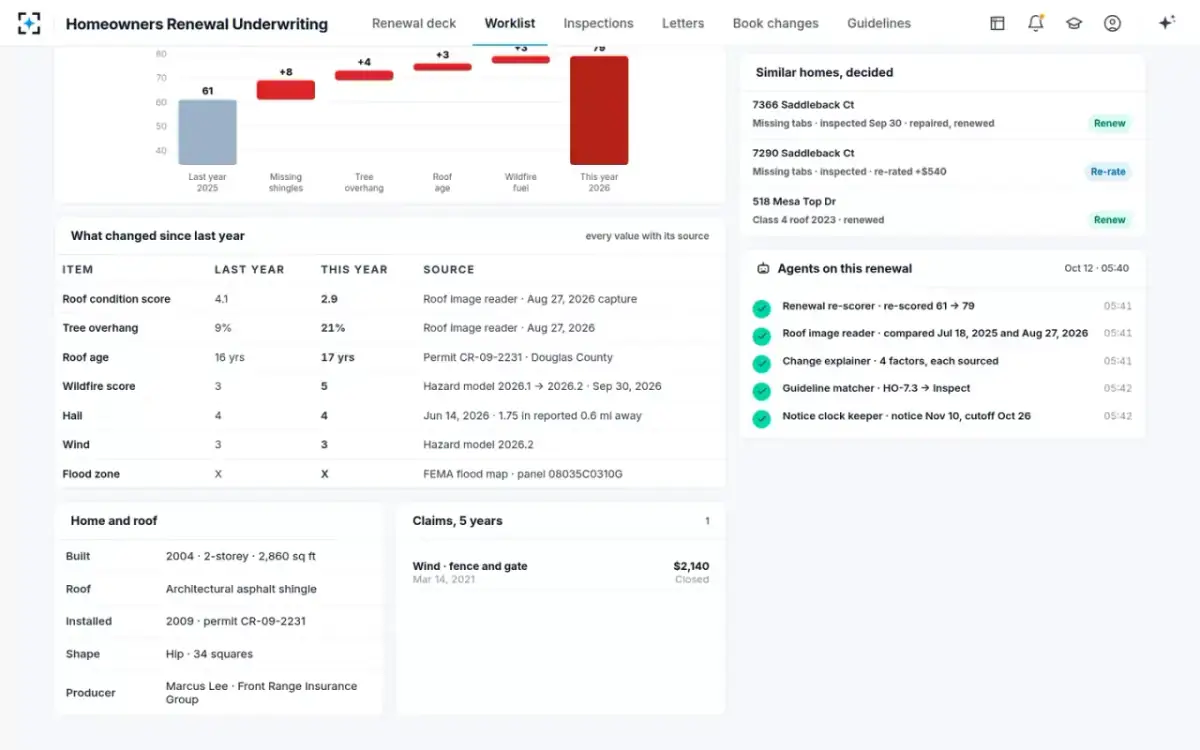
For an underwriter the practical question is evidence. The age that matters is the one a permit, an appraisal record or an inspection supports, not the age typed into an application years ago. In the sample insurer's renewal files, roof age comes from the county permit, with its number beside the figure.
Roof age from the permit, beside every other input that changed
Will insurance cover a 15 or 16 year old roof in Florida?
A Florida insurer can insist on more for a roof of 15 or 16 than for a newer one, but it cannot simply refuse. For a roof of 15 or more, the statute requires the insurer to "allow a homeowner to have a roof inspection performed by an authorized inspector at the homeowner's expense before requiring the replacement of the roof". If that inspection finds at least five years of useful life, the insurer may not refuse to issue or renew "solely because of roof age".
Three cautions keep that answer honest. First, the rule is about refusal, not price: whether a 16-year-old roof costs more to insure depends on the insurer's filed rating plan. Second, an inspection that finds less than five years of life, or finds damage, opens the door to a nonrenewal for that reason, with specific reasons in writing (§627.4091) and 120 days' notice (§627.4133(2)(b)); what makes such a nonrenewal hold on appeal is a guide of its own. Third, "authorized inspector" is defined: an inspector approved by the insurer who is a licensed home inspector, a certified building code inspector, a licensed general, building, residential or roofing contractor, a professional engineer, an architect, or someone else the insurer recognises as qualified.
How old can a roof be to get homeowners insurance in Florida as a new policy?
The same branches apply to a new policy as to a renewal, because the statute speaks of refusing "to issue" as well as refusing "to renew". An insurer may not turn down an application solely because the roof is under 15 years old, and for an older roof it must allow the applicant's own inspection before requiring replacement as a condition of writing the policy.
What changes for new business is the first 60 days. Florida lets an insurer cancel a residential policy in force less than 60 days with 20 days' notice, and after that only for a short list of causes, which include "a failure to comply, within 60 days after the date of effectuation of coverage, with underwriting requirements established by the insurer before the date of effectuation of coverage" (§627.4133(2)(b)2–3). A roof inspection required at binding therefore has to be completed inside that window to be enforceable. For a buyer, the practical step is to get the roof's permit history and, for an older roof, an authorized inspector's report before applying.
What the 15-year rule says, and what it does not
Much of the confusion about Florida's roof law comes from reading more into it than it holds. The table separates the two.
Florida's roof-age rule: what it covers and what it leaves to other law
What §627.7011(5) says: No refusal to issue or renew solely because of the roof’s age.
What it does not say: Nothing about condition: a damaged 10-year-old roof can still be a lawful reason.
What §627.7011(5) says: Insurer must allow an inspection by an authorized inspector before requiring replacement.
What it does not say: It does not make the insurer pay for that inspection; the statute says at the homeowner’s expense.
What §627.7011(5) says: If the inspection finds 5+ years remaining, no refusal solely because of age.
What it does not say: No promise of the same premium or terms.
What §627.7011(5) says: From the last 100% build or replacement to code, or the first date of a completed series of partial replacements.
What it does not say: Nothing on which document proves the date; that falls to the evidence the insurer relies on.
What §627.7011(5) says: Homeowners policies issued or renewed on or after July 1, 2022.
What it does not say: Mobile home policies and policies not “homeowners’ policies” as commonly understood are excluded.
What §627.7011(5) says: —
What it does not say: Notice and reasons come from §§627.4133 and 627.4091: 120 days, specific reasons.
Florida roof age law in 2024 and 2026: is the 2022 rule still current?
Yes. The official 2026 statutes still carry the roof-age subsection, with its application date: "This subsection applies to homeowners' insurance policies issued or renewed on or after July 1, 2022" (§627.7011(5)(e)). The section has been amended since, most recently by chapter 2024-182, so read the current text rather than a 2022 summary; the 2026 version on the Florida Senate's site is the one quoted here.
Other Florida rules sit beside it. A home damaged in a declared hurricane cannot be non-renewed until 90 days after it is repaired (§627.4133(2)(e)). Wind mitigation discounts use a uniform verification form "that shall be used by all insurers when submitted by policyholders for the purpose of factoring discounts for wind insurance" (§627.711); how that form differs from a four-point inspection is set out in 4 point inspection vs wind mitigation, from Botminds' Aerial Imagery Verification.
Why roof age matters so much to Florida insurers
Because the roof is where wind loss starts, and Florida's market is a wind market. The Treasury's Federal Insurance Office names roof age as its example of a property-level reason for nonrenewal (FIO, January 2025; the national picture is in why insurance companies are non renewing homeowners policies). The statute does not deny that risk; it insists that age be measured properly and that an older roof with life left in it be judged on its condition.
For an underwriter that is a workload problem as much as a legal one. Every year, every roof in a Florida book is a year older, and a slice of the book crosses 15. Each of those renewals needs the inspection branch offered and, if a decision is adverse, a notice 120 days ahead. Ordering inspections inside each state's notice window has its own guide; the shorter version is that a Florida insurer deciding at 75 days, as a Colorado or Texas carrier can, has already missed the date.
Applying the rule on a renewal book without skipping a branch
A renewal rule that applies Florida's statute correctly has to do four things on every policy: read the roof's age from evidence, not the application; know the date of the last full replacement or the first of a completed series of partials; route roofs of 15 or more to the inspection branch before any replacement demand; and keep age apart from condition, so that a refusal never rests on age where the law forbids it.
A Florida roof-age renewal check, in the order the statute asks the questions
- Confirm the policy is a homeowners policy issued or renewed after July 1, 2022
Mobile home policies are outside subsection (5).
- Take roof age from a permit or other dated evidence
Keep the document that gave the date with the file; Florida requires specific reasons, and Texas now requires the source of every reason.
- Apply the 100% rule and the partial-replacement rule
A patch does not reset the age; a completed series of partials takes the first date.
- Under 15: never let age alone drive an adverse action
Condition findings can still apply, each with its own evidence.
- 15 or older: offer the inspection before any replacement demand
At the homeowner’s expense, by an authorized inspector as the statute defines one.
- Accept an authorized inspector’s finding of 5+ years of life
Age alone is then off the table for that renewal.
- Separate age from condition in the letter
Specific reasons under §627.4091; one reason per finding.
- Count back 120 days from renewal, and earlier for your own cutoff
Leave time for the inspection to come back before the notice must be mailed.
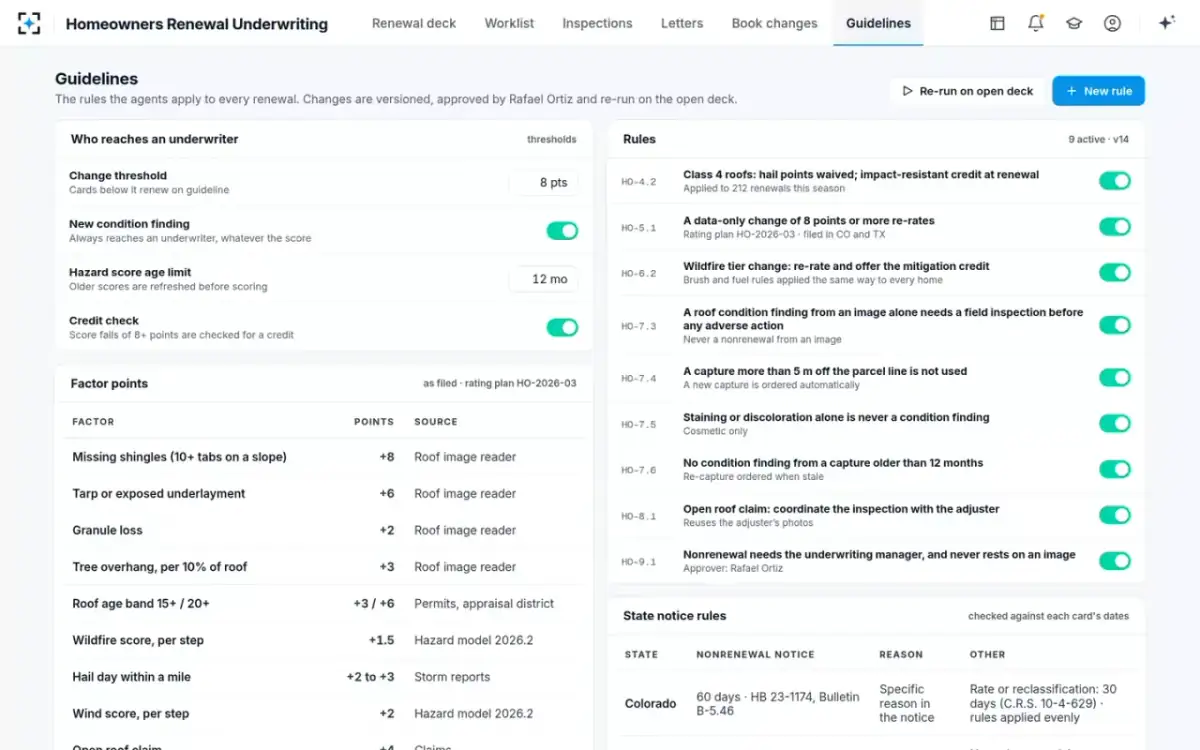
In Homeowners Renewal Underwriting those checks become guidelines the underwriting manager owns. Roof age arrives from the permit with its number; roof-age points are kept apart from roof-condition points, so a letter can say which is which; an image-only condition finding goes to inspection before any adverse action; and the notice clock is set per state, so a Florida renewal's cutoff falls well before its 120-day date. The sample book in the solution is Colorado and Texas; a Florida book would carry the statute's branches as rules of its own, approved before they apply.
Roof-age points kept separate from roof-condition points
To see a whole renewal season worked this way, start from Homeowners Renewal Underwriting.
Questions people ask
What is the Florida 15 year roof law?
Fla. Stat. §627.7011(5), in force for homeowners policies issued or renewed since July 1, 2022. An insurer may not refuse to issue or renew solely because a roof is under 15 years old, must allow an inspection before requiring replacement of an older roof, and may not refuse for age alone if an authorized inspector finds five or more years of useful life left.
Can a Florida insurer drop me because my roof is 15 years old?
Not for age alone without the inspection step. The insurer must first allow you to have the roof inspected by an authorized inspector at your expense; if the report shows five or more years of remaining life, age alone cannot be the reason. A nonrenewal for condition or other lawful reasons still needs specific written reasons and 120 days' notice.
What are Citizens Insurance roof age requirements?
Citizens Property Insurance Corporation sets its eligibility and roof rules in its own underwriting manual, filed with Florida's Office of Insurance Regulation. Read the current manual for your renewal date alongside §627.7011(5), and ask your agent which version applies. Citizens' eligibility rules do change: Senate Bill 2-A of 2022, for example, made renewal policyholders ineligible once offered comparable private cover at no more than 20% above the Citizens renewal premium.
Who can do a roof inspection for insurance in Florida?
An "authorized inspector" under §627.7011(5)(a) must be approved by the insurer and be a licensed home inspector, a certified building code inspector, a licensed general, building, residential or roofing contractor, a professional engineer, a professional architect, or another person the insurer recognises as qualified. Ask the insurer which inspectors it accepts before you book one.
Does replacing part of my roof reset its age?
Only when the parts add up to the whole roof. The statute counts age from the last full build or replacement, or, for a series of partial replacements that together covered the whole surface, from the date of the first of them. A one-slope repair leaves the roof's age where it was.