Homeowners insurance renewal inspection requirements are set mostly by the insurer, not by statute: an insurer may ask to inspect the exterior, the roof or the lot before renewing, and its guidelines say when. State law shapes the requirement in two ways. Some states limit what an adverse renewal decision can rest on: Florida requires an insurer to let the owner of a roof 15 years or older get an inspection before demanding replacement, and Maryland, Maine and Delaware have told insurers to investigate further, or inspect, before acting on unclear or disputed aerial images. And every state sets a notice date, 60 days before renewal in Texas and Colorado, 75 in California and 120 in Florida, after which an inspection can no longer change the outcome this year. The underwriting skill is ordering inspections only where the evidence disagrees, and early enough. Botminds' Homeowners Renewal Underwriting does that: it sends an image-only roof finding to inspection before any adverse action, scopes the order from what changed, and ranks every renewal by its own state's cutoff.
The sample season below is a fictional insurer's, Larkmoor Mutual's, January 2027 renewals in Colorado and Texas, as they run through the solution.
Renew, re-rate or inspect: the evidence decides which
Renew
When the change is small, or it favours the homeowner.
A new Class 4 roof on permit: score down 13, renew with a $402 credit.
Re-rate
When the change rests on data that does not need a site visit to trust.
A roof that moved into an older age band on its permit; a hazard score from a dated model version.
Inspect
When the change rests on an image alone, or the sources disagree.
About 14 missing shingles seen in one aerial capture: inspect before any adverse action.
When does a homeowners insurer require an inspection at renewal?
When its guidelines say a finding needs confirming, and increasingly when a regulator expects it. Insurers inspect at renewal for roof condition, visible damage, unrepaired claim damage, undisclosed features and mitigation credits. The regulators' 2025 bulletins on aerial imagery turned part of that into an expectation. Maryland's position is that if imagery "alerts an insurer to a possible problem with the condition of an insured property without unequivocally establishing the existence of the problem, the insurer should conduct further investigation", by better images or "inspecting the property by alternative means" (Maryland Bulletin 25-10). Delaware recommends that "if a customer disputes a finding based on aerial imagery, the insurer should conduct a physical inspection" (Delaware Bulletin No. 150).
Florida writes one inspection into statute. For a roof at least 15 years old, an insurer must let the homeowner pay for an authorized inspector's report on the roof before it can require a new roof as a condition of renewal (Fla. Stat. §627.7011(5)(c)). The Florida roof-age guide walks that rule branch by branch.
California adds a mitigation case. An insurer that verifies wildfire mitigation by inspection must offer a free inspection option alongside any paid one, and must accept inspections by CAL FIRE or a local fire department (CDI insurer FAQ, September 2026).
The notice date decides when an inspection is too late
An inspection only changes a renewal if its report arrives before the insurer's own decision cutoff, and that cutoff has to sit ahead of the state's notice date with time to draft, sign and mail. Work backwards from each state's notice period and the latest sensible day to open the review moves a long way.
When the review must open, working back from each state's notice date
- Decide, incl. inspection14 d
- Draft, sign, mail15 d
- Notice period120 d
- Decide, incl. inspection14 d
- Draft, sign, mail15 d
- Notice period75 d
- Decide, incl. inspection14 d
- Draft, sign, mail15 d
- Notice period60 d
- Decide, incl. inspection14 d
- Draft, sign, mail15 d
- Notice period60 d
The chart makes a point a single-state carrier can miss. A review cycle that opens 90 days before renewal, as the sample insurer's does for Colorado and Texas, is already past the Florida notice date when it starts, and leaves California with no decision window at all. A multi-state book needs a cutoff per state, and the inspection has to fit inside the window before it. In the sample season the inspection vendor is asked to report within 10 days of the order, and reports came back in a median of six.
The consequence of missing the date is that the inspection's finding waits a year, or worse. In Texas, without notice mailed at least 60 days before the policy expires, the insurer must renew at the insured's request (§551.105). In California the policy, with no change in its terms, continues 75 days from a late notice (CDI).
How many days notice for non renewal of homeowners insurance in Texas?
Sixty days: the insurer must mail written notice of nonrenewal, or of renewal with a change in coverage, no later than the 60th day before the policy expires. If it does not, it must renew at the insured's request, though the policy ends once replacement coverage with another insurer takes effect (Tex. Ins. Code §551.105). Since January 2026 the written statement must also give the precise reason and the source of the information relied on (§551.002(c)), so an inspection report relied on for a nonrenewal has to be named in it. Notice requirements state by state are the specialty of Botminds' Cancellation and Nonrenewal Compliance.
Order inspections only where the evidence disagrees
Inspecting every changed renewal is slow and expensive; inspecting none is how a nonrenewal rests on a blurry image. The rule that works is to inspect where the evidence for an adverse change rests on a single source that cannot settle it, usually one aerial image, or where sources disagree, such as a permit that says new roof and an image that says damage.
In the sample season, 1,284 of 18,460 January renewals changed enough to need an underwriter. Of those, 154, 12%, went to inspection. The rest were renewed or re-rated on data that needed no site visit: a permit date, a model version, a storm report. Of 97 reports returned so far, 61 confirmed the image finding and 36 cleared it. Each cleared finding was an adverse action that would have rested on something not there.
Inspections: ordered from the changed renewals, scoped from what moved
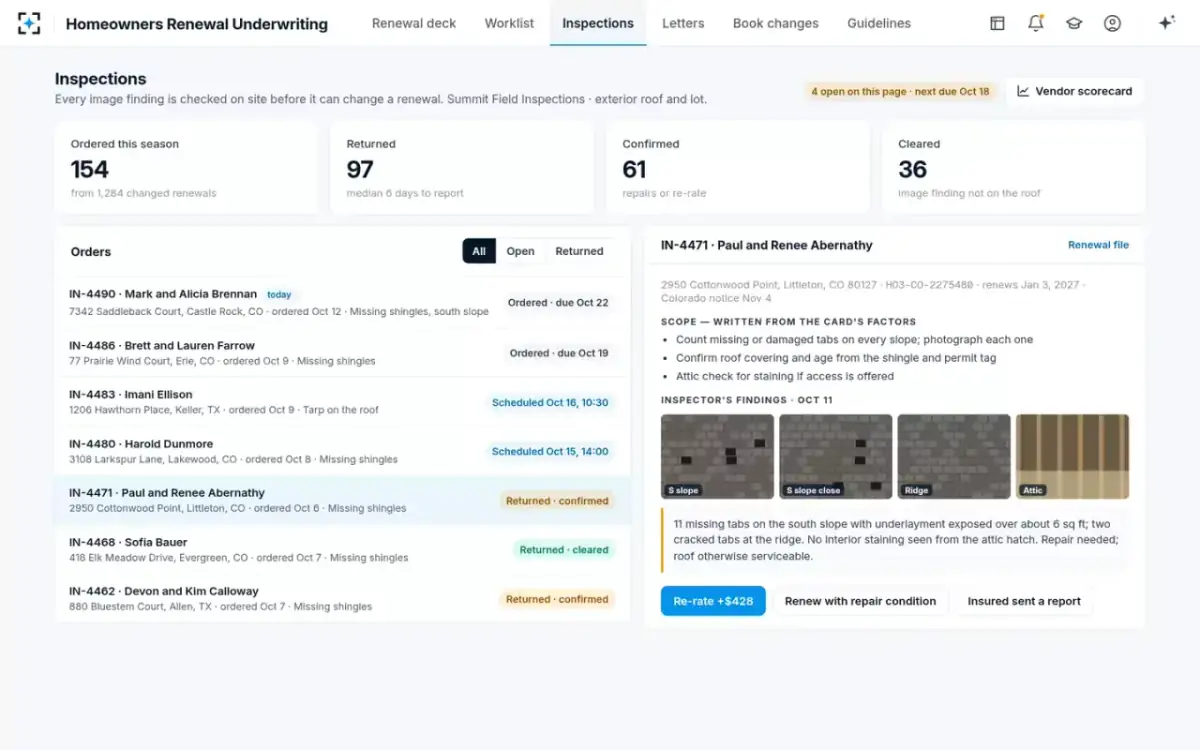
Homeowners insurance renewal inspection checklist: what the inspector should be asked
An inspection ordered "to check the roof" returns a general report. One scoped from the factors that triggered it returns an answer. In the sample set-up each order carries a scope written from the renewal's own changes.
A renewal inspection checklist, scoped from what changed
- Count missing or damaged tabs on every slope, and photograph each
Settles the image finding directly, and tells the underwriter whether this is a repair or a replacement.
- Confirm the roof covering and its age from the shingle and the permit tag
Age drives Florida’s 15-year rule and most roof-age bands; the permit is the evidence.
- Check for tarps, exposed underlayment and granule loss
The conditions an image suggests but cannot measure.
- Note tree overhang and fuel within 30 feet of the house
Wind and wildfire factors that a homeowner can fix before renewal.
- Check the attic for staining, if access is offered
The one sign of a leak an aerial capture cannot see.
- Confirm it is the right house
Maine lists complaints of images showing the wrong structure; an inspector on site removes the doubt.
- Record any repair already done, with dates
A repaired roof is a renewed roof; the report should say so in terms the underwriter can rely on.
- If there is an open roof claim, coordinate with the adjuster
The sample guidelines reuse the adjuster’s photos rather than send a second visit.
What happens if you fail a home insurance inspection?
Usually a choice, not a cancellation. A confirmed finding leads to one of three outcomes: renew with a repair condition, re-rate, or, for serious conditions, not renew, with specific reasons and the state's notice. On one sample report, 11 missing tabs on the south slope with underlayment exposed over about six square feet, the underwriter's options were to re-rate by $428 or renew with a condition that the roof be repaired. Maine's regulator encourages that order of things: "Insurers are encouraged to issue loss control recommendations and provide homeowners with reasonable time to make needed repairs before taking other action, such as nonrenewal" (Maine Bulletin 483).
For the homeowner the practical steps are the same everywhere: get a copy of the report and photos, fix what is real, and send proof of the repair, or a roofer's own report, before the notice date. In the sample set-up a report sent by the insured reopens the renewal.
Insurance inspection after the renewal notice: what can still change
If an inspection happens after the renewal has been offered or taken effect, what the insurer can do depends on state cancellation law, which is narrower than renewal law. Texas lets an insurer cancel a homeowners policy mid-term for "an increase in the hazard covered by the policy that is within the control of the insured and that would produce an increase in the premium rate", with 10 days' notice (§551.104(c), (e)). Florida, once a policy has been in force 60 days, allows cancellation for a short list of causes including "a substantial change in the risk covered by the policy" (§627.4133(2)(b)3). Most other findings wait for the next renewal. An inspection ordered before the cutoff avoids that whole problem.
For a new policy, Texas sets an inspection rule of its own: an insurer may cancel a homeowners policy in force less than 60 days if, before the policy took effect, it did not accept a required inspection report by a licensed or otherwise authorized inspector "dated not earlier than the 90th day before the effective date of the policy" (§551.104(g)(2)).
Who does what when a renewal goes to inspection
Six people around one renewal inspection, before and after the agents
Today
Orders inspections from a list, often late in the window, with a generic scope.
With agents
Swipes Inspect on an image-only finding; the order goes out the same morning with a scope written from the factors.
Still theirs: The decision after the report: renew, repair condition or re-rate.
Today
Chases the vendor and the calendar by hand.
With agents
Sees every order with its due date, ten days from ordering, against each renewal’s cutoff.
Still theirs: The vendor relationship and its scorecard.
Today
Gets an address and a general request.
With agents
Gets a scope: which slope, which finding, which permit tag.
Still theirs: What is actually on the roof.
Today
Gets a letter saying an inspection is needed, sometimes without knowing why.
With agents
Gets numbered reasons, each with its photo or permit, and the option to send their own roofer’s report instead.
Still theirs: The right to repair, dispute and be heard.
Today
Hears about the inspection from the client.
With agents
Gets a copy of every letter with the reasons and dates.
Still theirs: The client conversation.
Today
Finds out about inconsistent inspection decisions in an audit.
With agents
Sees nightly any similar homes where one was inspected and one was not.
Still theirs: Approval of every nonrenewal.
When an image cannot be trusted, inspect the roof and replace the image
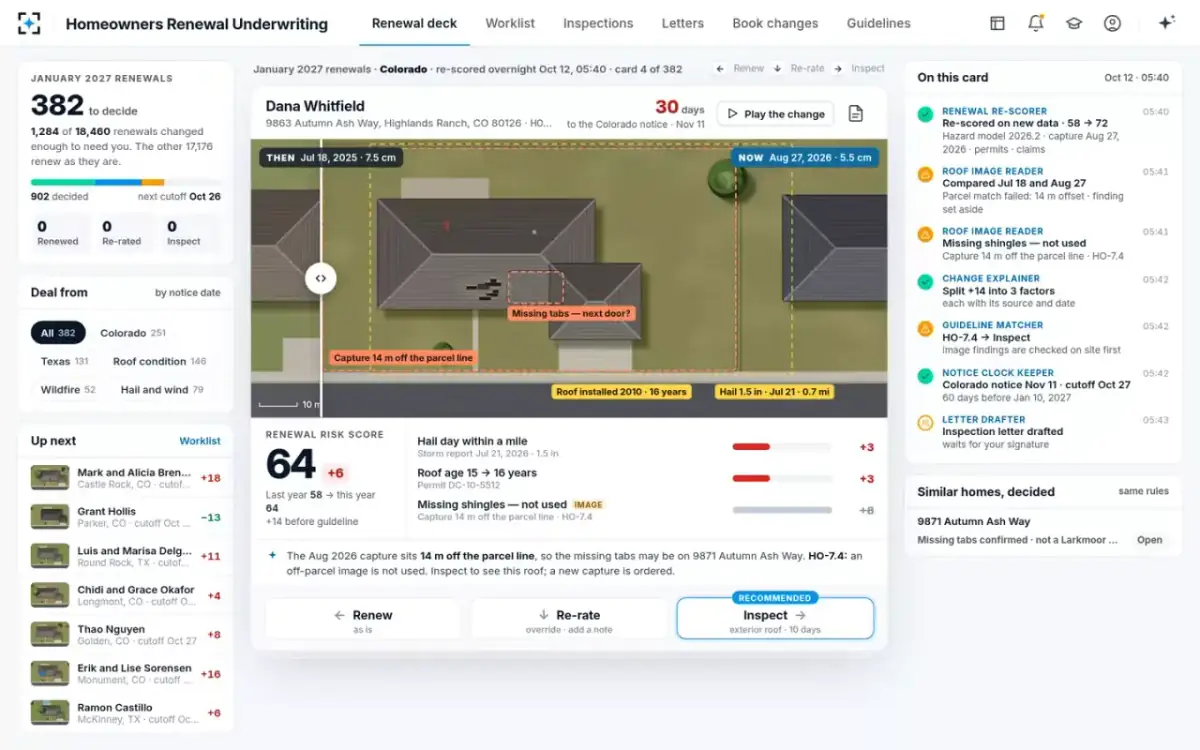
Some inspections are ordered because the image itself fails. In the sample deck, one Highlands Ranch capture sat 14 metres off the parcel line, so the missing tabs it showed might belong to the neighbour. Under the insurer's rule an off-parcel image is not used; the finding was marked as such, the score change shrank from 14 points to 6, and the recommendation became an inspection of the right roof while a new capture was ordered. That is the order of operations every recent bulletin asks for: doubt the image, check the house, then decide. How to test an imagery tool for image quality before trusting it is set out in the aerial imagery underwriting tool test; what one renewal review costs prices the inspection line.
A capture off the parcel line is set aside, and the roof is inspected
For the full sample season, from re-score to signed letter, start from Homeowners Renewal Underwriting.
Questions people ask
Does homeowners insurance require an inspection?
Not always. Many policies are written and renewed on data alone, but insurers can require an exterior or roof inspection under their guidelines, at new business or renewal. In Texas a new homeowners policy can be cancelled in its first 60 days if the insurer did not accept a required inspection report dated within 90 days before the policy began.
Who pays for a renewal inspection?
Usually the insurer, when it orders the inspection; the sample letters say there is no cost to the homeowner. Florida's roof rule is the exception that runs the other way: for a roof 15 or more years old, the homeowner may commission an authorized inspector at their own expense to show five years of remaining life.
Can I send my own roofer's report instead?
Often, yes. Several state regulators encourage insurers to let homeowners provide updated information or dispute imagery, and in the sample set-up a roofer's report sent by the insured is accepted in place of the inspection and reopens the renewal. Florida's statute names the professionals whose inspection counts for the roof-age rule.
How long does a homeowners insurance inspection take?
The visit itself is short; the wait is for scheduling and the report. In the fictional sample season the vendor is asked to report within 10 days of the order, and returned reports took a median of six days. Order early enough that the report lands before the insurer's decision cutoff.
What is a conditional renewal of homeowners insurance?
A renewal offered on new terms, such as a repair condition, a higher deductible or a premium change, rather than a refusal to renew. States set their own notice rules for it; Texas, for example, counts a renewal "with written notice of change in coverage" within its 60-day rule. Botminds' Cancellation and Nonrenewal Compliance covers those notice requirements state by state.