To look up a wildfire score by address, start with the insurer, because the score that changes your premium or your renewal is the insurer's own, usually built from a vendor's model. In California an insurer that rates on wildfire risk must give you that score in writing, at least 45 days before each renewal and 75 before any nonrenewal, with the range of possible scores, where yours sits, the features of your property that drove it, and the right to appeal (10 CCR §2644.9, as summarised in the CDI's 2026 Annual Notice). For a second, public view, the USDA Forest Service's Wildfire Risk to Communities map shows wildfire risk for your community; by its own account it is "not designed for insurance companies" (Wildfire Risk to Communities FAQ). When a score moves at renewal, the question that matters is which input moved: the vegetation near the house, the house itself, or the model. Botminds' Homeowners Renewal Underwriting re-scores every renewal and splits each change into its sources, so the underwriter and the letter can say which.
Four numbers for anyone looking up a wildfire score
45days
before each renewal: when a California insurer must give you its wildfire score
30days
for a California insurer to decide your appeal of the score, in writing
2024
year the Forest Service map was fully rebuilt; its 2020 and 2024 versions cannot be compared
25.1per 1,000
Western-zone homeowners policies non-renewed in 2024, the highest of any zone
Wildfire score lookup by address: the two places to look
There are two kinds of wildfire score, and they answer different questions. An insurer's wildfire score rates one property for pricing and eligibility, usually on a short scale or as a tier, and is often licensed from a model vendor. A public risk map rates places, so a community or a planner can see where risk is concentrated. A homeowner can look up the second freely; the first comes from the insurer, and in California the insurer must provide it.
Two wildfire scores for one address, and what each is for
Your insurer's wildfire score
- Rates your property, often from a vendor's model and a named model version.
- Can move your premium, your tier or your renewal.
- In California: given to you in writing with the range of possible scores, your place in it, the effect on your premium and the features of your property that drove it.
- In California: the mitigation steps that would lower it, with the premium saving for each, and a right to appeal.
The Forest Service's Wildfire Risk to Communities map
- Created by the USDA Forest Service "under the direction of Congress in the 2018 Consolidated Appropriations Act".
- Built from national data sets with different vintages, including LANDFIRE vegetation and fuels.
- "not a replacement for parcel-level or home assessments"; the data "are not locally calibrated and are not fine scale".
- "not designed for insurance companies"; useful for seeing whether your area's hazard is high relative to the state.
The public map is worth checking for one reason above all: it tells you whether your community sits in a high-hazard area at all. If it does not, and your insurer's score says otherwise, that is a question to put to the insurer. If it does, the map will not tell you why your own score moved this year; only the insurer's inputs will (Wildfire Risk to Communities, About).
What is my wildfire risk score, and what does it mean?
It is the insurer's estimate of how exposed your property is to wildfire loss, expressed on the insurer's or its vendor's scale. A number alone means little: a 5 is high on a 1-to-5 scale and low on a 1-to-100 one. That is why California's regulation requires the insurer to state "The range of such scores or classifications that could possibly be assigned to any policyholder or applicant" and "The relative position of the score or classification assigned to the policyholder or applicant in question within that range of possible scores or classifications, and the impact of the score or classification on the rate or premium" (10 CCR §2644.9(k)).
The regulation also requires the why: "a detailed written explanation of why the policyholder or applicant received the assigned score or classification", which "shall make specific reference to the features of the property in question that influenced the assignment". Outside California, ask for the same three things: the scale, your position on it, and the features that drove it. Texas, since January 2026, requires any nonrenewal statement to name the precise risk factor and the source of the information relied on (Tex. Ins. Code §551.002(c)), which covers a wildfire score used as a reason.
Wildfire risk score by address or by ZIP code?
By address, if you want the number that prices your policy; by community or ZIP code, if you want context. Insurers score parcels, and two houses on one street can differ by the brush between them. The Forest Service's FAQ says its data "are not designed for considering risk at the individual home scale" and that the site "uses a generalized concept of susceptibility for all homes". A ZIP-code view is also how federal analysts study the market: the Treasury found that in the riskiest fifth of ZIP codes, measured by expected climate losses, the paid loss ratio was 18% higher than in the safest fifth, and nonrenewal rates more than doubled between 2018 and 2022 (FIO, January 2025).
Why a wildfire score changes when nothing at the house did
A wildfire score can move because the property changed, because the land around it changed, or because the model changed. The third is the one homeowners least expect. Models are versioned and re-run; their inputs, vegetation maps, weather records, fire history, have vintages. The Forest Service's own site shows how large such a change can be: its 2024 release completely updated the maps, and "Direct comparisons between the 2020 and 2024 versions are impossible due to fundamental methodological changes" (WRC FAQ). Its FAQ also says an update to the risk data "is planned for 2026."
Insurance scores behave the same way. A new model version can shift scores across a whole region overnight. That is not wrong in itself, but it changes what a renewal letter has to say. A letter that reports "your wildfire score rose" without saying whether the house, the vegetation or the model changed leaves the homeowner unable to act, which is exactly the problem regulators' specific-reason rules are aimed at.
Last year's score and this year's, input by input
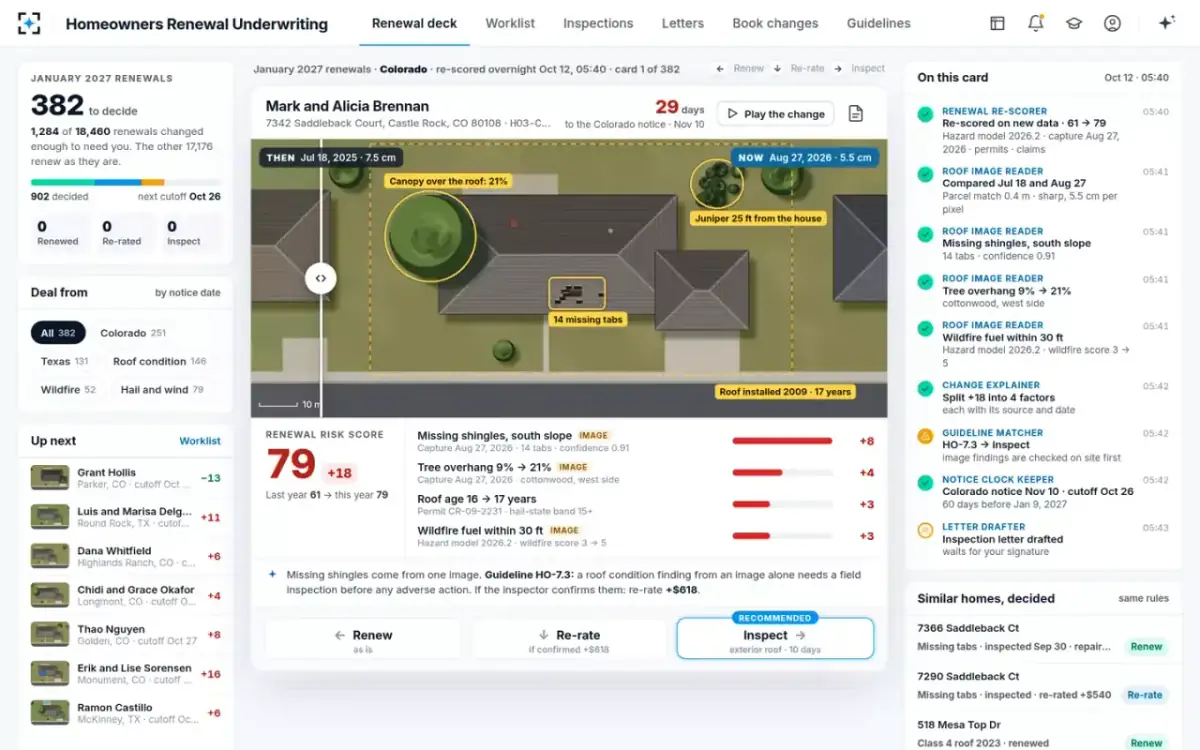
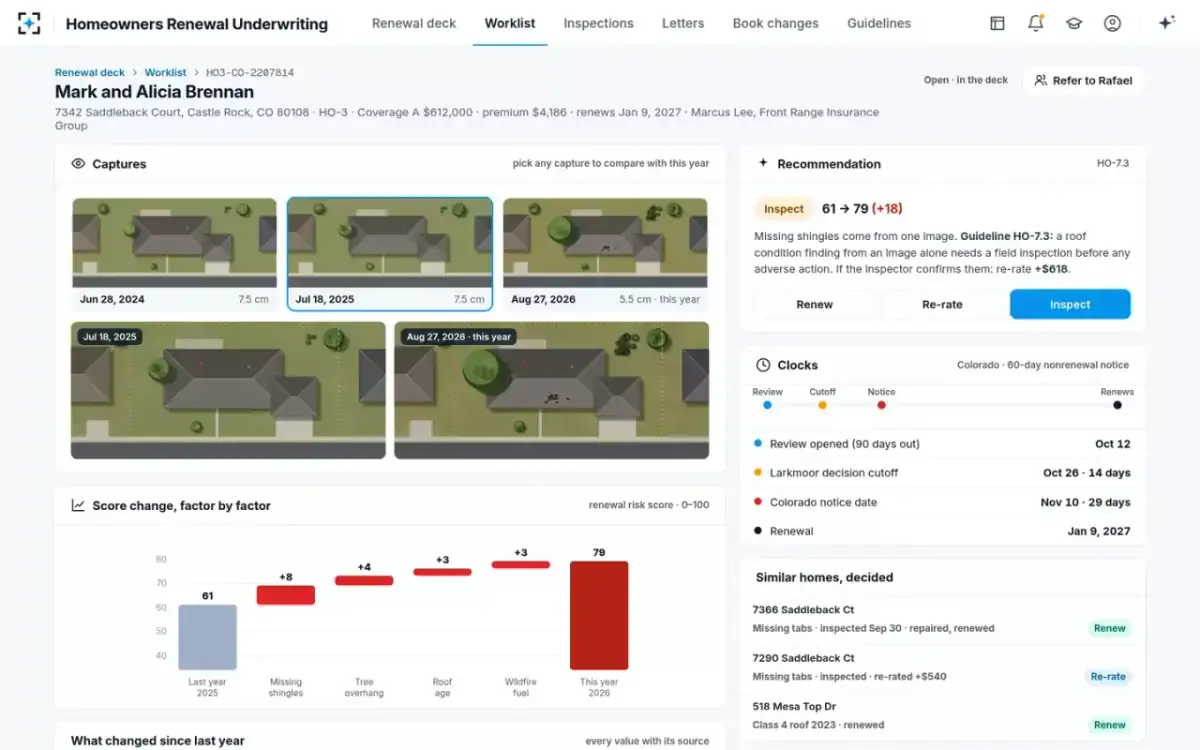
Here is a wildfire change taken apart on a sample renewal: a fictional insurer's January 2027 renewal of a fictional home in Castle Rock, Colorado, as Homeowners Renewal Underwriting re-scored it on Oct 12, 2026.
One home's wildfire inputs at last renewal and at this one
Last renewal: 3
This renewal: 5
Last renewal: Version 2026.1
This renewal: Version 2026.2, dated Sep 30, 2026
Last renewal: No finding listed
This renewal: Juniper and brush about 25 ft from the north-east corner, from the Aug 27, 2026 aerial capture
Last renewal: —
This renewal: +3: two steps at 1.5 points each, as filed in the rating plan
Last renewal: Hail 4, wind 3, flood zone X
This renewal: Unchanged
Last renewal: —
This renewal: “Juniper and brush are now about 25 feet from the north-east corner of the house, and our wildfire score for the address rose from 3 to 5.”
Two inputs moved at once here: the model version and the vegetation in the newest capture. The letter names the vegetation, which the homeowner can do something about, and the score change, with the capture date and model version kept beside each in the insurer's copy. What it does not do is pretend the whole change was the juniper. The sample insurer's rule for a wildfire-tier change, HO-6.2, re-rates and offers the mitigation credit, and applies the brush and fuel rules "the same way to every home".
Then and now under one slider: the change that moved the score
Wildfire risk score in California: the disclosure and appeal clocks
California is the only state we know of with a regulation requiring insurers to disclose the wildfire score and hear appeals on it. The clocks are short and specific.
California's wildfire score clocks, in days
The appeal can be made "orally or in writing", directly to the insurer or through the agent or broker. The Department's consumer guidance gives the practical trigger: you can appeal "if you believe it is inaccurate —for instance, if you have done wildfire safety work since your last renewal", and if the appeal is denied, contact the Department at 800-927-4357 (CDI, Safer from Wildfires FAQ). When the insurer answers an appeal it must tell you that you may contact the Department.
Homeowners insurance in wildfire areas: what moves a renewal
In wildfire areas the renewal turns on three things: the hazard score, the property's mitigation, and any moratorium. The hazard side shows in the regulators' data: the Western zone's nonrenewal rate rose from 8.0 per 1,000 policies in 2022 to 25.1 in 2024 (NAIC). The guide to why insurers are non-renewing homeowners policies sets out the regional numbers.
Mitigation is where a homeowner has leverage, and in California it is priced by rule. The Department expects "at least $1 in premium reduction for each mandatory factor", and an insurer that requires inspections to verify mitigation must offer a free inspection option and "shall accept inspections by CAL FIRE or a local fire department as proof or verification" (CDI insurer FAQ, revised September 4, 2026). The consumer list includes a Class A fire-rated roof, a five-foot ember-resistant zone around the structure, ember- and fire-resistant vents and enclosed eaves.
Moratoria are the third. After a declared wildfire emergency, California bars nonrenewals in ZIP codes within or adjacent to the fire perimeter for a year when based solely on the wildfire's location. That is the work of Botminds' Binding Restriction Management, whose wildfire binding restrictions map follows each order.
What a renewal underwriter owes the homeowner when the score moves
When a wildfire score moves a renewal, the underwriter owes the homeowner the same thing California's regulation requires and Texas's statute now implies: what moved, from which source, and what would move it back. In Homeowners Renewal Underwriting that is how the change reaches the underwriter. The renewal re-scorer refreshes any hazard score older than 12 months before scoring; the change explainer splits the score change into filed factors, so wildfire appears as its own line with the model version and the capture behind it; the guideline matcher applies the wildfire rule the same way on every street; and the letter drafter writes the reason in plain words, with the mitigation credit where the rule offers one. A named underwriter decides and signs.
The renewal file: captures, clocks and the change, factor by factor
Wildfire score lookup tools: what an insurer or agent should look for
For an insurer or agency choosing a wildfire score lookup tool, the lookup is the easy part. What separates tools is whether they keep history and explain change. Ask whether the tool returns the model version and data vintage with every score; whether it stores last year's score for the same address so a change can be shown; whether it separates property features, such as vegetation within 30 feet or roof class, from area hazard; whether it can produce California's range, relative position and property-specific explanation; and whether it tracks mitigation credits per factor. A tool that returns only today's number cannot answer the question a renewal letter has to: what changed. Homeowners underwriting software, compared on one renewal applies the same test to the whole renewal process.
To see a wildfire change worked through a whole renewal season, start from Homeowners Renewal Underwriting.
Questions people ask
How do I find my wildfire risk score by address?
Ask your insurer or agent for the score used on your policy; California insurers that rate on wildfire risk must provide it in writing, at least 45 days before each renewal. For a public view of your community's risk, search your address on the USDA Forest Service's Wildfire Risk to Communities site, keeping in mind that it is community-level and not built for insurance.
What does a wildfire risk score of 5 mean?
It depends on the scale. On a 1-to-5 tier it is the top band; on a 1-to-100 scale it is low. California requires insurers to state the range of possible scores and where yours sits, and the effect on your premium; elsewhere, ask for both before reading anything into the number.
Can I appeal my wildfire score?
In California, yes: orally or in writing, to the insurer or through your agent or broker. The insurer must acknowledge within 10 calendar days and decide within 30; if it denies the appeal you can contact the Department of Insurance. Elsewhere, ask the insurer to reconsider with evidence such as defensible-space work or a new Class A roof.
Why did my wildfire score go up if nothing changed?
Often because the model or its data changed: a new model version, new vegetation data or new fire history. The Forest Service notes that its own 2020 and 2024 maps cannot be compared because the method changed. Ask your insurer which input moved, and whether the change came from your property or the model.
Does a wildfire score affect my homeowners insurance renewal?
It can raise the premium, change your tier or, with other factors, lead to a nonrenewal. In California a nonrenewal needs 75 days' notice and, where the insurer rates on wildfire risk, the score must be given at least 75 days before; after a declared wildfire, nonrenewals near the fire perimeter are restricted for a year.