A homeowners insurance non renewal appeal starts with the insurer and, if that fails, goes to the state insurance department as a complaint or, in some states, a formal hearing; it succeeds most often when the insurer's own file cannot show a specific reason backed by current, accurate evidence. Since 2024 at least nine states, among them Maryland, Maine, Delaware and Tennessee in 2025, have written down what they will not accept: nonspecific reasons, blurry or dated aerial images, the wrong house, and cosmetic roof staining offered as damage. Maryland adds that at a hearing the insurer carries the burden of showing its action was justified. For underwriters the lesson runs backwards: the appeal is won or lost when the renewal is decided. Botminds' Homeowners Renewal Underwriting builds that file as the decision is made, with every reason tied to a dated source and every image-only roof finding inspected first.
The sample file scored below belongs to a fictional insurer, Larkmoor Mutual, and a fictional household in Castle Rock, Colorado, as the solution handles them.
Four numbers behind a nonrenewal appeal
60–120days
notice before a homeowners nonrenewal in Texas and Colorado (60) up to Florida (120)
18+months
age of some images Maine homeowners said insurers relied on
2026
year Texas began requiring the source of information on every nonrenewal statement
36of 97
image findings cleared on site in a sample insurer’s season
Can you appeal a homeowners insurance non renewal?
Yes, in two stages. First with the insurer: ask, in writing, for the specific reason and the evidence behind it, correct whatever is wrong, and ask the insurer to rescind the notice. Then with the state: every insurance department takes complaints, and some states give the homeowner a formal hearing. California requires the nonrenewal notice itself to say that a consumer who has contacted the insurer and "remains unsatisfied" may have the matter reviewed by the department, with its website and telephone number (Cal. Ins. Code §678(a)(1)(B)).
Maryland and Maine go further. A Maryland homeowner who requests a hearing "would be entitled to review images and any other material that the insurer relied upon", and under §27-501(g) "the insurer would bear the burden of persuasion to show that the contested action was justified" (Maryland Insurance Administration, Bulletin 25-10). Maine's Bureau of Insurance says the same of its cancellation law: "Under the MPICCA, the burden is on the insurer to prove the reason for non-renewal" (Bulletin 483).
Maryland's statutes also give the Commissioner a specific power: to disallow a nonrenewal if the insurer's stated reason "contains erroneous information" and there is not enough basis for the action without it. A file built on a wrong roof age, a neighbour's roof or a stale capture is exposed to exactly that.
What regulators say fails: the seven tests a nonrenewal must pass
Read together, the 2025 bulletins and the reason statutes give seven tests. Each comes from a regulator's or legislature's own text, and each is something an underwriting file either shows or does not. Delaware's bulletin states the first one bluntly: "Nonspecific reasons, such as “claims experience,” “underwriting judgment,” or “increase in hazard,” are unacceptable as they do not provide sufficient notice for the insured to address the underlying issue" (Delaware Bulletin No. 150).
The others follow the evidence. Maryland's position is that an image may support a nonrenewal "only if the image provides a clear, accurate, and current view of the property" (MD 25-10). Maine reports homeowners' complaints that images were more than 18 months old or showed the wrong structure. Delaware holds that "cosmetic issues, such as discoloration and streaking, do not constitute valid grounds for cancellation" and that insurers "must provide clear evidence of significant degradation or damage that increases the risk of loss". Tennessee asks insurers to let the homeowner "provide updated information or dispute the accuracy of the aerial imagery used" (Tennessee Bulletin 25-03).
The tests, scored against one sample file
Here are the seven tests applied to two files: a weak one, assembled from the failures the regulators describe, and the sample file for the Brennan home in Castle Rock as Homeowners Renewal Underwriting prepared it. The Brennan file is at the inspection stage, so it is scored as the file an adverse decision would rest on if the inspection confirms the damage.
Seven tests regulators apply to a nonrenewal, scored on two files
A specific reason, not a label
Whose ruleDelaware Bulletin 150; Fla. Stat. §627.4091; Md. Ins. §§27-604, 27-605
Weak fileFails “Increase in hazard.”
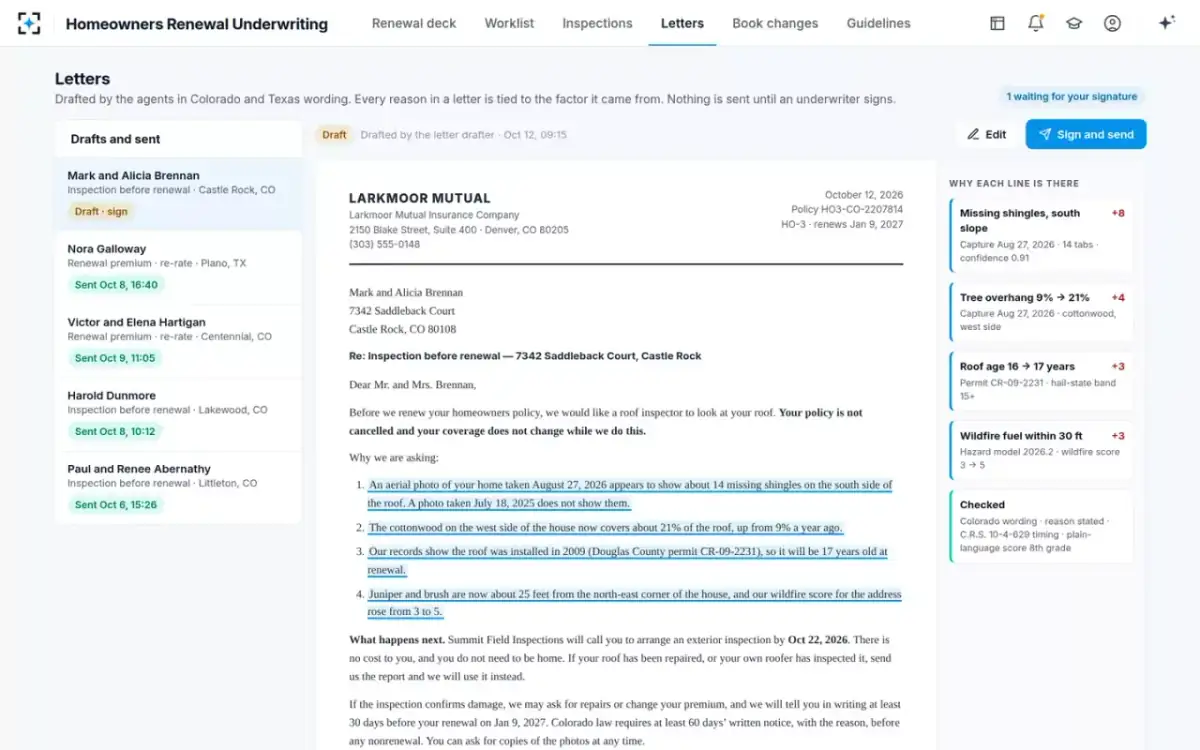
Sample fileHolds Four numbered reasons: about 14 missing shingles on the south slope; tree cover up from 9% to 21% of the roof; roof installed 2009; brush 25 ft from the house and a wildfire score up from 3 to 5.
The source of each reason named
Whose ruleTex. Ins. Code §551.002(c), from Jan 1, 2026
Weak fileFails None given.
Sample fileHolds Aerial capture of Aug 27, 2026 against Jul 18, 2025; Douglas County permit CR-09-2231; hazard model 2026.2.
An image that is clear, current and of the right house
Whose ruleMaryland 25-10; Maine 483; Tennessee 25-03
Weak fileFails A capture more than 18 months old, parcel not checked.
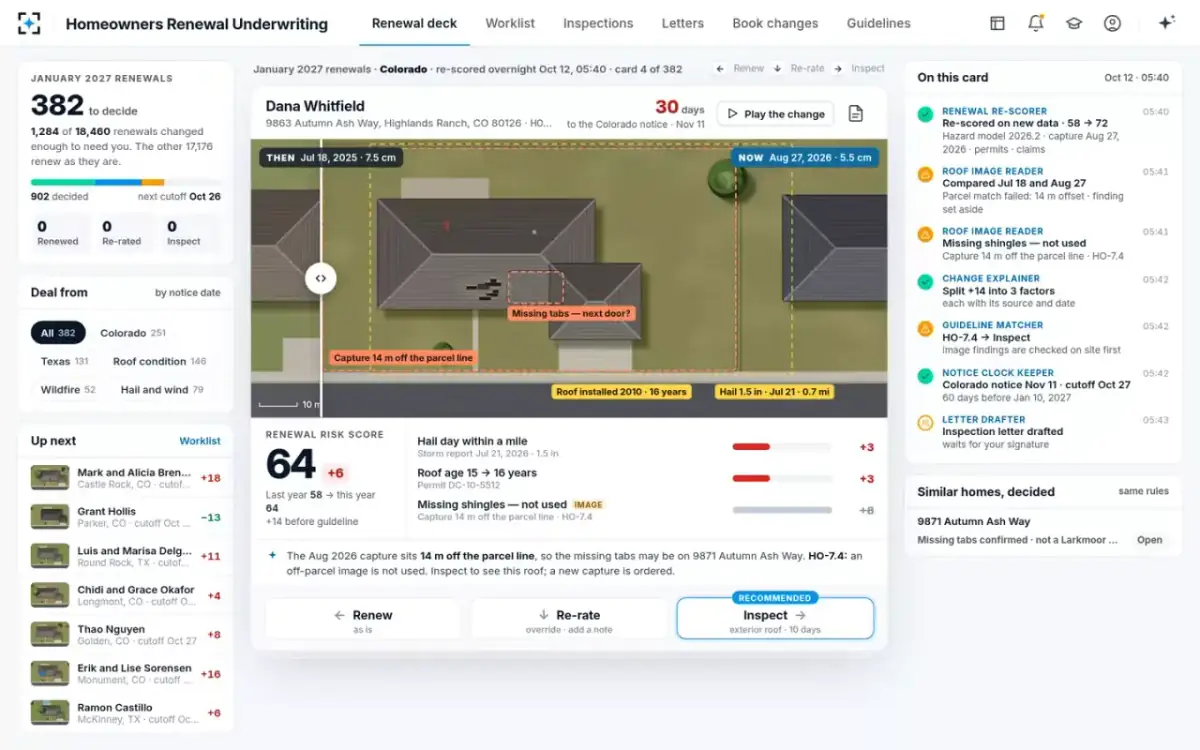
Sample fileHolds 5.5 cm capture taken six weeks before the review; parcel match checked; an image more than 5 m off the parcel line is not used.
Damage, not a cosmetic blemish
Whose ruleDelaware Bulletin 150; Maryland 25-10
Weak fileFails “Roof staining.”
Sample fileHolds Missing tabs counted; staining or discoloration alone is never a finding under the insurer’s rules.
Confirmed before any adverse action
Whose ruleMaryland 25-10 (further investigation); Delaware 150 (physical inspection when disputed)
Weak fileFails Decided on the image.
Sample fileHolds Exterior roof inspection ordered, due four days before the decision cutoff; nothing adverse until it returns.
The homeowner can see the evidence and answer it
Whose ruleMaryland 25-10; Maine 483; Delaware 150
Weak fileFails Photos not offered.
Sample fileHolds Copies of the photos on request; the homeowner’s own roofer’s report accepted instead, and it reopens the renewal.
Notice in time
Whose ruleColorado HB23-1174: 60 days
Weak fileFails Decided after the notice date; the policy renews as it was.
Sample fileHolds Decision cutoff Oct 26; Colorado notice date Nov 10; renewal Jan 9, 2027.
The weak file fails every test, and none of its failures is exotic. A label in place of a reason is what a letter template produces when the underwriter's reasoning lives in a notes field. A stale image is what a bulk imagery feed delivers when nobody checks the capture date against the decision date. The sample file passes because each pass was decided before anyone wrote a word: the guidelines forbid a finding from staining alone, set aside any capture more than 5 m off the parcel line or older than 12 months, and send every image-only roof finding to an inspector before any adverse action.
Homeowners insurance non renewal reasons that hold, and reasons that do not
A reason holds when the homeowner can tell from it what is wrong, where the insurer saw it, and what would fix it. The difference is easiest to see line by line.
The same roof, two letters: one invites the complaint, one answers it
A letter that invites an appeal: “Your policy will not be renewed due to an increase in hazard.”
A letter that holds: “An aerial photo of your home taken August 27, 2026 appears to show about 14 missing shingles on the south side of the roof. A photo taken July 18, 2025 does not show them.”
A letter that invites an appeal: None.
A letter that holds: The capture date, and the permit or hazard model behind every other reason, in the margin of the insurer’s copy.
A letter that invites an appeal: Decided on the image.
A letter that holds: An exterior roof inspection at no cost to the homeowner before any change.
A letter that invites an appeal: Nothing stated.
A letter that holds: Send the report of a repair or your own roofer’s inspection instead; ask for copies of the photos at any time.
A letter that invites an appeal: Notice mailed close to the legal minimum.
A letter that holds: Inspection due weeks before the notice date, so the decision, and any repair, can happen in time.
A good letter also does something for the insurer: it settles disputes before they become hearings. Maine's bulletin observes that "Many hearing requests can be resolved before the hearing when the homeowner is given an opportunity to provide more accurate information to the insurer" (Bulletin 483). In the sample season, 36 of 97 returned inspections cleared the image finding. Each of those was a dispute avoided, at the cost of a field visit.
A letter that says why, with every reason tied to its source
Who carries the burden of proof in a nonrenewal dispute?
In the states that have said so, the insurer. Maryland places the burden of persuasion on the insurer at a hearing; Maine says the burden is on the insurer to prove the reason, and adds that "If a change to the insurability of the property is asserted as a reason for nonrenewal, recent evidence will be required to meet this burden of proof." Where a state is silent, an examiner applying the NAIC's market-conduct standards tests the same thing from the other side: that "Cancellation/nonrenewal, discontinuance and declination notices comply with policy and contract provisions, state laws and the regulated entity's guidelines" (NAIC Market Regulation Handbook standards).
The practical consequence for an underwriting department is that the file has to be complete on the day the notice is mailed. Evidence gathered after a complaint, such as a new capture or a belated inspection, shows what the insurer could have known, not what it relied on. Texas has now written that into statute: since January 1, 2026, the written statement must name the source of the information the insurer relied on for each incident or risk factor (§551.002(c)(2)).
Can an insurance company non renew for no reason in Florida?
No. Florida requires that "Each notice of nonrenewal or cancellation must be accompanied by the specific reasons for nonrenewal or cancellation, including the specific underwriting reasons, if applicable" (Fla. Stat. §627.4091), and the notice for a homeowners policy must arrive at least 120 days before the nonrenewal takes effect (§627.4133(2)(b)). Florida also limits what the reason can be. A roof under 15 years old cannot be the sole reason, an act-of-God claim generally cannot be used, and a home damaged by a hurricane in a declared emergency cannot be non-renewed until 90 days after it is repaired. The Florida roof-age rule and what one claim can do to a renewal are set out in their own guides.
What to do if your homeowners insurance is not renewed
Act on the reason first and the market second, and use every day of the notice period. The notice periods, 60 days in Texas and Colorado, 75 in California and 120 in Florida, exist so that a homeowner can fix the problem or find other cover.
A homeowner's appeal checklist, in the order that saves the most time
- Read the reason, and ask for it in writing if it is vague
A label such as “increase in hazard” is the kind of reason Delaware calls unacceptable. Ask what condition, where, and from which source.
- Ask for copies of any photo or aerial image used, with its date
Maryland, Maine, Tennessee and Delaware all expect insurers to let homeowners see imagery used against them.
- Check that it is your house and your roof
Maine lists images of a neighbour’s building among homeowners’ complaints.
- Get your own evidence
A roofer’s or licensed inspector’s report, or a permit for a repair or replacement. In Florida, an authorized inspector’s finding of five years’ remaining life protects a roof 15 or more years old from nonrenewal for age alone.
- Fix what is real, and send proof before the effective date
Ask the insurer to rescind the notice once the repair is done.
- Talk to your agent at the same time
The agent can press the insurer and start shopping for replacement cover while the appeal runs.
- File a complaint with your state insurance department if the insurer will not reconsider
California notices must carry the department’s contact details; Maryland and Maine offer hearings at which the insurer bears the burden.
- Check whether a moratorium or repair rule applies
California bars wildfire-based nonrenewals near a declared fire for a year; Florida bars nonrenewal until 90 days after hurricane repairs.
Moratoria are their own discipline; Botminds' Binding Restriction Management handles the declared-emergency side, and the California moratorium nonrenewal notice guide explains the one-year rule near a fire perimeter.
Building the file before the complaint: what underwriting QA should check
Underwriting quality assurance usually samples decided files after the season. The seven tests above are better applied before the letter goes out, on every adverse decision, because each failure is cheap to fix before mailing and expensive afterwards. In Homeowners Renewal Underwriting they are applied as the work is done rather than sampled later.
The reason test is met by construction: the change explainer splits every score change into filed factors, each with its points, source and date, and the letter drafter writes one plain reason per factor. The image tests are met by rules the manager owns: no capture off the parcel or older than 12 months, no finding from staining alone, no adverse action on an image-only finding without inspection. The consistency test, which no single-file review can apply, runs every night: in the sample season it found 14 pairs of similar homes decided differently, including one Texas home re-rated on an image without the inspection the guidelines require, which was flagged to reopen.
When the photo shows the wrong house, the finding is set aside
What the solution does not do is decide. Every changed renewal is decided by a named underwriter; every nonrenewal goes to the underwriting manager; nothing is mailed until the deciding underwriter signs. The appeal-proof file is the by-product of that discipline, and Homeowners Renewal Underwriting shows it on a full sample book.
Questions people ask
What are common homeowners insurance non renewal reasons?
The condition of the property, most often the roof; a change in hazard such as wildfire or hail exposure; claims history; and an insurer's decision to reduce exposure in an area. The federal Insurance Office describes nonrenewals as driven by the risk profiles of properties, giving roof age as its example, or of areas with more severe climate-related risks. Whatever the reason, most states require it to be specific.
My insurance company refused to renew my policy: what are my rights?
You are owed timely written notice with the reason, the right to ask the insurer to reconsider, and the right to complain to your state insurance department. In Texas, if notice was not mailed at least 60 days before expiry, the insurer must renew the policy at your request (Tex. Ins. Code §551.105).
What are the homeowners insurance non renewal laws in my state?
Each state sets its own notice period and reason rules: for example 60 days in Texas and Colorado, 75 in California and 120 in Florida, with Florida and Texas requiring specific reasons. Your state insurance department publishes its rules and takes complaints; Botminds' Cancellation and Nonrenewal Compliance covers the state-by-state notice requirements for insurers.
Can an insurance company refuse to renew because of an aerial photo?
It can use the photo, but several regulators limit how. Maryland says an image can support a nonrenewal only if it gives a clear, accurate and current view; Delaware says discoloration and streaking are not valid grounds; Maine and Tennessee say images should not be the only information used. If the photo is old, blurry or of the wrong house, ask for a copy and dispute it.
How long does a nonrenewal appeal take?
There is no single clock. An insurer will often reconsider within days once a repair or a roofer's report arrives, and California requires insurers to answer a wildfire score appeal in writing within 30 calendar days. A department complaint or hearing can take longer, so start before the notice period runs out and shop for cover in parallel.