A California moratorium nonrenewal notice is any notice of nonrenewal, or of cancellation, issued due to wildfire risk for a covered property in a ZIP code that the Insurance Commissioner has listed under the one-year wildfire moratorium. If it was issued on or after the Governor’s emergency declaration, the insurer must offer to rescind it and to reinstate or renew the policy, even if the notice went out before anyone knew the ZIP code was listed. That last part is what makes the work hard: the moratorium runs from the declaration, while the bulletin naming the ZIP codes has arrived between 2 and 51 days later since 2024, so every bulletin opens a search backwards through notices already printed and mailed. Botminds’ Binding Restriction Management reads each bulletin’s ZIP codes and declaration date, cited to the line, has counsel confirm them, holds new notices inside the moratorium and lists every notice already mailed that must be offered back.
The bulletins and statute are the California Department of Insurance’s and the Legislature’s, linked where they appear; the lag figures are our count from them. The carrier and notices in the screens are fictional sample data in the solution.
The gap between a declaration and its bulletin is where offers to rescind come from
8
days: the median lag from the Governor’s declaration to the bulletin, 15 declaration dates since July 2024
51
days, the longest: Franklin Fire, declared 18 June 2025, bulletin 8 August 2025
61
ZIP codes added to one bulletin within eight days of its first issue, each frozen from the original declaration
13
moratorium bulletins since July 2024, every one requiring offers to rescind
What happens to a nonrenewal notice when a California moratorium starts?
If the notice was issued due to wildfire risk, for a property in a listed ZIP code, on or after the declaration date, it has to be offered back. Every moratorium bulletin says so in substantially the same words: insurers “must offer to rescind any notices of cancellation or non-renewal issued due to wildfire risk since the Governor’s” declaration, and “offer to reinstate or renew policies in effect at the time of the applicable emergency declaration” where such notices were issued on or after it (CDI Bulletin 2025-12). A notice issued before the declaration is not caught by that duty, and a notice issued for a reason other than wildfire risk is not caught by the moratorium at all.
From the bulletin onward the instruction is simpler: no insurer may issue a notice of cancellation or non-renewal due to wildfire risk in the listed ZIP codes for one year from the declaration. The hard part is the time before the bulletin, when the law has already changed and the carrier does not yet know where.
The first 60 days after three declarations: shaded days are where the offers to rescind come from
- No bulletin yet: notices due to wildfire risk must later be offered back51 d
- Bulletin out
- No bulletin yet8 d
- Bulletin out: residential and commercial notices held
- Before the first bulletin, 2 d
- 61 ZIP codes not yet listed8 d
- Amended list out
The moratorium clock starts on the declaration, not the bulletin
The statute fixes the start: an insurer may not cancel or refuse to renew “for one year after the declaration of a state of emergency” (Cal. Ins. Code §675.1(b)(1)). The bulletin comes after: the Commissioner lists ZIP codes from the perimeter data CAL FIRE provides for the fire tied to the declared emergency, and in every bulletin since 2024 the clock was already running when it arrived.
Which declaration counts is not always obvious. The Hughes Fire moratorium did not start on the 7 January 2025 declaration for the Los Angeles fires; the bulletin started it on 27 January 2025, when Executive Order N-14-25 was issued, “specifically incorporating the Hughes Fire as one of several named fires in the order,” and the bulletin followed on 25 February (CDI Bulletin 2025-6). A carrier that dated the Hughes ZIP codes from 7 January would have offered back notices the Hughes bulletin does not reach, unless the ZIP code was also listed for one of the 7 January fires, as three were; one that dated them from 25 February would have offered back too few.
How long the bulletins lag the declarations
The lag is usually about a week, and sometimes much longer. Across the 15 declaration dates named in the 13 bulletins since July 2024, the median was 8 days and the mean about 13; the longest, for the Franklin Fire, was 51. Two bulletins were later amended or supplemented to add ZIP codes, which reopens the gap for the ZIP codes added.
Days from each declaration to the bulletin listing its ZIP codes, 2024 to 2026
A carrier cannot shorten that lag, but it can decide what to do inside it. One option is to hold every wildfire-reason notice for property in and around the declared counties from the declaration until the bulletin arrives, then release those outside the listed ZIP codes; around, because listed ZIP codes can fall outside the counties a declaration names. The other is to keep printing and offer back afterwards. The first costs a few days of delay on some notices; the second costs letters, reinstatements and an explanation for each one.
Which notices must be offered back
Four tests decide it, and every one needs data a print system may not keep. The property is in a listed ZIP code; the notice was issued on or after the declaration date that the bulletin names; it was issued due to wildfire risk; and the policy was in effect at the time of the declaration. From 2026, the policy may also be commercial property, if it falls inside the new commercial definition explained in the 2026 update.
The reason test is the one most often missing. A nonrenewal notice states a reason for the insured, but the print file may carry only a code, and “underwriting” covers wildfire exposure and a dozen other things. A carrier that cannot tell which notices were issued due to wildfire risk will either offer back too many or defend too few.
Rescind, reinstate or renew: what each duty means in practice
The bulletins use three verbs, and which one applies depends on where the notice had got to. The table is our reading of the bulletins’ wording against four common positions; counsel should confirm it for any real case.
A notice issued due to wildfire risk after the declaration, in a listed ZIP code: what the insurer offers
| Where the notice had got to | What the insurer offers | Why |
|---|---|---|
| Printed, not yet mailed | Hold it; it should not mail | From the bulletin on, no such notice may be issued in the listed ZIP codes |
| Mailed; the policy has not yet expired | To rescind the notice, so the policy renews | The bulletin’s duty to offer to rescind notices issued since the declaration |
| Mailed; the policy has expired or been cancelled | To reinstate or renew the policy | The duty to offer to reinstate or renew policies in effect at the time of the declaration |
| Issued before the declaration | No offer under the bulletin | The duty reaches notices issued on or after the declaration date |
The word “offer” matters. The insured may have replaced the policy already, sometimes through the FAIR Plan or another carrier, and may decline. The carrier’s job is to make the offer clearly and to keep the evidence that it did; the insured decides.
When is a nonrenewal still allowed in a moratorium ZIP code?
When the reason is not the wildfire area. The statute bars a nonrenewal made solely because the insured structure is in an area where a wildfire has occurred, and lists three circumstances in which the moratorium does not apply at all: willful or grossly negligent acts or omissions by the named insured that materially increase the risk, losses unrelated to the post-disaster condition that would make the risk ineligible, and physical or risk changes beyond the catastrophe-damaged condition that make the property uninsurable (§675.1(c)).
A notice for one of those reasons still follows the ordinary rules, including California’s requirement that a nonrenewal notice be delivered or mailed at least 75 days before the policy expires (Cal. Ins. Code §678(c)). A notice released from a moratorium ZIP code should therefore carry its reason and the name of the person who released it, because that is what the carrier will be asked to show.
A worked example: one notice inside two windows
Take a hypothetical homeowners policy on a house in ZIP code 93023, in Ventura County, expiring on 31 March 2026. On 30 December 2025 the carrier mails a nonrenewal notice, more than the 75 days ahead the statute requires, citing wildfire exposure. Two moratoria bear on it, and neither looks obvious from the print room.
The first is old. 93023 was added to the Palisades and Eaton bulletin for the Olivas Fire in January 2025, under the 7 January 2025 declaration, so a wildfire-risk notice there was barred until 7 January 2026; the notice should never have been printed. The second is new. On 23 December 2025 the Governor declared an emergency for the Gifford Fire in San Luis Obispo and Santa Barbara counties, and Bulletin 2026-1 of 9 January 2026 listed 93023 among its 29 ZIP codes, although the house is in neither county. From 9 January the carrier owes an offer to rescind under Gifford as well, and the ZIP code stays frozen for wildfire-risk notices until 23 December 2026.
A table with one moratorium per ZIP code would have shown 93023 as clear on 30 December if it had kept only the expired Mountain Fire window, and a search by declared county would have missed the Gifford listing. A search by ZIP code and date, across every bulletin, finds both.
Running the print queue backwards in Binding Restriction Management
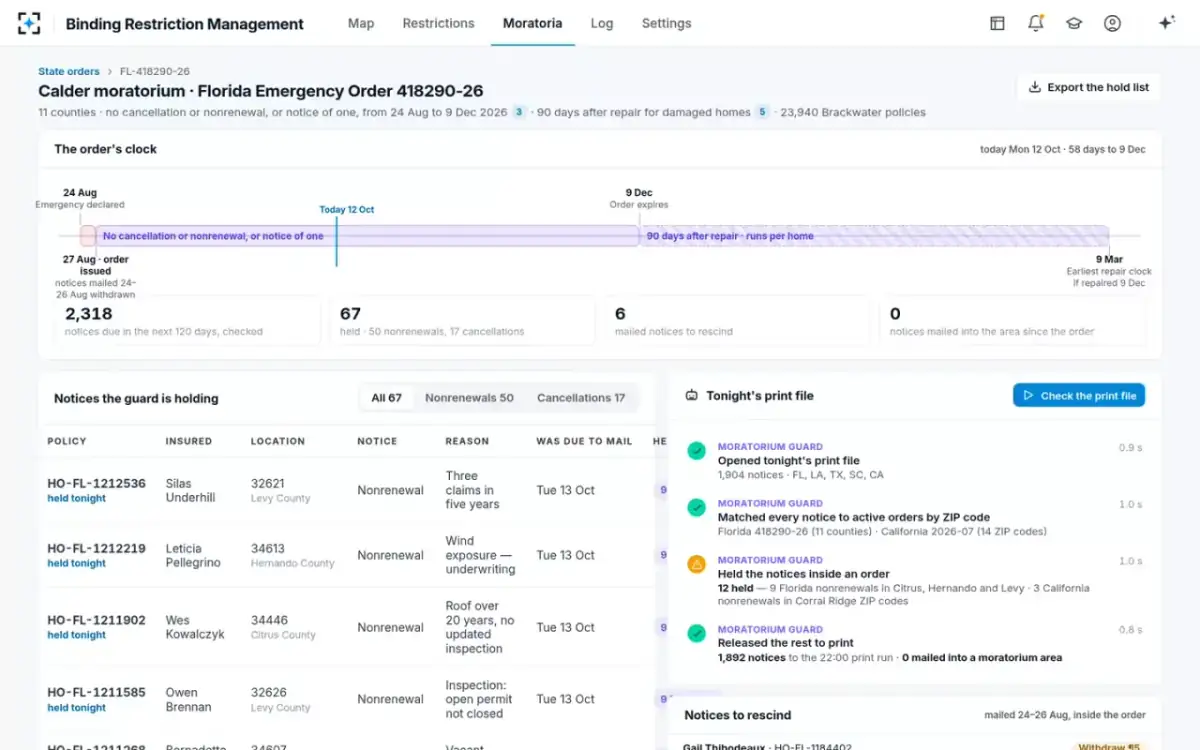
Every new bulletin, and every supplement, should trigger the same search: all cancellation and nonrenewal notices issued since the declaration date, for property in the listed ZIP codes, with a wildfire-related reason. The sample carrier’s guard does that the night a bulletin is confirmed and lists the notices to offer back; the same guard checks every forward print run against every active bulletin, so the list stops growing.
Binding Restriction Management: notices held tonight, and notices already mailed to offer back
What to keep for the examiner
Market conduct examiners test cancellation and nonrenewal notices against policy provisions, state law and the company’s own guidelines; it is one of the NAIC’s standard examination tests (NAIC Market Regulation Handbook examination standards). For a moratorium, that means being able to show, for any notice in a listed ZIP code, why it mailed or why it was held, and for any notice offered back, when and how the offer went.
Evidence to keep for every moratorium bulletin
- The bulletin, its declaration date and every supplement
With the date each was received and loaded, so the gap between bulletin and table is visible.
- The search run on each bulletin and supplement
Its criteria: ZIP codes, declaration date, wildfire-related reasons, policy classes; and its results.
- Each offer to rescind, reinstate or renew
The letter, the date it went, and the insured’s answer.
- Each held notice and who released it, with the reason
For a release inside a moratorium ZIP code, the exception relied on.
- Every print run’s check
Notices in, notices held, notices released, against which bulletins.
Questions people ask
What does California’s moratorium nonrenewal law say?
Insurance Code §675.1(b) bars cancelling or refusing to renew a residential property policy for property in a ZIP code within or adjacent to a wildfire perimeter, for one year after the emergency declaration, solely because a wildfire occurred in the area. From 2026, §675.55 does the same for commercial property policies other than inland marine, transit and commercial auto, and other than larger accounts that are not habitational.
Was there a California moratorium on non-renewals in 2024?
Yes, six bulletins in 2024 covered the Thompson, Gold Complex, Park, Borel, Line, Bridge, Airport, Boyles, Shelly, Bear and Mountain fires, listing 205 distinct ZIP codes by our count. Each ran one year from its declaration, so all of them ended during 2025.
Is a California non renewal moratorium the same as a ban on all nonrenewals?
No. It reaches nonrenewals and cancellations issued because of wildfire risk; a notice for nonpayment, fraud or an unrelated reason can still go, subject to the statute’s exceptions and the usual notice rules. That is why the reason on each notice matters.
I received a homeowners nonrenewal notice in California before a moratorium was announced. Does it still apply?
It depends on two dates and one reason, and the insurer must check them: whether the notice was issued on or after the Governor’s declaration, whether your property is in a listed ZIP code, and whether the notice was issued due to wildfire risk. If all three are met, the bulletin requires the insurer to offer to rescind it or to reinstate or renew the policy; the Department’s consumer hotline, 800-927-4357, answers questions about a specific notice.
How long after the declaration can a California moratorium ZIP code be added?
There is no fixed limit in the bulletins, which say the Department may issue a supplemental bulletin if more ZIP codes are found within or adjacent to the perimeter. Since 2024, additions came within eight days of one bulletin and 26 days after another; each added ZIP code is frozen from the original declaration.