Binding restrictions in insurance are temporary stops a carrier puts on binding, the act that makes coverage take effect, in an area a hurricane, wildfire or severe hail storm threatens. They are set under the carrier’s binding authority rules, not by statute, and they usually suspend new business, coverage increases and deductible decreases while letting renewals on the same terms continue. A restriction can fail in two directions. Too late, and agents bind policies inside the forecast cone that will pay a full claim after a day of premium. Too wide, and the carrier refuses business in ZIP codes the storm never reaches, sends agents’ customers to competitors and adds days to the lift. Botminds’ Binding Restriction Management is built to make both errors small and, more importantly, measured: every restriction is drawn to the ZIP code from the advisory, and a dry run shows what it would stop, next to what the same event would stop county-wide and statewide, before two people sign.
The examples use fictional sample data from the solution: Brackwater Mutual, a carrier with 412,600 Florida policies, and Hurricane Delphine. The research figures come from the Treasury’s Federal Insurance Office, the National Hurricane Center and Florida’s Office of Insurance Regulation, linked where they appear.
The same storm, three ways to draw the stop
214
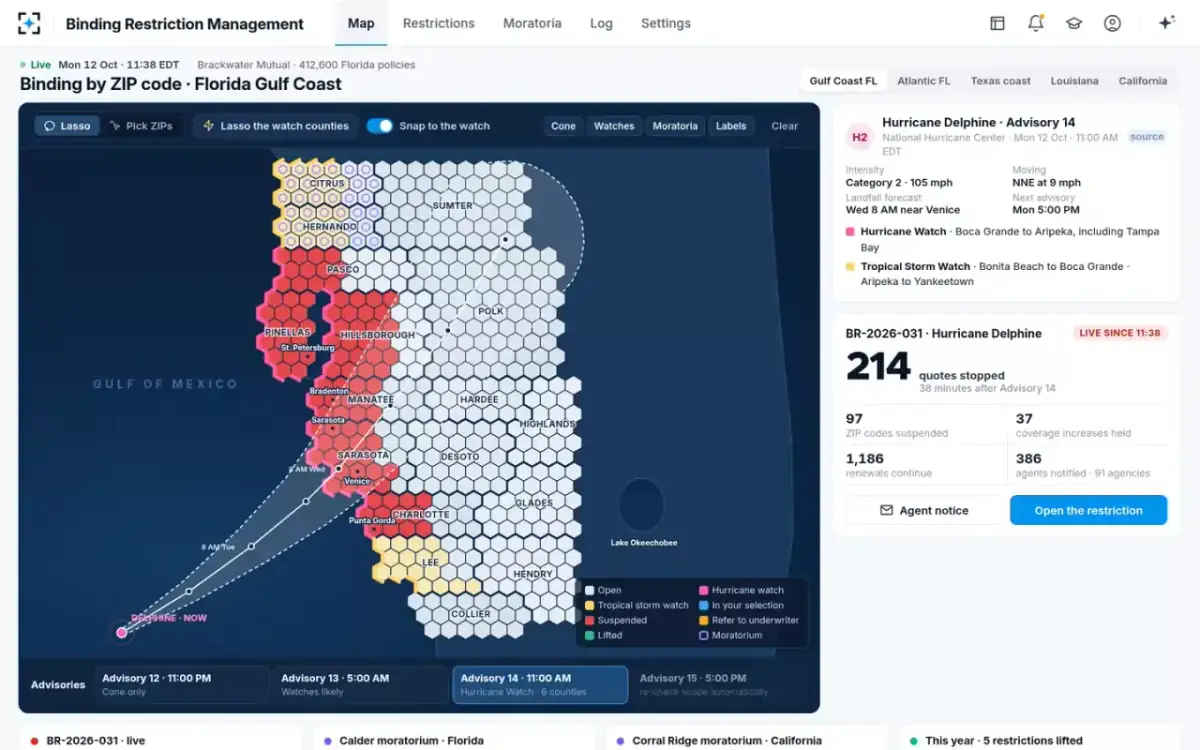
quotes stopped by a restriction drawn to the 97 ZIP codes under the watch
263
quotes stopped if all 147 ZIP codes in the six watch counties were suspended
1,042
quotes stopped by a statewide suspension for the same storm
4.9×
more quotes stopped statewide than inside the watch
What is a binding restriction in insurance?
In insurance terms, a binding restriction limits an agent’s authority to bind coverage for a period and a place. It is also called a binding suspension or a binding moratorium; all three mean the carrier has withdrawn, temporarily, the agent’s power to put new risk on its books in a defined area. It is not a cancellation, not a nonrenewal and not a rate change: policies already in force stay in force, and in the sample carrier’s rules renewals on the same terms continue.
What triggers it is a public warning that every desk and every agent can see at once. A hurricane watch means hurricane-force winds are possible in the area and is issued 48 hours before tropical-storm-force winds are expected (NHC glossary). For hail, a carrier can key to the Storm Prediction Center’s convective outlooks, though the SPC itself cautions that “It is important not to rigidly associate the type of risk area (e.g., 2-SLGT-yellow) with the severe potential for any given thunderstorm in the risk area” (SPC), which is one reason the sample carrier refers hail-area binds to an underwriter rather than stopping them.
What does binding an insurance policy mean?
Binding means agreeing to provide coverage before the policy is issued, and it is real coverage from that moment. Florida’s statute is typical: binders for property insurance “may be made orally or in writing,” and are “deemed to include all the usual terms of the policy” (Fla. Stat. §627.420). The same section adds that no notice of cancellation or nonrenewal is required for a binder “unless the duration of the binder exceeds 60 days.”
That is why the restriction sits on binding rather than on quoting. A quote is an offer and costs nothing if the storm comes; a binder made by phone at 13:00 on a watch day is a policy with full coverage on its usual terms, even if no premium has been collected and no paper exists. The cost of a late restriction is counted in binders, not quotes.
Two ways a binding restriction fails, and what each one costs
Too late
The bulletin goes out hours after the advisory
In the sample carrier’s 2025 log the average was 182 minutes, with every agent still able to bind inside the watch.
Policies bind inside the cone
A binder is coverage on the policy’s usual terms from the moment it is made, orally or in writing.
One day of premium meets a full claim
The claim is paid as for any policy; the premium that was meant to fund it was never collected.
The loss ratio carries it
Highest-risk ZIP codes already ran at a 64.7% paid loss ratio over 2018–2022, against 56.1% elsewhere.
Too wide
The stop is drawn by county or state
The same storm stopped 263 quotes county-wide and 1,042 statewide, against 214 inside the watch.
Quotes stop where the storm never reaches
828 quotes held statewide outside the watch, each a buyer an agent now has to explain the delay to.
Agents place the business elsewhere
An agent appointed with several carriers can send the next buyer to one that is still writing.
The desk takes the calls, and the lift takes longer
About 300 calls after one bulletin; every extra ZIP code is one more to review before it reopens.
Too late: the policies bound inside the cone
The cost of a late restriction is a claim without its premium. A policy bound on a watch day collects a day or two of premium before landfall and then pays like any other, and catastrophe claims are not small. Across 2018 to 2022 the national average homeowners claim severity in the Federal Insurance Office’s data was $18,206, and in the Southeast the highest-risk ZIP codes averaged $23,244 per claim (FIO, January 2025). Those ZIP codes were already losing more than the rest: “The Highest Risk category had the highest paid loss ratio at 64.7 percent over the five-year period, while the lower four categories had an average paid loss ratio of 56.1 percent.”
Late is usually a matter of hours, not days, and the hours are spent agreeing scope. In the sample carrier’s 2025 log the average from advisory to bulletin, when the work ran on email and a spreadsheet, was 182 minutes. A storm that produces claims on the scale of Hurricane Milton, which brought 304,408 residential property claims in Florida’s data call (Florida OIR), makes every one of those minutes a window in which an agent can still bind on the coast.
Too wide: the quotes refused where the storm never reaches
The cost of a wide restriction is premium refused and trust spent. When the sample storm’s watch covered 97 ZIP codes, a statewide suspension would have stopped 828 more quotes than the precise one, in places outside the National Hurricane Center’s watch. Some of those buyers wait; some go to a carrier that is still writing; all of them call their agent, and many of those agents call the carrier.
The calls are the cost that shows up first. After the sample carrier’s last bulletin by email, the agent desk took about 300 calls asking whether the bulletin covered the caller’s ZIP code. A restriction that stops business in a ZIP code the storm cannot reach also has to be lifted there, and every additional ZIP code under a restriction is one more for someone to review before it reopens.
Why counties and states are the wrong unit for a storm
Counties and states are convenient because policy systems know them, but a storm’s threat is drawn along a coast and narrows with time. The National Hurricane Center’s forecast cone is made from circles sized “so that two-thirds of historical official forecast errors over a 5-year sample fall within the circle” (NHC); for 2026 those circles grow from 25 nautical miles at 12 hours to 200 at five days. A carrier that acts on the five-day cone, or on a whole state, is acting on a track error several hundred miles across.
How wide the NHC’s two-thirds circle is at each forecast hour, Atlantic 2026
The watch is the practical compromise. It is issued about 48 hours out, when the track error circle is around 62 nautical miles, and it is drawn between named coastal breakpoints, which can be mapped to ZIP codes. In the sample, that turned six counties into 97 of their 147 ZIP codes; Pinellas was covered whole, while eastern Hillsborough’s inland ZIP codes, outside the watch, kept writing.
Pricing both errors on one storm
Both costs can be written down before the season, which is when a carrier should decide its rules. Each term below is something a carrier can estimate from its own book: how many quotes typically bind in the hours a bulletin takes, how often a policy in the watch area claims, how much premium a stopped quote would have brought and how much of it is lost for good. None of the inputs needs a model of the storm; they need the carrier’s own binding and claims history.
The expected cost of a late stop, and of a wide one
Too late
binds in the delay × claim rate in the watch area × average claim − premium collected
Binds in the delay: quotes in flight in the watch area × the share that bind per hour × hours from advisory to stop.
Catastrophe underwriting lead
Too wide
quotes stopped outside the threat × share that would have bound × premium × share lost for good
Quotes stopped outside the threat: the dry run’s county-wide or statewide count minus the count inside the watch.
Distribution and finance
Too long
quotes held after the threat passes × days held × share abandoned per day × premium
A lift drawn ZIP by ZIP reopens most of the area while damaged ZIP codes stay held.
Underwriting operations
Agent time
calls per bulletin × minutes per call + exception requests × minutes per decision
The calls a precise notice prevents, and the exceptions an underwriter still has to decide.
Agent communications
Two features of the sample make the arithmetic practical. The dry run is kept with each restriction, so the counts behind the decision, 214, 263 and 1,042 on Delphine, are there to review after the season. And the log keeps the minutes from trigger to live for every restriction, so the “hours from advisory to stop” term is measured, not guessed.
How long a restriction stays on costs as much as how wide it is
A restriction that is precise on the way in and blunt on the way out still refuses business for days it need not. The sample carrier lifts ZIP by ZIP: a ZIP code reopens when the watch is discontinued, no warning or evacuation order is in force, reported damage is below 4 claims per 1,000 policies, and both people sign. For Delphine that reopened 74 of the 97 ZIP codes at the first preview and kept 23 around the landfall area for damage review.
Lifting ZIP by ZIP in Binding Restriction Management: 74 reopen, 23 stay held
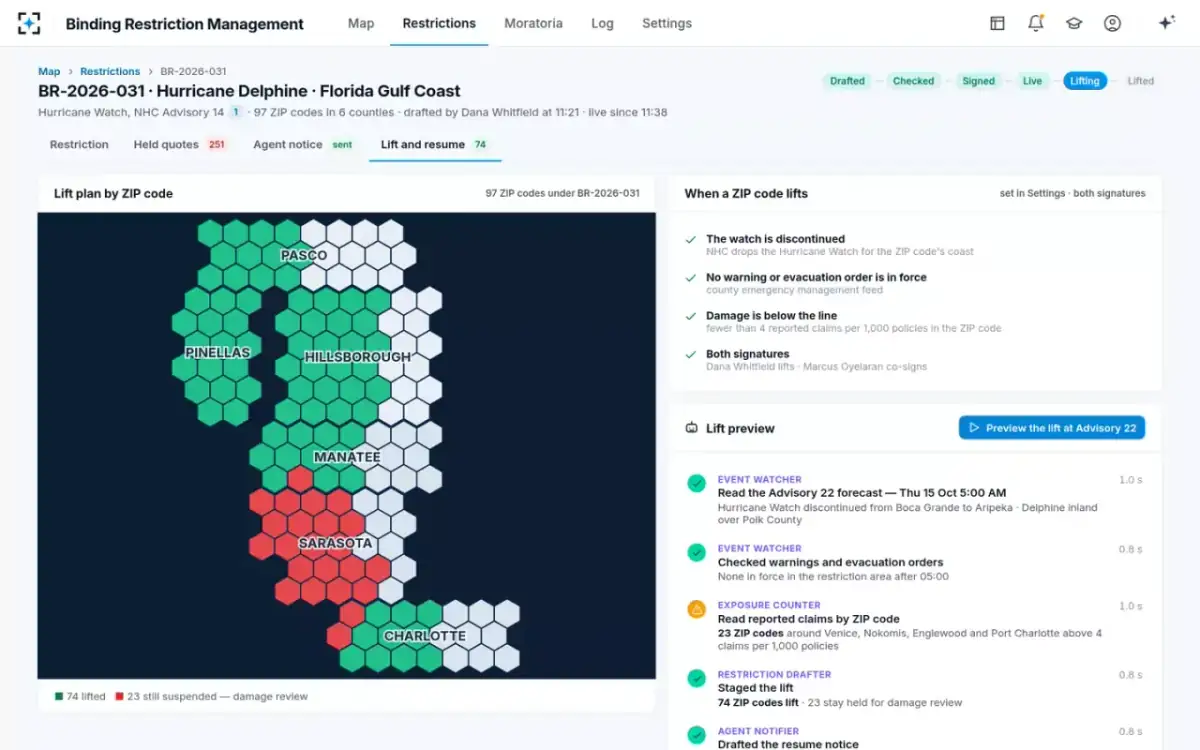
The sample log shows the range: restrictions held from 20 hours for a hail outlook in Texas to 17 days for a California wildfire. The difference between a 74-ZIP lift on Thursday morning and an all-or-nothing lift after damage reviews finish is several days of new business across most of the area, which is the third term in the formula.
Too late and too wide, side by side
Too late: Claims, through losses on policies that collected a day of premium.
Too wide: Distribution, through refused premium, agent time and buyers sent elsewhere.
Too late: Weeks later, in the claims from the storm.
Too wide: Within the hour, in the calls to the agent desk.
Too late: Minutes from advisory to stop; policies bound in the watch area after the advisory.
Too wide: Quotes stopped outside the watch; calls per bulletin; days from the threat passing to the lift.
Too late: A restriction drafted from the advisory, with the signers ready.
Too wide: A scope drawn to the ZIP code, a dry run against the county and state counts, and a lift by ZIP code.
What a well-drawn binding restriction looks like
A good restriction can be read in one look and defended a year later. It names its trigger, the advisory, outlook, evacuation order or perimeter and its time; it lists its ZIP codes; it states what is suspended, what continues and what goes to an underwriter, each with the rule section; it carries two signatures; it shows the dry run it was signed against; and it says what will lift it. One Florida restriction, traced minute by minute, shows every one of those parts on a single storm.
The same discipline answers the question a board or a reinsurer asks after the season: how many restrictions, how fast, how wide and how many policies bound inside one. If the answers come from a log rather than an email archive, the carrier knows its two error rates and can decide, with numbers, whether to move its triggers. Setting those rules before the season is the subject of the go-live plan for June.
Binding Restriction Management: binding stopped in the watch ZIP codes only
Questions people ask
What does binding restriction mean?
It means an agent temporarily may not bind certain coverage in a defined area, usually new business and coverage increases where a hurricane watch, wildfire or hail outlook is in force. The carrier sets it under its binding authority rules and lifts it when the threat has passed.
What is binding in insurance?
Binding is the agreement that puts coverage in force before the policy is issued, by an agent or the carrier with authority to do so. Under Florida’s statute a binder can be oral or written, carries the policy’s usual terms, and needs no cancellation notice unless it lasts more than 60 days.
What does binding moratorium mean?
A binding moratorium is another name for a binding restriction: a pause on binding new risk. Do not confuse it with a moratorium on cancellations and nonrenewals, which a state imposes after a disaster and which protects policies already in force.
Are binding restrictions required by law?
Not for private carriers, as far as we found: they are a carrier underwriting practice. Texas writes a storm moratorium into the plan of operation of its windstorm pool, and states regulate what happens after the storm, but the decision to stop binding, and where, is the carrier’s.
Can an agent bind during a binding restriction?
Not for the suspended lines, and in a well-run restriction the quoting system refuses the bind rather than relying on the agent remembering the bulletin. In the sample carrier’s rules renewals at the same terms continue, and some requests, such as replacing a policy with no gap in coverage, go to an underwriter to decide.
How fast should a binding restriction go live?
Fast enough that the watch’s 48 hours are mostly protected time. The sample carrier’s restrictions in 2026 went live 38 to 64 minutes after their triggers, against a 2025 average of 182 minutes to the bulletin by email.