Hurricane binding restrictions in Florida are set by each carrier, not by the state: when the National Hurricane Center puts a hurricane watch on part of the coast, the carrier suspends binding of new homeowners business, coverage increases and similar changes in that area, under its own binding authority rules, until the watch lifts and damage is known. Florida law regulates what happens after the storm, cancellations, nonrenewals and grace periods, but leaves the decision to stop binding, and how precisely to draw it, to the carrier. That makes speed and scope the carrier’s problem. Botminds’ Binding Restriction Management answers it with six agents that map the advisory to ZIP codes, count what a stop would catch, draft the rules, list the agents and check the state orders, and two people who sign before anything reaches the quoting system.
What follows is one restriction traced from the advisory to the last agent told. The storm, Hurricane Delphine, the carrier, Brackwater Mutual with 412,600 Florida policies, and every person named are fictional sample data in the solution; the ZIP codes, counties, NHC definitions and Florida law are real.
One Florida restriction, from advisory to every agent told
38min
from NHC Advisory 14 to binding stopped in the quoting system
97of 147
ZIP codes in the six watch counties that the restriction covers
2
signatures before the quoting system stops a single quote
386
agents in 91 agencies sent a notice at 11:39, each about their own ZIP codes
What is a hurricane binding restriction in Florida?
It is a temporary stop on binding, set under the carrier’s binding authority rules and triggered by a public weather event: for a hurricane, a National Hurricane Center watch or warning. A hurricane watch means hurricane-force winds may reach the area, and it is issued 48 hours before tropical-storm-force winds are expected (NHC glossary). A restriction keyed to the watch therefore gives a carrier about two days of protection before conditions arrive, and costs it the business it would have written in that area in those two days.
What is suspended is a choice. The sample carrier’s rules suspend new homeowners, condominium and dwelling fire business, physical damage on new auto business and added vehicles, coverage increases and deductible decreases; they let renewals on the same terms and replacement vehicles continue; and they send two kinds of request to an underwriter. The restriction is a list of those lines applied to a list of ZIP codes, and both lists have to be right.
Thirty-nine minutes from the advisory to every agent told
- Advisory read and mapped to ZIP codes6 min
- Lasso, dry run, restriction drafted15 min
- Six checks, first signature13 min
- Co-sign, live, notice5 min
Is there a Florida statute on binding restrictions?
No Florida statute we found defines a binding restriction or says when one must start. Florida law speaks to the other end of a storm. Section 627.4133(2)(f) moves the effective date of any cancellation or nonrenewal that would fall during a hurricane: it “is extended until the end of the duration of such hurricane” (Fla. Stat. §627.4133). The Commissioner’s emergency orders after a declared emergency freeze cancellations and nonrenewals in named counties, but they do not tell a carrier whether to bind new business; the Milton order said in terms that its rule “shall not apply to new policies effective on or after October 8, 2024” (OIR Emergency Order 400473-24).
So whether to stop binding, where and for how long, is a carrier decision that a market conduct examiner can later ask the carrier to explain. Citizens Property Insurance Corporation, the insurer the state created under §627.351(6), sets underwriting rules for its own agents; the statute that governs it, which we searched, says nothing about suspending binding during a watch (Fla. Stat. §627.351). Texas is the contrast: its windstorm pool’s storm moratorium is written into a plan of operation the regulator adopts, which is covered in the questions below.
11:00 to 11:06: the advisory becomes 97 ZIP codes
The National Hurricane Center draws a watch between two breakpoints, agreed places on the coast that serve as its end points (NHC breakpoints). Advisory 14 put the Hurricane Watch from Boca Grande to Aripeka, including Tampa Bay, and a Tropical Storm Watch either side. A quoting system cannot use “Boca Grande to Aripeka”; it needs ZIP codes. The event watcher read the advisory at 11:02 and mapped the watch to 97 ZIP codes in six counties.
At 11:06 the underwriting operations manager lassoed Pasco, Pinellas, Hillsborough, Manatee, Sarasota and Charlotte. With the map set to snap to the watch, the selection kept the ZIP codes the watch covers and left 50 lassoed inland ZIP codes open, among them Brandon, Valrico and Plant City in eastern Hillsborough, whose 17 quotes kept writing.
Where the watch fell: ZIP codes, quotes and policies by county
| County | ZIP codes under the restriction | Quotes stopped | Policies in force inside |
|---|---|---|---|
| Pasco | 12 of 24 | 31 | 21,400 |
| Pinellas | 17 of 17 | 52 | 38,900 |
| Hillsborough | 24 of 36 | 44 | 34,600 |
| Manatee | 12 of 21 | 33 | 18,200 |
| Sarasota | 20 of 28 | 36 | 21,300 |
| Charlotte | 12 of 21 | 18 | 7,470 |
| Six counties | 97 of 147 | 214 | 141,870 |
11:06 to 11:21: the dry run, before anything applies
A dry run counts what the restriction would stop before it stops anything. For the 97 ZIP codes it counted 214 new business quotes in flight, 37 coverage increases to hold, 1,186 renewals at the same terms that would go ahead, 141,870 policies in force with $52.4 billion of insured value inside, and 386 agents in 91 agencies to notify. It also counted the same storm drawn wider: 263 quotes if every ZIP code in the six counties were suspended, 1,042 if the whole state were.
The dry run in Binding Restriction Management: what this restriction would stop, and the same storm drawn wider
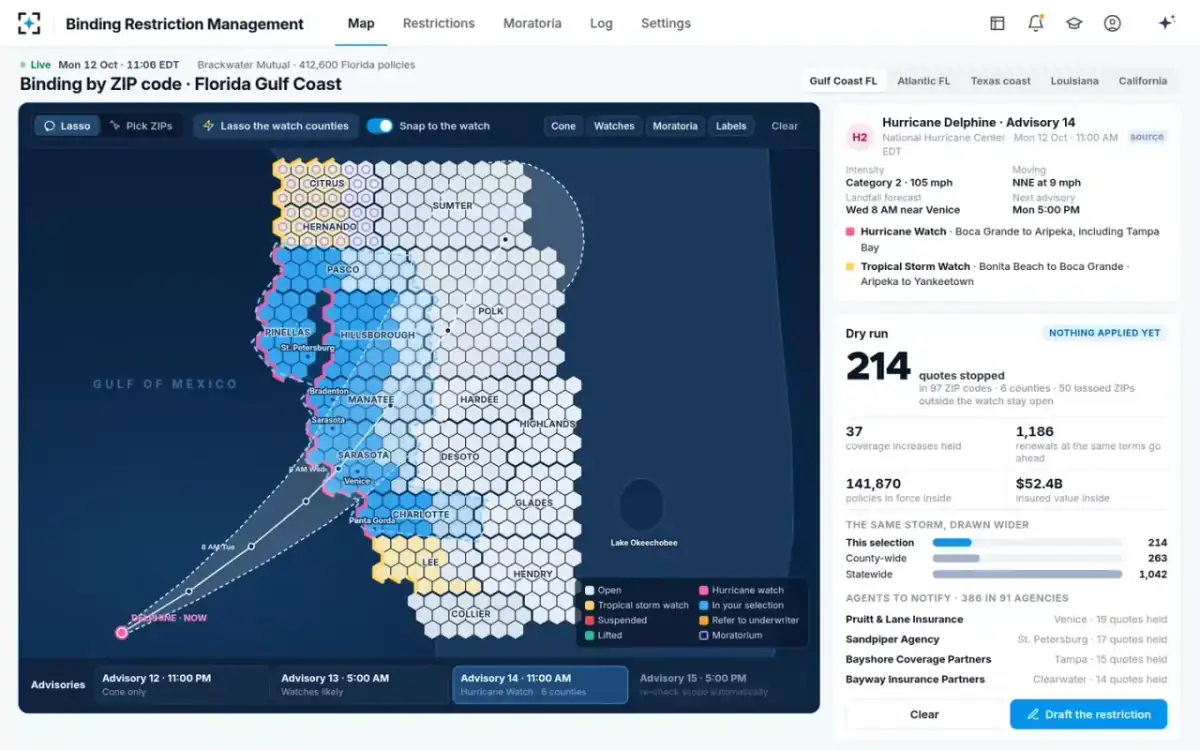
The comparison is the point of the dry run. It turns a judgement made under pressure, how wide to go, into a number someone can sign. Pricing that choice across a book is the subject of what binding restrictions cost when drawn too wide or too late; here it is enough that the manager could see, at 11:20, that the precise version stopped 49 fewer quotes than the county version and about a fifth of the statewide one.
11:21: six checks, each one citing its source
At 11:21 the restriction was drafted from the map and six checks ran in view, each by one agent with one job and a limit it cannot cross. None of them applies, lifts, sends or releases anything; each writes down what it found and where it found it, and the people sign.
Hurricane binding restriction BR-2026-031: five agents run six checks, then two people sign
Agent
Event watcherRead NHC Advisory 14 and mapped the watch breakpoints to 97 ZIP codes; left 50 lassoed inland ZIP codes outside.
Never: sets or lifts a restriction
Agent
Exposure counterCounted 141,870 policies, $52.4B insured value, 214 quotes in flight, 37 coverage increases, 1,186 renewals due.
Never: changes a quote or a policy; it only reads
Agent
Restriction drafterApplied binding authority rules version 14, section 4, line by line; found four exception requests and routed them to an underwriter.
Never: applies or lifts a restriction
Agent
Agent notifierListed 386 agents in 91 agencies appointed in the 97 ZIP codes and drafted the email, portal banner and quoting stop.
Never: sends before the restriction is signed
Agent
Moratorium guardChecked active state orders: the Calder order covers Citrus and Hernando, outside this restriction, so no conflicts.
Never: releases a held notice
A person decides
Operations managerRead the scope, the rules and the dry run, and applied the restriction at 11:34.
A person decides
Catastrophe underwriting leadCo-signed from his phone at 11:36. Nothing reaches the quoting system before the second signature.
The moratorium check looks out of place on a binding restriction, but it catches a real collision. In the sample, an August storm had already left an order freezing cancellations in eleven Florida counties. A carrier that ignores which orders are live when it draws the next restriction ends up running two sets of rules on the same ZIP codes without knowing it.
What the restriction does, line by line
A restriction an agent can follow says what stops, what continues and what goes to a person, each with the rule section behind it. The sample carrier’s section 4 is typical of what agents ask about: it stops the business that can be bought because a storm is coming and lets the business that already existed continue.
Inside the suspended ZIP codes: what stops, what continues, who decides
| Activity | In the suspended ZIP codes | Rule |
|---|---|---|
| New business: homeowners, condominium, dwelling fire | Suspended | §4.1(a) |
| Auto physical damage on new business and added vehicles | Suspended | §4.1(c) |
| Coverage increases: A, B, C, D and scheduled property | Suspended | §4.1(b) |
| Deductible decreases, including the hurricane deductible | Suspended | §4.1(b) |
| Renewals at the same terms, including offers already sent | Continues | §4.2 |
| Replacement vehicle with the same coverage | Continues | §4.2(c) |
| Replacement of coverage with no lapse and proof of prior insurance | Underwriter decides | §4.3 |
| Change requests signed before the watch | Underwriter decides | §4.5 |
| Tropical Storm Watch areas: Lee, Hernando, Citrus | Refer; not in this restriction | §4.4 |
The two “underwriter decides” lines are where most of the friction is. Four requests arrived on the sample storm; two met §4.3 or §4.5 and two did not. Which requests can still bind during a watch works through them from the buyer’s and the agent’s side.
11:34 to 11:38: two signatures, then the quoting stop
The operations manager applied the restriction at 11:34 and the catastrophe underwriting lead co-signed from his phone at 11:36. Two minutes later the quoting system refused new business in the 97 ZIP codes, and 251 quotes and changes were held: 214 new business quotes and 37 coverage increases, each with the insured, the location, the agency, the line, the coverage and the premium.
Signed and live in Binding Restriction Management: the rules, two signatures, minutes from the advisory
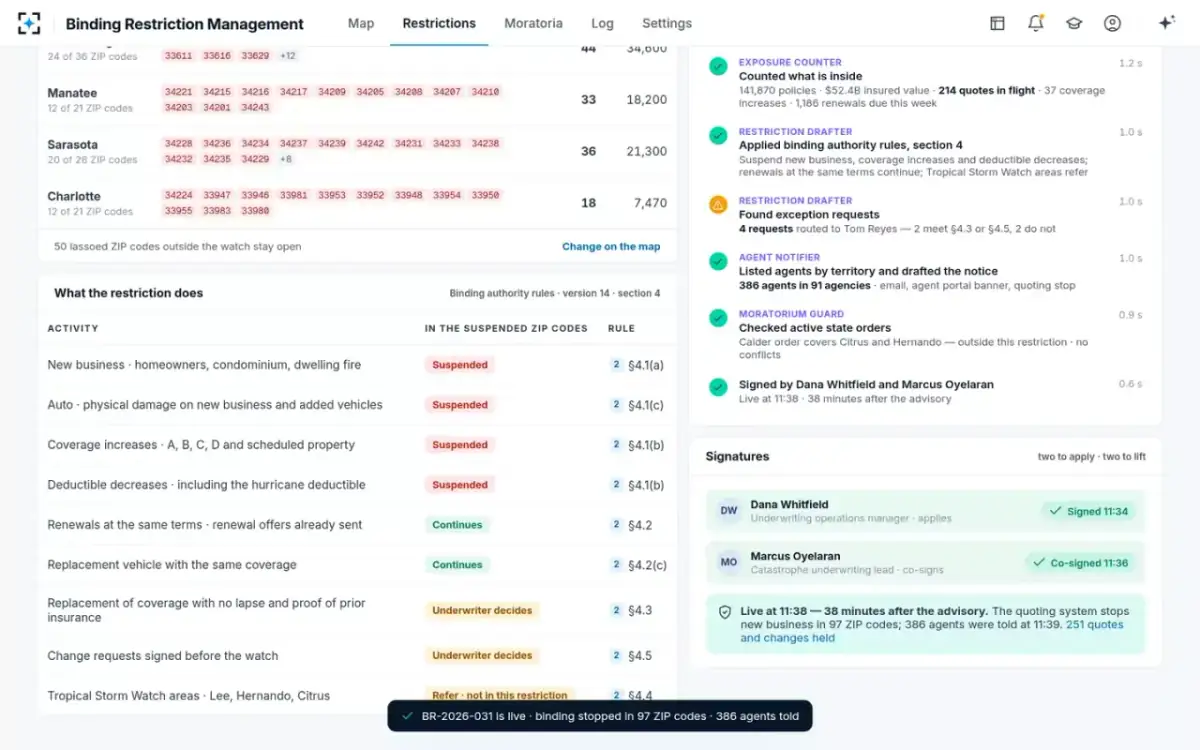
Why two signatures and not one? Because a binding restriction is a business decision with two failure modes, and they belong to different people. The operations manager owns the cost of stopping business; the catastrophe lead owns the cost of binding into the storm. Requiring both makes each see the other’s number before the quoting system moves.
11:39: a notice each agency can read about its own ZIP codes
The notice went to 386 agents in 91 agencies as an email, a banner in the agent portal and a hard stop in the quoting screen, a minute after the restriction went live. It said what is suspended, what agents can still do, and listed the ZIP codes county by county. Each agency also saw its own held quotes.
The agent notice: what stops, what agents can still do, and each agency’s ZIP codes
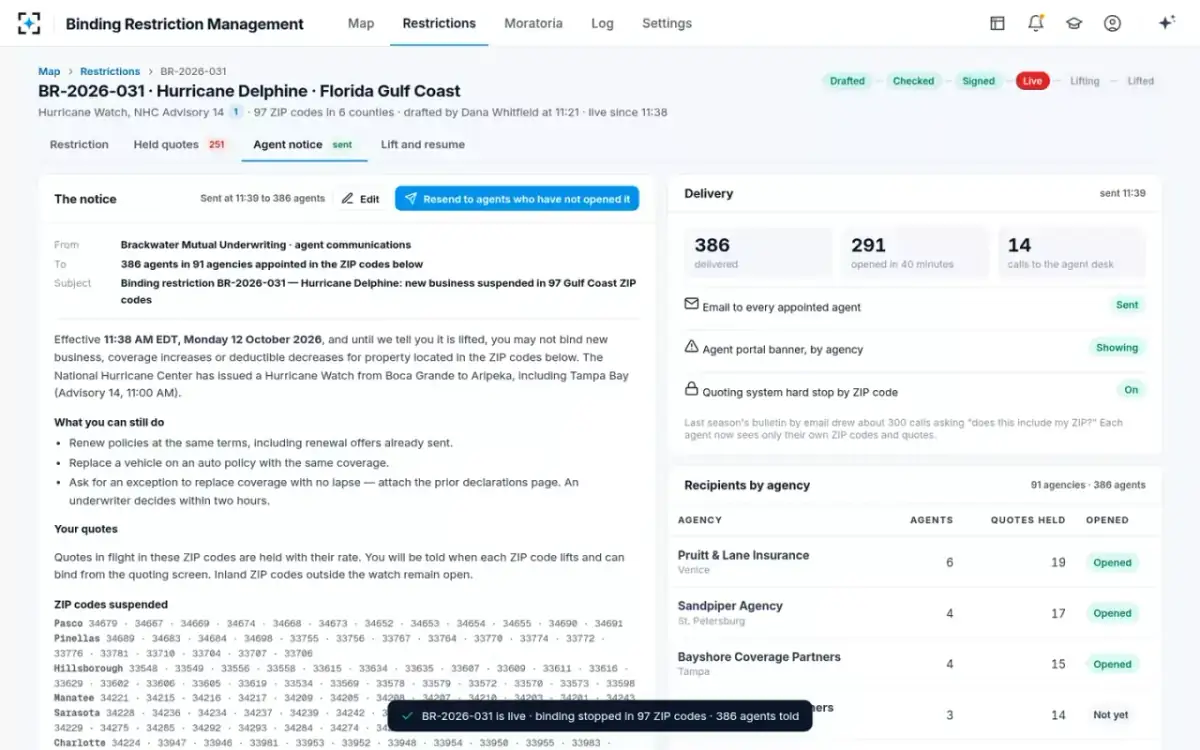
In 40 minutes, 291 agents had opened the notice and the agent desk had taken 14 calls. Agents who had not opened it got a resend. Everything in the notice traces to the restriction: the advisory number and time, the rule section, the ZIP list, so the notice cannot say something the restriction does not.
Florida 2024: the declarations came first, and binding was the carrier’s call
The 2024 season shows how much of the early timeline belongs to carriers alone. Governor DeSantis declared a state of emergency for Hurricane Milton on 5 October 2024 (Executive Order 24-214) and widened it on 6 October (24-215). The insurance order for Milton was filed on 16 October; its freeze on cancellations and nonrenewals ran from 8 October, and its rules did not reach new policies effective from that date (OIR Emergency Order 400473-24).
In the days between the declaration and landfall, then, nothing in state law decided whether an agent could bind a homeowners policy on the coast; the carrier’s binding rules did. That is also when advisories come fastest. Public advisories come every six hours, with intermediate advisories every three hours while coastal watches or warnings are up (NHC), so a restriction drawn at 11:00 may need to change by 14:00. In the sample, the scope is re-checked at every advisory: the drafter proposes the change, and the manager signs it.
The lift, ZIP by ZIP, and what the trace shows
A restriction that took 39 minutes to set should not take a day to lift. The sample carrier’s rules lift a ZIP code when four things are true: the watch is discontinued, no warning or evacuation order is in force, reported damage is below 4 claims per 1,000 policies, and both people sign. The preview for Advisory 22, Thursday at 5:00, lifted 74 ZIP codes and kept 23 around Venice, Nokomis, Englewood and Port Charlotte for damage review, and each agent’s resume notice listed only their own ZIP codes and quotes.
For a buyer, the trace answers three questions a demonstration usually skips. Can every line of the restriction be traced to an advisory, a rule section and a signature? Is the dry run kept, so the choice of scope can be defended? And does the same tool know which state orders are live? Those are the tests to run on any system, and they apply as much to the lift as to the stop. For how the same steps work when the threat is a fire, not a storm, see drawing a wildfire restriction on the perimeter.
Questions people ask
Are there hurricane binding restrictions in Texas?
Yes, and the best-documented one is public. The Texas Windstorm Insurance Association may not accept new or increased coverage applications once a hurricane is in the Gulf of Mexico or inside 80 degrees west and 20 degrees north, a rule in its plan of operation at 28 TAC §5.4001(d)(2)(E)(ii). In 2022 the Texas Department of Insurance exempted the policyholders of an insolvent insurer from it by emergency rule, noting that coverage applied for during the moratorium “would not go into effect until the moratorium ends” (TDI).
Do insurance binding restrictions in Florida stop renewals?
Usually not. Renewals on the same terms continue under the sample carrier’s rules, and Florida law pushes the other way during a storm: a cancellation or nonrenewal that would take effect during a hurricane is extended to the end of the hurricane’s duration, which runs to 72 hours after the last watch or warning for any part of Florida ends.
Can an agent bind a quote that was issued before the watch?
Not once the restriction is live, unless it was bound before. In the sample, quotes in suspended ZIP codes are held with their rate, and the agent is told when each ZIP code lifts. A quote is an offer; only the bind creates coverage.
How often does a binding restriction change during a storm?
As often as the watch does. The NHC issues advisories every six hours and intermediate ones every three while coastal watches or warnings are in effect, and a watch can grow, shrink or become a warning at any of them. A restriction should be re-checked at each one, with each change signed like the first.
When do hurricane binding restrictions end?
When the carrier’s lift conditions are met, and those are best written down before the storm. Conditions a carrier can state in advance include the watch or warning discontinued, evacuation orders lifted and damage reports below a threshold; the sample carrier uses all three, plus both signatures, and lifts ZIP by ZIP rather than all at once.