The California insurance moratorium changed on 1 January 2026: the one-year ban on cancelling or nonrenewing policies in ZIP codes within or adjacent to a declared wildfire’s perimeter, which since 2019 has protected homeowners, renters and condominium owners, now also covers commercial property insurance. Senate Bill 547 added Insurance Code §675.55 with the same perimeter, the same one-year clock and the same exceptions, but with its own definition of which commercial policies count: small and mid-sized commercial property is in, inland marine and commercial auto are out, larger accounts are out unless they insure habitational property such as apartments, condominium associations or student housing. For a carrier the change is less about law than about data: its notice process now has to know a policy’s premium, its insured’s headcount and its use before it can tell whether a ZIP code freezes it. Botminds’ Binding Restriction Management reads each bulletin’s scope with the paragraph it came from, has counsel confirm it, and checks every cancellation and nonrenewal notice against the active bulletins before it prints.
The bulletins, statute and bill quoted here are the California Department of Insurance’s and the Legislature’s, linked where they appear; the carrier, policies and print runs in the screens are fictional sample data in the solution.
“Effective January 1, 2026, this moratorium also includes commercial property insurance policies.”
California Department of Insurance, Bulletin 2026-6, 14 August 2026
What changed in California’s insurance moratorium in 2026?
One thing changed: the class of policies. The Legislative Counsel’s digest of SB 547 puts it in a sentence: “This bill would extend that prohibition against cancellation or nonrenewal and its exceptions to a policy of commercial property insurance, except as specified” (SB 547, Chapter 544, Statutes of 2025). The Governor approved it on 10 October 2025, and it took effect on 1 January 2026, the date the Department’s bulletin gives.
The text of the new section mirrors the old one almost word for word. An insurer may not cancel or refuse to renew a commercial property policy for property in a ZIP code within or next to the fire perimeter for a year after the emergency declaration, and the prohibition “applies to all policies of commercial property insurance in effect at the time of the declared emergency.” The perimeter is still determined by CAL FIRE with the Office of Emergency Services, and the Commissioner still lists the ZIP codes in a bulletin.
Two years of California moratoria, and where the commercial rule begins
- Residential only, §675.1456 d
- SB 54783 d
- Residential and commercial, §675.1 and §675.55299 d
- 2024 · six bulletins, eleven fires6
- 2025 · five bulletins, eleven fires5
- 2026 so far · Gifford (residential), Gann (both)2
How the mandatory one-year moratorium on nonrenewals works
The mechanism has not changed since Senate Bill 824 took effect in 2019. When the Governor declares a state of emergency for a wildfire, CAL FIRE provides the fire perimeter, the Commissioner determines the ZIP codes within or adjacent to it and issues a bulletin, and for one year from the declaration no insurer may cancel or refuse to renew a covered policy for a property in those ZIP codes solely because the insured structure is in an area where a wildfire has occurred (Cal. Ins. Code §675.1(b)(1)). The bulletins turn that into a direct instruction: no admitted or non-admitted insurer may issue a notice of cancellation or non-renewal due to wildfire risk in the listed ZIP codes.
The clock runs from the declaration, not from the bulletin, so each bulletin also requires insurers to offer to rescind notices issued since the declaration and to reinstate or renew the policies affected. How to find and offer back those notices is the subject of its own guide; the 2026 change means the search now includes commercial notices too.
Which commercial policies the 2026 rule covers, and which it leaves out
The new section starts from every “policy subject to Section 675.5” and takes two groups out. The first is by type: “Policies that are inland marine, transit, or transportation insurance, including commercial automobile insurance.” The second is by size, and it needs both conditions: “A policy of commercial property insurance with an annual premium of twenty-five thousand dollars ($25,000) or more and the insured employed at least 25 employees on average during the prior 12 months” (§675.55(c)).
Then it puts some of the large accounts back. Subdivision (d) applies the moratorium, whatever the premium and headcount, to commercial property that insures real property “used primarily for commercial residential or habitational purposes”, and lists eight examples: homeowners associations, condominium associations, long-term rental hotels or motels, apartment complexes, condominium complexes, multifamily dwellings with more than five units, student housing and senior living facilities.
Is this commercial policy inside the 2026 moratorium? Seven examples
| Policy | Premium and headcount | Inside the moratorium? | Why |
|---|---|---|---|
| Building and contents, a retail store | $18,000 premium; 12 employees | Yes | Below both size thresholds |
| Building and contents, a restaurant group | $40,000 premium; 18 employees | Yes | The size exclusion needs both: $25,000 or more and 25 or more employees |
| Building and contents, a manufacturer | $60,000 premium; 140 employees | No | Both size thresholds met; not habitational |
| Apartment complex | $95,000 premium; 30 employees | Yes | Habitational carve-back in §675.55(d) |
| Condominium association master policy | $52,000 premium; no employees | Yes | Listed in §675.55(d) and below the headcount threshold |
| Contractor’s equipment floater | $9,000 premium; 8 employees | No | Inland marine is excluded by type |
| Commercial auto, a delivery fleet | $30,000 premium; 22 employees | No | Commercial auto is excluded by type |
The size test is the one that catches processes out. A carrier’s policy system knows the premium; it does not usually know “at least 25 employees on average during the prior 12 months”, which is underwriting information that may sit on an application form or nowhere. A notice process that assumes large premium means large insured will release notices the law freezes, which is why the employee count needs a field before a commercial account can be checked.
What the 2026 law did not change
The perimeter rule, the one-year clock, the bulletin and the exceptions are the same for both lines. The commercial section copies the three circumstances in which the moratorium does not apply: willful or grossly negligent acts by the named insured that materially increase the risk, losses unrelated to the disaster that would make the risk ineligible, and physical or risk changes beyond the catastrophe-damaged condition that make the property uninsurable. And it still applies only to policies in effect when the emergency was declared; it says nothing about new business.
The residential and commercial moratoria, line by line
Residential · §675.1(b), since 2019: Residential property insurance as defined in §10087(a): individually owned structures of up to four dwelling units, condominium units, mobile homes and their contents, and tenants’ contents.
Commercial · §675.55, from 1 January 2026: Commercial property policies subject to §675.5, less inland marine, transit, transportation and commercial auto, and less accounts with $25,000 or more premium and 25 or more employees unless habitational.
Residential · §675.1(b), since 2019: ZIP codes within or adjacent to CAL FIRE’s perimeter, listed by bulletin.
Commercial · §675.55, from 1 January 2026: The same.
Residential · §675.1(b), since 2019: One year from the Governor’s declaration.
Commercial · §675.55, from 1 January 2026: The same.
Residential · §675.1(b), since 2019: Willful or grossly negligent acts; unrelated losses; physical or risk changes making the property uninsurable.
Commercial · §675.55, from 1 January 2026: The same three.
Residential · §675.1(b), since 2019: All residential policies in effect at the time of the declared emergency.
Commercial · §675.55, from 1 January 2026: All commercial policies in effect at the time of the declared emergency.
The first commercial moratorium: the Gann Fire, August 2026
The Governor proclaimed a state of emergency for Calaveras County for the Gann Fire on 6 August 2026, and the Commissioner’s Bulletin 2026-6 followed on 14 August, addressed for the first time to “All Admitted and Non-Admitted Insurers Writing Residential or Commercial Property Insurance in California”. It lists 22 ZIP codes and bars notices of cancellation or non-renewal due to wildfire risk for residential or commercial property there for one year from 6 August (CDI Bulletin 2026-6).
The bulletin before it shows where the line falls. Bulletin 2026-1, issued on 9 January 2026, eight days after the new law took effect, covered 29 ZIP codes for the Gifford Fire under a declaration of 23 December 2025, and it was addressed to insurers writing residential property insurance only (CDI Bulletin 2026-1). A carrier reading bulletins in 2026 therefore has to read each one’s addressees and scope, not assume that every 2026 bulletin reaches commercial policies.
Binding Restriction Management: every order’s scope on one screen, read from its own text
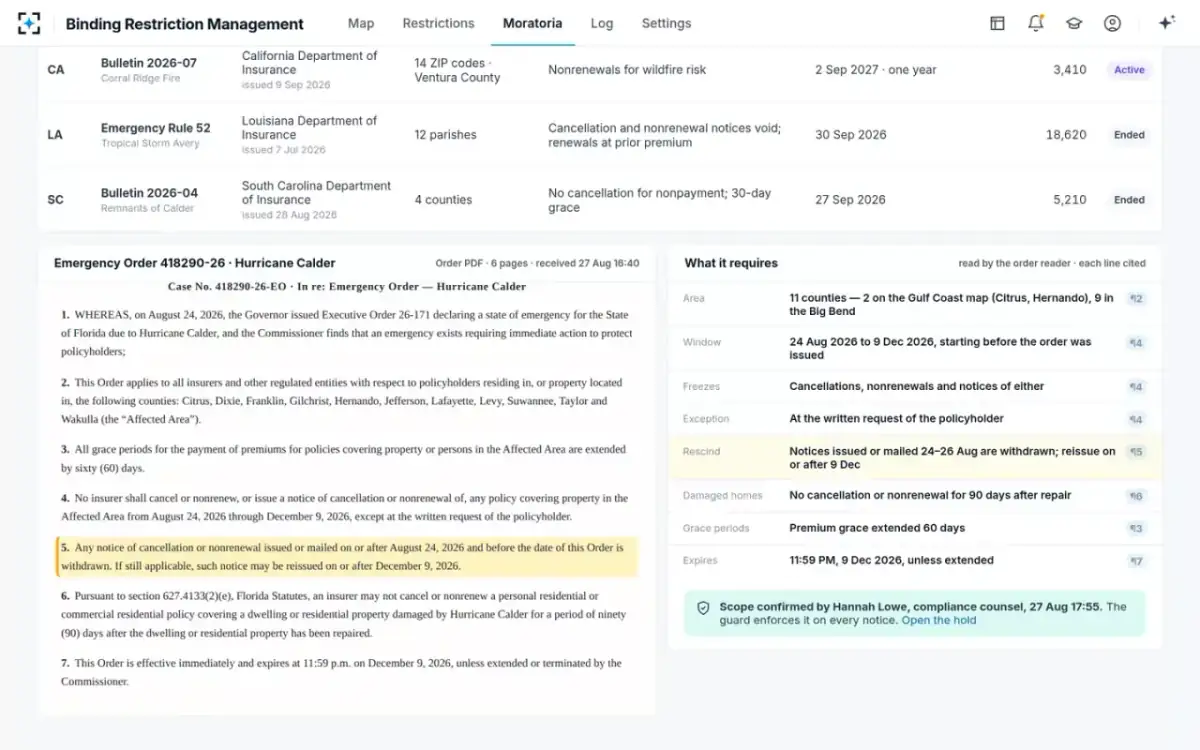
One ZIP code, two moratoria, two scopes
The Gann Fire’s list overlaps an earlier one almost entirely. Of the 22 Gann ZIP codes, 19 were also listed in Bulletin 2025-13 for the TCU Lightning Complex, under a declaration of 19 September 2025 (CDI Bulletin 2025-13). In those 19 ZIP codes, from 6 August to 19 September 2026, residential policies sit under two moratoria at once; commercial policies, on the bulletins as issued, sit under one, Gann’s, which runs to 6 August 2027. After 19 September 2026, both lines are frozen only by Gann.
A table that keeps one moratorium per ZIP code cannot hold that. It needs one row per ZIP code per bulletin, with the scope of each, so that a commercial nonrenewal in one of those ZIP codes in late August is checked against Gann and not cleared because the TCU row says residential only. Following one ZIP code through three moratoria shows the same structure for a residential ZIP code in Ventura County.
A worked example: one commercial nonrenewal caught between declaration and bulletin
Take a hypothetical apartment complex in one of the shared Gann ZIP codes, insured on a commercial property policy with a $70,000 premium, renewing on 1 November 2026. In July the carrier decided not to renew it because of wildfire exposure, and its print run mailed the nonrenewal notice on 10 August. On 6 August the Governor had declared the emergency; on 14 August the bulletin listed the ZIP code.
Under the 2025 rules the notice would have stood, because the moratorium reached residential policies only. Under the 2026 rules it does not. The policy is commercial property, its premium is above $25,000, but an apartment complex is habitational, so §675.55(d) keeps it inside whatever its headcount. The notice was issued due to wildfire risk after the declaration, so the bulletin’s duty applies: the carrier must offer to rescind it and to renew the policy. Had the notice cited losses unrelated to the fire that made the risk ineligible, it would fall under an exception, and that is a judgement for counsel, not for the print system.
Nothing in the example needed a new kind of rule; it needed three data points the commercial book may not carry in a form a notice process can read: the use of the property, the premium and the declaration date the notice is measured against. The statute speaks only to cancelling and refusing to renew; it says nothing about the renewal premium, which follows the carrier’s rates as usual.
Getting ready: five changes to a commercial notice process
California’s personal lines carriers have had to keep moratorium ZIP codes out of their homeowners notices since 2019. Carriers that write small commercial property, or package policies with property, now need the same check on a book that was never in scope, with fields it may not have.
Five changes before the next commercial moratorium bulletin
- Put commercial property notices through the same guard as homeowners notices
Cancellations and nonrenewals from the commercial print runs, matched by the property’s ZIP code and the declaration date.
- Capture the two size tests
Annual premium and average employees over the prior 12 months; without the headcount, a large-premium account cannot be cleared.
- Flag habitational property
Associations, apartments, condominium complexes, multifamily over five units, long-term rental hotels, student and senior housing stay inside whatever their size.
- Read each bulletin’s addressees and scope
Bulletin 2026-1 reached residential only; Bulletin 2026-6 reached both. Keep the scope per bulletin, not per year.
- Extend the rescind and reinstate search to commercial notices
Notices issued due to wildfire risk on or after a covered declaration must be offered back, commercial ones included.
Where Binding Restriction Management fits in the 2026 change
In Binding Restriction Management those changes are settings and data, not code: the order reader captures each bulletin’s scope with its paragraph, counsel confirms it, and the guard checks every notice in the print file, residential and commercial, against the rows that apply. The solution relies on the carrier’s policy data for premium, headcount and use; where a field is missing, the notice is held for a person rather than released.
Questions people ask
What was the California insurance moratorium in 2025?
In 2025 the Department issued five moratorium bulletins, for the Palisades, Eaton and five other Los Angeles and Ventura fires, the Hughes, Franklin and Pack fires and the TCU Lightning Complex, listing 147 distinct ZIP codes by our count. All of them were residential only, because the commercial rule did not take effect until 1 January 2026.
Is there a California home insurance moratorium?
Yes, and it is automatic once a wildfire emergency is declared and the bulletin lists the ZIP codes: for one year, no insurer may cancel or refuse to renew a homeowners, condominium, mobile home or renters policy there solely because the property is in an area where a wildfire has occurred. It protects policies in force at the time of the declaration.
What is the California Department of Insurance moratorium?
It is the Commissioner’s bulletin applying the statutory moratorium to a specific fire: it names the declaration, lists the ZIP codes and instructs insurers to offer to rescind notices issued since the declaration. The prohibition itself is in the Insurance Code; the bulletin says where and from when.
Is the California wildfire insurance moratorium a ban on all nonrenewals?
No. It bars cancelling or nonrenewing solely because the property is in a wildfire area, which the bulletins describe as notices issued due to wildfire risk. Nonrenewals for other reasons, and the three statutory exceptions, remain available, subject to the usual notice rules.
Where is the California insurance moratorium law?
Insurance Code §675.1(b) to (d) for residential property, as amended by SB 894 effective 1 January 2019, and §675.55 for commercial property, added by SB 547 effective 1 January 2026. Each fire’s ZIP codes and start date are in the Commissioner’s bulletins.