Property catastrophe exposure management software is a family of tools, not one: catastrophe models estimate what a book could lose and how much reinsurance it needs; event-response controls stop new exposure from being bound while a storm or fire threatens and restart it afterwards; and moratorium controls keep cancellation and nonrenewal notices out of the areas a state has frozen. A carrier can own the first and still run the second and third by email and spreadsheet, as the sample carrier in this guide did until 2025. Botminds’ Binding Restriction Management is an event-response and moratorium system, not a catastrophe model: six agents map each advisory or fire perimeter to ZIP codes, count what a stop would catch, draft the restriction from the carrier’s own binding rules, notify agents and check every notice against the state orders, and named people sign each step. The question a buyer has to answer is whether it can be live before the season. This plan works back from 1 June.
The schedule and responsibilities below are our planning template, not a measured delivery time; the screens and figures from the solution are fictional sample data on a carrier called Brackwater Mutual. Weather and regulatory rules come from the National Hurricane Center, the Storm Prediction Center and the state regulators, linked where they appear.
Live by 1 June: who does what in each fortnight from 9 March
Weeks 1–2
Binding rules become settings: triggers by peril, what is suspended, what continues, what goes to an underwriter, who signs
Cat underwriting leadA
Underwriting operationsR
Compliance counselC
IT and policy systemsI
Agent communicationsC
Weeks 3–4
Book and territory: policies and quotes by location, ZIP to county tables, agent appointments by ZIP code
Cat underwriting leadI
Underwriting operationsA
Compliance counselI
IT and policy systemsR
Agent communicationsC
Weeks 5–6
Orders and notices: the live state orders loaded and confirmed, the cancellation and nonrenewal print file connected
Cat underwriting leadI
Underwriting operationsC
Compliance counselA
IT and policy systemsR
Agent communicationsI
Weeks 7–8
Agent channels: notice wording, portal banner, quoting stop by ZIP code, resend rules
Cat underwriting leadC
Underwriting operationsA
Compliance counselC
IT and policy systemsR
Agent communicationsR
Weeks 9–10
Replay last season: a past storm’s advisories against that week’s quotes, and last year’s orders against last year’s print files
Cat underwriting leadA
Underwriting operationsR
Compliance counselR
IT and policy systemsC
Agent communicationsI
Weeks 11–12
Signers named and drilled, apply and lift in test, go or no-go against the checklist; live for 1 June
Cat underwriting leadA
Underwriting operationsR
Compliance counselC
IT and policy systemsC
Agent communicationsI
What does property catastrophe exposure management software do?
It answers three different questions on three different clocks. Before the season: how much could this book lose in a bad storm, and is the reinsurance enough? During an event: where must binding stop now, who must be told, and when can it restart? After an event: which cancellation and nonrenewal notices must not mail, and which already mailed must be withdrawn? The first is a modelling problem measured in months. The second is measured in minutes from the National Hurricane Center’s advisory. The third is measured in print runs, for months after the storm.
The three are easy to confuse under one label, and buying for the first leaves the event and the moratorium on email, which is where the errors are made: in the sample carrier’s 2025 log the average from advisory to bulletin by email and spreadsheet was 182 minutes, while the hurricane watch that triggers the work is issued only 48 hours before tropical-storm-force winds are expected (NHC glossary).
Exposure management in insurance: the model, the binding control and the moratorium guard
Catastrophe model: What could the book lose, at what return period, and what reinsurance does it need?
Binding Restriction Management: Where must binding stop now, who is told, which notices must not mail, and when does it restart?
Catastrophe model: An annual or quarterly run before the season and before reinsurance renewal.
Binding Restriction Management: Every advisory during an event, and every print run for months after it.
Catastrophe model: Exposure data, hazard and vulnerability models.
Binding Restriction Management: NHC, NWS and SPC products, fire perimeters, the carrier’s binding rules, policies and quotes by location, agent appointments, state orders.
Catastrophe model: Loss estimates and accumulations by area.
Binding Restriction Management: A signed restriction by ZIP code, an agent notice, a held-quote list, a moratorium hold on notices and a log.
Catastrophe model: Cat management, actuarial and reinsurance.
Binding Restriction Management: The operations manager and cat lead sign each restriction and lift; counsel confirms each order and releases held notices.
Exposure management in insurance: three jobs, three tools, one book
The three jobs share one book and should share one set of numbers. The binding control needs the same policies in force by location that the model uses, and the moratorium guard needs the same addresses the policy system prints on notices. A carrier that keeps them in three places finds out on a watch morning that the ZIP codes in the quoting system do not match the ZIP codes on the notices.
For the modelling job, the Catastrophe Claims Management guide to catastrophe modeling software covers what it does and does not do. This guide is about the other two, and about having them live before the first watch of the season.
What you bring: rules, territories, agents and orders
Six inputs decide most of the plan, and all of them already exist at a personal lines carrier, usually in different places. The binding authority rules, ideally the section agents already read. The book by location: policies in force and quotes in flight, each with its ZIP code and county. Agent appointments by ZIP code, with email addresses and portal accounts. The live state orders and bulletins, by state. The notice templates and the print schedule for cancellations and nonrenewals. And one past storm with its advisories and its bulletins, for the replay.
Triggers by peril: the public source, what it means, and the sample carrier’s setting
| Peril | Public source and definition | Sample carrier’s setting |
|---|---|---|
| Hurricane watch or warning | NHC: hurricane-force winds possible (watch, 48 hours ahead of tropical-storm-force winds) or expected (warning, 36 hours ahead) | Suspend binding |
| Tropical storm watch | NHC: winds of 39 to 73 mph possible within 48 hours | Refer to an underwriter |
| Tropical storm warning | NHC: winds of 39 to 73 mph expected within 36 hours | Suspend binding |
| Wildfire | Fire line and evacuation orders from fire agencies; California’s moratorium ZIP codes come from CAL FIRE’s perimeter | Within 10 miles of an active fire line or an evacuation order |
| Severe hail | SPC: severe hail is 1 inch in diameter or larger; moderate and high risk are the top two outlook categories | Moderate or high risk: refer |
| Re-check | NHC: advisories every 6 hours, intermediate every 3 hours while coastal watches or warnings are in effect | Scope re-checked at every advisory; the manager signs each change |
Live by June: a twelve-week plan from March
Twelve weeks is enough if the inputs exist and each has an owner; it is not enough if the binding rules are still being argued. The plan front-loads the rules and the data because everything after depends on them, and it ends with two weeks of rehearsal because the first real use will be at 11:00 on a weekday with a storm in the Gulf.
From the rules to the first watch: the twelve weeks to 1 June
- Rules as settingswk 1–2
- Book and territorieswk 3–4
- Orders and print filewk 5–6
- Agent channelswk 7–8
- Build continues
- Replay last seasonwk 9–10
- Drill and go or no-gowk 11–12
Week by week: who does what
The catastrophe underwriting lead answers for the rules and the replay, because those decide whether the restriction will match the risk. Underwriting operations does most of the work: it owns the settings, the territory tables and the drill, and its manager is the first signer. Compliance counsel owns the orders library and confirms the scope of each one. IT connects the policy, quoting and print systems. Agent communications owns the wording every agent will read.
Two decisions belong in week one, not week eleven. The first is precision: ZIP code, county or state. The second is the lift rule, which is easy to leave unwritten. The sample carrier lifts a ZIP code when the watch is discontinued, no warning or evacuation order is in force, reported damage is below 4 claims per 1,000 policies and both signers agree. Whatever the rule, it should be written before the season, because on the Thursday after landfall nobody has time to agree it.
Your binding rules as settings in Binding Restriction Management, versioned and logged
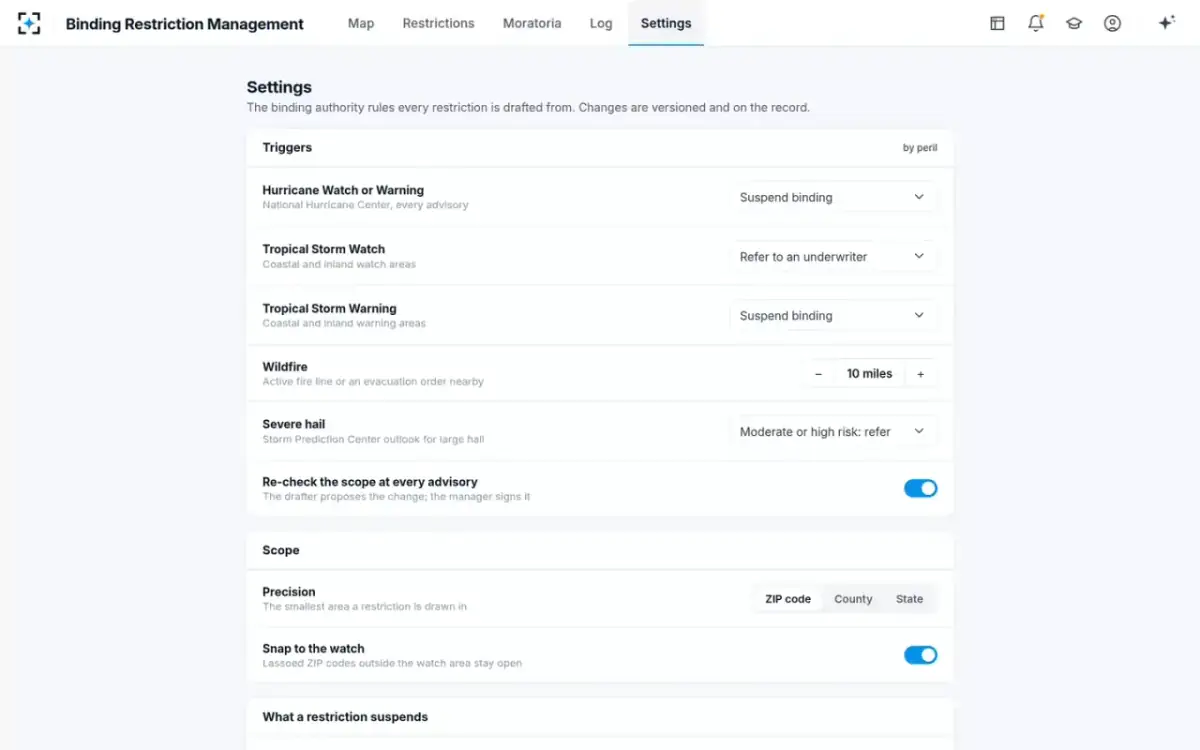
The dry run on last year’s storm
The replay is the acceptance test, and it has two halves. The first replays a past storm’s advisories against that week’s quotes: did the restriction the solution drafts match what underwriting would sign, and what would it have stopped compared with the bulletin that actually went out? The second replays last year’s orders against last year’s print files, which turns a compliance claim into a count.
Florida carriers have a ready-made test. OIR’s Milton order barred cancellations, nonrenewals and notices of either from 8 October to 10 December 2024 in 35 counties, and required cancellation notices issued or mailed in the ten days before 8 October in those counties to be withdrawn and reissued on or after 10 December (OIR Emergency Order 400473-24; the order is read clause by clause in cancellation after a hurricane under Florida law). Running the 2024 print files through the guard shows, notice by notice, whether any mailed into the window or should have been withdrawn. California carriers can do the same with any 2025 moratorium bulletin, where the window starts on the Governor’s declaration date (Cal. Ins. Code §675.1).
A restriction checked step by step in Binding Restriction Management before anyone signs
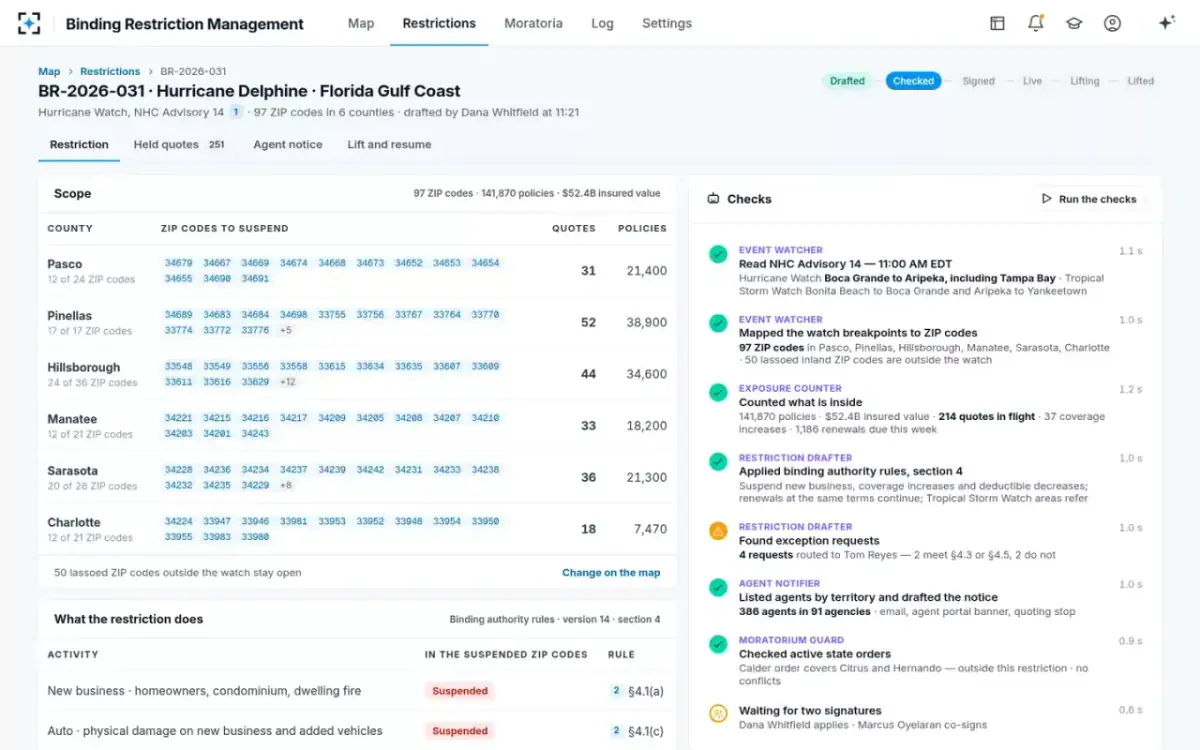
Cat underwriting guidelines, written as settings
Catastrophe underwriting guidelines usually live in a manual section agents half remember. Written as settings, each line becomes something the solution can apply and an examiner can read: the trigger and its public source, the precision, what is suspended, what continues, what is referred, who signs, how the notice goes and how the moratorium guard runs. Each change is versioned, so every restriction names the rule version it was drafted from.
Two guideline lines are worth adding if a carrier’s manual lacks them. A rule for replacements with no lapse, because the most common exception request on a watch day is a homeowner whose current policy expires during the storm. And a statement of what happens to quotes in flight, held with their rate until the ZIP code lifts or withdrawn, because agents will ask within minutes. The buyer's side of those exceptions, set out in buying homeowners insurance during a hurricane watch in Florida, shows why the wording matters.
What to ask before you buy an event-response tool
A demonstration on the vendor’s own storm proves little. The questions below are the ones a go-live will answer anyway, so it is better to ask them first.
Before you buy catastrophe exposure management software for event response
- Will it draft from our binding rules, word for word?
A restriction an agent can follow cites the carrier’s own section, not the vendor’s template.
- Can it run on last year’s storm and last year’s print files before go-live?
The replay is the only test that uses your data, your advisories and your orders.
- Is the dry run kept with each restriction?
The counts behind a scope decision, inside the watch, county-wide and statewide, are what a board or examiner asks for later.
- Who signs, and can anything reach the quoting system before they do?
Nothing should. In the sample, two signatures to apply and two to lift.
- Does the notice go to each agent about their own ZIP codes?
One bulletin for all agents is what generates the calls.
- Does it check every print run against every active order, by property ZIP code and date?
Including orders whose window opened before they were issued, and notices already mailed.
- Does it apply Florida’s statewide hurricane-duration extension, not only the county orders?
Cancellations and nonrenewals that would take effect during a hurricane are extended by statute across Florida; ask how the tool handles it.
- What does it not do?
An event-response tool that claims to replace your catastrophe model, or your counsel, is claiming too much.
The last two questions are the honest ones. Binding Restriction Management reads the orders, holds notices and lists those to withdraw, but counsel confirms each order’s scope and releases each held notice; and it counts exposure inside an area rather than modelling losses. A carrier that needs both buys both, and connects them through one book of policies by location.
Questions people ask
What is a property catastrophe exposure management system?
A set of tools that keeps a property insurer’s catastrophe exposure inside its appetite: models that estimate potential losses, controls that stop new exposure while an event threatens, and checks that keep notices out of areas a state has frozen. Few carriers buy all three from one vendor; what matters is that they share one view of policies by location.
What are exposure management tools in insurance?
They range from catastrophe models and accumulation reports to event-response tools that map watches, warnings and fire perimeters to the book in force. The event-response kind is judged on minutes and precision: how long from the advisory to binding stopped, and how close the stopped area is to the threatened one.
What is the catastrophe underwriting process during a hurricane?
It runs from the advisory to the lift: map the watch to the book, decide what to suspend, sign, tell agents, decide exception requests while binding is stopped, then lift as the watch is discontinued and damage is known. After landfall it continues as moratorium work on cancellations and nonrenewals for weeks or months.
What should cat underwriting guidelines include?
The triggers by peril with their public source, the precision of a restriction, what is suspended, what continues and what is referred, who signs to apply and to lift, the lift conditions, and how agents are told. Each line should be specific enough to apply without a meeting on a watch morning.
Why go live by June rather than before the first storm?
Because the first storm does not wait for the plan. The Atlantic season opens on 1 June, and Florida’s regulator reports that the 2024 season brought three storms that caused significant damage to the state; a carrier rehearsing in the season is rehearsing on live business.