Under Florida law, cancellation after a hurricane is limited three ways. First, any cancellation or nonrenewal of a residential property policy that would take effect during a hurricane, which the statute times from a hurricane warning anywhere in Florida to 72 hours after the last watch or warning ends, is pushed back to the end of that period. Second, once the Governor declares an emergency, the Commissioner of Insurance Regulation can issue an order that freezes cancellations, nonrenewals and the notices of either in named counties for a set window, which in 2024 began days before the orders were filed. Third, a home damaged by the declared hurricane cannot be cancelled or nonrenewed until 90 days after it is repaired, with narrow exceptions for nonpayment, fraud, delay and paid limits. For a policyholder that is protection; for a carrier it is three overlapping calendars that every notice must clear. Botminds’ Binding Restriction Management reads each order into its counties, window and duties, cited to the paragraph, has counsel confirm it, and checks every cancellation and nonrenewal notice against the orders before it prints.
The statutes and the 2024 orders are linked where they appear. The screens show fictional sample data from the solution, including an imagined order for an imagined storm, Hurricane Calder; nothing here is legal advice, and a policyholder with a notice should call the Department of Financial Services’ consumer line or a lawyer.
“If the insurer elects to nonrenew a policy covering a property that has been damaged, the insurer shall provide at least 90 days’ notice to the insured that the insurer intends to nonrenew the policy 90 days after the dwelling or residential property has been repaired.”
Florida Statutes §627.4133(2)(e)3
Can an insurer cancel your policy after a hurricane in Florida?
Only within narrow limits, and for a while not at all. If your county is named in the Commissioner’s emergency order, the insurer may not cancel or nonrenew your policy, or send you a notice that it will, during the order’s window unless you ask in writing. If your home was damaged by the declared hurricane, it may not cancel or nonrenew until 90 days after the repairs are done, except for nonpayment, fraud or misstatement related to the claim, a repair delay you caused, or because it has paid the policy limits (Fla. Stat. §627.4133(2)(e)). And any cancellation or nonrenewal that would have taken effect during the hurricane itself is extended to its end.
After those windows, ordinary rules return: an insurer can nonrenew for the reasons and on the notice Florida law allows, and the notice must give the specific reason. The three limits do not stop a nonrenewal; they move it, and they require the insurer to tell you clearly and in time.
Florida’s limits on cancellation after a hurricane, on one page
Who is protected
- Personal and commercial residential property policies: homes, mobile homes, condominium units and associations, apartment buildings.
- Under a Commissioner’s order after a declared emergency: holders of any property and casualty contract covering a risk in the named counties, including surplus lines.
What is barred
- During an order’s window: cancelling, nonrenewing, or issuing a notice of either, except at the policyholder’s written request or concurrence.
- For a home damaged by the declared hurricane: cancelling or nonrenewing until 90 days after it is repaired.
When
- The hurricane: from a hurricane warning anywhere in Florida to 72 hours after the last watch or warning ends; effective dates falling inside are pushed to its end.
- The order: from issuance for 120 days, extendable once; its window can start before it is filed.
- The repair: 90 days after the home is repaired, with 90 days’ notice of the intended nonrenewal.
What is still allowed
- Before repair: 10 days’ notice for nonpayment; 45 days for a material misstatement or fraud related to the claim, an unreasonable delay in repair caused by the insured, or paid policy limits.
- Under an order: a cancellation or nonrenewal the policyholder asks for, or agrees to, in writing.
Three clocks: the hurricane, the order and the repair
The first clock is set by statute and runs statewide. For policies providing residential coverage, a hurricane’s duration starts when a hurricane warning is issued for any part of Florida and ends 72 hours after the last hurricane watch or warning for any part of Florida is terminated (Fla. Stat. §627.4025(2)(c)). A nonrenewal due on a date inside that period is extended to its end, and the insurer may collect premium for the extra days. The clock does not care whether the storm came near the insured home; a warning in the Panhandle extends a nonrenewal in Miami.
The second clock is the Commissioner’s. When the Governor declares a state of emergency, the Commissioner may issue general orders to everyone the Insurance Code regulates in the affected area; an order “becomes effective upon issuance and continues for 120 days unless terminated sooner by the commissioner,” and can be extended once for another 120 days (Fla. Stat. §252.63). The third clock runs house by house: 90 days after each damaged home is repaired, a date only the claim file and the repair paperwork can tell.
Cancellation after a hurricane in Florida in 2024: what did the orders say?
The 2024 orders followed a pattern, and the pattern shows how the window works. For Helene, the Governor declared an emergency on 23 September; the Commissioner’s order was filed on 30 September and froze cancellations, nonrenewals and notices in 26 counties from 26 September (OIR Emergency Order 400385-24). For Milton, the declaration came on 5 October, and the order filed on 16 October froze them in 35 counties from 8 October (OIR Emergency Order 400473-24). On 16 October the Helene order was amended so both windows ended on 10 December 2024 (OIR).
Both 2024 freezes started before the orders that imposed them were filed
- Look-back: notices withdrawn10 d
- Window before the order4 d
- Window after the order, to 26 Nov57 d
- Extended to 10 Dec14 d
- Look-back: notices withdrawn10 d
- Window before the order8 d
- Window after the order55 d
Each order did four things to cancellation; in the Milton order’s words, it barred cancelling or nonrenewing “or issue a notice of cancellation or nonrenewal” in the counties during the window, “except at the written request or written concurrence of the policyholder.” It ordered cancellation notices issued or mailed in the ten days before the window withdrawn and reissued after it. It kept notices that would have taken effect inside the window valid but required the insurer to “extend the coverage to and including December 10, 2024, or a later date specified by the insurer,” at a pro rata premium. And it applied the 90-days-after-repair rule to homes the storm damaged. The Milton order also extended policyholders’ deadlines to 10 December and, for that period, made rate changes subject to the Office’s prior approval.
Notices already in the mail when the order arrives
The window opening before the order is filed is what makes the paperwork hard. Milton’s order required that “All notices of cancellation issued or mailed within ten (10) calendar days preceding October 8, 2024, and affecting a policyholder in one of the Affected Counties, shall be withdrawn and reissued to insureds on or after December 10, 2024.” By the time the order was filed on 16 October, every cancellation notice issued or mailed from 28 September onward in 35 counties had to be found, including notices printed a week before the Governor’s declaration.
From the Governor’s declaration to the reissued notice, as Binding Restriction Management tracks it
A person decides
GovernorDeclares a state of emergency for named counties under §252.36.
A person decides
CommissionerIssues an order for the counties it chooses, with a window that may start days earlier, for up to 120 days, extendable once.
Agent
Order readerExtracts the counties, window, freezes, exceptions, notices to withdraw, repaired-home rule and expiry, each cited to its paragraph.
Never: decides an ambiguous scope; it asks counsel
A person decides
Compliance counselConfirms the extracted scope against the order before anything is enforced.
Agent
Moratorium guardHolds every notice inside the window and counties, lists notices in the look-back to withdraw, and tracks 90 days after each repair.
Never: releases a held notice
A person decides
Compliance counselReleases held notices only where the order allows, such as a written request, and signs off each withdrawal and reissue.
A carrier also needs to know which notices the order does not reach. The 2024 orders reached property and casualty contracts covering risks in the named counties, including surplus lines; they did not reach a county outside the list, even one inside the Governor’s declaration, and the rule they applied did not reach new policies effective on or after the window’s first day. Those boundaries are where a print run either holds too much or releases too much.
When can an insurer still cancel or nonrenew after a hurricane?
Before repair, the statute keeps three doors open. An insurer or agent may cancel on 10 days’ notice for nonpayment; and on 45 days’ notice for a material misstatement or fraud related to the claim, where the insured has unreasonably caused a delay in the repair, or where the insurer has paid policy limits (§627.4133(2)(e)2). For damage from a covered peril other than the declared hurricane, the protection runs until the earlier of the repair or one year after the final claim payment.
Under an order, the door is the policyholder’s own request. Each 2024 order allowed a cancellation or nonrenewal “at the written request or written concurrence of the policyholder,” which covers the homeowner who sells, replaces the policy or moves. A carrier should keep that writing with the notice, because it is the only reason a notice inside the window can mail.
Do the rules cover condominiums, apartments and surplus lines?
Yes, with different routes. The statute’s protections in §627.4133(2) apply to “any personal lines or commercial residential property insurance policy”, and the list that follows names condominium associations, condominium unit owners and apartment buildings as well as homes and mobile homes (§627.4133(2)). A condominium association’s master policy is therefore inside the 90-days-after-repair rule and the hurricane-duration extension, not only the unit owners’ policies.
Surplus lines insurers are not authorized insurers, so §627.4133(2)(e) does not reach them directly; §626.9201(2)(c) applies the same 90-days-after-repair rule to them once there is a declaration and an order, and the 2024 orders applied it in a section of its own. The orders’ freezes on cancellation reached every property and casualty contract the Code regulates in the named counties, “including policies issued by surplus lines insurers” (OIR Emergency Order 400473-24).
What “repaired” means, and the 90-day letter
The statute defines it: “A structure is deemed to be repaired when substantially completed and restored to the extent that it is insurable by another authorized insurer writing policies in this state” (§627.4133(2)(e)5.a). It is a practical test, not a certificate of occupancy, and the date can be contested, which is why the 90-day letter matters: a carrier that intends to nonrenew a damaged home must say so at least 90 days ahead, and the nonrenewal takes effect 90 days after repair.
The rule has a long tail. It applies to damage from the hurricane in the declaration and the Commissioner’s order, and the statute extends it expressly to homes damaged by Hurricanes Ian and Nicole. A carrier with thousands of claims from one storm has thousands of separate repair clocks, each starting on a different day, and every nonrenewal run for a year or more after the storm has to check them.
Binding Restriction Management: the order’s clock, the notices held, the repair clocks running
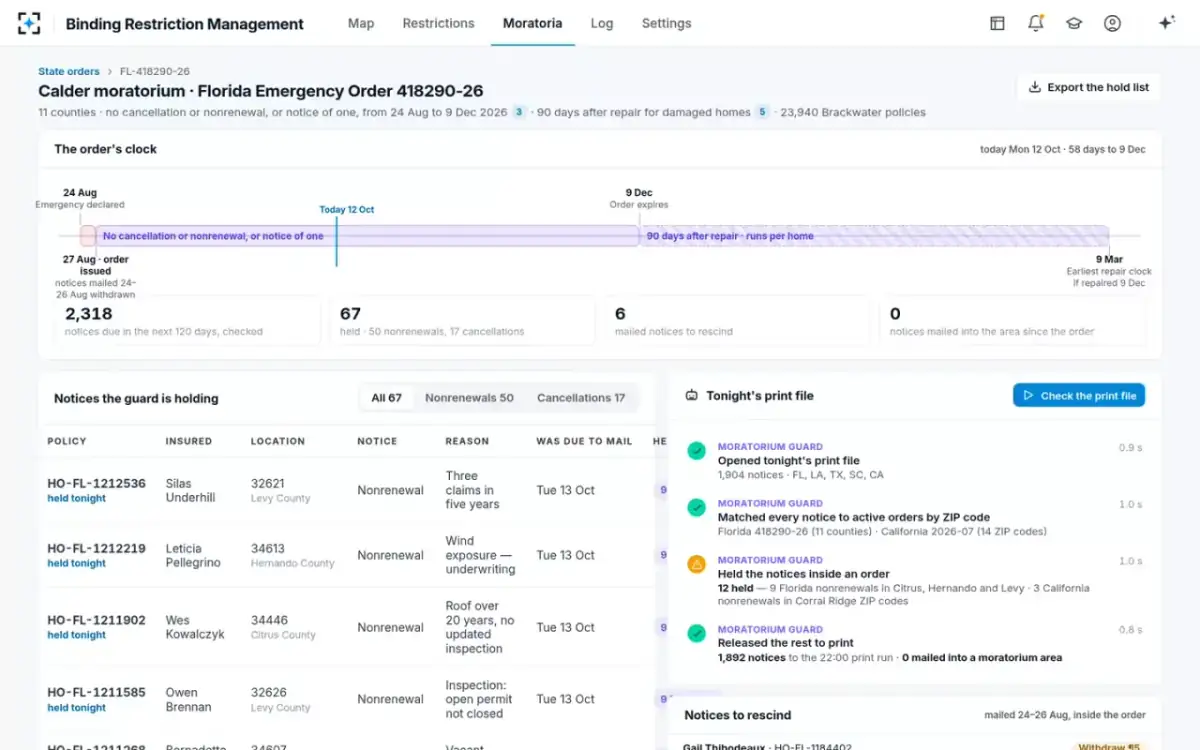
What Florida’s rules ask of a carrier’s notice process
Read together, the rules ask a carrier to prove a negative: that no cancellation or nonrenewal notice went to a protected policyholder at the wrong time. Florida’s regulator has said it initiated “more than 50 market conduct investigations following Hurricane Ian” (OIR, January 2026), and a notice process is easier to defend when every hold and release is logged with its reason.
A post-hurricane notice checklist for a Florida carrier
- Apply the statewide hurricane duration to every effective date
From the first hurricane warning anywhere in Florida to 72 hours after the last watch or warning ends; not only in the order’s counties.
- Load each order’s counties and window the day it is filed
And backdate the hold to the window’s first day, which in 2024 was four and eight days before filing.
- Find the notices in the look-back
Cancellation notices issued or mailed in the ten days before the window, withdrawn and reissued after it.
- Extend coverage on notices that fall inside the window
To the window’s end or later, at a pro rata premium, without a new notice.
- Track repair dates per claim
And send the 90-day letter before any nonrenewal of a damaged home, timed from the repair.
- Keep the policyholder’s written request with any notice released inside a window
It is the order’s only general exception.
- Map counties to the ZIP codes of insured property
Orders name counties; policy systems and print files often carry ZIP codes.
Binding Restriction Management does the reading, the matching and the holding; compliance counsel confirms each order and releases each held notice. The checklist is the test to run on any process, and what to ask of a moratorium map or tool sets out the same test for California’s ZIP code bulletins.
Questions people ask
Is there an insurance moratorium in Florida law?
Not a standing one that starts by itself. Florida’s law gives the Commissioner power to impose one by order after the Governor declares an emergency, for up to 120 days, extendable once, and sets two automatic protections in statute: the extension of effective dates during a hurricane’s duration, and the bar on cancelling a damaged home until 90 days after repair.
Which Florida statute sets the insurance moratorium rules?
Section 627.4133(2)(e) and (f) for damaged homes and the hurricane-duration extension, read with §627.4025(2)(c) for when a hurricane starts and ends; §252.63 for the Commissioner’s emergency orders; and §626.9201(2)(c) for the same repaired-home rule on surplus lines policies. The orders themselves apply Rule 69O-142.015 of the Florida Administrative Code.
Was there an insurance moratorium in Florida for the 2024 hurricanes?
Yes. The Helene order froze cancellations and nonrenewals in 26 counties from 26 September 2024 and the Milton order in 35 counties from 8 October, both to 10 December 2024. The 2025 season brought no named-storm landfall in Florida, according to the Office of Insurance Regulation.
How much notice of cancellation is required in Florida?
For a residential property policy, the general rule is 120 days’ written notice of nonrenewal, cancellation or termination, with the reason; 10 days for nonpayment; and 20 days for cancellation in the first 60 days of a new policy for reasons other than nonpayment. A notice that falls inside an emergency order’s window waits for the window to end, whatever its notice period.
Can my insurer raise my premium after a hurricane?
A renewal can carry an approved rate change, but the 2024 Milton order slowed it: from 8 October to 10 December 2024, rate changes for new or renewal business needed the Office’s approval before use, and “use and file” filings were suspended. Coverage increases you request, or required by law or your policy, were not affected.