An insurance moratorium ZIP codes map is not something a regulator hands a carrier: in California the ZIP codes under each one-year wildfire moratorium are listed as text in a Department of Insurance bulletin, built from CAL FIRE’s fire perimeter and often amended days later; Florida’s emergency orders name counties; Oregon’s cover ZIP codes subject to evacuation notices. Every carrier writing in those states keeps its own map of which ZIP codes are frozen, from when, until when and for which policies, and every cancellation and nonrenewal notice it prints is only as right as that map. Botminds’ Binding Restriction Management builds the map from the orders themselves: an order reader extracts each area and window with the paragraph it came from, compliance counsel confirms the scope, and a moratorium guard matches every notice to the active orders by ZIP code and date before it prints.
The best way to judge a moratorium map, bought or built, is to follow one ZIP code through it. This guide follows 93023, in Ventura County, California, which sat under three different wildfire moratoria between November 2024 and December 2026. The California bulletins, statute and Census Bureau data are public and linked; the carrier, its policies and its print runs are fictional sample data in the solution.
“The department shall provide the commissioner with data describing the fire perimeter sufficient for the commissioner to determine which ZIP Codes are within or adjacent to the fire perimeter.”
California Insurance Code §675.1(b)(2)
Where is the insurance moratorium ZIP codes map?
For California, the authoritative list is the Commissioner’s bulletin, not a map. The statute has CAL FIRE, in consultation with the Office of Emergency Services, determine the fire perimeter; the Commissioner decides which ZIP codes are within or adjacent to it, and “The commissioner shall then issue a bulletin to inform insurers which ZIP Codes are subject to this subdivision” (Cal. Ins. Code §675.1). Each bulletin is a PDF on the Department’s bulletin index with the ZIP codes typed out by fire (CDI bulletins). Any map, a carrier’s or a vendor’s, is a copy of those lists, and the question is how faithful and how current it is.
The lists are not small, and they overlap. Our count from the thirteen moratorium bulletins issued from July 2024 to August 2026, taking the latest version of each, is 366 distinct ZIP codes, 57 of them listed by more than one bulletin, each with its own declaration date and its own one-year clock.
Thirteen California moratorium bulletins, 2024 to 2026: ZIP codes listed in each
One ZIP code, three fires: 93023 from November 2024 to December 2026
A ZIP code is not under “the” moratorium; it can be under several at once, each with a different start and end. 93023 shows how. It entered the Mountain Fire list on 14 November 2024, for a declaration of 7 November. It was added to the Palisades and Eaton bulletin for the Olivas Fire, under the 7 January 2025 declaration, by the January amendments. Then it appeared again in the Gifford Fire bulletin of 9 January 2026, for a declaration that covered San Luis Obispo and Santa Barbara counties, although Census Bureau data place 93023 wholly in Ventura County.
ZIP code 93023 under three moratoria: no gap from November 2024 to December 2026
| Fire and bulletin | Declaration | Bulletin listing 93023 | Moratorium runs to |
|---|---|---|---|
| Mountain Fire · Bulletin 2024-13 | 7 Nov 2024, Ventura County | 14 Nov 2024 | 7 Nov 2025 |
| Olivas Fire · Bulletin 2025-1, amended | 7 Jan 2025, Los Angeles and Ventura counties | Not in the 9 Jan 2025 version; listed in the 17 Jan amendment | 7 Jan 2026 |
| Gifford Fire · Bulletin 2026-1 | 23 Dec 2025, San Luis Obispo and Santa Barbara counties | 9 Jan 2026 | 23 Dec 2026 |
Read as one table, 93023 is frozen continuously for about 25 months. Read as a map that keeps one moratorium per ZIP code, it is not: a carrier that kept only the Mountain Fire window would have released the ZIP code on 7 November 2025, two months before the Olivas window closed and seven weeks before Gifford began. The error is invisible on a map coloured “in moratorium” or “not”; it is obvious in a table with one row per ZIP code per order.
Hop 1: the fire perimeter becomes a list of ZIP codes
The first hop belongs to the state. CAL FIRE describes the perimeter and the Commissioner turns it into ZIP codes within or adjacent to it. Adjacent is the word that makes the list wider than the fire, and it is why 93023 can appear for a fire whose declaration named two other counties: the law follows the perimeter and the ZIP codes beside it, not county lines. How much of a county a perimeter really touches is worked through, fire by fire, in the guide to wildfire binding maps.
Five hops of one ZIP code, each with an owner
A person decides
CAL FIRE and the CommissionerDetermine the fire perimeter and the ZIP codes within or adjacent to it, and publish them in a bulletin, sometimes amended days later.
Agent
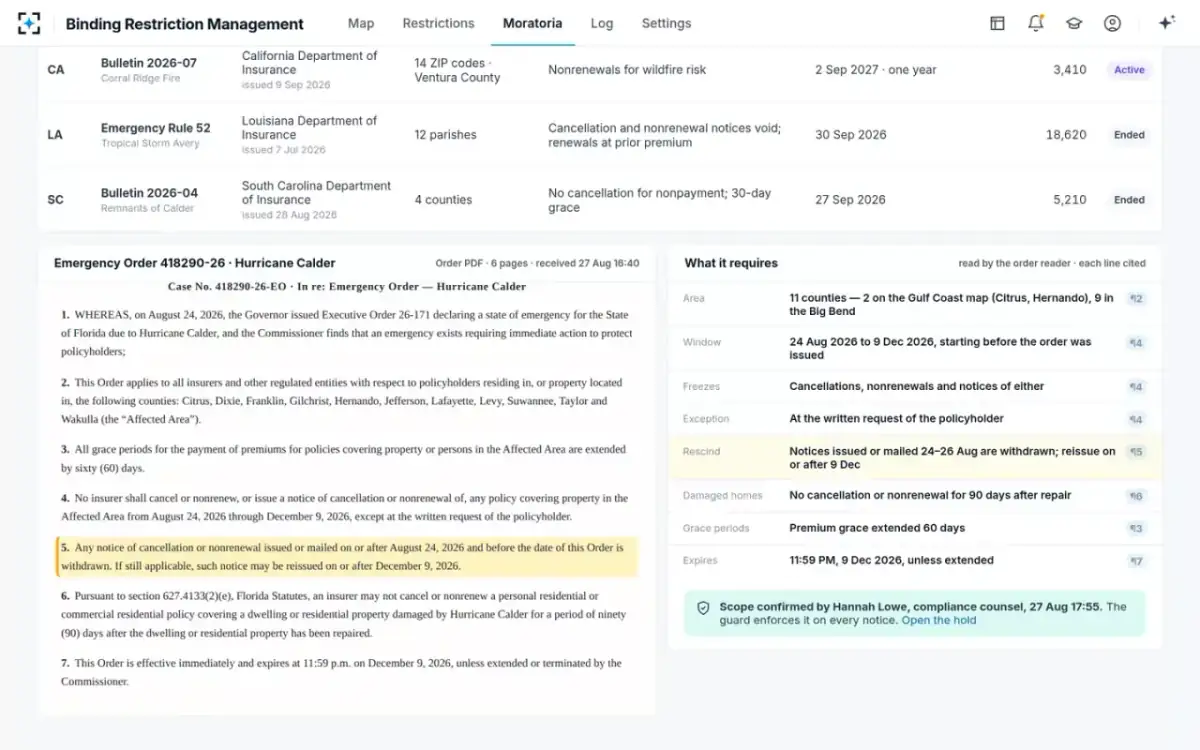
Order readerExtracts each ZIP code, fire, declaration date, window, scope and duty to rescind, each cited to its paragraph, into one row per ZIP code per order.
Never: decides an ambiguous scope; it asks counsel
A person decides
Compliance counselConfirms what was extracted against the bulletin before anything is enforced, and again for each amendment.
Agent
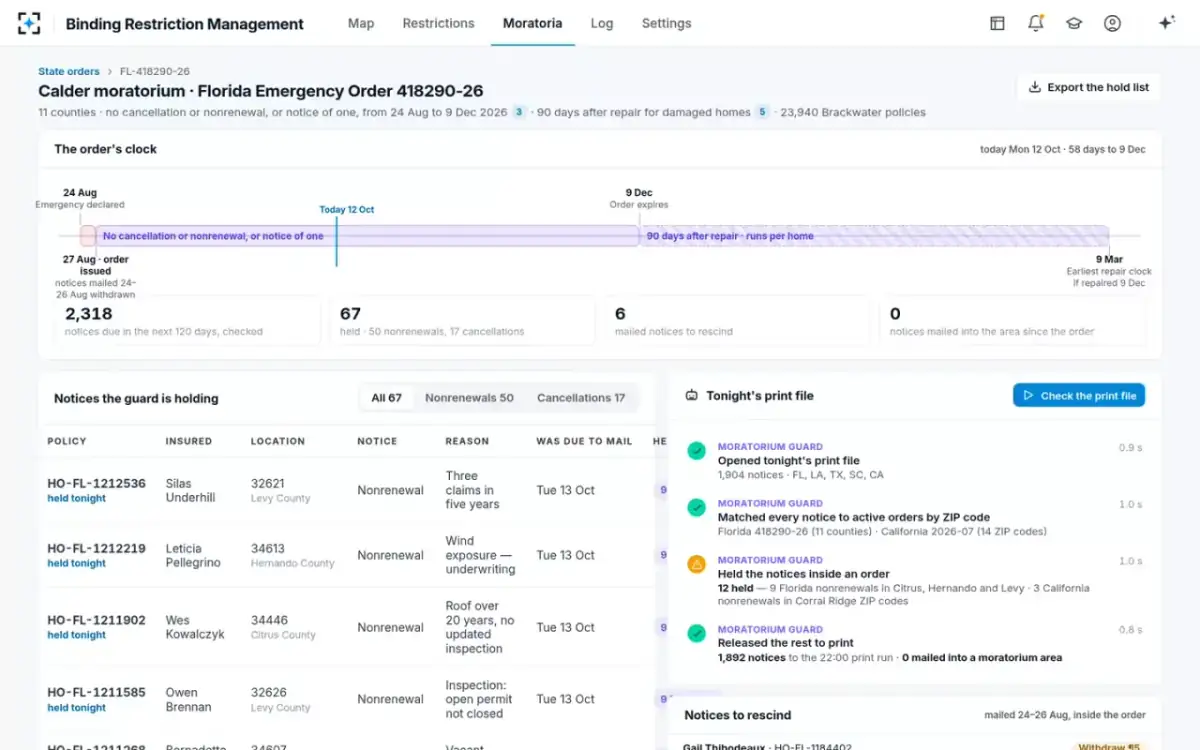
Moratorium guardMatches each notice in a print file to the active orders by the property’s ZIP code and the notice date; holds those inside; lists notices already mailed that must be offered back.
Never: releases a held notice
A person decides
Compliance counselReleases a held notice only when the reason is outside the moratorium, and signs off each rescission offer.
Hop 2: the bulletin, and the bulletin after it
The list a carrier receives first is rarely the last. Bulletin 2025-1, issued on 9 January 2025 two days after the declaration, listed 35 ZIP codes for the Palisades and Eaton fires (CDI Bulletin 2025-1). It was amended on 14 January and again on 17 January, and the 17 January version listed 96 ZIP codes across seven fires (CDI Bulletin 2025-1, amended). By 17 January, eight days after the first list, 61 ZIP codes had been added and none removed. Every bulletin warns of this, and the Gann Fire bulletin of August 2026 puts it in one line: “the Department may issue a supplemental bulletin adding such additional ZIP Codes” (CDI Bulletin 2026-6).
The window does not move when the list grows. A ZIP code added on 17 January was under the moratorium from 7 January, so a carrier that loaded the first list and stopped there would have kept treating 61 frozen ZIP codes as open. That is the hop a moratorium map most often fails, and the reason the duty to offer back notices, set out in the guide to rescinding California nonrenewal notices, is written into every bulletin.
Hop 3: the carrier’s own table
The third hop is the carrier’s, and it is a data-design question. One row per ZIP code is too coarse, as 93023 shows. The row that works is one per ZIP code per order, carrying the order’s declaration date, end date, the policies it covers and the paragraph each field came from. From 2026 the policies column matters more: the Gann Fire bulletin is the first to include commercial property, under a law that took effect on 1 January 2026, so a ZIP code can be frozen for homeowners under one order and for homeowners and commercial property under the next. The 2026 change has its own guide.
Binding Restriction Management: state orders, one per row, each field cited to its paragraph
Hop 4: the policy’s address, not the customer’s
The statute protects the property, by where it is located: in a ZIP code within or adjacent to the fire perimeter (§675.1(b)(1)). The ZIP code that matters is the insured property’s, not the mailing address on the notice. A homeowner who lives in Los Angeles and owns a house in 93023 is inside the moratorium; a tenant in 93023 who moved last month may not be. A guard that matches on the mailing address will hold the wrong notices and release the right ones.
The fourth hop also has a precision problem the map hides. Census Bureau ZIP Code Tabulation Areas approximate USPS ZIP codes but are not the same thing, and some bulletin ZIP codes have no tabulation area at all: of the Gann Fire list, 95229 does not appear in the Census Bureau’s 2020 relationship file, so a polygon map built from tabulation areas has no shape to colour for it. A table matched on the property’s ZIP code still catches it.
Hop 5: the print run, and the notices already out
The last hop is the one that produces a violation. Cancellation and nonrenewal notices are usually printed in scheduled runs from the policy system, and each run has to be matched against every active order before it mails. The sample carrier’s guard opened a print file of 1,904 notices across five states, held 12, nine Florida nonrenewals and three California nonrenewals in moratorium ZIP codes, and released the other 1,892 to the 22:00 run. Counsel, not the guard, releases a held notice when its reason falls outside the moratorium.
Binding Restriction Management checks the print file against every active order before it mails
Florida and Oregon draw their moratorium maps differently
Outside California the unit changes, and so does the clock. Florida’s Commissioner names counties: the Milton order of October 2024 covered 35 “Affected Counties”, fewer than the 51 counties named in the Governor’s second declaration (OIR Emergency Order 400473-24). Oregon’s 2026 wildfire order applies to areas its bulletins name by ZIP code or another suitable boundary (Oregon DCBS), which in practice meant ZIP codes under evacuation notices (the wildfire binding restrictions map sets out that order and its extensions).
Three states, three ways of drawing a moratorium area
What the area is drawn from: ZIP codes within or adjacent to CAL FIRE’s fire perimeter, listed by the Commissioner in bulletins and amendments.
What the carrier’s map has to carry: One row per ZIP code per bulletin, dated from the Governor’s declaration, with residential or commercial scope.
What the area is drawn from: Counties named in the Commissioner’s order, chosen from those in the Governor’s declaration.
What the carrier’s map has to carry: Counties mapped to the ZIP codes of insured property, with a window that can start before the order is filed.
What the area is drawn from: ZIP codes or other areas named in bulletins; described as ZIP codes under evacuation notices.
What the carrier’s map has to carry: Rows that change with each bulletin and an order that lasts 30 days unless extended.
What to ask of any moratorium ZIP code map or tool
A tool that colours ZIP codes on a map answers the easy question. The questions below are the ones that find out whether it will keep a notice out of a frozen ZIP code on the night the print run goes.
Questions to put to any moratorium ZIP code map, vendor or in-house
- Does it keep one row per ZIP code per order?
93023 sat under three moratoria with three end dates. A map with one status per ZIP code releases it two months early.
- How fast does an amendment reach the table?
Bulletin 2025-1 grew from 35 to 96 ZIP codes in eight days, and the window for every added ZIP code still began on the declaration date.
- Is every field traced to the paragraph it came from, and who confirmed it?
Counsel should be able to open the bulletin at the line behind each ZIP code and date.
- Does it match on the insured property’s ZIP code?
The statute speaks of property located in the ZIP code, not where the notice is mailed.
- Does it handle ZIP codes with no map polygon?
A ZIP code with no Census Bureau tabulation area, such as 95229 on the Gann list, can be in a bulletin and missing from an area-based map.
- Does it check every print run, and list notices already mailed?
An order’s window can begin before the bulletin or order is issued; the notices mailed in between must be found.
- Does it carry scope by line?
From 2026 California’s moratorium reaches some commercial property; Florida’s 2024 orders reached every property and casualty contract the Code regulates.
- Who releases a held notice?
A named person with the reason written down, never the tool on its own.
Where Binding Restriction Management fits, and where it does not: it reads the orders and bulletins, builds the per-order table, checks each print file and lists the notices to offer back, but compliance counsel confirms each scope and releases each held notice, and it relies on the carrier’s own policy data for the property address. It does not publish a consumer-facing map, and it does not replace the bulletin: when the two disagree, the bulletin wins and the table is corrected.
Questions people ask
Which ZIP codes were under an insurance moratorium in 2024?
In California, the six moratorium bulletins of 2024, for the Thompson, Gold Complex, Park, Borel, Line, Bridge, Airport, Boyles, Shelly, Bear and Mountain fires, listed 205 distinct ZIP codes by our count. Each moratorium runs one year from its declaration, so every 2024 window closed during 2025, but some of those ZIP codes were listed again for later fires.
Where can I find the California insurance moratorium ZIP codes?
In the California Department of Insurance’s bulletins, listed on its bulletin index by number and fire. Each bulletin names the Governor’s declaration date and lists the ZIP codes fire by fire; check for supplemental or amended versions, which can add ZIP codes after the first issue.
Is there a California wildfire moratorium ZIP codes list for 2025?
Yes, in five bulletins: 2025-1 as amended for the Palisades, Eaton, Hurst, Lidia, Sunset, Woodley and Olivas fires, 2025-6 for Hughes, 2025-12 for Franklin, 2025-13 for the TCU Lightning Complex and 2025-17 for Pack. Together they list 147 distinct ZIP codes by our count.
Are there insurance moratorium ZIP codes in Texas?
We found no Texas statute that freezes cancellations or nonrenewals by ZIP code after a disaster the way California’s does. The Texas rule we found that turns on a storm is the windstorm pool’s moratorium on new or increased coverage applications while a hurricane threatens, which works on applications, not on notices.
How often do California moratorium ZIP code lists change?
As often as the Department issues a supplemental bulletin. Bulletin 2024-9 was revised once, adding one ZIP code; Bulletin 2025-1 was amended twice within eight days and grew from 35 ZIP codes to 96. A carrier should re-check its table against the bulletin index on every print cycle.
Does a moratorium ZIP code stop me from buying a new policy?
No. California’s moratorium limits cancellations and nonrenewals of policies already in force; it says nothing about new policies. Whether a carrier binds new business near an active fire is its own binding rule, which is a separate restriction drawn by distance from the fire line or evacuation orders.