Insurance companies stop writing policies in hurricane season only where, and only while, a storm threatens. The season itself, 1 June to 30 November in the Atlantic, is open for business; what closes is binding, usually new homeowners business and coverage increases, in the area under a National Hurricane Center watch or warning, under the carrier’s own binding rules. The stop is short and local, but it is hard to run: an advisory lands, someone agrees a county list, a bulletin goes to agents, and every hour of that is an hour in which agents can still bind inside the cone. Botminds’ Binding Restriction Management exists for that stretch and for the months after landfall: it maps each advisory to ZIP codes, counts what a stop would catch, waits for two signatures, tells every agent about their own ZIP codes, and checks each cancellation and nonrenewal notice against the state’s orders before it prints.
This page follows one season through the four desks that carry it. The carrier, its storms and its people are fictional sample data in the solution, Brackwater Mutual with 412,600 Florida policies; the rules, the weather definitions and the 2024 Florida figures come from the regulators and agencies linked where they appear.
A season lasts six months; a binding stop lasts hours or days
183
days in the Atlantic hurricane season, 1 June to 30 November
48h
before tropical-storm-force winds, when a hurricane watch is issued
3
storms that hit Florida in the 2024 season and caused significant damage
0
named storms that made landfall in Florida in the 2025 season
Do insurance companies stop writing policies for the whole hurricane season?
No. A carrier that stopped writing from June to November would lose half its year, and the market does not close: Florida’s homeowners multi-peril policies numbered 4,141,774 at 30 September 2025, deep into a season (Florida OIR). What stops is binding, in a place, for the life of a threat. Agents meet it as a binding restriction, a binding suspension or a binding moratorium, three names for the same carrier rule.
The clearest written example comes from Texas, where the rule sits in the plan of operation of the state’s windstorm pool. The Texas Department of Insurance describes it as “the prohibition on TWIA’s acceptance of new or increased coverage applications once a hurricane is in the Gulf of Mexico or within the boundaries of 80 degrees west longitude and 20 degrees north latitude (the storm moratorium)” (TDI emergency rule, 2022). Private carriers write theirs into their binding authority rules for appointed agents; no Florida or Texas statute we found defines one. That is why one carrier stops at the county line, another at the watch boundary and a third across the state, and why the cost of a restriction drawn too wide or too late is a choice each carrier makes.
Why carriers stop binding inside the cone: one storm can bring hundreds of thousands of claims
The arithmetic behind the stop is simple. A policy bound the day before landfall pays the same claim as one bound ten years earlier, but it has collected one day of premium. Milton alone produced 304,408 residential property claims in OIR’s data, with $5.6 billion of estimated insured losses across all lines. A carrier that keeps binding inside the watch is selling the storm, not the season.
The trigger is the watch: the National Hurricane Center’s 48-hour and 36-hour clocks
A binding rule needs a trigger that every desk, every agent and every regulator can see at the same moment, and the National Hurricane Center provides it. The National Hurricane Center defines a hurricane watch as an announcement that hurricane-force winds “are possible within the specified area”, and adds that “the hurricane watch is issued 48 hours in advance of the anticipated onset of tropical storm force winds.” A warning means those winds are expected, and “the warning is issued 36 hours in advance of the anticipated onset of tropical-storm-force winds” (NHC glossary).
Two details shape the work. The watch is drawn between coastal breakpoints, “an agreed upon coastal location that can be chosen as one of two specific end points” (NHC breakpoints), not by county or ZIP code, so somebody has to translate a stretch of coast into the units a quoting system understands. And the line moves: public advisories come every six hours, at 5 and 11, morning and evening Eastern time, and “intermediate public advisories are issued every 3 hours when coastal watches or warnings are in effect” (NHC product descriptions). A restriction set at 11:00 may need to grow at 17:00.
Four NHC announcements, and what the sample carrier’s rules do with each
| Announcement | What the NHC means | Issued ahead of tropical-storm-force winds | Sample carrier’s rule |
|---|---|---|---|
| Tropical Storm Watch | Winds of 39 to 73 mph possible within the area | Within 48 hours | Refer each bind to an underwriter |
| Tropical Storm Warning | Winds of 39 to 73 mph expected within the area | Within 36 hours | Suspend binding |
| Hurricane Watch | Winds of 74 mph or more possible within the area | 48 hours | Suspend binding |
| Hurricane Warning | Winds of 74 mph or more expected somewhere within the area | 36 hours | Suspend binding |
A season of short stops and one long freeze
Seen across a season, binding restrictions are short and scattered, while the freezes that follow a storm last for months. The sample carrier’s 2026 log shows it: four restrictions between 1 June and 30 November, each covering between 31 and 97 ZIP codes in one state, live for 29 days in total. The Florida order that followed one of those storms froze cancellations and nonrenewals in eleven counties for 107 days.
The sample carrier’s 2026 season: four binding stops of 3 to 17 days, then a 107-day freeze
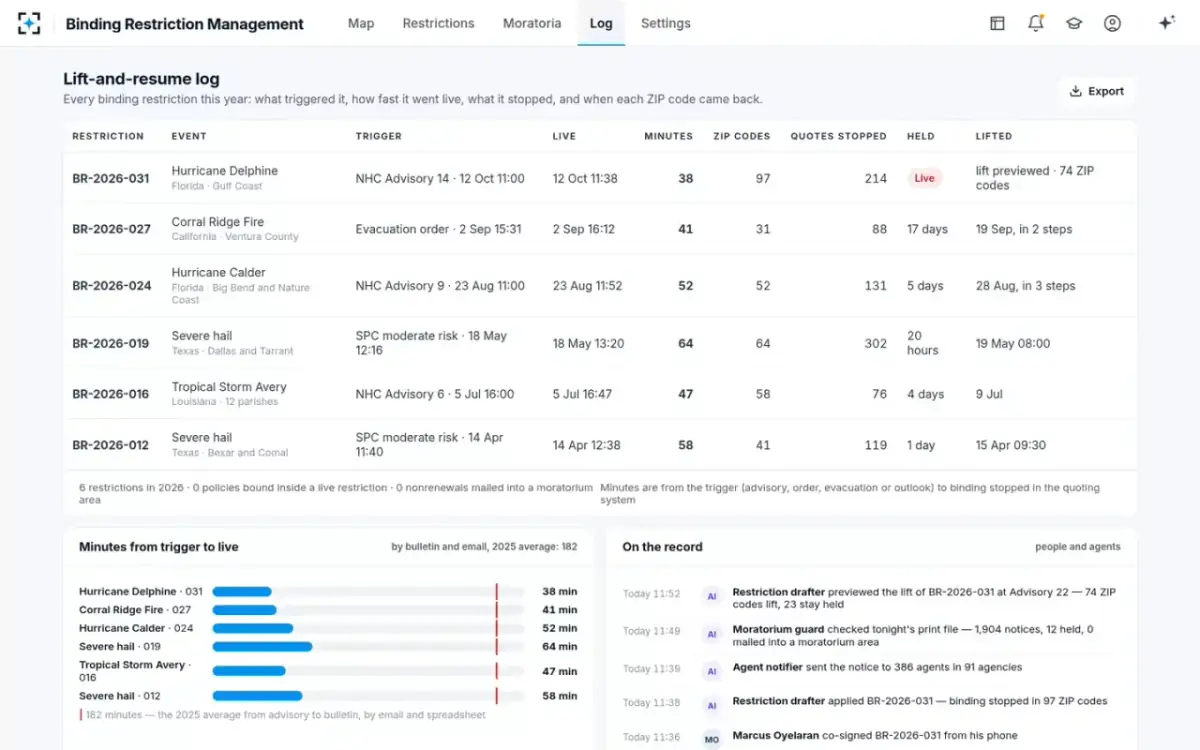
The two kinds of restriction ask for different skills. The first is a race measured in minutes, against an advisory clock. The second is a compliance exercise measured in print runs: every monthly batch of cancellations and nonrenewals has to be matched against each order’s counties or ZIP codes and its dates. The sample log’s average from advisory to bulletin in 2025, when the work ran on email and a spreadsheet, was 182 minutes; with the restriction drafted from the map, Delphine’s went live 38 minutes after the advisory.
Who carries a hurricane season: four desks on one clock
A binding stop is usually owned by underwriting operations, signed by the catastrophe underwriting lead, explained by agent communications and policed afterwards by compliance. Each desk sees a different part of the same storm, which is why they so often meet first in an email thread at 11:15 on a watch morning, agreeing a county list.
The four desks a hurricane season runs through, before and after the stop is drawn by ZIP code
Today
Agrees a county list by email after the advisory and sends the bulletin about three hours later; picks a whole county or state when unsure.
With agents
Lassos the counties under the watch, reads the count of quotes and agents inside, and signs a restriction drawn to the ZIP code.
Still theirs: The decision to apply and to lift
Today
Approves the scope from a description in an email, without the cone, the watch and the quotes on one screen.
With agents
Co-signs from the signing view, which shows the scope, the rules line by line and the dry run.
Still theirs: The second signature, to apply and to lift
Today
Sends one bulletin to every agent and fields the calls asking whether it includes their ZIP code.
With agents
Each agency gets its own ZIP codes and held quotes; she sees who has opened the notice and resends to the rest.
Still theirs: The wording agents read
Today
Reads each state order as a PDF and maps its counties or ZIP codes onto the notice runs by hand.
With agents
Confirms what was extracted from each order, paragraph by paragraph, before every notice is checked against it.
Still theirs: The scope of every order, and every release of a held notice
The fifth person, the underwriter, carries the exceptions: the renewal that changes terms, the replacement policy, the house closing on Thursday. Which requests can still bind during a watch is the question agents and buyers ask most, and it has a page of its own.
Where the working days go when the bulletin goes out by email
The minutes before the stop get the attention, but most of a storm’s staff time goes later, into calls, held quotes and notices. Our estimate for one hurricane on a regional homeowners book puts the work at about ten and a half staff days by email and spreadsheet, and the largest single block is checking cancellation and nonrenewal notices against the moratoria before each print run.
Where one hurricane’s staff days go: notice checking is the largest block
By email and spreadsheet · 10.5 staff days
- Scope and bulletin · 5%
- Agents’ calls · 19%
- Held quotes, exceptions · 14%
- Staging the lift · 10%
- Reading orders · 14%
- Checking notices · 38%
Drafted from the map · 2.35 staff days
- Scope and bulletin · 4%
- Agents’ calls · 21%
- Held quotes, exceptions · 21%
- Staging the lift · 11%
- Reading orders · 21%
- Checking notices · 22%
The calls are the most avoidable part. After the sample carrier’s last bulletin by email, the agent desk took about 300 calls asking whether it covered the caller’s ZIP code. When the Delphine notice listed each agency’s own ZIP codes and held quotes, 291 of 386 agents had opened it within 40 minutes and the agent desk took 14 calls.
Is it harder to buy insurance during the fall hurricanes?
In a threatened area, yes, for a few days at a time; elsewhere, not because of the storm. The late season is when threats cluster. The Texas Department of Insurance, citing the National Weather Service, notes that “the peak hurricane threat for the Texas coast exists from August through September” (TDI), and Florida’s claims data calls for 2024 opened for Debby in August, Helene in September and Milton in October. A buyer whose closing falls in those weeks is more likely to meet a watch, and a watch is when new business stops.
The practical answer is timing. A homeowners policy bound before a watch is posted stands; one requested after usually waits until the area lifts. Flood insurance runs on its own clock, 30 days for most new federal flood policies, and the exceptions are set out with the other routes in the guide to buying during a watch.
After landfall the stop reverses: cancellations frozen by order
Once a storm passes, the restriction on the carrier changes direction. Binding reopens, ZIP code by ZIP code as damage is known, while the state limits what the carrier may end. In 2024 Florida’s Office of Insurance Regulation prohibited “the cancellation or nonrenewal of a policy in an impacted area, except at the written request of the policyholder, until December 10, 2024” in 26 counties for Helene and 35 for Milton (OIR, 16 October 2024).
Those orders, not the binding stop, are where carriers most often go wrong, because the cancellation and nonrenewal runs are monthly and automatic and the orders change their counties, dates and duties from storm to storm. How Florida’s cancellation rules work after a hurricane sets out the statute and the orders line by line.
Are insurance companies pulling out of Florida?
The regulator’s latest figures say the opposite. OIR’s January 2026 report counts “Seventeen new companies” approved to write residential property policies in Florida since the 2022 and 2023 reforms, and in May 2026 the Commissioner put the number of new entrants at 20 (OIR, January 2026; OIR, May 2026). Citizens, the state’s insurer of last resort, held 318,420 of the 4,141,774 homeowners multi-peril policies, 7.69%, at 30 September 2025.
A binding restriction is not a withdrawal and should not read like one. A notice that says new business is suspended in 97 ZIP codes until the watch lifts tells an agent the carrier is still writing everywhere else; a bulletin that says the state is closed tells the same agent, and every customer they call, something else entirely.
What changes when the stop is drawn by ZIP code
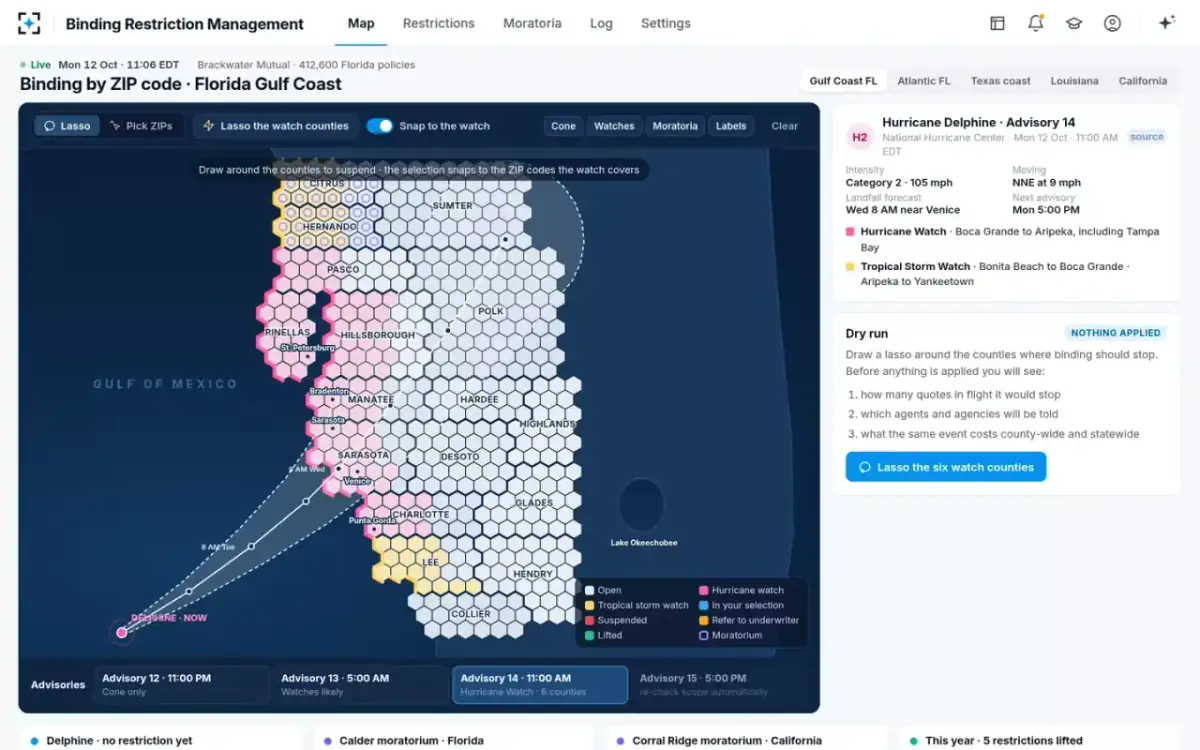
Drawn by ZIP code, a restriction stops what the storm threatens and nothing more. In the sample, Advisory 14 put a Hurricane Watch on six Gulf Coast counties at 11:00. Snapped to the watch, the restriction covered 97 of those counties’ 147 ZIP codes and stopped 214 quotes; the same storm drawn county-wide would have stopped 263, and statewide 1,042. Two people signed at 11:34 and 11:36, the quoting system stopped new business at 11:38, and 386 agents in 91 agencies had their notice at 11:39.
Binding Restriction Management: the advisory on the map, before anything is applied
The season’s history matters as much as the speed. Every restriction, its trigger, its minutes to live, its ZIP codes, its quotes stopped and how it lifted is on one log, which is also what an examiner or a reinsurer asks for after a storm.
Binding Restriction Management: one season’s binding restrictions on a single log
Questions people ask
What happens to a quote that was in progress when binding stopped?
It is held, not lost. In the sample carrier’s rules a quote inside a suspended ZIP code keeps its rate while the restriction stands, and the agent is told when that ZIP code lifts and the quote can bind. On the sample storm 214 new business quotes and 37 coverage increases were held this way.
Should I buy insurance before hurricane season starts?
Buying before 1 June is not required, but buying before a watch is. A homeowners policy requested once a watch covers the property usually waits until the area lifts, and a new federal flood policy normally takes effect only after a 30-day wait. A purchase tied to a mortgage closing is the main exception for flood.
Can I get insurance during a hurricane in Florida?
Outside the watch or warning area, yes. Inside it, new business and coverage increases are usually suspended until the area lifts, while renewals on the same terms continue. The sample carrier lets an underwriter approve a replacement policy with no gap in coverage; ask the agent which rules apply.
How long does a binding restriction last?
It depends on the threat and on the carrier’s lift rule. The sample carrier’s 2026 restrictions lasted from 20 hours for a hail outlook to 17 days for a California wildfire, and its hurricane lifts ZIP code by ZIP code once the watch is discontinued, no warning or evacuation order remains and reported damage is below its threshold.
Does a binding restriction apply to car insurance too?
It can. In the sample carrier’s rules, physical damage coverage on new auto policies and on added vehicles is suspended in the watch area, because a car bought the day before landfall is exposed to the same flood. Replacing a vehicle already insured with the same coverage continues.
Who decides when binding stops and starts again?
The carrier, under its own binding authority rules; for a state windstorm pool such as Texas’s, the rule is in a plan of operation the regulator adopts. In the sample, the underwriting operations manager applies and lifts each restriction and the catastrophe underwriting lead co-signs both.