In a homeowners underwriting software comparison for renewals, four approaches are on the table: a manual list worked from the policy system, a rules engine that fires on fields such as roof age, a vendor risk or roof-condition score delivered as a number, and an agent pipeline that gathers each input, re-scores, explains the change factor by factor and drafts the letter for an underwriter to decide and sign. They differ less in what they detect than in what they can prove. Since January 2026 Texas requires every nonrenewal statement to name the precise risk factor and the source of the information relied on, and at least nine states have warned insurers against acting on stale or unclear aerial images. Botminds' Homeowners Renewal Underwriting is the fourth approach. This guide runs one sample renewal through all four, honestly, and lists what to ask any vendor.
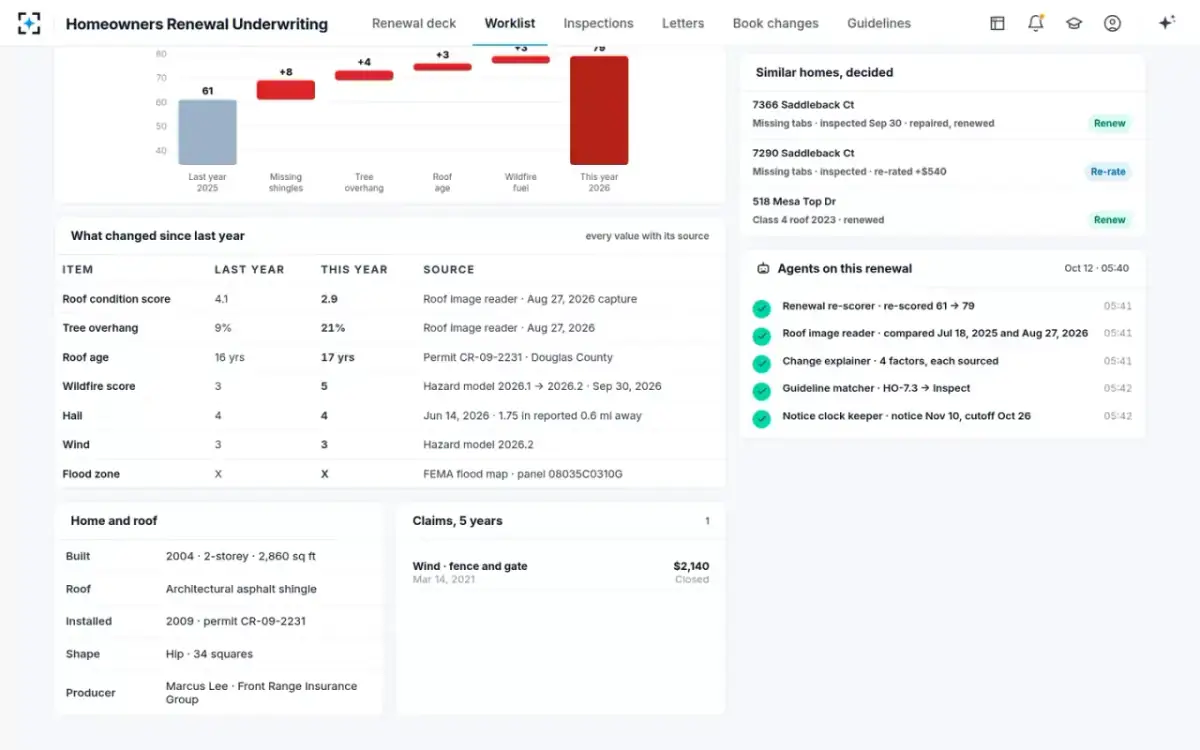
The renewal used is the Brennan home in Castle Rock, Colorado, at a fictional sample insurer, Larkmoor Mutual, renewing January 9, 2027. Here is what changed since last year:
One renewal, six inputs: what any homeowners underwriting software has to work with
Roof condition score
4.1 → 2.9
Aerial capture Aug 27, 2026 against Jul 18, 2025
Missing shingles
about 14 tabs, south slope
Same capture, confidence 0.91; image only
Tree overhang
9% → 21% of the roof
Same capture; image only
Roof age
16 → 17 years
Douglas County permit CR-09-2231
Wildfire score
3 → 5
Hazard model 2026.1 → 2026.2
Hail, wind, flood
unchanged
Storm reports; hazard model; FEMA panel
Four approaches to renewal underwriting, run on the same changed home
Each approach below gets the same data on the same morning, 90 days before renewal. The table shows what each one notices, what it leaves the underwriter to do, and what it can put in a letter to the homeowner. The assessments are ours, describing each approach as it is typically built, not any named product.
Homeowners underwriting software compared on one renewal: what each approach can show
| Question | Manual list | Rules engine | Vendor risk score | Agent pipeline with sources |
|---|---|---|---|---|
| Does the home reach an underwriter? | When the list gets to it, in policy or date order | Yes, if a field crosses a rule: roof age over 15 fires | Yes, if the score crosses a band | Yes: +18 points and a new condition finding; ranked by its decision cutoff |
| What is the underwriter told? | Nothing until the file is pulled by hand | Which rule fired | A score fell from 4.1 to 2.9 | Four factors with points: missing shingles +8, overhang +4, roof age +3, wildfire fuel +3 |
| Can it tell what rests on one image? | Only if the underwriter checks | No: rules see fields, not evidence | Rarely: the image and its date sit inside the vendor | Yes: shingles and overhang flagged as image-only, so the rule sends it to inspection |
| Stale, blurry or wrong-house image? | By eye, if noticed | Not checked | Depends on the vendor | Checked: sharpness, capture date and parcel match on every image |
| Similar homes, same answer? | Not checked | Yes for rule fields | Same score, but decisions still vary | Nightly pair check across the book |
| Notice date tracked? | In a calendar | Often in the policy system | No | Each renewal ranked by cutoff; warning ten days ahead |
| What the letter can say | Whatever the underwriter writes | “Roof age exceeds guideline” | “Risk characteristics changed” | One plain reason per factor, each with its capture, permit or model version |
| Meets the Texas source rule? | If the underwriter writes it in | For the rule, not for the data behind it | Names the vendor, not the evidence | Yes: source and date travel with every input |
The table's last two rows carry the argument. Every approach can find this home. The manual list will find it eventually, the rules engine finds the roof age, the vendor score finds the condition drop. What separates them is the letter. "Risk characteristics changed" is the kind of reason Delaware calls unacceptable, and a vendor score with no capture date behind it cannot show that the image was clear, accurate and current, as Maryland requires (MD Bulletin 25-10). The nonrenewal appeal tests are scored on this same file in their own guide.
What homeowners underwriting software companies sell: four product shapes
The market sorts into four shapes, and most carriers already own two of them. Policy administration and rating systems hold the policy, the rating plan and usually some rules; they are the system of record and the place the decision lands. Data and score vendors sell aerial imagery, roof-condition scores and peril scores for wildfire, hail, wind and flood. Underwriting workbenches put those feeds in front of an underwriter, policy by policy. Agent-based renewal software, the newest shape, does the gathering, scoring, explaining and drafting across the whole book and hands the underwriter only the changed homes.
These are layers, not rivals. A renewal process needs a policy system, data, and something that turns data into decisions on time. The buying question is which layer does the last part, and how much of it a person still assembles by hand. The NAIC's 2022 survey of larger home insurers counted 2,413 models in use, 42% of them developed by third parties, with 95 distinct third-party model vendors and 76 data providers named (NAIC Home AI/ML Survey memo). Most carriers are already integrating several vendors; the renewal layer has to work across them.
Buying a score versus buying a process
A score answers "how risky is this home now?" A renewal process answers "what changed, why, what do we do, by when, and what do we tell the homeowner?" The difference matters most where regulators now look.
A vendor score and a renewal process, on what an examiner will ask
Buying a score: A number per home, refreshed on the vendor’s cycle.
Buying a renewal process: A decision-ready renewal: what moved, by how much, from which source, with a recommendation and the rule behind it.
Buying a score: Two numbers to compare, if you kept last year’s.
Buying a renewal process: The change itself, split into filed factors with points.
Buying a score: Held by the vendor; access varies.
Buying a renewal process: Each capture, permit, claim and model version attached and dated.
Buying a score: Yours to build around the score.
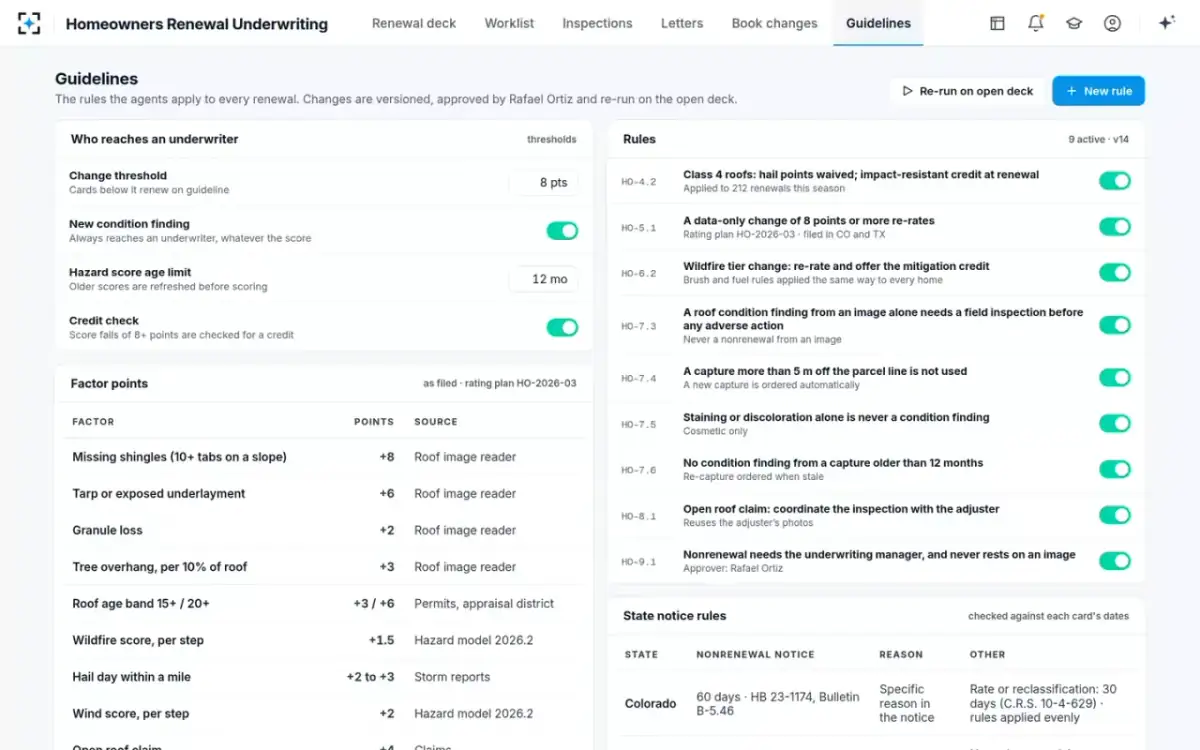
Buying a renewal process: Your guidelines and filed factor points as settings, versioned and approved by your manager.
Buying a score: Written by the underwriter from the score.
Buying a renewal process: Drafted per factor in the state’s wording; sent only when the underwriter signs.
Buying a score: You answer for the vendor’s model.
Buying a renewal process: You still answer for the scores you buy, but every decision shows which inputs it used.
Nothing in that comparison argues against buying scores. Homeowners Renewal Underwriting runs on the scores and captures a carrier already buys: aerial captures with their resolution, date and parcel match, wildfire, hail, wind and flood scores by model version, permits and roof records, claims and storm reports, and the inspection vendor's findings. It does not produce imagery or hazard models of its own. Inspecting roof imagery in depth before an adverse action is the job of Botminds' Aerial Imagery Verification, whose guide to insurance aerial imagery software sets out what to ask of it.
What changed since last year, every value with its source
What to look for in renewal underwriting software: eight questions
A demonstration on the vendor's data proves little. Ask for each question to be answered on one of your own renewals, with your guidelines loaded.
Eight questions to put to any homeowners renewal underwriting software
- Show me last year’s and this year’s value for every input, with its source and date.
Without both values there is no “change”; without the source there is no Texas statement.
- Which parts of this score change rest on an image alone?
The distinction every recent state bulletin on aerial imagery turns on.
- What happens to a capture that is old, blurry or off the parcel?
The answer should be a rule you can read, not a model confidence you cannot.
- Where do my guidelines and filed factor points live, and who can change them?
Texas defines underwriting guidelines to include electronic rules and requires them to be filed; you must be able to show what was applied, version by version.
- Can it find two similar homes we decided differently?
Consistency across a book is what single-file review cannot check.
- How is each renewal’s notice date worked out, per state?
60 days in Texas and Colorado, 75 in California, 120 in Florida: the cutoff must be set per state.
- What does the underwriter sign, and what do they see when signing?
Every reason on the letter should be visible, tied to its factor, at the moment of signature.
- Will you support our audits and regulators’ inquiries?
The NAIC model bulletin suggests contract terms giving audit rights and requiring the third party to cooperate with regulatory inquiries.
Where Homeowners Renewal Underwriting fits, and where it does not
It fits between the data you buy and the decision your underwriter makes. Six agents re-score every renewal 90 days out, compare the roof captures, split each change into filed factors with sources, match your guidelines, keep each renewal's notice clock and draft the letters. A named underwriter decides every changed renewal, the manager approves nonrenewals, exceptions and re-rates over $1,000, and nothing is mailed unsigned.
It does not replace the policy administration system, which stays the system of record, or the rating engine, whose filed factor points the solution reads as settings. It does not generate aerial imagery or hazard scores. It does not decide: there is no setting under which it sends an adverse letter on its own. And its sample book covers Colorado and Texas; a carrier in other states sets their notice rules and reason requirements as guidelines, which the underwriting manager approves before they apply.
Your guidelines and filed factors, as settings you approve
Property insurance software: where renewal underwriting sits in the stack
Property insurance software is a broad category: policy administration, rating, billing, claims, document generation and data feeds. Renewal underwriting is a thin layer across several of them, and the integration points decide the effort. In the sample set-up those are six: the policy system for renewing policies, coverage and premium; aerial captures, three summers per home; hazard scores by model version; permits and roof records; five years of claims and storm reports; and the inspection vendor, orders out and findings back. The decision goes back to the policy system.
That shape has a practical consequence for a comparison. A tool that only reads one feed, imagery say, cannot produce a renewal decision; a tool that only lives inside the policy system cannot see the evidence. The comparison that matters is how many of the six an approach reads, and whether it keeps the date and source of each.
Is there free homeowners underwriting software?
Not for regulated renewal decisions, but some of the most useful inputs are free and public. FEMA publishes flood maps. The USDA Forest Service's Wildfire Risk to Communities maps community wildfire risk nationwide, though its own FAQ says it is not designed for insurers and is not a replacement for parcel-level or home assessments. A spreadsheet that joins these public layers to a policy export is a reasonable start for a small mutual. It is not a renewal process: it keeps no notice clock, drafts no letter, and leaves the underwriter to note every source by hand. The wildfire score lookup guide shows what the public map can and cannot tell you about one address.
How to run a fair comparison on your own renewals
Pick last season's renewals, not next season's. Choose a few hundred, including the homes you inspected, the ones you re-rated, any you non-renewed and any that drew a complaint. Run each approach on the data as it stood 90 days before each renewal, with your guidelines loaded, and compare four things: which homes each sends to a person, whether those match the ones your underwriters actually changed, whether every adverse reason it would have written names its source and date, and whether it would have decided before each state's notice date. Botminds will run the solution on a sample of your own upcoming renewals, which can sit beside that back-test; start from Homeowners Renewal Underwriting.
Questions people ask
Which homeowners underwriting software companies should I compare?
Compare by shape rather than brand: your policy administration and rating system, the data and score vendors you already buy from, any underwriting workbench, and agent-based renewal software. The NAIC's survey of larger home insurers found 95 distinct third-party model vendors in use, so most carriers already integrate several; the renewal layer must work across them.
What is renewal underwriting software?
Software that re-reads each policy before it renews against current data and guidelines and helps the underwriter decide to renew, re-rate, inspect or not renew before the state's notice date. The better tools show what changed since last year, from which source, and draft the reason for the homeowner.
Is AI homeowners insurance underwriting software allowed?
Yes, within the same standards as any underwriting decision. Twenty-nine jurisdictions have adopted the NAIC model bulletin on insurers' use of AI as of October 2026, which expects documented governance and oversight of third-party systems. Adverse decisions still need specific reasons, and in Texas the source of the information relied on.
How long does it take to put renewal underwriting software live?
It depends mostly on the six integrations and on loading your guidelines and filed factor points. A practical plan runs it first on last season's renewals, compares its output with what your underwriters decided, and goes live for a renewal month only once the notice clocks and letters have been checked for each state you write.
Can renewal software decide on its own?
Some rules engines and score-based systems can renew or decline automatically; the NAIC survey found about half of home insurers' underwriting models ran as automation. In Homeowners Renewal Underwriting the agents renew unchanged policies on guideline, but every changed renewal is decided and every letter signed by a named underwriter.