Can an insurance company drop you after one claim? For homeowners insurance the honest answer is: sometimes, at renewal, but usually not for the claim alone, and in some states not at all for certain claims. Insurers generally cannot cancel a homeowners policy mid-term because you filed a claim; what they can do, within state limits, is decline to renew it at the end of the term or renew it at a higher price. Florida forbids using an act-of-God claim, or a single water-damage claim, as the cause unless you ignored the insurer's requests to prevent a repeat. Texas does not count natural-cause claims at all toward its rule, which allows a refusal to renew only after three claims in three years and only if the insurer warned you after the second. What more often happens is that the claim becomes one input among several, roof age, roof condition, hazard scores, in a renewal score. Botminds' Homeowners Renewal Underwriting re-scores every renewal and shows the underwriter exactly how much of any change came from claims, so the decision and the letter say so.
The sample renewal below is from a fictional insurer, Larkmoor Mutual, and a fictional household, as they appear in the solution.
One claim can change a renewal in three different ways
As a count
The claim adds to your claims history, which insurers read from their own files and from claims databases. Some states limit how many claims, and which kinds, can count.
As a condition
The claim reveals damage. If it is not repaired by renewal, the unrepaired roof or water damage, not the claim, becomes the reason.
As a price
The claim moves a rating factor and the premium rises at renewal, with no change to whether you are covered. Texas allows a surcharge after two claims in three policy years.
Can a home insurance company drop you for filing a claim?
Not mid-term in the states whose rules are set out here, and not freely at renewal. Texas and Florida both limit mid-term cancellation of a homeowners policy to a short list of causes, such as nonpayment, fraud, a material misstatement or a substantial change in the risk, and filing a legitimate claim is not on either list. Texas, for example, lets an insurer cancel any policy for a fraudulent claim, not a genuine one (Tex. Ins. Code §551.104(b)). At renewal the insurer has more room, but that room is fenced, and the fences differ by state.
Florida's fence is about the kind of claim. "Claims on property insurance policies that are the result of an act of God may not be used as a cause for cancellation or nonrenewal, unless the insurer can demonstrate, by claims frequency or otherwise, that the insured has failed to take action reasonably necessary as requested by the insurer to prevent recurrence of damage" (Fla. Stat. §627.4133(3)). The same section protects a single water claim: it "may not be used as the sole cause for cancellation or nonrenewal" without the same showing (§627.4133(6)).
Texas's fence is about the number. A claim "resulting from a loss caused by natural causes", a claim filed but not paid, and certain appliance claims do not count at all. An insurer "may refuse to renew an insurance policy if the insured has filed three or more claims under the policy in any three-year period", but only if it warned the homeowner after the second claim; if it did not, "the insurer may not refuse to renew the policy because of claims" (§551.107).
Homeowners claim rules in Florida and Texas, side by side
The two biggest homeowners markets with detailed claim rules approach the question from opposite ends. Florida protects categories of claims; Texas sets a count and a warning.
What one claim can and cannot do to a homeowners renewal in Florida and Texas
| Situation | Florida | Texas |
|---|---|---|
| A storm, hail or other natural-cause claim | Cannot be the cause of nonrenewal unless you failed to take action the insurer reasonably asked for to prevent a repeat (§627.4133(3)). | Does not count as a claim for the renewal rule (§551.107(b)(1)). |
| A single water-damage claim | Cannot be the sole cause, on the same condition (§627.4133(6)). | Counts, unless natural-cause or excluded; one claim alone does not reach the threshold. |
| Damage not yet repaired | No cancellation or nonrenewal until repaired or one year after the final claim payment, whichever is earlier, for damage from a covered peril (§627.4133(2)(e)1.b); 90 days after repair for a declared hurricane. | No specific repair period in ch. 551; the condition may still be a lawful reason. |
| How many claims allow a refusal | No fixed number in statute. | Three or more in any three-year period, after a written warning at two (§551.107(d)–(e)). |
| A surcharge instead | Through the filed rating plan. | Allowed at renewal after two or more claims in the preceding three policy years, on sound actuarial principles (§551.107(c)). |
| A phone call that is not a claim | Not addressed in these sections. | A customer inquiry cannot be a basis for nonrenewal (§551.113). |
| Notice of nonrenewal | 120 days, with specific reasons. | 60 days; written statement with the precise reason and its source. |
Two points are easy to miss. First, Texas's warning is a precondition: the notice must list the policyholder's claims and contain a prescribed sentence, beginning "The filing by you of another claim, except for a claim resulting from a loss caused by natural causes", and without it the insurer loses the right to non-renew for claims. Second, Florida's repair rule protects the homeowner while the claim is being fixed, which is exactly when a renewal date often falls.
From the claim to the renewal decision: who does what
A claim reaches a renewal through several hands, and each has its own obligations. Following one renewal through them shows where a single claim's weight is set.
How a claim travels to the renewal decision, step by step
A person decides
Homeowner files a claimThe insurer adjusts and pays it, or does not. In Texas a claim filed but not paid does not count toward the renewal rule.
Agent
Claims history is updatedThe insurer’s own files and claims databases log it; the CFPB lists one such database as holding seven years of home and personal property claims.
Agent
Renewal re-score, 90 days outThe claim becomes one input beside roof age, roof condition and hazard scores.
Never: counts natural-cause claims toward a Texas claims limit
Agent
Change explainerSplits any score change into factors, so the claim’s share is visible on its own line.
Never: shows a factor without its source and date
A person decides
Underwriter decidesRenew, re-rate or inspect. A nonrenewal goes to the underwriting manager.
A person decides
Underwriter signs the letterOne reason per factor, each with its source, in the state’s wording and timing.
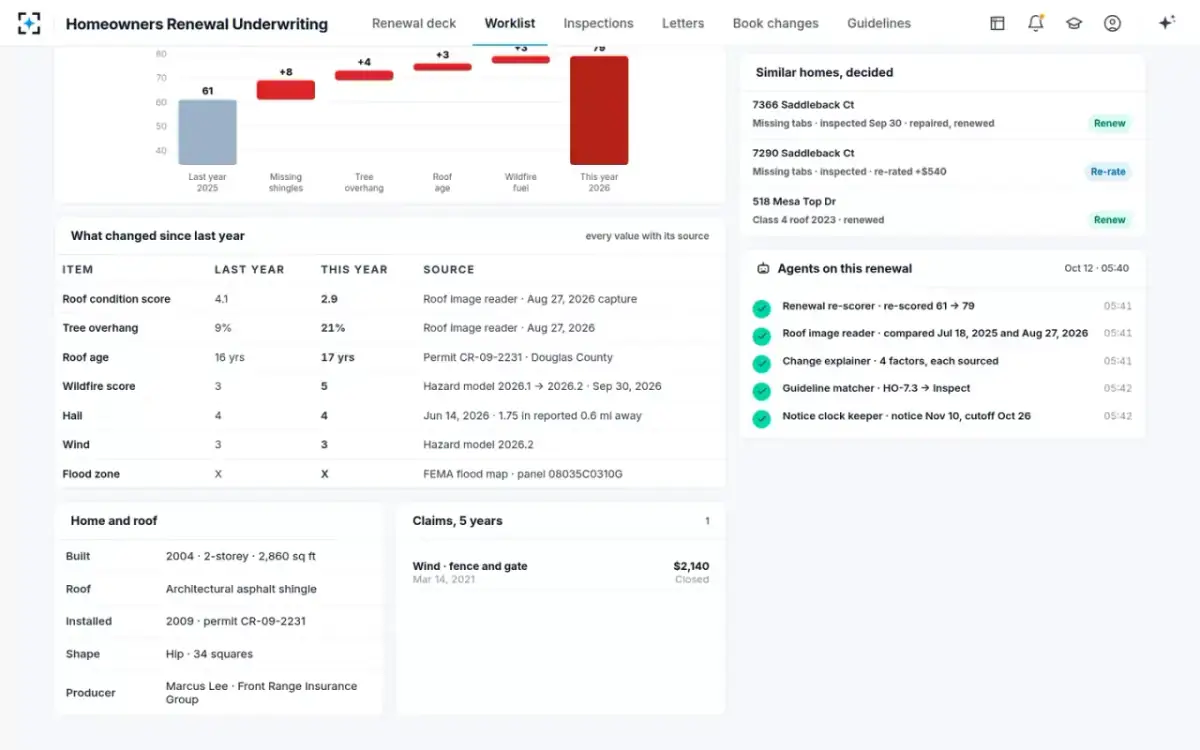
The steps that matter for a homeowner's question are the middle two. If the claim is one of many inputs, the question becomes how much of the change it caused. In the sample insurer's January book, claims were the top factor for 30 of the 1,284 renewals whose score moved enough to need an underwriter. Roof condition led 512 of them, hail and wind 268, roof age 214.
Clue report homeowners insurance: where insurers read your claims history
Insurers read claims from their own files and from claims databases run by consumer reporting companies. The Consumer Financial Protection Bureau lists LexisNexis's C.L.U.E. as one, holding "seven years of home insurance and personal property claims" used "to help inform pricing and underwriting decisions for the insurance industry"; it "will provide one free report every 12 months if you request it" (CFPB, list of consumer reporting companies).
Because these are consumer reports, the Fair Credit Reporting Act applies. If an insurer takes adverse action based in whole or in part on information in a consumer report, federal law requires it to tell you, name the reporting company and tell you how to get a free copy and dispute errors (15 U.S.C. §1681m). A claim recorded against the wrong address, or a claim you never filed, is worth disputing before renewal, not after.
One claim in five years, and how little it moved this renewal
How many claims before insurance drops you?
In Texas the statute gives a number: three non-natural claims in any three-year period, after a warning at two. Elsewhere there is usually no number in law, and each insurer's underwriting guidelines set its own approach. Those guidelines must be applied consistently; the NAIC's market-conduct standards test that "Rejections and declinations are not unfairly discriminatory" and that insurers follow their own guidelines in selecting risks.
For a homeowner the more useful question is often not how many claims but which. A paid water claim from an unrepaired leak is a different signal from a hail claim the whole street filed after the same storm. Florida writes that distinction into law, and Texas does too, by leaving natural causes out of the count. An insurer that treats every claim as equal is not only blunt; in those two states it may be unlawful.
Can homeowners insurance drop you after a claim if the damage is not fixed?
Often yes, but the reason is then the condition, not the claim, and the insurer must say so. The Treasury's Federal Insurance Office describes nonrenewals as driven by the risk of the property, with roof age as its example, or of the area (FIO, January 2025). A roof damaged in a covered storm and left unrepaired is a property risk in its own right.
Florida gives the homeowner time. After damage from a covered peril, the insurer may not cancel or non-renew until the home is repaired or a year after the final claim payment, whichever comes first, and after a declared hurricane not until 90 days after repair (§627.4133(2)(e)). Elsewhere the notice period is the window: 60 days in Texas and Colorado, 75 in California. A letter that names the condition precisely, where on the roof, seen when and by what means, gives the homeowner the chance to fix it and send proof. Delaware calls a bare reason such as claims experience unacceptable precisely because it leaves the homeowner nothing to fix (Delaware Bulletin No. 150; the regulators' tests are set out in the nonrenewal appeal guide).
Do insurance companies drop you after a claim? What the national data show
Nonrenewals have risen sharply, but the regulators' data do not break them down by claim. State insurance regulators counted 2,019,799 company-initiated homeowners nonrenewals in 2024, and they also report that claim frequency and severity "have generally increased over time" (NAIC, 2026). Both are consistent with insurers shedding exposure in areas where claims have risen, which is an area decision rather than a reaction to one household's claim. Why insurers are non-renewing homeowners policies sets out the regional picture.
What to do after a claim, before your renewal
Six steps that keep one claim from deciding your renewal
- Repair, and keep proof
Invoices, permits and photos. An unrepaired condition can be a lawful reason even where the claim cannot.
- Do what the insurer asks to prevent a repeat
In Florida that is the condition on which an act-of-God or single water claim can be used at all.
- Check your claims history once a year
Request the free report from the claims databases the CFPB lists and dispute any claim that is not yours.
- Know the difference between an inquiry and a claim
In Texas a call asking whether something is covered, with no claim or investigation, cannot be used against you.
- Read any warning letter carefully
In Texas a notice after your second claim is what allows a refusal to renew after a third.
- If a nonrenewal arrives, ask for the precise reason and its source
Texas requires both in the written statement; Florida requires specific reasons.
If a nonrenewal does arrive, the nonrenewal appeal guide sets out the tests regulators apply and the order in which to challenge one.
How a renewal underwriter should weigh one claim
On the insurer's side, the lesson of the Florida and Texas rules is that a claim's weight has to be decided by kind and by state, and has to be visible. In Homeowners Renewal Underwriting the guideline matcher never counts a natural-cause claim toward a Texas claims limit; the change explainer shows claims as their own factor with points, source and date; and a renewal whose score moved because of claims reaches a named underwriter like any other change, with the decision and the letter in that underwriter's hands. Nonrenewals go to the underwriting manager. Each letter gives one reason per factor, so a homeowner whose renewal changed because of the roof is not told it was the claim, and the reverse.
Across a season, claims moved few renewals
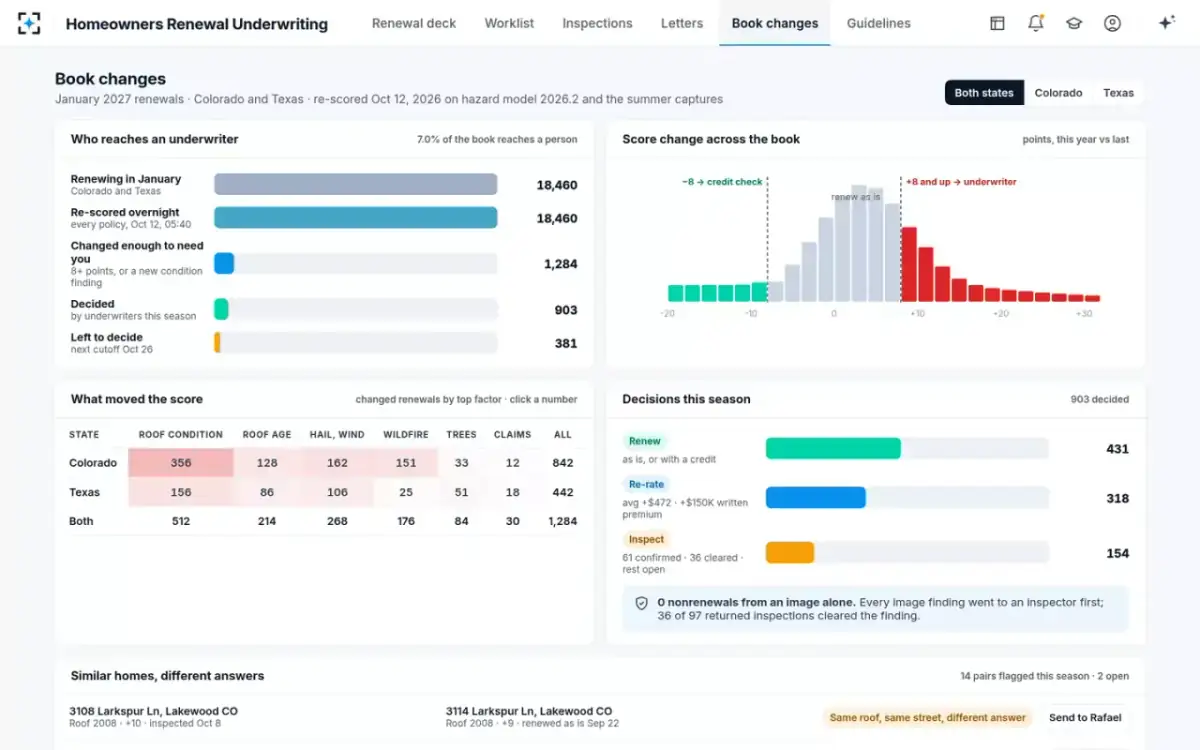
For the full sample season, start from Homeowners Renewal Underwriting.
Questions people ask
Will one homeowners claim raise my premium?
It can, through the insurer's filed rating plan, without any change to whether you are covered. Texas allows a claims surcharge at renewal only after two or more claims in the preceding three policy years, excluding natural-cause claims, and the surcharge must rest on sound actuarial principles. Other states leave it to each insurer's approved rating plan.
Does a claim that was denied count against me?
In Texas, no: a claim "filed but is not paid or payable under the policy" is excluded from the renewal and surcharge rules. Other states do not all say so, and a denied claim can still appear in a claims database, so check your report and dispute anything recorded wrongly.
Does asking my insurer a question count as a claim?
In Texas, not if it is a general question about coverage or the claims process that does not lead to an investigation or claim: the law calls it a customer inquiry and bars insurers from using it as a basis for nonrenewal. Elsewhere, ask your agent first if you are unsure.
How long do claims stay on my insurance history?
The CFPB describes the C.L.U.E. database as holding seven years of home and personal property claims. An insurer's own guidelines may look at a shorter window: the sample insurer in Homeowners Renewal Underwriting reads five years of claims, and Texas's renewal rule looks at any three-year period.
Can my auto claim affect my homeowners renewal?
Homeowners claim rules such as Texas's §551.107 count claims under the homeowners policy. Whether an insurer's homeowners rating plan uses other information, such as an insurance score, depends on its filed plan, and under federal law an adverse action based on a consumer report must be followed by a notice naming the reporting company.