The AI homeowners insurance underwriting process is the same renewal review an underwriter has always done, broken into tasks and reassigned: software agents pull the renewing policies, fetch new hazard scores, compare this year's aerial capture of the roof with last year's, re-score, split each change into its sources and draft the letter, while a named underwriter decides Renew, Re-rate or Inspect and signs whatever goes to the homeowner. The hard part has never been any single task. It is doing all of them for a whole homeowners book in the 90 days before renewal, consistently, and with every adverse reason traceable to a dated source. Botminds' Homeowners Renewal Underwriting is built on that split: six agents do the reading for every renewal, and only the homes whose risk changed reach a person.
The test for any AI in underwriting is the one the NAIC's model bulletin sets: a decision an insurer makes or supports with it must not be inaccurate, arbitrary, capricious or unfairly discriminatory (NAIC Model Bulletin on the Use of AI Systems by Insurers, December 2023). The standard falls on the decision, whoever or whatever prepared it. The examples below use a fictional sample insurer, Larkmoor Mutual, and its January 2027 Colorado and Texas renewals as they run through the solution.
What is the AI homeowners insurance underwriting process? Fourteen tasks, three owners
Written out, a homeowners renewal review is fourteen tasks. Seven are reading, arithmetic and drafting: gathering, comparing, scoring, explaining, matching, counting days and writing. Four are judgments only an underwriter or a manager should make. Three are shared: the agents do the work under a rule or threshold a person sets and can change, or a person acts on what the agents prepared. The grid below is how the sample insurer has them allocated.
Who does what in an AI-assisted homeowners renewal review
Pull every renewing policy, its coverage and premium, 90 days out
Agents
Renewal re-scorer. Never changes premium or terms.
Fetch new wildfire, hail, wind and flood scores; refresh any older than 12 months
Agents
Every input carries its date and model version.
Compare last year’s and this year’s aerial captures of the roof
Agents
Roof image reader. Checks the image is sharp, current and on the parcel; confidence on every finding; never calls discoloration damage.
Re-score, and renew on guideline every policy below the change threshold
Shared
The agents apply it; the underwriting manager sets the threshold (8 points, or any new condition finding).
Split each score change into filed factors, with source and date
Agents
Change explainer. Flags which factors rest on an image alone.
Recommend Renew, Re-rate or Inspect, citing the guideline used
Agents
Guideline matcher. Same inputs, same answer. Never recommends nonrenewal from an image.
Decide Renew, Re-rate or Inspect on each changed renewal
Person
A named personal lines underwriter.
Order an inspection, scoped from the factors that moved
Shared
The underwriter decides to inspect; the order and scope go out from the factors.
Work out each notice date and the insurer’s cutoff; warn ten days ahead
Agents
Notice clock keeper. Never lets a cutoff pass without a person deciding.
Draft the letter: one plain reason per factor, its source in the margin
Agents
Letter drafter. State wording, copy to the producer.
Sign and send the letter
Person
The deciding underwriter: “I reviewed this letter and every reason in it.”
Nonrenewals, exceptions to guideline, re-rates over $1,000
Person
The underwriting manager.
Pair similar homes decided differently, every night
Shared
The check finds the pairs; the manager sends back or reopens.
Set factor points as filed; approve any guideline change
Person
Product manager for points; manager approves rules, which are re-run on the open deck.
The pattern in the grid is that agents never hold the pen on anything that reaches the insured. They draft; a person signs. They recommend; a person decides. They find inconsistent pairs; a manager sends one back. Where the agents do act alone, renewing an unchanged policy on guideline or refreshing a stale score, they act under a threshold the underwriting manager set and can see.
How are insurance companies using AI in homeowners underwriting?
Mostly in claims, and in underwriting more cautiously than in marketing. The best regulator data is the NAIC's survey of larger home insurers, run under the market-conduct authority of ten states on 2022 data: of 194 companies, 136, about 70%, used, planned to use or planned to explore advanced AI or machine learning. By function the shares were "claims, 54%; underwriting and marketing (both at 47%); fraud detection, 42%; rating, 35%; and loss prevention, 14%" (NAIC Home AI/ML Survey memo, 2023).
The detail on underwriting is more telling than the headline. Ninety-one companies reported underwriting models in use, "and the majority of those were for automated denial/inputs into nonautomated denial decisions, and for verification of policy characteristics." About half of those models ran as automation, a third as support and a sixth as augmentation. The most common data elements in underwriting were "Roof data, Consumer or other type of Score, Defect identification in images, and Insured demographic data." And on what consumers are told, fewer than 10% of companies said they give consumers information about the data elements used beyond what the law requires, on questions few companies answered.
Two cautions apply. The survey was limited to "more advanced" models and to insurers with at least $50 million of homeowners premium, so it undercounts the generalized linear models most rating plans still use. And it is four years old. It does show where the regulators' attention began: automated adverse decisions, roof data and images, and what the homeowner is told.
Where AI should stop: the decisions regulators hold a person to
AI should stop at the decision that adversely affects the homeowner, and at the explanation of it. No state rule we know of bans software from recommending a nonrenewal, but every adverse step carries a duty the software cannot discharge. Texas requires the written statement to name the exact incident or risk factor and where the insurer got the information, effective January 2026 (Tex. Ins. Code §551.002(c); the statute's words are in a personal lines underwriter's renewal season). Florida requires the specific underwriting reasons on every nonrenewal. State regulators in Maryland, Maine, Delaware and Tennessee have warned insurers against acting on aerial images that are blurry, dated or show only cosmetic staining, and told them to investigate further, or inspect, before they do.
The NAIC model bulletin turns that into a governance expectation. Insurers' controls should be proportionate to, among other things, "the nature of the decisions being made, informed, or supported using the AI System" and the potential harm to consumers (NAIC model bulletin). New York's Circular Letter No. 7 asks insurers to show, before using external data or AI in underwriting or pricing, that the result is not unfairly discriminatory (NY DFS, 2024). Colorado's governance regulation now reaches private passenger auto as well as life and health insurers, but not yet homeowners (Colorado Division of Insurance).
The practical reading for a homeowners renewal is a short rule: the agents may find, score, explain and draft; a named person decides each changed renewal, signs each letter, and approves every nonrenewal. That is how the sample insurer's guidelines read, down to rule HO-9.1: "Nonrenewal needs the underwriting manager, and never rests on an image."
One renewal through the process, from re-score to signature
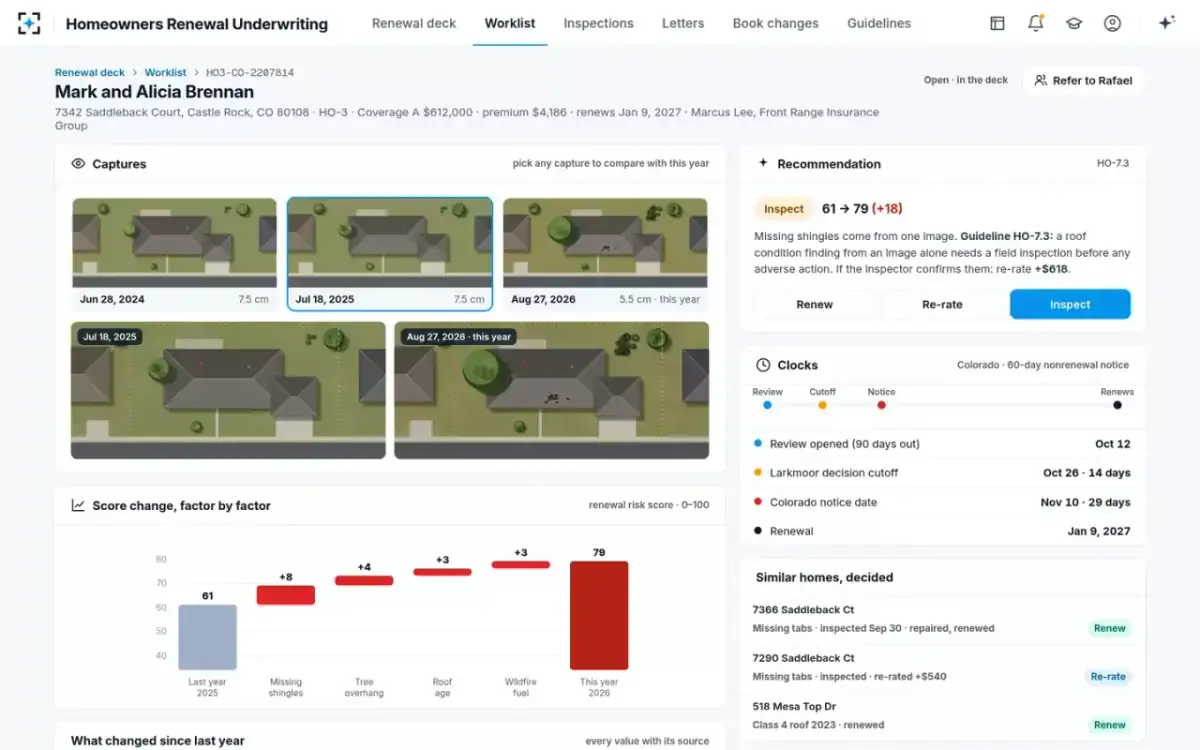
Take the first card in the sample insurer's January deck: the Brennan home in Castle Rock, Colorado, renewing Jan 9, 2027. The overnight re-score on Oct 12 moved it from 61 to 79. Here is every step, and who took it.
One changed renewal, step by step: agents prepare, people decide
Agent
Renewal re-scorerRe-scored the home on hazard model 2026.2, the Aug 27, 2026 capture, permits and claims: 61 → 79.
Never: scores with a hazard score older than 12 months
Agent
Roof image readerCompared the Jul 18, 2025 and Aug 27, 2026 captures: about 14 missing tabs on the south slope (confidence 0.91), tree overhang 9% → 21%.
Never: uses an off-parcel or stale image
Agent
Change explainerSplit +18 into missing shingles +8, tree overhang +4, roof age +3 and wildfire fuel +3, each with its source and date.
Never: shows a factor without its source and date
Agent
Guideline matcherMatched HO-7.3: a roof finding from one image needs a field inspection before any adverse action. Recommended Inspect; +$618 if confirmed.
Never: recommends nonrenewal from an image
A person decides
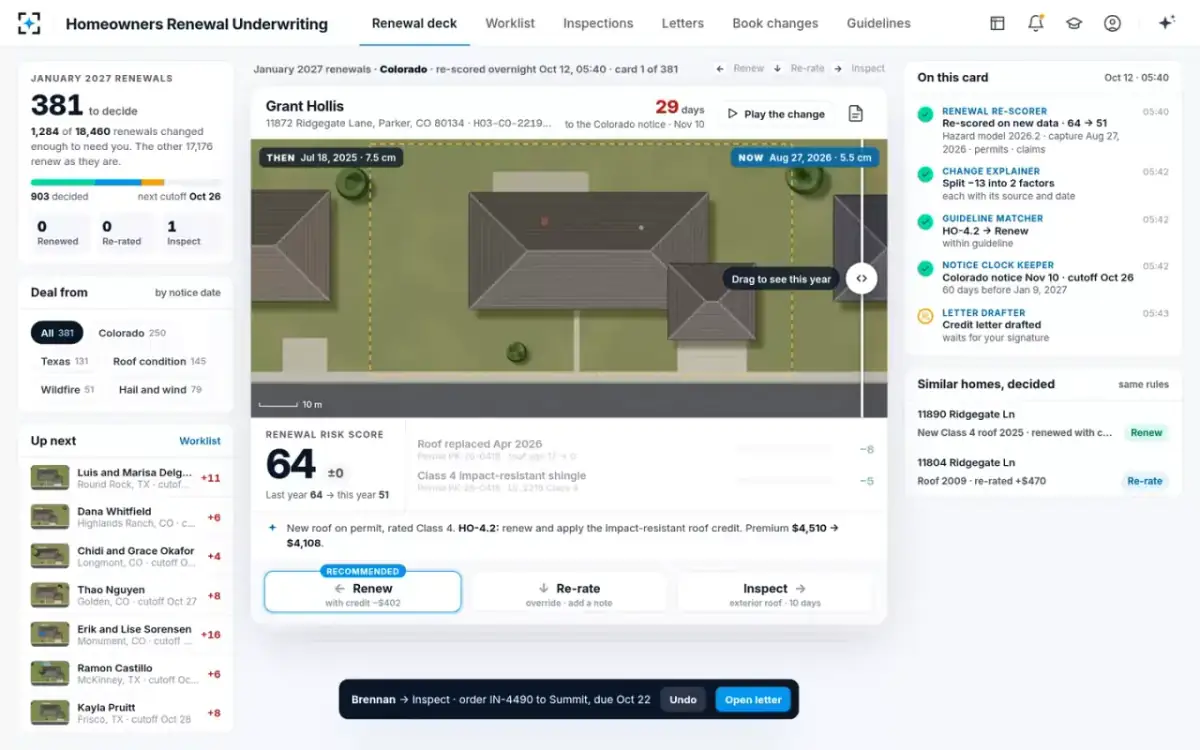
Jenna Albright, underwriterSwiped Inspect. Order IN-4490 went to the field vendor, due Oct 22, four days before the Oct 26 cutoff.
Agent
Letter drafterDrafted the inspection letter in Colorado wording: four numbered reasons, each tied to its photo or permit.
Never: sends a letter before an underwriter signs
A person decides
Jenna Albright, underwriterSigns the letter: “I reviewed this letter and every reason in it.” The producer gets a copy.
The renewal file the underwriter decides from
What the process does to the book, not just to one file
The return from AI in renewal underwriting comes from how few files reach a person, and how quickly those that do are decided. At the sample insurer, 1,284 of 18,460 January renewals, 7.0%, crossed the eight-point threshold or picked up a new condition finding. Of the 903 decided so far this season, the split looks like this:
Most of the book renews on guideline; of the changed homes, fewer than one in five go to inspection
January book · 18,460
- Renews on guideline · 93%
- Reaches an underwriter · 7%
Changed renewals decided · 903
- Renew · 47.7%
- Re-rate · 35.2%
- Inspect · 17.1%
The last number in that caption is the strongest argument for keeping the decision with a person. More than a third of the inspected image findings did not hold up on site. A process that re-rated or non-renewed on the image would have been wrong on 36 homes; the process that inspected first was wrong on none of them, and not one nonrenewal in the season rested on an image alone.
AI homeowners insurance underwriting software and tools: what to look for
When evaluating an AI homeowners insurance underwriting tool, ask what it does at each of the fourteen tasks, not whether it "uses AI". Four questions separate the tools that fit a regulated renewal from those that do not.
Does every output carry its source and date? A score without the capture date, the hazard model version and the permit behind it cannot produce the Texas statement or answer a Maryland hearing. Can it say which part of a change rests on an image alone? That is the one distinction every recent state bulletin on aerial imagery turns on, and the bulletins are compared state by state in Botminds' Aerial Imagery Verification guide to aerial imagery laws by state. Who sets the thresholds and rules, and is every change versioned? If the vendor sets them, the insurer cannot show an examiner that its guidelines were followed. What does a person sign, and what do they see when they sign it? A signature on a letter whose reasons the underwriter never saw is not a control.
The page on homeowners underwriting software, compared on one renewal runs the same changed home through a rules engine, a vendor score and an agent pipeline and shows what each can and cannot put in the letter.
The decision itself: one swipe, with Undo
Will AI take over underwriting jobs?
It will take over tasks, and federal projections already assume fewer underwriters. BLS projects underwriter employment to fall 4% from 2025 to 2035 and attributes it to automated underwriting software that processes applications faster (BLS). In renewal underwriting the tasks that disappear are the fetching and first-pass scoring. The tasks that remain, deciding a changed renewal, defending it, and keeping similar homes on the same answer, are the ones regulators hold a person to, so the job concentrates rather than vanishes. A personal lines underwriter's renewal season follows that day hour by hour.
NAIC AI bulletin: how many states have adopted it
As of October 8, 2026, the NAIC's adoption map lists 29 jurisdictions that have adopted the model bulletin, 27 states plus the District of Columbia and Puerto Rico, the most recent being South Carolina (September 24, 2026) and North Dakota (October 5, 2026). Four more states regulate insurers' AI with their own instruments: California's 2022 bulletin, Colorado's regulation 3 CCR 702-10, New York's Circular Letter No. 7 and Texas's 2020 bulletin (NAIC adoption map). The map itself cautions that it "does not reflect a determination" of whether each adoption contains all elements of the model, so a carrier writing in several states reads each state's text. For a homeowners renewal process, every one of them points to the same design: document the model, know the data, and keep a person answerable for the decision.
To see the agents, the deck and the letters working together on a sample book, start from Homeowners Renewal Underwriting.
Questions people ask
What is AI in insurance underwriting?
Software that reads underwriting data and produces a score, a finding or a recommendation: a roof condition from an aerial image, a risk score from hazard and claims data, a flag for a policy characteristic that does not match. In the NAIC's 2022 home insurer survey, 47% of responding companies used, planned or explored advanced AI or machine learning in underwriting.
Is there free AI homeowners underwriting software?
Not for a regulated renewal decision. The free public tools are data sources, such as the USDA Forest Service's Wildfire Risk to Communities map, which says it is not designed for insurers. The cost of renewal software is in connecting the policy system, captures, hazard scores, permits, claims and the inspection vendor, and in keeping every input dated.
Can an insurer use AI to non-renew a homeowners policy?
Insurers may use AI to inform the decision, but the nonrenewal must meet the same standards as any other: a specific reason, and in Texas since 2026 the source of the information relied on. Several state regulators have said blurry, dated or merely stained aerial images do not justify a nonrenewal on their own, so a responsible process inspects first.
How accurate is AI roof condition scoring?
No regulator publishes an accuracy figure. The practical test is replay against inspections: in the fictional sample season, 36 of 97 inspected image findings were cleared on site. That is why the sample guidelines send every image-only roof finding to inspection before any adverse action.
Does the NAIC AI bulletin apply to homeowners insurance?
Yes, in the states that have adopted it. The model bulletin covers AI systems used across the insurance life cycle, including underwriting and rating, for every line the adopting department regulates. Colorado's separate governance regulation does not yet reach homeowners.