Aerial imagery laws for home insurance are made state by state, and most are bulletins rather than statutes. We found no federal rule on insurers' use of aerial images. Of the nine states whose rules we read in full, as their regulators or legislatures published them, one has a statute: Louisiana, since May 2024, bars an insurer from relying solely on aerial images more than 24 months old to identify the condition behind a homeowners cancellation or nonrenewal. Eight have bulletins or notices: Connecticut and Pennsylvania in 2024; Delaware, Maine, West Virginia, Maryland and Tennessee in 2025; and Colorado in 2026. Read side by side, they converge on five tests: a clear and current image, of the right house, showing real damage rather than cosmetic wear, confirmed by a second source, with the homeowner able to see it and answer. Botminds' Aerial Imagery Verification checks each homeowners referral against the rules of the state the risk is in, which is why one set of controls written to those five tests can satisfy the whole map.
The rules change often; this map reflects the texts as their issuers published them, read in October 2026. Several other states, among them Massachusetts, New Hampshire, Rhode Island and Michigan, have issued bulletins on the subject that we could not retrieve from the issuer's own site, so we do not summarise them here.
Aerial imagery rules for home insurers, as the states published them
9
states whose rules we read in full
1
statute: Louisiana, R.S. 22:1339
24months
Louisiana’s limit for an image relied on alone for a condition
12months
Colorado’s expectation for imagery in underwriting and rating
Which states have aerial imagery laws for home insurance?
In the texts we read, Louisiana has a statute; Connecticut, Pennsylvania, Delaware, Maine, West Virginia, Maryland, Tennessee and Colorado have bulletins or notices from their insurance regulators. They arrived in a short burst. Connecticut's notice came in March 2024, Pennsylvania's in May 2024, the same month Louisiana's statute took effect. Five states followed in 2025, and Colorado issued its bulletin in March 2026 and proposed a revision that August.
The burst followed complaints. Connecticut's department reviewed nonrenewals based on roof condition, found that the images "did not definitively show material roofing degradation or damage", and wrote: "This practice will not be tolerated in Connecticut" (Connecticut notice). Maine's bureau had received "inquiries and requests for hearings over the past two years" before writing its bulletin (Maine Bulletin 483). The rules read less like new policy than like regulators applying their existing cancellation and nonrenewal laws to a new kind of evidence.
Statute, bulletin or notice: how much each one binds
A statute binds; a bulletin states how the regulator reads the law it enforces. Colorado says so in its own bulletin: "Bulletins themselves establish neither binding norms nor finally determine issues or rights" (Colorado Bulletin B-5.57). That does not make a bulletin optional. It tells an insurer how the department will judge a complaint, a hearing or an examination under the statutes it already has.
Most bulletins say which statute they rest on. Maryland's applies the state's cancellation and nonrenewal sections, which require the insurer to state "the actual reason, in clear and specific terms", and its hearing rule, under which the insurer carries the burden (Maryland Bulletin 25-10). Pennsylvania's notice reminds insurers of the Unfair Insurance Practices Act and cites hearing decisions and a court ruling on what a termination must prove (Pennsylvania Notice 2024-06). Louisiana's rule needs no reading: it is the statute.
A statute and a bulletin on the same question: how old may the image be?
Louisiana statute, R.S. 22:1339: Law, effective 22 May 2024.
Colorado bulletin, B-5.57: The Division’s position; it says bulletins set no binding norms.
Louisiana statute, R.S. 22:1339: 24 months from the date of the cancellation or nonrenewal.
Colorado bulletin, B-5.57: 12 months for general underwriting and rating; a draft would make it 18.
Louisiana statute, R.S. 22:1339: When the insurer relies solely on aerial images to identify the condition behind the action.
Colorado bulletin, B-5.57: Whenever imagery is used in underwriting or rating, and in claims.
Louisiana statute, R.S. 22:1339: Images used only to identify and locate the property and its improvements: no age limit.
Colorado bulletin, B-5.57: None stated; parcel-level imagery may not suffice for condition decisions.
Louisiana statute, R.S. 22:1339: Homeowners insurance.
Colorado bulletin, B-5.57: All admitted property and casualty insurers using aerial imagery or data derived from it.
The map: nine states, five tests
Set against the five tests, the nine rules agree more than their dates and formats suggest. None of the rules that address roof appearance treats a cosmetic finding as enough on its own; most expect a second source; and the newer bulletins all expect the homeowner to see the image. Where a cell is blank, that rule's text does not address the test; it does not mean the state permits the opposite.
Aerial imagery laws by state: nine rules against five tests
Clear and current—
The right house—
Cosmetic is not conditionCosmetic conditions do not support nonrenewal
A second sourceInspection or roofer’s report when damage is not unequivocal; in filed guidelines
The homeowner can answer60 days’ notice with a specific reason
Clear and current—
The right house—
Cosmetic is not conditionCosmetic images not to be the sole evidence
A second sourcePrudent to inspect when damage is not unequivocal
The homeowner can answerNotice and a chance to cure a hazard that is not obvious
Clear and currentNo sole reliance on images over 24 months for the condition
The right house—
Cosmetic is not condition—
A second sourceOlder images may not stand alone
The homeowner can answer—
Clear and current—
The right house—
Cosmetic is not conditionDiscoloration and streaking not valid grounds to cancel
A second sourcePhysical inspection recommended on a dispute
The homeowner can answerAccess to the imagery; specific reasons
Clear and currentRecent imagery; complaints of images over 18 months
The right houseWrong structure among complaints
Cosmetic is not conditionBlurry staining usually not enough alone
A second sourceOne tool; recent, clear information if inconclusive
The homeowner can answerNotify first, give copies, allow a dispute
Clear and currentRecent, accurate imagery for a nonrenewal
The right houseWrong structure named as misuse
Cosmetic is not conditionStaining usually not sufficient alone
A second sourceNot the only information, if possible
The homeowner can answerNotify first, give copies, allow a dispute; time to repair
Clear and currentClear, accurate and current view
The right house—
Cosmetic is not conditionStreaking may not suffice on its own
A second sourceFurther investigation if not unequivocal
The homeowner can answerImages reviewable at a hearing; insurer bears the burden
Clear and currentRecent and accurate; older imagery alone unreliable
The right houseWrong structure named as misuse
Cosmetic is not conditionBlurry or outdated roof images not enough alone
A second sourceOne tool among many
The homeowner can answerNotify first, give copies, allow a dispute
Clear and currentNo more than 12 months for underwriting and rating
The right house—
Cosmetic is not conditionAppearance alone does not support an adverse action
A second sourceAdditional reliable information before any adverse action
The homeowner can answerA meaningful opportunity to dispute and show repairs
Test one: a clear and current image. How old is too old, state by state?
Only two of the nine rules put a number on it: Louisiana's statute (24 months, for an image relied on alone) and Colorado's bulletin (12 months, for underwriting and rating). The others use words. Maryland's is the most cited: satellite or aerial imagery may support a cancellation, nonrenewal or claim denial only when it gives a clear, accurate and current view of the property (Maryland Bulletin 25-10). Maine and West Virginia ask for "recent" imagery when a nonrenewal is initiated, and Maine records complaints about images "more than 18 months old".
For a multi-state writer the practical answer is the strictest limit that applies to the use. The sample carrier in Aerial Imagery Verification lets no image older than 12 months support an adverse action, with each state's limit applying where it is shorter, and lets older captures only corroborate a newer source. What a homeowner can do with an old picture is the subject of an old photo of my house, used without notice.
Test two: the right house
Three of the nine rules name the wrong house outright. Maine lists homeowners' complaints that "the image shows the wrong structure or property" (Maine Bulletin 483); West Virginia and Tennessee both list images that "show the wrong structure or property" among the ways aerial imagery can be misused (West Virginia, Tennessee). None sets a tolerance, so the test is the insurer's to define and to evidence.
The usual control is a measured offset between the capture's building footprint and the insured parcel, with captures past a tolerance excluded before anything is read from them. The sample carrier's tolerance is 8 metres; on its sample referral a 2023 capture sat 31 metres off and matched the house next door. Colorado's bulletin points the same way from another angle, warning that imagery good enough for "parcel-level identification" may not be good enough for a decision on condition (Colorado Bulletin B-5.57).
Test three: cosmetic wear is not a condition
Every rule we read that addresses roof appearance says the same thing: streaks and discoloration alone do not justify the action. Pennsylvania: "Aerial images alone showing discoloration, streaking or other cosmetic damage should not be used as the sole evidence to support cancellation or nonrenewal actions" (Pennsylvania Notice 2024-06). Connecticut takes the firmest position, that cosmetic roofing conditions do not support nonrenewal at all, and gives the contrast: ponding, incomplete patching or a tarpaulin over the roof would generally support underwriting action (Connecticut notice).
Delaware applies it to cancellations, saying discoloration and streaking "do not constitute valid grounds" (Delaware Bulletin No. 150), and Colorado to every adverse action, which "should be supported by evidence of degradation or damage rather than appearance alone" (Colorado Bulletin B-5.57). Maryland is the most guarded: streaking "may not be sufficient to independently support" an action on roof degradation, and a footnote adds that it can be "nothing more than a cosmetic blemish".
Test four: a second source before acting
Most of the rules expect something besides the image before an adverse action, usually a physical inspection. Pennsylvania: "In the absence of unequivocal and material damage shown, it would be prudent for an insurer to conduct a physical inspection to validate the specific type of damage that the aerial image purports to evidence" (Pennsylvania Notice 2024-06). West Virginia: "If possible, aerial imagery should not be the only information utilized in decision-making" (West Virginia Bulletin 25-02).
The second source need not always be a visit. Connecticut accepts a report from a licensed home improvement contractor or roofer submitted by the policyholder, and expects the guardrail to be written into the insurer's filed underwriting guidelines (Connecticut notice). Colorado lists "updated imagery, documentation from qualified professionals, or a physical inspection" (Colorado Bulletin B-5.57). Maryland asks for "further investigation" whenever an image does not unequivocally establish the problem (Maryland Bulletin 25-10).
Test five: the homeowner sees the image and can answer
The newer bulletins all expect the homeowner to see the evidence and respond before the action takes effect. Maine, Tennessee and West Virginia describe it as best practice to notify the homeowner before acting, give copies of the images and allow updated information or a dispute (Maine, Tennessee, West Virginia). Delaware expects insurers to "Maintain transparency by providing customers access to UAS captured imagery used in policy determinations" (Delaware Bulletin No. 150).
Colorado gives the fullest version: a "meaningful opportunity to dispute the accuracy of aerial imagery, correct errors, provide updated information, and submit proof of completed repairs or remediation" (Colorado Bulletin B-5.57). Pennsylvania reaches the same place through its hearing decisions, which treat prior notice and a chance to cure as prerequisites when the hazard may not be obvious to the insured (Pennsylvania Notice 2024-06).
The Maryland bulletin on aerial imagery, read closely
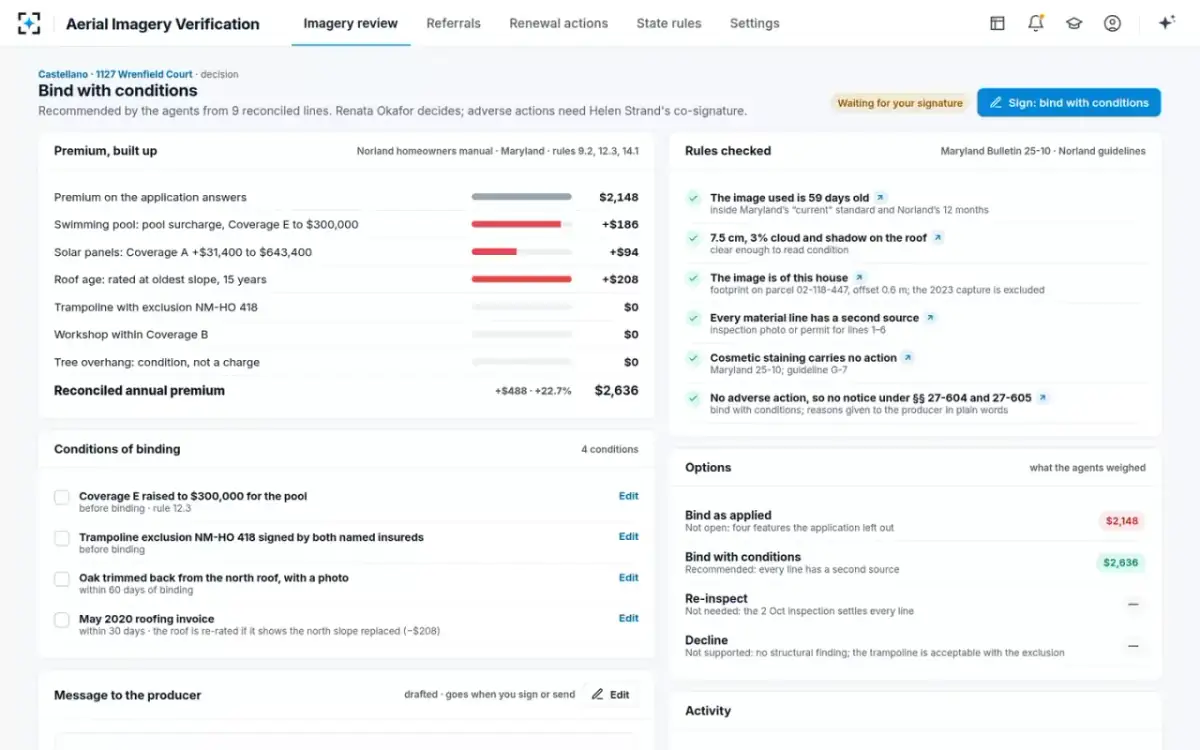
Maryland Bulletin 25-10, issued on 17 June 2025, is the rule most often cited, and it covers more ground than its headline test. It applies to cancellations, nonrenewals and claim denials; it says images that are "low-resolution, out-of-focus, blurry, or dated" cannot justify a cancellation or nonrenewal based on the property's condition "without further investigation" (Maryland Bulletin 25-10); and it treats denying a claim on unclear images as an unfair claim settlement practice.
Three details matter to an underwriting team. Imagery is "not categorically prohibited", so a clear, current image of a real condition can still carry weight. An insured who requests a hearing may review the images, and the insurer bears the burden of persuasion. And insurers using artificial intelligence "to enhance, interpret, or otherwise review satellite or aerial images" are pointed to Maryland's AI bulletin, 24-11, one of 29 jurisdictions' adoptions of the NAIC model bulletin on AI as of October 2026 (NAIC adoption map).
A Maryland referral, with each of the state's tests checked
Colorado's aerial imagery bulletin, and the 2026 draft that would change it
Colorado Bulletin B-5.57, issued on 16 March 2026, is the most technical of the nine. It is the only one to name the image properties an insurer should weigh: spatial resolution, orthorectification, elevation modelling, capture date and the fact that imagery shows only surfaces. It is also the widest in scope, applying to "all admitted property and casualty insurers utilizing aerial imagery or aerial imagery derived data in decision making", to vendor tools as well as insurers' own, and to underwriting, pricing and claims (Colorado Bulletin B-5.57).
On 18 August 2026 the Division asked for comments on a revision, with a deadline of 1 September. In its words, "This bulletin is being revised to remove rating, extend aerial imagery to eighteen (18) months, and allow for customer provided photos as additional verification" (Colorado request for comment). Until a revised bulletin is adopted, the March 2026 text, with its 12-month expectation and its inclusion of rating, is the Division's stated position.
One control set for the whole map
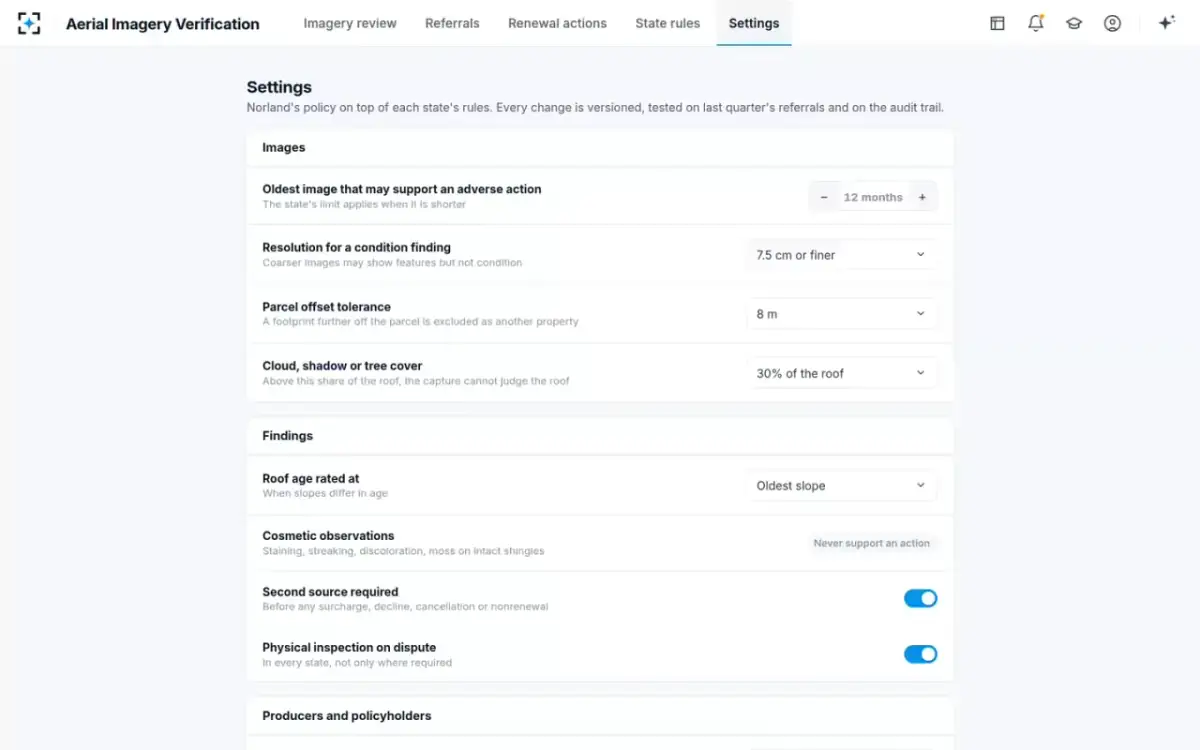
Because the nine rules converge, a homeowners writer can meet all of them with one set of controls set to the strictest version of each test, and let a state's rule apply where it is stricter still. That is how the sample carrier runs Aerial Imagery Verification: the settings are its policy, each state's rule sits on top, and every change is versioned and tested on the previous quarter's referrals before it applies.
One control set that meets the five tests in every state on the map
- An age limit for any image that supports an adverse action
12 months at most, the state’s limit where shorter; older captures only corroborate.
- A resolution and cover floor for condition findings
Condition read only from sharp captures with little cloud, shadow or tree over the roof.
- A parcel check before anything is read
A measured footprint offset, and captures past the tolerance excluded as another property.
- Cosmetic findings carry no action
Staining, streaking, discoloration and moss on intact shingles are labelled cosmetic everywhere.
- A second source before any surcharge, decline, cancellation or nonrenewal
An inspection photo, a permit, a newer capture or a professional’s report.
- A physical inspection on any dispute
In every state, not only where a bulletin recommends it.
- The homeowner sees the image and can answer
Every adverse notice carries the reason in plain words, the dated image, the photo and how to dispute.
- The guardrails written into filed guidelines
As Connecticut expects, and so an examiner can match each action to a filed rule.
The control set as settings, with each state's rule on top
How these tests play out on a single nonrenewal, from the first flag to the co-signature, is traced in who decides when a drone or satellite image flags a roof. The solution itself is on the Aerial Imagery Verification page.
Questions people ask
Is there a Michigan aerial imagery bulletin?
Michigan's Department of Insurance and Financial Services has issued Bulletin 2025-12-INS on insurers' use of aerial imagery. Its site refused our requests, so we have not read it in full and do not summarise it here. Read it on the department's own site, and check whether it has been amended.
What does the Maine aerial imagery bulletin say?
Maine's Bulletin 483, of 19 March 2025, tells homeowners insurers to use aerial imagery as only one tool, to weigh its age and clarity, and, as best practice, to notify the homeowner before a nonrenewal, provide copies of the images and allow a dispute. It records complaints about images over 18 months old and of the wrong structure.
Can an insurance company use satellite images in California?
We found no California statute or bulletin specific to aerial or satellite imagery among the sources we read. California's general rules still govern any action that follows, including at least 75 days' notice before a policy expires for a nonrenewal under Insurance Code §678(c). The NAIC lists California's Bulletin 2022-5 as the state's own instrument on insurers' use of AI rather than an adoption of the model bulletin.
Is there a federal law on insurers' use of aerial imagery?
We found none; insurance is regulated by the states. The federal rules that touch the subject govern how drones fly, under 14 C.F.R. Part 107, which Delaware's bulletin cites, not how insurers use what they capture.
Which states set an age limit for aerial images?
Among the nine we read, Louisiana by statute (24 months, for images relied on alone to identify the condition behind a cancellation or nonrenewal) and Colorado by bulletin (12 months for underwriting and rating, with an August 2026 draft proposing 18). Maryland, Maine, West Virginia and Tennessee require current or recent imagery without fixing a number.