If an insurance company used an old aerial photo of your house to cancel or not renew your homeowners policy, and did not tell you first, several states' rules address exactly that, though not in the same way. Louisiana's statute bars an insurer from relying solely on aerial images more than 24 months old to identify the condition behind a homeowners cancellation or nonrenewal. Colorado expects imagery used in underwriting to be no more than 12 months old. Maine, Tennessee and West Virginia call it best practice to tell the homeowner before acting, send copies of the images and let the homeowner answer, and Maine has recorded complaints about images more than 18 months old and of the wrong house. Two facts settle most of these disputes: the date the picture was taken and whether it shows your house. Botminds' Aerial Imagery Verification, built for homeowners underwriters, is designed so the insurer checks both before any letter goes: every capture is dated and matched to the parcel, and nothing adverse rests on one image.
This page explains the rules; it is not legal advice, and the state that matters is the one your house is in. The worked example is a fictional sample file in the solution, with invented people and figures.
How old is too old? Four numbers from the rules and one sample file
24months
Louisiana: oldest image an insurer may rely on alone for a condition
12months
Colorado: oldest imagery expected for underwriting and rating
18+months
age of some images in homeowners’ complaints to Maine
31m
how far off the parcel one sample capture sat: the house next door
Can an insurance company use an old photo of your house?
It can use one, but in the states we read an old photo alone should not decide your policy's fate on the condition of the house. Louisiana's statute is the clearest: "An insurer shall not solely rely upon aerial images of an insured property to identify the specific condition that serves as the insurer's basis for cancellation or nonrenewal of a policy of homeowners' insurance unless the images are taken within twenty-four months of the date of the cancellation or nonrenewal of the policy" (La. R.S. 22:1339).
Elsewhere the rules use words rather than numbers. Tennessee: "Older aerial imagery standing alone is unreliable and unlikely to provide a sufficient basis on which to deny a claim or cancel or nonrenew a policy" (Tennessee Bulletin 25-03). West Virginia says older imagery "standing alone will often not be sufficient" to meet the insurer's burden (West Virginia Bulletin 25-02). Colorado expects imagery for general underwriting and rating to be "no more than twelve (12) months old unless more recent conditions warrant updated verification" (Colorado Bulletin B-5.57).
One use of an old photo is expressly allowed in Louisiana: finding the house. The statute exempts images used "solely for the purpose of identification and location of the immovable property and any improvements" from any age limit. An old capture can show where the pool is; it cannot, alone, show what the roof is like today.
How old is too old? Capture dates against the decision date
The age that matters is the capture's age on the day of the decision, measured against the rule for that use. On the sample file below an underwriter decided on 12 October 2026 with three captures on file. Only one was recent enough to support anything on its own.
Three captures of one sample address, aged on the day of the decision
- 59 d
- Within 12 months12 mo
- 12 to 24 months+6 mo
- Within 12 months12 mo
- 12 to 24 months12 mo
- Beyond 24 months+16 mo
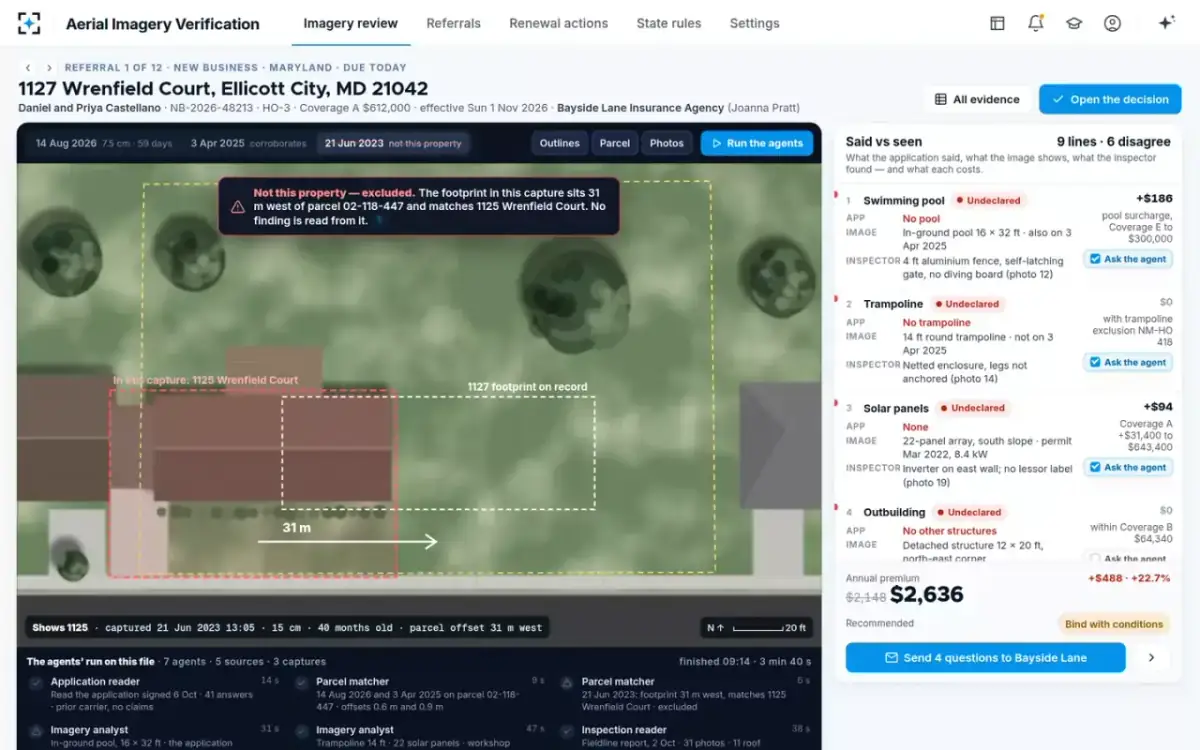
The newest capture, 59 days old and sharp, carries the findings. The April 2025 capture, 18 months old, is used only to corroborate: it shows the pool and two roof tones, which helps, but on the sample carrier no image over 12 months may support an adverse action. The June 2023 capture would be too old under both numeric rules on this page in any case, but its age is not its main problem. It is of the wrong house.
The wrong house: how it happens, and how a carrier checks
An image of the wrong house can come from a capture located by address rather than by parcel: the geocode lands near the right spot, and the nearest roof is read. Maine lists an image of someone else's building among homeowners' complaints (Maine Bulletin 483), and Tennessee and West Virginia both name it as a way imagery is misused; their wording is compared in the aerial imagery laws by state.
The check is a measurement. Place the capture's building footprint on the insured parcel's boundary and measure the offset; past a set tolerance, the capture is of somewhere else. On the sample file the June 2023 capture's footprint sits 31 metres west of parcel 02-118-447 and matches 1125 Wrenfield Court, the house next door. The sample carrier's tolerance is 8 metres, so the capture is marked "Not this property", kept in the file and never read.
An old capture of the house next door, caught before it is read
Insurance company used an old photo of my house without notice: what the rules say about telling you first
The newer state bulletins expect insurers to tell homeowners before acting on imagery, and Maine's explains why. It found that some insurers had not told homeowners that imagery was behind a nonrenewal at all:
In some instances, insurers have not informed homeowners that a nonrenewal action is being taken based upon aerial imagery, and homeowners do not learn that aerial imagery has been used until shortly before the date of a hearing.
Maine Bureau of Insurance, Bulletin 483, 19 March 2025
Maine, Tennessee and West Virginia each describe the same best practice: notify the homeowner before the action, say that it is based on aerial imagery, provide copies of the images, and allow the homeowner to give updated information or dispute them (Maine, Tennessee, West Virginia). Maryland encourages insurers to share images that appear to show a problem before cancelling or nonrenewing, and gives an insured who requests a hearing the right to review them (Maryland Bulletin 25-10).
Pennsylvania goes further through its hearing decisions. Its 2024 notice reminds insurers that "Prior notice and an opportunity to cure a hazardous condition are prerequisites to a lawful policy termination when the hazard may not be obvious to the insured" (Pennsylvania Notice 2024-06). A roof condition seen only from the air is often exactly that kind of hazard.
Two facts to ask for first: the capture date and the parcel
Ask for the image and its capture date, and ask how the insurer knows it shows your house. Those two facts decide whether most of the rules on this page apply, and an insurer that checked them can answer at once. The rest of what to ask follows from them.
What to ask for when a notice relies on an aerial image
- The image itself, and its capture date
Not a score or a description: the picture, with the date it was taken. Several states call giving copies best practice.
- How the insurer matched it to your house
The address alone is not enough; ask whether the building in the image is on your parcel.
- The specific reason
Which condition, on which part of the roof or property. Florida, Maryland and Connecticut require a specific reason with a nonrenewal.
- Any second source
An inspection photo, a newer capture or a permit. Most of the rules we read expect one before an adverse action.
- Whether the finding is cosmetic
Streaks and discoloration alone do not support a nonrenewal in Connecticut, Pennsylvania or Delaware.
- How to answer, and by when
Who to send repair proof or a roofer’s report to, and whether a re-inspection is available.
What a roof condition non renewal letter must say
A nonrenewal letter must state the reason specifically, and "roof condition" alone is not specific. Florida requires each notice of nonrenewal or cancellation to set out the specific reasons, including any specific underwriting reason (Fla. Stat. §627.4091). Maryland's statute requires the actual reason, stated clearly and specifically, and the Commissioner may disallow an action whose stated reason contains erroneous information (Maryland Bulletin 25-10).
Connecticut requires at least 60 days' notice of nonrenewal with a statement of the reason, and its department has said that generic reasons such as claims experience or an increase in hazard do not give the homeowner enough to act on (Connecticut notice). It also asks insurers to give as much notice as possible on roof issues, given the time it takes to book a roofer. A letter that names the slope, the condition, the image's date and the photo that confirmed it lets the homeowner either fix the roof or show the insurer it is wrong.
Disputing a decision based on aerial photos: the routes the rules describe
The rules describe three routes, and they work best in this order: answer the insurer with evidence, ask for a re-inspection, and if neither works, use the state's process. Colorado expects insurers to give you a real chance to dispute the image, correct its errors, send newer information and prove that repairs are done (Colorado Bulletin B-5.57). Connecticut names, as one guardrail it expects in insurers' filed guidelines, "receipt of a report prepared by a licensed home improvement contractor or roofer addressing the condition of the subject roof as submitted by the policyholder" (Connecticut notice).
The second route is a person on the roof. Delaware recommends a physical inspection when a customer disputes a finding based on aerial imagery (Delaware Bulletin No. 150). The third is the regulator: Maine's hearing process under its cancellation control act, Maryland's hearing at which the insurer carries the burden, or a complaint to the state's insurance department, which in Tennessee entitles the homeowner to view the evidence the insurer relied on (Tennessee Bulletin 25-03). Connecticut's advisory adds that many insurers will review updated information if images or inspection data are outdated or incomplete (Connecticut advisory).
How a carrier checks the picture before the letter goes
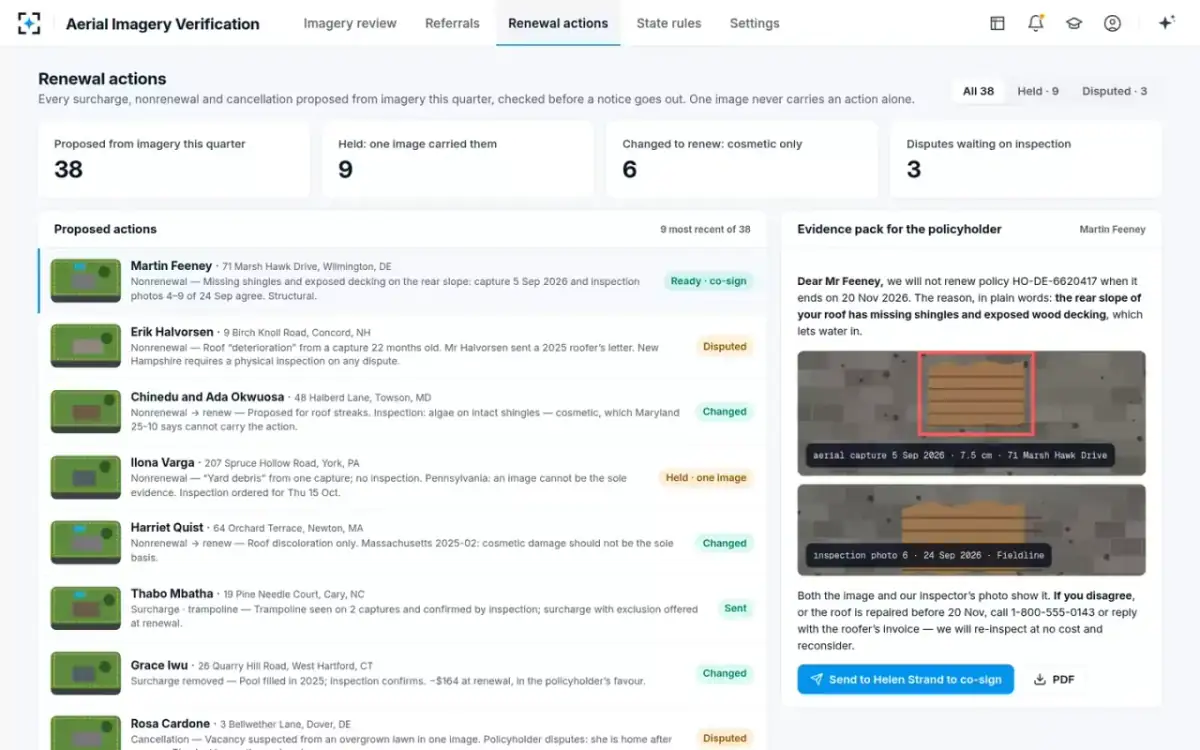
The carrier-side version of this page is a set of checks run before any notice is drafted. In Aerial Imagery Verification every capture is placed on the insured parcel and its offset measured; captures past the tolerance are excluded before anything is read. Each capture's date, resolution and cloud and shadow cover are scored, and no condition finding is read from a capture older than the state's limit. Images older than the carrier's limit, 12 months on the sample carrier, may back up a newer source but never carry an action.
Then the decision has to survive two more rules: nothing adverse on one source, and a co-signature from the underwriting manager on every nonrenewal. When an action does go, the homeowner's evidence pack carries the reason in plain words, the date-stamped image, the inspection photo and how to dispute. On the sample carrier's books this quarter, 9 of 38 imagery-based actions were held because one image carried them, and 6 were changed to renew because the finding was cosmetic.
Every imagery-based action, checked before a notice goes
For complaint handlers: what to look for in the file
A complaint about an old or wrong photo can usually be judged from the insurer's file in minutes, if the file holds what the rules expect. The table lists what to look for and the rule that makes it matter.
Reviewing an imagery-based nonrenewal: what the file should show
| Look for | Where in the file | Why it matters |
|---|---|---|
| The capture date of every image relied on | Image metadata, notice, evidence sent to the homeowner | Louisiana’s 24-month statute; Colorado’s 12 months; “recent” or “current” in Maine, Tennessee, West Virginia and Maryland |
| A parcel match for each capture | Underwriting notes or imagery report | Wrong-structure images are named in Maine, Tennessee and West Virginia |
| A specific reason | The notice | Florida §627.4091; Maryland’s actual reason, stated clearly; Connecticut’s 60-day notice with reason |
| A second source | Inspection report, newer capture, permit, professional report | Physical inspection or further investigation expected in Pennsylvania, Maryland, Maine, Colorado |
| A cosmetic-versus-condition call | Inspection notes | Cosmetic findings do not support the action in Connecticut, Pennsylvania and Delaware |
| Notice before the action and copies given | Correspondence | Best practice in Maine, Tennessee and West Virginia; access in Delaware; review at hearing in Maryland |
The full set of rules, state by state, is in the map of aerial imagery laws by state, and who must decide at each step is set out in insurance companies using drones to cancel coverage. The solution is on the Aerial Imagery Verification page.
Questions people ask
Can my home insurance be cancelled because of aerial photos?
Mid-term cancellation is limited by law in many states, including Connecticut, Delaware and Pennsylvania, once a policy has been in force for a set period; Connecticut, for example, generally allows it after 60 days only for reasons such as nonpayment, material misrepresentation or a physical change that materially increases a hazard. A nonrenewal at the end of the term is easier for the insurer, but the image rules on this page apply to both.
What should a nonrenewal notice based on drone or satellite photos include?
The specific reason, and under the best practice Maine, Tennessee and West Virginia describe, a statement that the action rests on aerial imagery, copies of the images, and a way to provide updated information or dispute them. Delaware expects insurers to give customers access to the imagery used in policy determinations.
Can an insurer use an old photo just to find my house?
Yes. Louisiana's statute expressly allows images used only to identify and locate the property and its improvements to be used without any age limit. The age limit applies when the image is relied on alone to identify the condition behind a cancellation or nonrenewal.
Where do insurers get aerial photos of houses?
Mostly from imagery captured over whole areas by aircraft, drones or satellites and licensed to insurers. Louisiana's statute counts images bought from a third party and taken from planes and satellites as aerial images, and Tennessee's bulletin covers imagery the insurer buys as well as imagery it collects.
How do I find out when the photo of my house was taken?
Ask the insurer for the image and its capture date; a carrier that checked the image's age can answer at once. If you request a hearing in Maryland you are entitled to review the images the insurer relied on, and in Tennessee a homeowner who complains to the department may view the evidence behind the decision.