Insurance companies do use drones, aircraft and satellites to look at the houses they insure, and some have cancelled or nonrenewed homeowners coverage on what those images seemed to show. The rules in the states we read are narrower than either side of the argument. An image may flag a roof, but the decision to cancel or not renew needs a clear, current picture of the right house, evidence that the problem is real rather than cosmetic, and a chance for the homeowner to answer. Someone at the insurer has to make that call and sign it. Botminds' Aerial Imagery Verification is built around that line: its agents outline, measure and price what the images show, and a homeowners underwriter decides, with an underwriting manager co-signing every adverse action.
The examples come from a fictional sample carrier, Norland Mutual, as it runs through the solution. Its people, policyholders and addresses are invented, and every figure about its book is sample data, not a customer result.
The mere suspicion or question that something has changed is not cause for nonrenewal.
Pennsylvania Insurance Department, Notice 2024-06, citing Anderson/Donegal (2013)
Can insurance companies use drones to cancel your homeowners insurance?
They can use the images, and in some cases an image alone can be enough, but not often. Connecticut, which has taken one of the firmest lines, still says that "Aerial images that unequivocally show material damage, however, may be appropriate to support nonrenewal action" (Connecticut notice). Maryland says imagery is "not categorically prohibited" and that inspecting the house by other means "may not be necessary in all situations" (Maryland Bulletin 25-10). Neither state bans drones. Both narrow what an image can carry on its own.
The narrowing has a reason. Pennsylvania's department investigated complaints about nonrenewals and midterm cancellations based on roof condition and "found that the aerial images relied upon did not definitively show material roofing degradation or damage" (Pennsylvania Notice 2024-06). Maine reports homeowners who did not learn that imagery had been used against them until shortly before their hearing (Maine Bulletin 483). Louisiana went further than guidance and wrote a statute: an insurer may not rely solely on aerial images to identify the condition behind a homeowners cancellation or nonrenewal unless they were taken within 24 months (La. R.S. 22:1339).
The volume behind these rules is large. State regulators' market conduct data show company-initiated homeowners nonrenewals rising from 1,255,975 in 2023 to 2,019,799 in 2024, 60.8% more in a year, or 19.6 per 1,000 policies in force (NAIC; the percentage is our arithmetic). The NAIC data do not say how many rested on an image, and we found no regulator that publishes that count.
Do insurance companies use drones for inspections? Drones, planes and satellites
Yes, and the rules do not care much which platform took the picture. Delaware's bulletin, written about drones, credits them with enhancing "efficiency in claim processing, loss assessments, and underwriting by providing high-resolution aerial imagery and reducing costs associated with traditional inspections" (Delaware Bulletin No. 150). Maryland's bulletin covers both kinds, images taken from orbit and images "captured from an airborne platform, such as an aircraft or drone" (Maryland Bulletin 25-10).
Most images used in homeowners underwriting are not flown for one house. They are captured over whole areas by aircraft or satellites and licensed by the insurer. Tennessee's definition reaches imagery "whether collected by the insurer or a third party" (Tennessee Bulletin 25-03), and Louisiana's statute names "third-party proprietary aerial imagery taken by a fixed-wing aircraft and satellites" (La. R.S. 22:1339). A homeowner who has never seen a drone over the house may still have been looked at from above several times a year.
Who decides when an image flags a roof? Nine decision points
A person decides, at every point where the outcome can hurt the homeowner. The map below follows one imagery referral from the first flag to a dispute, with what the agents do at each point, who holds the decision and which rule bears on it. It is how the sample carrier has set up Aerial Imagery Verification; the rules column is what the state bulletins say.
Nine decision points in an imagery referral, and who holds each
1An image flags something
Who holds itNobody yet
What the agents doThe imagery analyst outlines the roof, the pool, the trees and measures each.
What the rules sayAn image may raise a question; Maryland says it does not settle one unless it “unequivocally” establishes the problem.
2Is it this house?
Who holds itAgent check, underwriter sees it
What the agents doThe parcel matcher measures the footprint’s offset; past the tolerance the capture is excluded before anything is read.
What the rules sayMaine and Tennessee both name images of the wrong structure as a cause of complaints or misuse.
3Can the image judge the roof?
Who holds itAgent check, underwriter sees it
What the agents doCapture date, resolution and cloud, shadow or tree cover over the roof are scored against the carrier’s settings and the state’s rule.
What the rules sayMaryland: low-resolution, blurry or dated images cannot justify the action without further investigation.
4Cosmetic or condition?
Who holds itUnderwriter
What the agents doThe inspection reader classes each roof observation, citing the photo; cosmetic stays cosmetic.
What the rules sayConnecticut, Pennsylvania and Delaware: streaking and discoloration alone do not support the action.
5Is there a second source?
Who holds itUnderwriter
What the agents doThe reconciler blocks any adverse recommendation that rests on one source.
What the rules sayMaine, West Virginia and Tennessee: imagery should be one tool, not the only information.
6Renew, condition, re-inspect or not renew
Who holds itHomeowners underwriter
What the agents doThe reconciler recommends and prices each line from the rating manual.
What the rules sayThe decision is the carrier’s, and its reasons must be specific.
7Any adverse action
Who holds itUnderwriting manager co-signs
What the agents doNothing; the action waits for a second signature.
What the rules sayThe carrier’s own control; no state we read prescribes who signs.
8The notice and the evidence
Who holds itUnderwriter sends
What the agents doThe drafter writes the reason in plain words with the dated image, the inspection photo and how to dispute.
What the rules sayMaine, Tennessee and West Virginia call copies of the images and a chance to dispute best practice.
9A dispute
Who holds itCoordinator orders, underwriter reconsiders
What the agents doA physical inspection is ordered in every state by default.
What the rules sayDelaware recommends a physical inspection when a finding from imagery is disputed.
Two points on the map carry most of the legal risk. The third, whether the image can judge the roof at all, is where Maryland draws its line: when an image suggests a problem but does not establish it "unequivocally", the insurer should investigate further, by better images or another kind of inspection, before acting (Maryland Bulletin 25-10). The fourth, cosmetic or condition, is where Connecticut and Pennsylvania found the actions they complained of. The age limit at point three differs by state; the state-by-state map of aerial imagery rules sets out each one.
What the agents may do, and the line they never cross
The agents read, match, measure, classify and price; they never decide, never send and never act on one source. Seven agents work each referral in Aerial Imagery Verification, and each has written limits. The two people at the end of the chain are the homeowners underwriter, who decides and signs, and the underwriting manager, who co-signs anything adverse.
Aerial Imagery Verification: seven agents, two signatures
Agent
Application readerReads the application, prior carrier and producer notes into the attributes to check.
Never: infers or changes an answer the applicant did not give
Agent
Parcel matcherPlaces each capture on the insured parcel by geocode, boundary and building footprint.
Never: lets a feature be read from a capture more than 8 m off the parcel
Agent
Imagery analystOutlines and measures features, and scores each capture’s date, resolution, cloud and shadow.
Never: reads condition from a capture older than the state’s limit or coarser than the resolution set for condition
Agent
Inspection readerReads the inspection report and photos; classes each roof observation.
Never: upgrades a cosmetic observation
Agent
Property data checkerReads permits, assessor and homestead data; dates the roof from permits.
Never: treats a permit as proof of the work’s full scope
Agent
ReconcilerSets every source side by side, prices each line and recommends.
Never: recommends anything adverse on one source
Agent
Question and notice drafterDrafts one message to the producer and the evidence pack for any adverse notice.
Never: sends without the underwriter
A person decides
Homeowners underwriterDecides bind, renew, condition, re-inspect or not renew, and signs.
A person decides
Underwriting managerCo-signs every decline, cancellation and nonrenewal before it goes.
The limits are written to match the rules, not to sound cautious. A capture 31 metres off the parcel is the wrong house; reading a roof from it is the error Maine describes. A cosmetic observation upgraded to "deterioration" is the error Pennsylvania and Connecticut investigated. And a recommendation on one source is what nearly every bulletin calls insufficient on its own.
Can an insurance company non-renew because of aerial photos? What has to come first
It can, where the photos show a real, current problem with the house, but the rules we read expect three things first: a check that the image is reliable, a second look where it is not conclusive, and a chance for the homeowner to see the image and answer. Maine, Tennessee and West Virginia each describe the same best practice: tell the homeowner before acting, say that the action rests on aerial imagery, give copies of the images, and let the homeowner provide updated information or dispute them (Maine, Tennessee, West Virginia).
Repairs come before nonrenewal where they can. West Virginia encourages insurers to recommend the repair and allow reasonable time to make it before turning to nonrenewal (West Virginia Bulletin 25-02). On the sample carrier, a condition the inspection confirms but the homeowner can fix, such as branches resting on a gutter, becomes a condition with a deadline, not a nonrenewal.
An image that flags a roof, against a nonrenewal that can be defended
What the image gives: A footprint near the address.
What the action needs: A footprint on the insured parcel, with the offset measured.
What the image gives: A capture date, often months back.
What the action needs: A capture recent enough for the state’s rule and for the condition claimed.
What the image gives: Dark areas, streaks, a patch of a different tone.
What the action needs: Material damage or degradation, not appearance; cosmetic findings excluded.
What the image gives: One picture.
What the action needs: A second source: an inspection photo, a newer capture, a permit or a professional’s report.
What the image gives: Not told the image exists.
What the action needs: Told, given copies, and allowed to answer or repair first.
What the image gives: A score or a flag from software.
What the action needs: A named underwriter’s decision, co-signed, with specific reasons.
Cancellation is not nonrenewal: why a midterm action is harder
Cancelling a policy in the middle of its term is harder to justify than declining to renew it, and that is where "drones cancelling coverage" usually runs into the law. Once a policy has been in force for a set period, cancellation is limited to specific reasons. Connecticut's advisory tells homeowners that after 60 days, or on a renewal, cancellation is generally permitted only for reasons such as nonpayment, material misrepresentation, or a physical change in the property that materially increases a hazard insured against (Connecticut advisory). Delaware's bulletin points to the same structure in its statute, 18 Del. C. §4123 (Delaware Bulletin No. 150).
The roof in a picture rarely meets that bar on its own. Delaware puts the burden plainly: "An insurer must establish not only that a risk has increased but also that the increase is substantial." A dark patch on a capture shows that something looks different. It does not show that a hazard has increased, let alone substantially, which is why the sample carrier's settings require a second source before any surcharge, decline, cancellation or nonrenewal.
The dispute: a physical inspection, a roofer's letter or a new image
When a homeowner disputes what an image shows, the usual answer is a person at the house. Delaware's department recommends that when a customer disputes a finding drawn from aerial imagery, the insurer inspect the house in person to check its assessment (Delaware Bulletin No. 150). Colorado's 2026 bulletin widens the options to newer imagery or a qualified professional's report as well as a visit (Colorado Bulletin B-5.57; every state's version is in the aerial imagery laws by state).
Aerial Imagery Verification makes the inspection the default in every state, not only where a bulletin recommends it, and carriers can switch that setting. On the sample carrier's books this quarter, three disputes were waiting on an inspection. One is a renewal in New Hampshire where the image was 22 months old and the homeowner had sent a 2025 roofer's letter; another is a Delaware cancellation for suspected vacancy, inferred from an overgrown lawn on one capture, which the homeowner disputes.
One quarter of imagery-based actions at a sample carrier: held, changed and signed
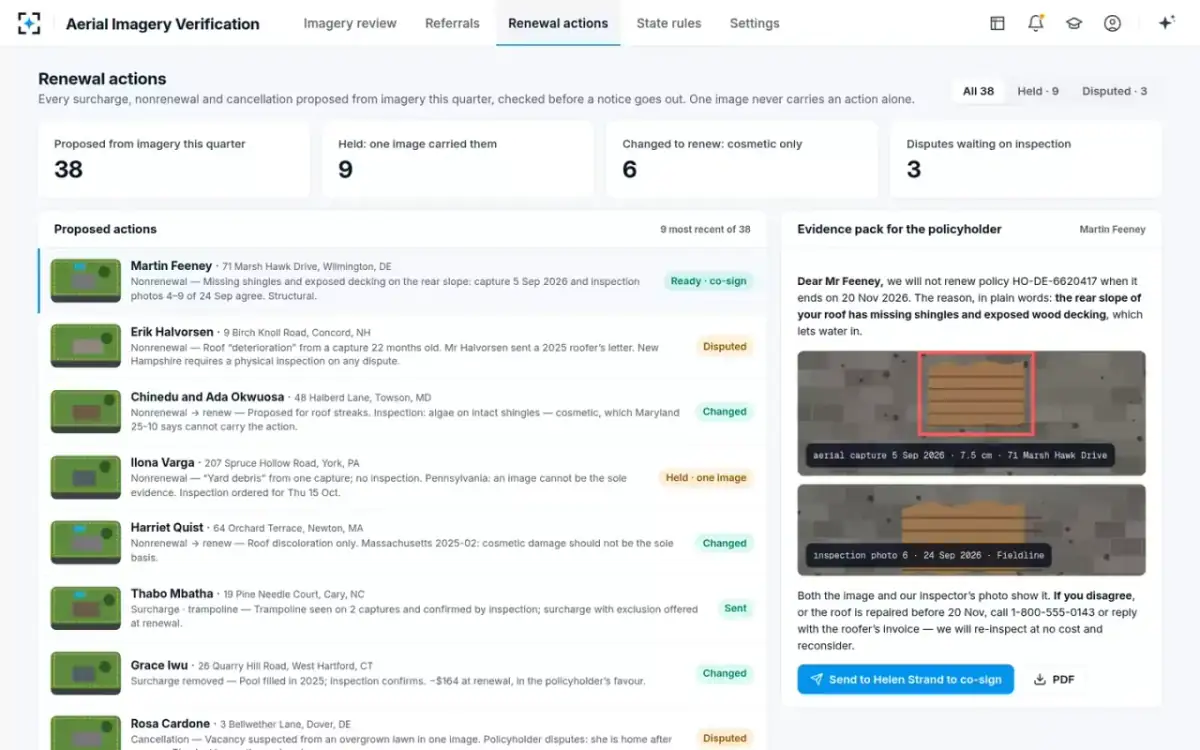
Most of what an imagery programme proposes should survive review, and some of it should not. The sample carrier's renewal actions screen counts every surcharge, nonrenewal and cancellation proposed from imagery in the quarter, and what happened to each before a notice went out.
One quarter of imagery-based actions at the sample carrier
38
surcharges, nonrenewals and cancellations proposed from imagery
9
held: one image carried them
6
changed to renew: the finding was cosmetic
3
disputes waiting on a physical inspection
Three files show the difference. Chinedu and Ada Okwuosa in Towson, Maryland, were proposed for nonrenewal over roof streaks; the inspection found algae on intact shingles, and the action changed to renew. Ilona Varga in York, Pennsylvania, was proposed for nonrenewal over "yard debris" seen on one capture with no inspection; the action was held and an inspection ordered. Martin Feeney in Wilmington, Delaware, was proposed for nonrenewal over missing shingles and exposed decking on the rear slope; a capture of 5 September 2026 and inspection photos of 24 September agree, the finding is structural, and the nonrenewal is ready for the manager's co-signature.
Every imagery-based action in the quarter, and the ones held
The co-signature and the letter: what the homeowner receives
A defensible nonrenewal reaches the homeowner with a specific reason, the evidence behind it and a way to answer. Specific reasons are the law in many states: Florida requires every notice of nonrenewal or cancellation to give its specific reasons, underwriting reasons included (Fla. Stat. §627.4091), and Maryland's statute asks for the actual reason, stated clearly and specifically (Maryland Bulletin 25-10).
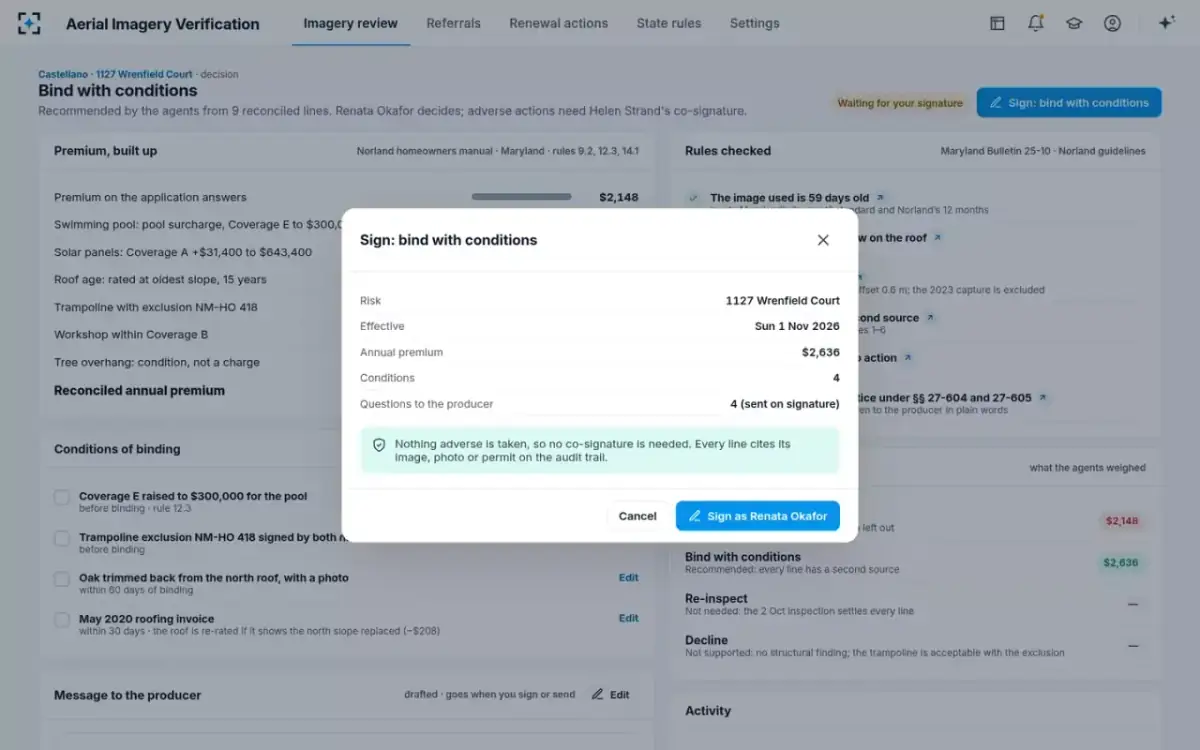
The sample carrier's letter to Mr Feeney says the rear slope "has missing shingles and exposed wood decking, which lets water in", shows the aerial capture and the inspector's photo of the same slope, and tells him that if he disagrees, or repairs the roof before the policy ends on 20 November, the carrier will re-inspect at no cost and reconsider. Nothing goes until Helen Strand, the underwriting manager, co-signs. When nothing adverse is taken, as on the Castellano new-business file, the underwriter signs alone.
When nothing adverse is taken, one signature; when it is, two
What a homeowner can ask for when the picture is old or of the wrong house is covered in an old photo of my house, used without notice. The full referral is on the Aerial Imagery Verification page.
Questions people ask
Can insurance companies use drones to inspect your home in Florida?
Yes; commercial drone flights are authorised under the federal Part 107 rules, and we found no Florida bulletin specific to aerial imagery among the rules we read. Florida's general rules still apply to any action that follows: a nonrenewal or cancellation must state the specific underwriting reasons (§627.4091), and a residential policyholder gets at least 120 days' written notice of a nonrenewal (§627.4133).
Can insurance companies take pictures of your house without permission?
Insurers do inspect the houses they insure, and most aerial images are captured over whole areas rather than of one house. The state rules we read deal with how the pictures are used, not whether they may be taken. Several, including Maine, Tennessee, West Virginia and Delaware, expect insurers to let homeowners see the images used in a decision about their policy.
My homeowners insurance was cancelled because of drone footage. What are the routes?
The rules we read describe three. Ask for the images and the reason, which Maryland says a homeowner is entitled to review in a hearing. Send updated information or proof of repairs, which Maine, Tennessee and Colorado describe. Or request the state's hearing or file a complaint with the insurance department, which reviews the insurer's evidence.
Do insurance companies use drones to inspect roofs?
Yes. Delaware's bulletin credits drones with high-resolution imagery and lower inspection costs in underwriting, and Colorado's 2026 bulletin covers both insurers' own imagery tools and tools bought from vendors. What changes from state to state is how much a roof image may carry without someone confirming it on the ground.
How many homeowners policies are nonrenewed each year?
Company-initiated homeowners nonrenewals reached 2,019,799 in 2024, up from 1,255,975 in 2023, in the state regulators' market conduct data that the NAIC published in 2026. That is 19.6 per 1,000 policies in force across the country. The data do not separate nonrenewals based on imagery.
Does AI decide homeowners nonrenewals?
It should not decide them alone. The NAIC's model bulletin on insurers' use of AI, adopted in 29 jurisdictions as of 8 October 2026, expects governance that keeps AI from producing adverse consumer outcomes, and Maryland points insurers that use AI to interpret aerial images to its own AI bulletin, 24-11. In Aerial Imagery Verification the agents recommend and a named underwriter decides.