Home insurance inspectors look for four things from outside the house: the roof (its covering, age and condition), hazards that make a loss more likely (branches over the roof, debris, damage left unrepaired), liability features that change the premium (a pool, a trampoline, an outbuilding) and signs that someone lives there. They photograph each one and file a report for the underwriter who must decide whether to write or renew the policy at the price the application implied. That underwriter has three accounts of the same house: what the applicant said, what an aerial image shows and what the inspector found. Only the inspector stood there. Botminds' Aerial Imagery Verification is built for that moment: its agents line the inspector's photos up against the application and the aerial captures before anyone decides, so the report is read first, not last.
The examples on this page come from a fictional sample file as it runs through the solution: a new-business homeowners application from Daniel and Priya Castellano for 1127 Wrenfield Court, Ellicott City, Maryland, written by an invented carrier, Norland Mutual. The inspection firm, inspector, agency and people are invented too, and every figure about the file is sample data, not a customer result.
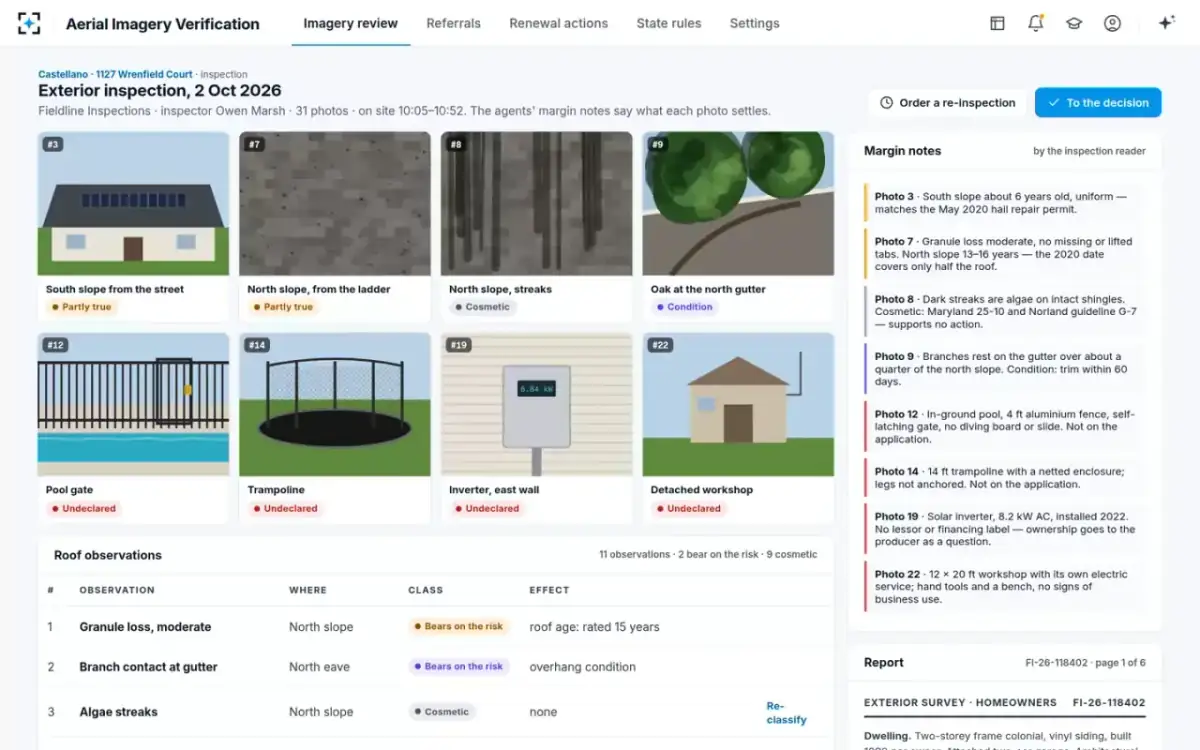
One exterior inspection in the sample file, 2 October 2026
31
photos taken by the inspector
47min
on site, 10:05 to 10:52
11
roof observations written into the report
2of 11
bear on the risk; the other 9 are cosmetic
What do home insurance inspectors look for? Four things an exterior report covers
An exterior inspection for home insurance answers four questions: is the roof what the application says, is there a hazard that makes a claim likely, is there a feature that changes the liability the policy carries, and is the house occupied as declared. Everything an inspector photographs serves one of the four, and a good report says which.
Regulators describe the roof part most plainly. Connecticut's insurance department, in a 2026 advisory for homeowners, lists the roof conditions insurers commonly look at: missing, lifted, curled, cracked or deteriorated shingles, more than one layer of roofing, unrepaired damage or heavy debris including moss, and overhanging tree limbs. It notes that roof-age limits for asphalt and similar materials vary by insurer and commonly fall in the 15 to 20-year range (Connecticut Insurance Department). A roof's age is the single fact applications most often get wrong, because roofs are replaced in parts.
The liability features are the ones homeowners forget to mention. On the sample file the inspector photographed an in-ground pool with its fence, a 14-foot trampoline, a 22-panel solar array's inverter and a detached workshop. None was on the application. Each changes either the premium, a coverage limit or an exclusion, and the price of each is worked through in what a trampoline, a pool and a roof slope add to the premium.
Occupancy is the quietest line. The inspector notes whether the house looks lived in: a car in the drive, furniture through the windows, an owner who answers the door. On the sample file the owner was present, and the county's homestead credit agreed.
What happens during a home insurance inspection, minute by minute
During a home insurance inspection the inspector walks the outside of the house, photographs each side and each roof slope, climbs a ladder where a slope cannot be judged from the ground, and photographs every feature that bears on the policy. An exterior visit, as the name says, does not need anyone inside. The sample visit took 47 minutes, from 10:05 to 10:52, and produced 31 numbered photos.
The order matters less than the numbering. Every observation in the written report should point to a photo, because the underwriter, the manager who co-signs an adverse decision and, in a dispute, the homeowner and the regulator will all ask the same question: which picture shows that? Several state rules assume the homeowner will see the evidence. Delaware's bulletin on aerial imagery expects insurers to let customers see the drone images used in decisions about their policies (Delaware Bulletin No. 150; the other states' versions are set side by side in the aerial imagery laws by state), and an inspection photo is the natural answer to an image the homeowner disputes.
What each of the inspector's photos settles on the sample file
#3 South slope, from the street
What it showsAbout 6 years old and uniform; matches the May 2020 hail repair permit.
What it settlesRoof age, half of it: the 2020 date is true for this slope.
#7 North slope, from the ladder
What it showsGranule loss moderate, no missing or lifted tabs. Slope 13 to 16 years old.
What it settlesRoof age, the other half: the roof is rated at its oldest slope.
#8 North slope, streaks
What it showsDark streaks are algae on intact shingles.
What it settlesCosmetic. Supports no action, whatever the aerial image suggested.
#9 Oak at the north gutter
What it showsBranches rest on the gutter over about a quarter of the slope.
What it settlesA condition: trim within 60 days. Not a charge.
#12 Pool
What it showsIn-ground pool, 4 ft aluminium fence with a self-latching entry, no diving board or slide.
What it settlesUndeclared pool; the liability limit the rating manual requires.
#14 Trampoline
What it shows14 ft, netted enclosure, legs not anchored.
What it settlesUndeclared trampoline: exclusion or removal before binding.
#22 Detached workshop
What it shows12 × 20 ft with its own electric service; hand tools, no sign of business use.
What it settlesAn outbuilding inside the other-structures limit; occupancy unaffected.
The roof, slope by slope: age, wear and what counts as cosmetic
The roof is where inspection and application disagree most often, and the disagreement is usually partial. The Castellanos' application said the roof was from 2020. Photo 3 shows a south slope about six years old that matches a May 2020 hail repair permit. Photo 7, taken from the ladder, shows a north slope 13 to 16 years old with moderate granule loss. The county permit history explains both: a full roof in June 2011 and a partial one in May 2020. The applicant was not wrong, only half right.
The inspector's second job on the roof is to separate wear that bears on the risk from wear that only looks bad. Of the eleven roof observations in the sample report, two bear on the risk: the moderate granule loss on the north slope and branches resting on the north gutter. The other nine, including dark streaks, are cosmetic. That split is not a matter of taste. The Connecticut advisory reminds homeowners that the department told insurers in March 2024 that aerial images of cosmetic conditions such as natural discoloration or streaking should not be used as a reason not to renew, and that insurers need evidence of material degradation or damage (Connecticut Insurance Department).
Streaks matter because they are what aerial images show best. On the sample file the August 2026 capture shows dark streaks on the north slope; the inspector's photo 8 shows algae on intact shingles. Read alone, the image suggests a worn roof. Read beside photo 8, it is a cleaning job.
Who reads the inspection report, and why does it arrive last?
The report is read by the homeowners underwriter who decides, by the underwriting manager who co-signs any adverse action, by the inspection coordinator who decides whether to order another visit, and by whoever answers the agent's questions. It arrives last because it is ordered last. Connecticut's advisory describes the common sequence: "Aerial imagery is typically used as a screening tool and may be followed by a physical inspection if questions or concerns are identified" (Connecticut Insurance Department).
That sequence makes sense for ordering, since a visit costs money and an image does not. It makes less sense for reading. By the time the report arrives, the image has already suggested an answer, and the report is read to confirm or overturn it. A report read that way gets skimmed for the line that settles the question the image raised, and the line nobody asked about, such as the trampoline's unanchored legs or the workshop's electric service, is missed.
Six people touch one inspection report, and only one stood at the house
Today
Photographs 31 things in 47 minutes; the report is opened after the image has already suggested an answer.
With agents
Each photo is read against the application line it settles, and cited by number wherever it is used.
Still theirs: standing at the house, and judging what is cosmetic and what bears on the risk
Today
Makes one answer out of three: the image says pool, the application says no pool, the report says fence.
With agents
Opens a referral with the application, the captures and the report already lined up and priced.
Still theirs: the decision and the signature
Today
Co-signs nonrenewals without knowing which picture they rest on.
With agents
Sees the inspection photo beside the image for every adverse action before co-signing.
Still theirs: the co-signature on every decline, cancellation and nonrenewal
Today
Re-orders visits for questions the photos already in the file could answer.
With agents
Sees what each photo settles before ordering another visit, and orders one when a dispute or a cloudy capture needs it.
Still theirs: choosing the vendor and the visit
Today
Fields several questions on the same referral, on different days.
With agents
Every question goes to the agency in one message, with the photo behind it.
Still theirs: the relationship with the producer
Today
Learns which photo mattered only if a notice arrives.
With agents
Any adverse notice carries the dated image, the inspection photo and how to dispute.
Still theirs: the right to answer with a repair invoice or a roofer’s letter
What an inspector sees that an aerial image cannot
An inspector sees what is under trees, what is at ground level and what is too small to resolve from the air. On the sample file the August 2026 capture is sharp, 7.5 centimetres a pixel, and only 59 days old. It still could not show that the trampoline's legs were not anchored, that the pool had no diving board, that the fence was four feet high with a self-latching entry, or that the inverter on the east wall carried no lessor's label. Those four facts decide an exclusion, a liability limit and an ownership question.
Regulators make the same point from the other side. Maine's bulletin on aerial imagery warns that "blurry, older images that appear to show staining or discoloration of shingles will usually not be enough, standing alone, to prove that a roof must be replaced" (Maine Bulletin 483), and Tennessee's tells insurers to get recent, clear information, through a physical inspection or otherwise, when an image cannot show a property's condition with certainty (Tennessee Bulletin 25-03). The inspection is the evidence the image points to, not a formality after it.
The same house, seen from the air and from the ground
Aerial capture, 14 Aug 2026: In-ground pool, 16 × 32 ft.
Inspector, 2 Oct 2026: Same pool; 4 ft aluminium fence, self-latching entry, no diving board or slide (photo 12).
Aerial capture, 14 Aug 2026: 14 ft round trampoline.
Inspector, 2 Oct 2026: Netted enclosure; legs not anchored (photo 14).
Aerial capture, 14 Aug 2026: 22 panels on the south slope.
Inspector, 2 Oct 2026: Inverter on the east wall with no lessor or financing label (photo 19).
Aerial capture, 14 Aug 2026: Two shingle tones; streaks on the north slope.
Inspector, 2 Oct 2026: South slope about 6 years, north 13 to 16; streaks are algae on intact shingles (photos 3, 7, 8).
Aerial capture, 14 Aug 2026: Oak canopy over 28% of the north slope.
Inspector, 2 Oct 2026: Branches rest on the gutter (photo 9).
Aerial capture, 14 Aug 2026: Cannot be judged from above.
Inspector, 2 Oct 2026: Occupied, owner present.
Do insurance companies send people to take pictures of your house?
Yes. Insurers send inspectors to photograph the outside of houses they insure or are asked to insure, and many also buy aerial images taken from planes, drones or satellites. Connecticut's advisory puts it simply: "Insurance companies have the right to inspect the properties they insure to evaluate maintenance and potential risk for a claim arising under a policy" (Connecticut Insurance Department).
The pictures a homeowner never sees taken are the aerial ones. Commercial drone flights are authorised under the federal small unmanned aircraft rules, 14 C.F.R. Part 107, and Delaware's bulletin notes that state law governs them too (Delaware Bulletin No. 150). Most aerial images used in underwriting are not flown for one house at all; they are captured over whole areas and licensed. Who may act on them, and how, is the subject of who decides when a drone or satellite image flags a roof.
Can I refuse a home insurance inspection? What happens to the decision
A homeowner can decline a visit, but the insurer then decides from what it already has, which may be the application and an aerial image. That is the combination regulators have been warning about. The inspection is usually the homeowner's best chance to have the roof judged by someone standing on it rather than by a picture taken months earlier.
Regulators encourage insurers to hear the homeowner before acting. Maine's bulletin observes that many requests for a hearing are settled before it is held once the homeowner gets a chance to give the insurer better information (Maine Bulletin 483). An inspection is the cheapest form of that information. A homeowner who has had work done can also send what proves it: the roofer's invoice, a permit number, a photo.
What do home insurance inspectors look for in Florida?
In Florida, two more inspections sit beside the exterior survey. A four-point inspection looks at the roof, electrical, plumbing and heating and cooling systems to decide whether an older home is insurable; Florida's Insurance Consumer Advocate describes it as commonly required by Florida homeowners insurers when they issue or renew a policy (Florida Department of Financial Services). A wind mitigation inspection, on the state's uniform form, records the roof and opening features that earn windstorm discounts (Fla. Stat. §627.711).
The roof carries legal weight in Florida too. An insurer may not refuse to issue or renew a homeowner's policy solely because of the age of a roof under 15 years old, and for an older roof it must let the homeowner have the roof inspected first, and may not refuse on age alone if an authorised inspector finds at least five years of useful life left (Fla. Stat. §627.7011). The two forms answer different questions and are easily confused; the four-point inspection and the wind mitigation form, side by side sets out which decides what.
Reading the report first: how Aerial Imagery Verification puts it beside the image
In Aerial Imagery Verification the inspection report is read at the same moment as the image and the application, by an agent whose only job is the report. The inspection reader reads the vendor's report and photos, and the roof and mitigation certificates, and classifies each roof observation as bearing on the risk or cosmetic. It has two limits: it cites the photo number for every observation, and it never upgrades a cosmetic observation. On the sample file it read all 31 photos and 11 roof notes as part of a run that took 3 minutes 40 seconds.
The inspection, with a margin note saying what each photo settles
The report then becomes one column of a grid. Nine attributes run down the side; the application, two aerial captures, a third capture excluded as another house, the inspection and the county's permit and assessor data run across the top. Each cell opens its source. On the sample file six of the nine attributes disagreed with the application, and every one of them had the inspection as a second source.
Every source for every attribute, the inspection among them
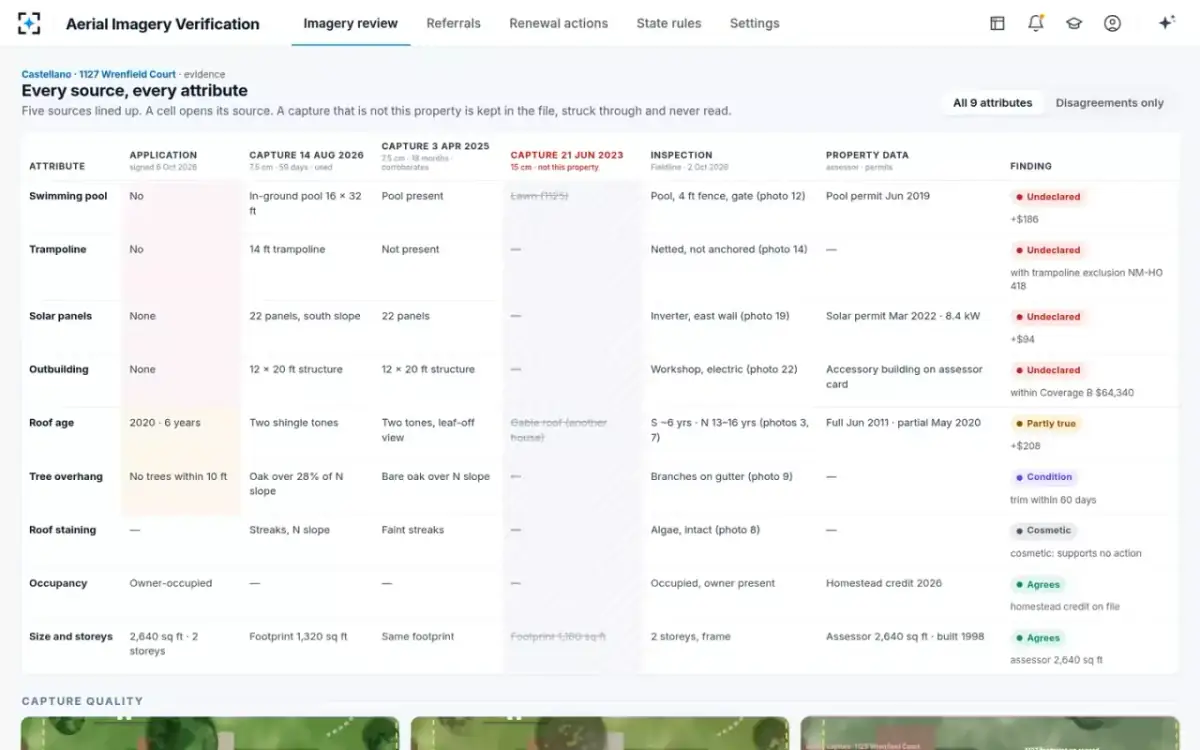
Reading the report first changes the coordinator's job most. Marcus Bell, the sample carrier's inspection coordinator, used to re-order visits for questions the photos already answered. With each photo's meaning stated, he orders a visit when a homeowner disputes a finding or a capture is too cloudy to judge the roof, and not otherwise. Botminds estimates the reading of the inspection report and photos falls from about 15 minutes per referral by hand to about 2. That is an estimate for the solution's design, not a measured result, and the decision itself stays with the homeowners underwriter.
For the line-by-line anatomy of the report itself, and how each line maps to an application answer, see the homeowners insurance inspection checklist. The whole referral, screen by screen, is on the Aerial Imagery Verification page.
Questions people ask
How long does a home insurance inspection take?
An exterior survey of a single house is usually a short visit; the sample inspection on this page took 47 minutes. Florida's Insurance Consumer Advocate puts a four-point inspection at about an hour, and warns that one finished much faster may not have been thorough (the guide is summarised in 4 point inspection vs wind mitigation). We found no published national average for exterior underwriting inspections.
Do home insurance inspectors go inside the house?
An exterior underwriting inspection does not need anyone inside. A Florida four-point inspection does: the state's consumer guide lists photos of the water heater, plumbing under the sinks, the open electrical panel and the heating and cooling equipment with its dated manufacturer's plate. Ask the insurer or the inspection firm which kind of visit it has ordered.
Will roof stains fail a home insurance inspection?
Stains alone should not. Delaware's insurance department says cosmetic issues such as discoloration and streaking are not valid grounds for cancellation, and Connecticut has told insurers that cosmetic roofing conditions do not support nonrenewal. An inspector who photographs algae on intact shingles, as on the sample file, is recording a cosmetic finding.
What happens if the inspection finds a real problem?
Usually a request to fix it before anything else. Tennessee and Maine both encourage insurers to issue loss control recommendations and give homeowners reasonable time to make repairs before taking other action such as nonrenewal. On the sample file the branches on the gutter became a condition of binding: trim within 60 days and send a photo.
Who pays for a home insurance inspection?
An inspection the insurer orders for its own underwriting is normally arranged by the insurer. Inspections the homeowner commissions are the homeowner's cost: Florida's roof law lets a homeowner with a roof 15 or more years old have it inspected by an authorised inspector at the homeowner's expense, and the state's consumer guide puts a standalone four-point inspection at typically $100 to $300.
Can I see the photos from my home insurance inspection?
Ask for them, especially if a notice relies on them. Maryland says an insured who requests a hearing is entitled to review the images and other material the insurer relied on, and Maine calls it best practice to give homeowners copies of the aerial images behind a nonrenewal. On the sample carrier every adverse notice includes the inspection photo it rests on.