A trampoline does not always increase homeowners insurance. Some insurers handle it through an exclusion or a condition rather than a surcharge, and in the sample file on this page it adds nothing to the premium but cannot be bound until both named insureds sign a trampoline exclusion or take it down. A pool more often raises the premium, through a surcharge and a higher liability limit; solar panels raise the dwelling limit; and a roof older than the application said moves the rate. Each answer comes from the insurer's own filed rating manual, so the amounts differ from carrier to carrier. For an underwriting team the sharper question is what each mismatch costs when nobody catches it, and what it costs when an aerial image is misread the other way. Botminds' Aerial Imagery Verification prices every line between the application and what the images, the inspection and the permits show, so both errors are visible before anyone signs.
The figures come from a fictional sample file in the solution: Daniel and Priya Castellano's application for a homeowners policy on 1127 Wrenfield Court, Ellicott City, Maryland, priced from the rating manual of an invented carrier, Norland Mutual. Every amount is sample data, not a market average or a customer's result.
One application, priced once every mismatch is found
+$488
a year: $2,148 on the application’s answers, $2,636 once every line is priced
+22.7%
on the premium the application implied
$0
for the trampoline, bound with a signed exclusion instead
6of 9
attributes on the application disagreed with the evidence
Does a trampoline increase homeowners insurance? Sometimes by nothing, through an exclusion
On many policies a trampoline changes the terms, not the price. In the sample carrier's Maryland manual a trampoline carries no surcharge; it carries a choice. Both named insureds sign trampoline exclusion NM-HO 418, or the trampoline comes down before the policy starts. The underwriter's message to the agency puts the question plainly: will both named insureds sign the exclusion, "or will the trampoline be removed before 1 Nov?"
Other carriers' manuals may surcharge a trampoline, refuse one without an enclosure, or ask about anchoring. The inspector's photo 14 on the sample file shows a 14-foot trampoline with a netted enclosure and legs not anchored, which is exactly the detail a manual's trampoline rule tends to turn on, and exactly the detail an aerial image cannot show.
What each undisclosed feature adds: the sample file, priced line by line
Priced line by line, four of the six mismatches on the sample file changed the premium, and two changed the terms instead. The largest single line was not a backyard feature at all but the roof.
What each mismatch on the application added to the annual premium
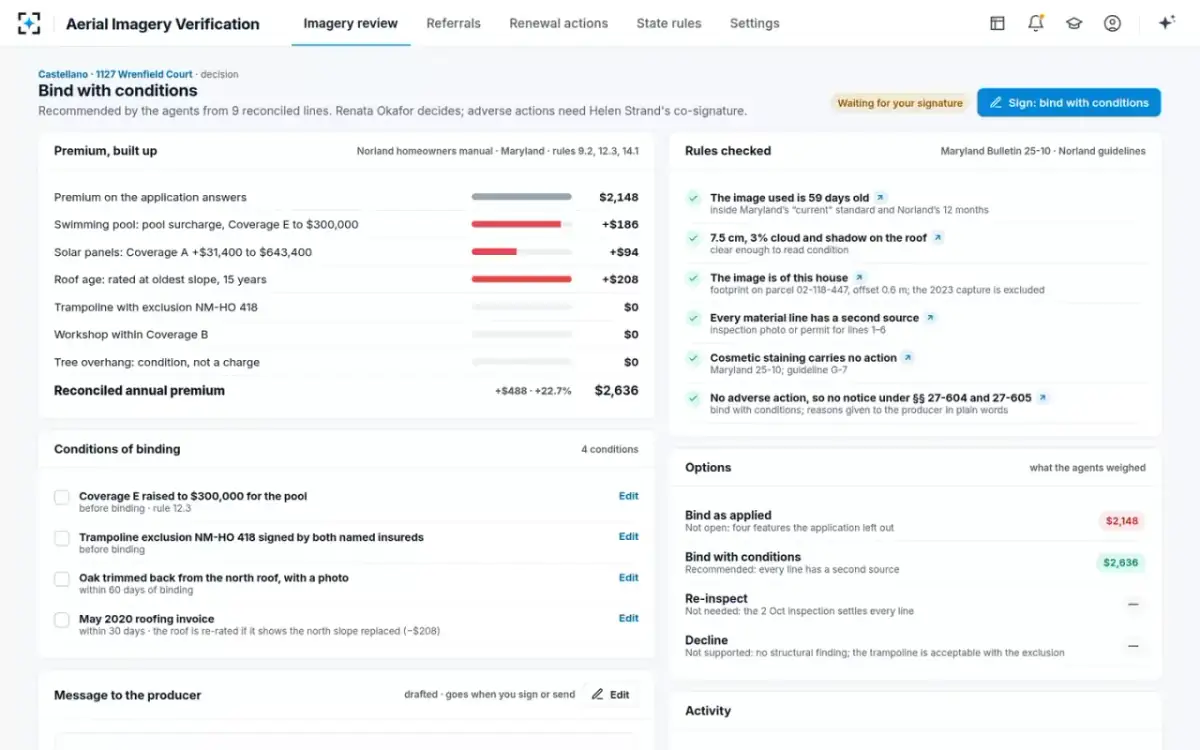
The three lines that move the premium move it for different reasons. The pool adds a hazard and needs a higher liability limit. The solar array adds value to insure. The roof changes the expected loss on the dwelling itself. The zero lines matter as much: the trampoline is priced through an exclusion, the oak through a condition, and the streaks through nothing at all, because on the sample carrier a cosmetic finding moves neither the premium nor any action.
Why insurers price trampolines and pools at all: the liability side
Insurers care about trampolines because people get hurt on them, and a homeowners policy pays for injuries to visitors. The American Academy of Pediatrics, in its policy statement on trampolines, found that "Most trampoline injuries occur with multiple simultaneous users on the mat", that safety measures in use "have not appeared to mitigate risk substantially", and concluded: "Therefore, the home use of trampolines is strongly discouraged" (AAP policy statement, 2012).
That is why the rule a carrier files tends to be an exclusion or a decline rather than a modest surcharge. A surcharge prices an exposure the carrier is willing to carry; an exclusion removes it. For the homeowner the answer to the search question is the same, no increase, with a very different policy behind it.
How does a pool affect homeowners insurance? A surcharge and a higher limit
A pool can affect homeowners insurance twice: a surcharge for the hazard and a higher minimum for the personal liability limit. On the sample file the carrier's rule 12.3 adds a $148 pool surcharge and requires personal liability (Coverage E) of at least $300,000. The application asked for $100,000, and raising it adds $38. Together, +$186 a year.
The pool was not a guess. It shows on the August 2026 capture as an in-ground pool 16 by 32 feet, on the April 2025 capture, in the inspector's photo 12 with a 4-foot aluminium fence and a self-latching entry and no diving board or slide, and in a county pool permit from June 2019. The underwriter still asks the agency to confirm there is no diving board or slide, because a manual's pool rule often turns on them. Whether a homeowner has to tell the insurer about a pool at all is the subject of the undisclosed pool, from the application to the correction.
Do solar panels increase homeowners insurance? The dwelling limit, not a surcharge
Roof-mounted solar panels raise homeowners insurance mainly by raising what is insured. The array is part of the house, so the dwelling limit (Coverage A) rises to cover rebuilding it. On the sample file the 22-panel array, permitted in March 2022, raises Coverage A by $31,400, from $612,000 to $643,400, which adds $94 a year.
Solar raises one question an image cannot answer: who owns the array. The inspector's photo 19 shows the inverter on the east wall with no lessor or financing label. A leased array may belong to the leasing company and be insured by it, which would change the dwelling limit back. So the third of the underwriter's four questions to the agency is simply: "Is the 22-panel array owned or leased?"
The roof that was half as old as stated: the largest line
Roof age was the largest line on the sample file, +$208, and it was not a lie on the application. The applicants said 2020. The south slope was replaced after hail in May 2020; the north slope dates from a full roof in June 2011 and the inspector put it at 13 to 16 years. The sample carrier's rule rates a roof with slopes of different ages at its oldest slope, here 15 years.
The decision keeps the door open. One condition of binding asks for the May 2020 roofing invoice within 30 days; if it shows the north slope was replaced too, the roof is re-rated and the $208 comes off. A roof finding priced this way is a number the homeowner can change with a document, which is very different from a roof finding that ends the policy. In Florida, roof age also carries legal limits on refusing to write or renew, set out in Florida's 15-year roof rule.
The premium built up from the manual, line by line
The first error: premium short, every year the policy renews
A feature the application left out is premium short every year until someone finds it. On the sample file that is $488 a year on one policy. Across a book, the cost is that figure times the share of policies with an undisclosed feature, compounded by every renewal that does not look. We found no regulator or academic estimate of how common undisclosed features are, so a carrier has to measure its own; the replay described in testing an aerial imagery underwriting tool on closed referrals is one way.
Premium short is also a rating error, not only lost revenue. The market conduct standards examiners work from test whether the rate charged matches the filed rates or the insurer's rating plan (NAIC examination standards). A policy rated without its pool is rated outside the filed plan, which is an examiner's finding as well as a revenue gap.
The second error: an image misread, and a hearing to defend
The opposite error costs more per file. An image read as a worn roof when the shingles are only stained, or as a pool when it is a tarpaulin, leads to a surcharge, a nonrenewal or a cancellation the insurer must then defend. Colorado's 2026 bulletin counts more than nonrenewals as adverse actions; its list runs to "underwriting or eligibility determinations, tier placement or rating impacts, coverage limitations or restrictions, nonrenewals, cancellations, and claim denials or reductions" (Colorado Bulletin B-5.57). An August 2026 draft revision proposes to remove rating from the bulletin's scope; until it is adopted, the March text stands (Colorado request for comment).
The defence is expensive because the burden sits with the insurer. Pennsylvania reminds insurers that "An insurer must prove not only that the risk has increased but that the increase has been substantial" (Pennsylvania Notice 2024-06). In Maryland, a homeowner who requests a hearing is entitled to review the images the insurer relied on, and the insurer carries the burden of persuasion (Maryland Bulletin 25-10). Maine says that where a change in insurability is the reason for a nonrenewal, the insurer will need recent evidence to carry its burden, and older imagery will often not do (Maine Bulletin 483).
Two errors, one cause: nobody lined the sources up
Feature missed: A pool, trampoline, array or older roof is left off the price.
Image misread: Stains, shadows or a neighbour’s roof are read as a condition.
Feature missed: The insurer, every year, in premium short of the filed rate.
Image misread: The homeowner first, in a surcharge or a lost policy; then the insurer, in a hearing.
Feature missed: At renewal if someone looks; after a loss if nobody does.
Image misread: When the homeowner disputes, complains or asks for a hearing.
Feature missed: An image and a permit set against the application.
Image misread: An inspection photo and a parcel check set against the image.
Feature missed: Four features and a roof slope: +$488 a year.
Image misread: Streaks read as cosmetic, not wear; a 2023 capture of the neighbour’s house excluded.
Who finds the error, and what it costs at each stage
The cost of a mismatch depends mostly on who finds it. Found by the underwriter at the referral, it is one message to the agency. Found at renewal, it is a year of premium short and an awkward conversation. Found after a loss, it is a dispute while the homeowner is already having a bad year. And a misread image found by the homeowner becomes a complaint or a hearing.
The same mismatch, priced by who finds it
1
At the referral
Homeowners underwriter
One message to the agency and a premium right from the first day. On the sample file: four questions, four conditions, $2,636 instead of $2,148.
2
At the first renewal
Renewal underwriter
A year of premium short ($488 on the sample file), a mid-term question to an insured who thought the price was settled, and a rate the filed manual did not allow.
3
After a loss
Claims
The undisclosed pool or trampoline becomes a question about the application while a claim is open: a costly place to find it, for both sides.
4
At a hearing
Underwriting manager and counsel
An adverse action that rested on a misread image, defended before the regulator with the insurer carrying the burden, and the policyholder entitled to see the images.
What reconciliation costs against what it finds
Lining every source up by hand is slow, which is why it is skipped. Botminds estimates an imagery referral takes about 70 minutes by hand: 10 reading the application and file, 20 finding, matching and measuring the captures, 15 reading the inspection report and photos, 8 checking permits and property data, 12 pricing the mismatches and writing to the agency, and 5 deciding and signing. With the agents doing the reading, the design target is about 11 minutes, of which 3 are still the underwriter's decision and signature. Those are estimates for the solution's design, not measured results.
The lines that cost nothing, and why
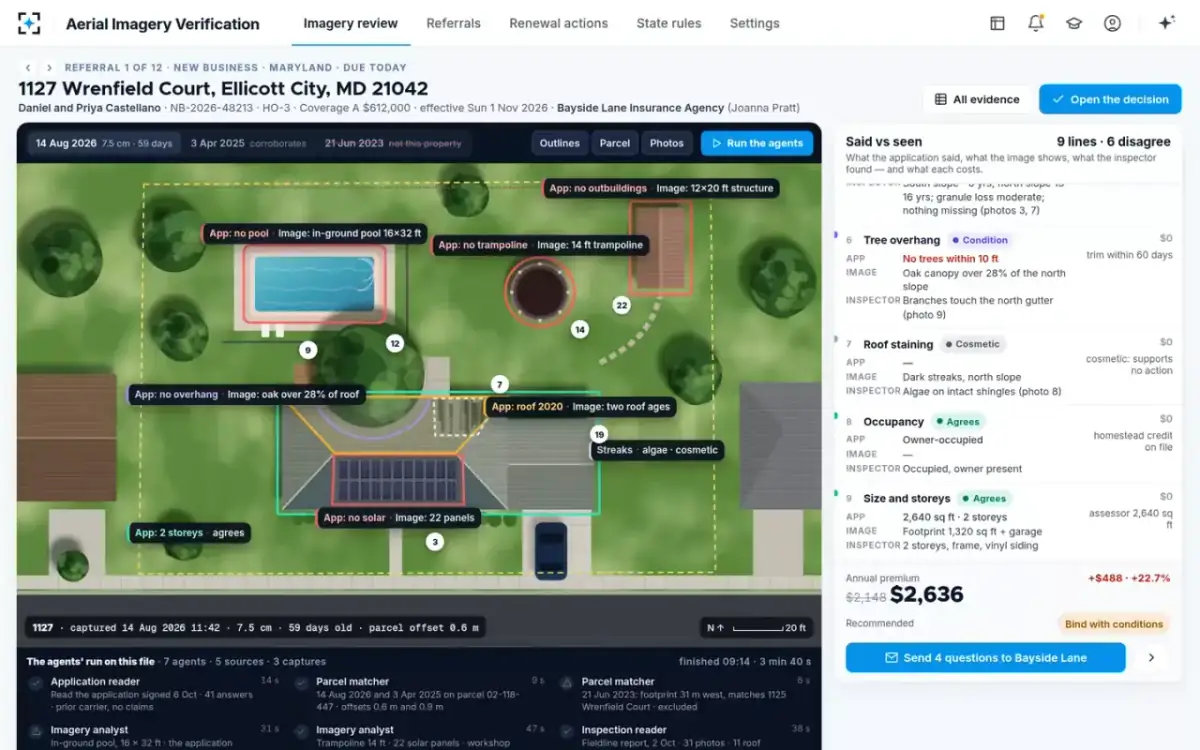
The arithmetic is simple to run on your own book. One sample file found $488 a year in about 11 minutes of underwriter time on the solution's estimate, against about 70 by hand. Whether that holds across a book depends on how often your applications leave features out, which is the number to measure first. The full referral, screen by screen, is on the Aerial Imagery Verification page.
Questions people ask
What is a homeowners insurance trampoline exclusion?
Typically an endorsement that removes injuries involving the trampoline from the policy's liability coverage, signed instead of paying a surcharge or removing the trampoline. On the sample file it is form NM-HO 418, and both named insureds must sign it before binding. Read the form itself: its wording, not the name, decides what is excluded.
What is the price of homeowners insurance with a pool?
It depends on the insurer's filed manual and on the liability limit you need. On the sample file the pool added $186 a year: a $148 surcharge and $38 to raise personal liability from $100,000 to the $300,000 the carrier requires with a pool. Other carriers price pools differently, and fences, diving boards and slides often change the answer.
Will my premium go down if I remove the trampoline?
If your insurer surcharges trampolines, removing it should remove the surcharge; if it excludes them, removing it removes the need for the exclusion. On the sample file removal before the start date was offered as the alternative to signing the exclusion. Tell the insurer, with a photo, so the file shows it.
Does a detached workshop or shed increase homeowners insurance?
Often not, if it fits within the other-structures limit (Coverage B). On the sample file the 12 by 20 foot workshop sat within a Coverage B limit of $64,340 and added nothing. A large building, or one used for a business, can change the answer, which is why the inspector noted the hand tools and the absence of business use.
Can a misread aerial image raise my premium?
It can, and Colorado treats a rating impact supported by aerial imagery as an adverse action that should not rest on the image alone. If a surcharge or a nonrenewal cites an image, ask for the image, its date and the evidence that confirmed it. Several states, including Maine and Tennessee, call giving homeowners copies of the images best practice.