If a homeowners insurance application asks whether there is a pool, the answer has to be accurate, because the answers on an application are representations the insurer prices and writes the policy on. A pool is the kind of fact that matters: it changes the liability the policy carries, and an insurer's manual may surcharge it or require a higher liability limit. Florida's law, for example, lets a misstatement or omission prevent recovery under a policy if it is material to the risk, or if the insurer would not have issued the policy at the same premium had it known. Insurers also find undisclosed pools on their own, on aerial images, inspection photos and county permits. What should follow is a correction, the right premium and the right limit, rather than a cancellation. Botminds' Aerial Imagery Verification, a homeowners underwriting solution, is built that way: a pool seen on one source is a question to ask the agent, and a pool confirmed by several is a correction to price.
This page explains how the rules and the underwriting work; it is not legal advice. The example is a fictional sample file in the solution, with invented people and figures.
One undisclosed pool, five places it shows up
Application, signed 6 Oct 2026
No pool
Aerial capture, 14 Aug 2026
In-ground pool, 16 × 32 ft
Aerial capture, 3 Apr 2025
Pool present
Inspection photo 12, 2 Oct 2026
4 ft aluminium fence, self-latching; no diving board or slide
County permit P19-00352
Pool permit, June 2019
Do you have to tell homeowners insurance about a pool?
If the insurer asks, yes: the answer must be true. Florida's statute puts the principle in plain terms: what an applicant states on an application, or in negotiating a policy, is a representation, not a warranty (Fla. Stat. §627.409). A representation does not have to be perfect; it has to be true where it matters, and a pool is the kind of fact that does.
Applications like the sample file's ask about pools, trampolines and outbuildings because each changes the risk the policy carries for injuries to visitors. A homeowner who adds a pool after the policy starts is in the same position at the next renewal, when the insurer may see it from the air or in an inspection. The cheapest moment to mention it is before the insurer finds it.
How insurers find out about a pool: four sources against one application
Insurers find undisclosed pools the way they find most undeclared features: by setting the application against sources that do not depend on the applicant's memory. A pool is the easiest feature to see from the air, and it leaves a paper trail in the county's permit records. On the sample file, four sources showed the pool the application left out, and they did not all show the same things.
What each source showed of the nine attributes on one sample application
Application, signed 6 Oct 2026
- agreed with the evidence · 22%
- contradicted by it · 67%
- not asked · 11%
Aerial capture, 14 Aug 2026
- showed the attribute · 89%
- cannot show it (occupancy) · 11%
Exterior inspection, 2 Oct 2026
- showed the attribute · 100%
Permits and property data
- showed the attribute · 67%
- silent · 33%
The split explains why no single source should decide. The capture saw almost everything but cannot tell whether anyone lives in the house or whether a pool has a diving board. Permits record what was built with permission, not what was built. The inspection saw everything, but only because someone was sent; it is the most expensive source and usually the last to arrive. Together they leave little room for doubt about the pool.
Why insurers ask about pools: liability, not the water
Insurers ask about pools because of the injuries that can happen around them, which a homeowners policy's personal liability coverage pays for. The numbers behind the concern are stark. The Centers for Disease Control and Prevention reports that "More children ages 1–4 die from drowning than any other cause of death", and an average of 4,083 unintentional drowning deaths a year in the United States from 2012 to 2021 (CDC).
That is why a pool rule can work through the liability limit as well as the price. On the sample carrier's manual, rule 12.3 adds a $148 pool surcharge and requires personal liability coverage of at least $300,000; the application had asked for $100,000, and raising it adds $38. The pool's total effect is +$186 a year. The rule also cares about details only an inspector sees, which is why the underwriter asked the agency to confirm there is no diving board or slide. What every undisclosed feature on the file cost is set out in does a trampoline increase homeowners insurance.
What counts as material? Florida's test for a misrepresentation
A misrepresentation is material when the truth would have changed the insurer's decision about the risk or its price. Florida's statute spells out when a misstatement, omission or concealment "may prevent recovery under the contract or policy": when it is fraudulent, when it matters to whether the insurer accepts the risk or to the hazard it takes on, or when, had the insurer known the true facts, it would in good faith not have issued the policy, not at that premium, not for that amount, or not with cover for the hazard that caused the loss (Fla. Stat. §627.409).
A pool can meet the premium test on its face: on the sample file it changes the rate by $186 and the liability limit by $200,000. That is why the stakes of an omitted pool are highest after a loss, when the question is no longer the premium but whether the policy responds. The same section sets the bar that protects homeowners, too: an innocent, immaterial misstatement does not, by itself, prevent recovery.
Rescission, cancellation or a corrected premium: what can follow
Three outcomes are possible when an undisclosed pool is found, and the right one depends on when it is found and how much it mattered. Before binding, the answer is a corrected premium and a condition. During the term, some states allow cancellation for material misrepresentation: Connecticut's advisory lists it among the limited reasons for cancelling a policy in force at least 60 days (Connecticut advisory), and Delaware's statute limits mid-term cancellation to listed circumstances (Delaware Bulletin No. 150).
Rescission, treating the policy as if it never existed, is the remedy regulators watch most closely. The market conduct standard examiners apply reads: "Rescissions are not made for non-material misrepresentation" (NAIC examination standards). And any adverse action has to say why: in Florida, a nonrenewal or cancellation notice must state its specific reasons, underwriting reasons among them (Fla. Stat. §627.4091), and a residential policyholder is owed at least 120 days' written notice of a nonrenewal (Fla. Stat. §627.4133).
One source is a question; four sources are a correction
The safest rule for an underwriter is to count sources before acting. A pool on one image is a question: the image may be old, of the wrong house, or of a pond, a tarpaulin or a pool since filled in. A pool on an image, a second capture, an inspection photo and a permit is a fact, and the right response is to price it. Neither is a reason to cancel.
The same undisclosed pool, seen once or seen four times
One source: A pool on one aerial capture, nothing else yet.
Four sources: Two captures, inspection photo 12 and permit P19-00352.
One source: An old image, a neighbour’s pool, a pond, a cover, a pool since filled.
Four sources: A pool, fenced, with no diving board, permitted in 2019.
One source: A question to the agent, with the image crop attached.
Four sources: A corrected premium and liability limit, as a condition of binding.
One source: A surcharge, decline, cancellation or nonrenewal.
Four sources: A cancellation: the pool is priced, not punished.
One source: A Pennsylvania referral where a pool was seen and not yet inspected: a question to the producer.
Four sources: The Castellano file: +$186 and Coverage E raised to $300,000 before binding.
The rule protects the insurer as much as the homeowner. Maine records complaints of images that showed a neighbour's building rather than the insured one (Maine Bulletin 483), and Maryland says a blurred, low-resolution or old image does not give a clear and accurate view of the property (Maryland Bulletin 25-10; the states' tests are compared in the aerial imagery laws by state). A surcharge on a pool that turns out to be the neighbour's is a refund, an apology and a complaint.
Do I have to tell insurance about an above ground pool?
The application's wording decides. If it asks about "a pool" or "a swimming pool", an above-ground pool is a pool; if it asks only about in-ground pools, it may not be, and an agent should ask before answering. The liability concern that makes insurers ask about pools does not depend on whether the water is above or below ground, so a manual's pool rule may well cover both.
Changes run both ways. On the sample carrier's books a Connecticut renewal shows a pool filled in during 2025; the inspection confirmed it, and the pool surcharge came off, $164 a year in the policyholder's favour. A homeowner who removes a pool or a trampoline has a reason to tell the insurer too.
Insurance found a pool not disclosed in Florida: what the law says next
In Florida, what follows depends on timing and materiality. Before the policy is issued, the insurer can price the pool or decline the application, and a declined applicant must be told the specific reasons for the denial, underwriting reasons included (Fla. Stat. §627.4091). After it is issued, the insurer may correct the premium at renewal, give at least 120 days' notice of a nonrenewal with its reason, or, after a loss, argue that the omission was material under §627.409.
The materiality test cuts both ways. If the insurer's own manual would have written the house at a higher premium, the omission was material to the premium. If it would have written the house on the same terms and at the same price, the premium test is not met. That is a reason for a homeowner to keep the application honest and for an insurer to price what it finds rather than reach for a cancellation.
When the underwriter finds the pool first
When the underwriter finds the pool before binding, the fix is a message, not a letter. On the sample file the agents found the pool, confirmed it on four sources and priced it; the underwriter then sent one message to the agency with all four questions the file raised, the pool first: confirm there is no diving board or slide, and that the insureds accept personal liability of $300,000. The image crops and inspection photos went with it.
The undisclosed pool, raised with the agency before binding
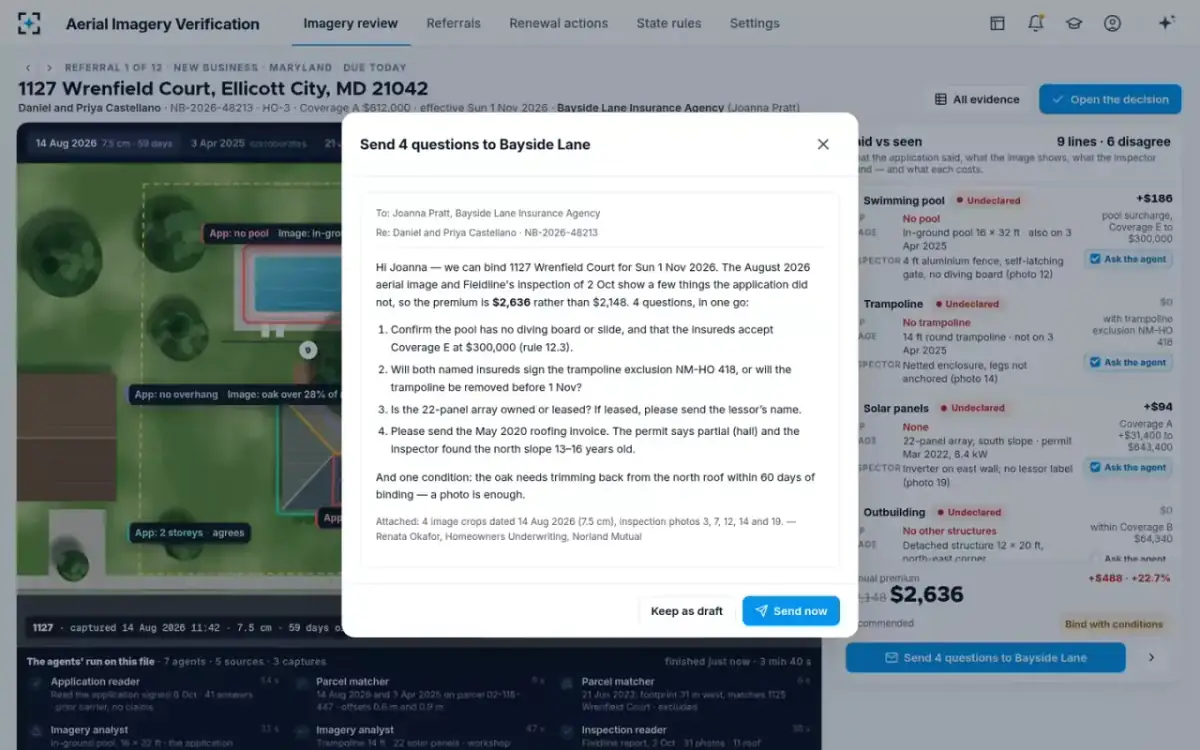
The Coverage E increase became a condition of binding rather than a reason to decline. The decision screen lists it first among four conditions, and "decline" is marked not supported because nothing on the file was structural. The pool was priced, not punished.
The pool row: one application against four sources
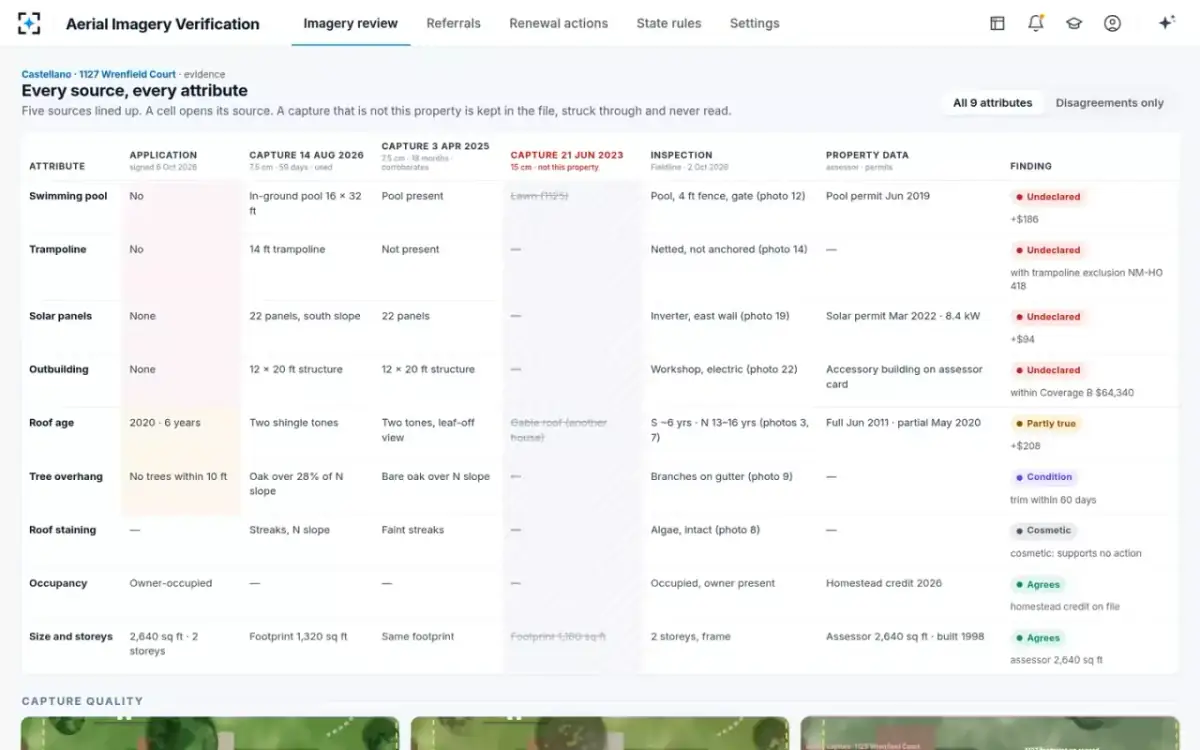
For agents completing applications: the questions that prevent the mismatch
An undisclosed pool need not be a lie; it can be a question nobody asked carefully. The agent filling in an application is the cheapest point at which to get the answer right, and a few direct questions do it.
Questions an agent can ask before submitting a homeowners application
- Is there a pool, of any kind, on the property?
In-ground, above-ground or inflatable left up all season; ask how the application defines a pool.
- How is it fenced, and is there a diving board or slide?
Pool rules often turn on these details, and an image cannot show them.
- Is there a trampoline, and is it enclosed and anchored?
Some manuals exclude trampolines; the exclusion needs signatures before binding.
- Any outbuildings, and what are they used for?
A workshop with its own electric service is a different risk from a garden shed.
- Solar panels: owned, leased or financed?
Ownership changes what the dwelling limit should cover.
- When was each part of the roof replaced?
Partial replacements are common; one date can be half right.
- Has anything been added or removed since the last renewal?
A pool filled in lowers the premium as surely as a pool added raises it.
How an inspector checks these same features from the ground is in the homeowners insurance inspection checklist. The solution is on the Aerial Imagery Verification page.
Questions people ask
Is my pool covered by homeowners insurance?
That depends on your policy's terms, and the pool's main effect is usually on the liability side: on the sample file it added a surcharge and raised the personal liability limit to $300,000. Whether damage to the pool itself is covered, and under which part of the policy, is in your declarations and policy form; ask your agent to show you.
Will my homeowners insurance go up if I tell them about my pool?
It may, by the amount the insurer's filed manual sets for a pool and any higher liability limit it requires. On the sample file that was $186 a year. Telling the insurer first means paying that from the start rather than in a correction later, and keeps the application accurate if you ever need to claim.
Can an insurer cancel my policy for not disclosing a pool?
In some states, during the term, for a material misrepresentation: Connecticut lists material misrepresentation among the limited reasons for cancelling a policy in force at least 60 days. The examination standard regulators use says rescissions are not made for non-material misrepresentation, and a notice must give specific reasons.
What is a material misrepresentation in insurance?
A false or incomplete statement that would have changed the insurer's decision: whether to accept the risk, what to charge, how much to cover, or whether to cover the hazard that caused a loss. Florida's statute, §627.409, sets out that test; an immaterial, innocent misstatement does not by itself prevent recovery under the policy.
What if I filled in my pool?
Tell the insurer, with a photo or the contractor's invoice. On the sample carrier a Connecticut renewal with a pool filled in during 2025 had its pool surcharge removed after an inspection confirmed it, saving the policyholder $164 a year.