A homeowners insurance inspection checklist covers five groups of lines: the dwelling (size, storeys, construction), occupancy, the roof (covering, age slope by slope, condition), hazards (trees over the roof, debris, damage left unrepaired) and liability features (a pool, a trampoline, outbuildings). In Florida the four-point and wind mitigation forms add the plumbing, electrical and heating systems and the roof's wind features. Each line on the report answers a question the application asked, and the lines that matter to the underwriter are the ones where the two answers differ. Botminds' Aerial Imagery Verification reads an inspection report that way: its inspection reader classifies every roof observation as bearing on the risk or cosmetic, cites the photo, and sets each line beside the application and the aerial image so the underwriter sees only what disagrees and why.
The annotated report on this page comes from a fictional sample file in the solution: an exterior inspection of 1127 Wrenfield Court, Ellicott City, Maryland, by an invented inspection firm for an invented carrier. Names and figures are sample data.
Conditions such as roof ponding, incomplete patching or tarping covering the roof would generally support taking underwriting action.
Connecticut Insurance Department, notice to homeowners insurers, March 2024
What is on a homeowners insurance inspection checklist? Five groups of lines
The checklist is the application, verified from outside the house. Dwelling lines check size, storeys and construction against what the applicant declared and the assessor holds. Occupancy lines check that someone lives there as declared. Roof lines check the covering, the age of each slope and its condition. Hazard lines check what makes a loss likely, from branches on the gutter to unrepaired damage. Liability lines check the features that change what the policy pays for injuries to others.
Two things make a checklist useful rather than a form. Every observation should cite a numbered photo, so anyone who reads the report later can see what the inspector saw. And every observation should say whether it bears on the risk or is cosmetic, because the rules for acting on the two are different, as the Connecticut notice above makes plain. Ponding, patching and tarpaulins are conditions. Streaks are not.
The report, annotated: each line against the application
Read against the application, the sample report's ten lines fall into four kinds: two agree, two are partly true, two are a condition or cosmetic, and four are features the application left out. The annotation in the right-hand column is all an underwriter needs from the report; the rest is the evidence behind it.
One exterior inspection report, every line set against the application
Dwelling
The inspector wroteTwo storeys, frame, vinyl siding
The application said2,640 sq ft, 2 storeys
FindingAgrees: assessor 2,640 sq ft
Occupancy
The inspector wroteOccupied, owner present
The application saidOwner-occupied
FindingAgrees: homestead credit on file
Roof, south slope
The inspector wroteAbout 6 years, uniform (photo 3)
The application saidRoof 2020
FindingPartly true: matches the May 2020 permit
Roof, north slope
The inspector wrote13 to 16 years; granule loss moderate; no missing or lifted tabs (photo 7)
The application saidRoof 2020
FindingPartly true: roof rated at its oldest slope, 15 years
Roof surface
The inspector wroteDark streaks are algae on intact shingles (photo 8)
The application saidNot asked
FindingCosmetic: supports no action
Trees
The inspector wroteBranches rest on the gutter over about a quarter of the north slope (photo 9)
The application saidNo trees within 10 ft
FindingCondition: trim within 60 days
Pool
The inspector wroteIn-ground; 4 ft aluminium fence, self-latching; no diving board or slide (photo 12)
The application saidNo pool
FindingUndeclared: surcharge and higher liability limit
Trampoline
The inspector wrote14 ft; netted enclosure; legs not anchored (photo 14)
The application saidNo trampoline
FindingUndeclared: exclusion or removal
Solar
The inspector wroteInverter on the east wall; no lessor or financing label (photo 19)
The application saidNone
FindingUndeclared: dwelling limit up; owned or leased?
Outbuildings
The inspector wrote12 × 20 ft workshop with its own electric service; no business use (photo 22)
The application saidNo other structures
FindingUndeclared: within the other-structures limit
On this file the dwelling and occupancy agree, the roof is partly right, and the backyard is where the application falls short. Seven of the ten report lines need the underwriter, and they cover the six attributes where the application was wrong; the other three, two that agree and one cosmetic, can be read and set aside. A checklist that puts the mismatches first saves the underwriter from reading 31 photos to find the six that matter.
Insurance company roof inspection checklist: covering, age by slope and condition
An insurance company's roof checklist asks three things: what the roof is made of, how old each part of it is, and whether its condition bears on the risk. Connecticut's insurance department gives homeowners a plain version of what insurers commonly consider. On age, asphalt, wood, rubber and similar materials "often have eligibility limits that vary by insurer, commonly in the 15 to 20-year range", architectural shingles "may be eligible for longer periods, often 25 years or more", and "Tile and slate roofs are generally considered lifetime materials" (Connecticut advisory).
On condition, the same advisory lists "Missing, lifted, curled, cracked, or deteriorated shingles", "Multiple layers of roofing material", "Unrepaired damage or excessive debris, including moss buildup" and "Overhanging tree limbs that may increase the risk of damage". A good report puts each slope on its own line, because roofs are replaced in parts. The sample roof is the proof: a south slope replaced after hail in 2020 and a north slope from 2011, under an application that said 2020.
Hazard lines: trees, debris and what is left unrepaired
Hazard lines record what makes a loss more likely without being a defect in the house itself: a limb resting on the gutter, debris in the valleys, a fence down, damage from a past storm still unrepaired. They matter because most can be fixed, and fixing them is often the insurer's preferred outcome. Maine encourages insurers to send loss control recommendations and give homeowners a reasonable time to repair before reaching for nonrenewal (Maine Bulletin 483).
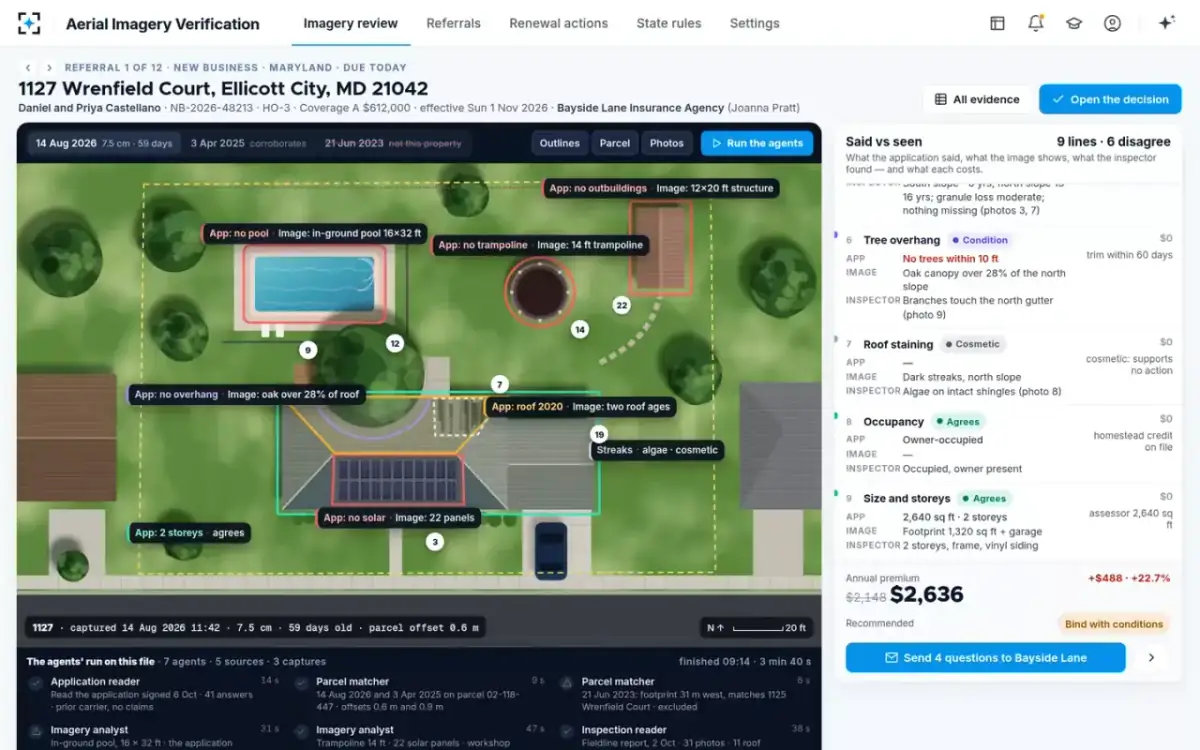
On the sample report the only hazard is an oak whose branches rest on the north gutter over about a quarter of that slope. The aerial capture showed the canopy over 28% of the slope; the inspector's photo 9 showed contact. It became a condition of binding with a deadline, trim within 60 days and send a photo, and added nothing to the premium.
Liability lines: pools, trampolines and outbuildings
Liability lines are where applications most often fall short, because homeowners do not think of a pool or a trampoline as part of the house. The checklist asks for each feature's existence and its details: for a pool, whether it is in-ground, how it is fenced and whether there is a diving board or slide; for a trampoline, its size, whether it has an enclosure and whether it is anchored; for an outbuilding, its size, its services and what it is used for.
The details are what an aerial image cannot supply. The sample capture showed a 16 by 32 foot pool, a 14-foot trampoline, a 12 by 20 foot structure and 22 solar panels. Only the inspector could add the fence height and the self-latching entry, the missing diving board, the unanchored legs, the workshop's own electric service and the inverter without a lessor's label. What each of those lines does to the price is set out in does a trampoline increase homeowners insurance.
Dwelling and occupancy: the lines that usually agree
Dwelling and occupancy lines usually agree with the application, and they are still worth checking because the cost of a mismatch is high. An occupancy answer that turns out wrong goes to whether the policy fits the house at all, and an examiner checks that the rate charged matches the filed rates or the insurer's rating plan (NAIC examination standards).
On the sample report both agree. The house is two storeys and 2,640 square feet, as the application and the assessor say, and it is occupied by its owners, which the county's 2026 homestead credit confirms. The inspector's job on these lines is to confirm in a sentence and move on.
What each line of the report must state, and the application answer it checks
| Report line | What it must state | Application answer it checks |
|---|---|---|
| Dwelling | Storeys, construction, siding, approximate area; photo of each side | Square footage, storeys, construction type, year built |
| Occupancy | Signs of occupancy; whether an occupant was present | Owner-occupied, tenant-occupied or vacant |
| Roof covering and age | Material and estimated age for each slope; photo of each slope | Roof material and year of the last replacement |
| Roof condition | Each observation, its location, its photo, and whether it is cosmetic or bears on the risk | Known damage or prior roof claims |
| Hazards | Trees over or touching the roof, debris, unrepaired damage, each with a photo | Trees within a set distance; known hazards |
| Liability features | Pool and its fencing, diving board or slide; trampoline, enclosure, anchoring; animals if seen | Pool, trampoline and similar questions |
| Outbuildings | Size, services, use, each with a photo | Other structures on the property |
| Solar and similar | Location, size, labels showing a lessor or lender | Additions and improvements; ownership |
Homeowners insurance inspection checklist for Florida: the four-point and wind mitigation lines
Florida adds two inspections to the exterior checklist, and each has its own lines. The four-point inspection covers roofing, electrical, plumbing and heating and cooling; Florida's Insurance Consumer Advocate lists the photos the report should include: each side of the home, each slope of the roof, the water heater and plumbing under the sinks with exposed valves, the open electrical panels, the heating and cooling equipment with its dated manufacturer's plate, and any noted hazards (Florida Department of Financial Services).
The wind mitigation inspection records the features Florida law says earn windstorm discounts: how well the roof resists uplift, how strong the roof, its covering and its connections to the walls and foundation are, and how the openings, windows, doors and skylights are protected (Fla. Stat. §627.0629). It is recorded on the state's uniform form, OIR-B1-1802, which the Office of Insurance Regulation updated effective 1 April 2026 and says "is valid for up to five (5) years provided no material changes are made to the structure or inaccuracies are found on the form" (Florida OIR). How the two forms differ is set out in 4 point inspection vs wind mitigation.
How to prepare for a home insurance inspection
Preparing for an inspection is mostly about making each line easy to see and easy to prove. The inspector needs a clear view of every side and every roof slope, and the homeowner is the person who knows which parts of the roof were replaced when. Connecticut's advice to homeowners whose insurer raises a roof concern applies equally before a visit: "Provide documentation, such as receipts or contracts, if repairs or replacement have been completed or scheduled" (Connecticut advisory).
Before the inspector arrives: a homeowner's checklist
- Re-read your application answers
Roof year, pool, trampoline, outbuildings, occupancy. A mismatch is easier to explain before the report than after.
- Find the roof paperwork
Invoices and permit numbers for each replacement, by slope if the roof was done in parts.
- Clear the view
Side yards open and unlocked, vehicles moved from in front of the house, access for a ladder if needed.
- Deal with the easy hazards
Debris off the roof and out of the gutters; branches off the roof where you safely can.
- Check the pool and trampoline details
Fence height, self-closing and self-latching entries, whether the trampoline is anchored and enclosed.
- In Florida, have the four-point items reachable
Water heater, electrical panel, heating and cooling equipment and its data plate.
- Have your wind mitigation form ready if you have one
Florida’s form is valid for up to five years if nothing material has changed.
- Ask for the report and photos
You will want them if a notice later relies on what the inspector saw.
What the inspection reader does with each line
In Aerial Imagery Verification an agent called the inspection reader reads each report and its photos as soon as it arrives. It reads the inspection firm's report, the photos and any roof or wind mitigation certificates, classifies each roof observation as bearing on the risk or cosmetic, and writes a margin note against each photo saying what it settles. On the sample file it read 11 roof observations and marked 2 as bearing on the risk: moderate granule loss on the north slope and branch contact at the gutter.
It has two limits, and both protect the homeowner. It cites the photo number for every observation, so nothing in the decision rests on a sentence nobody can check. And it never upgrades a cosmetic observation: algae on intact shingles stays cosmetic, whatever the aerial image looked like. A person can reclassify a line, with the change on the audit trail; the agent cannot.
Every roof observation classed, every photo noted
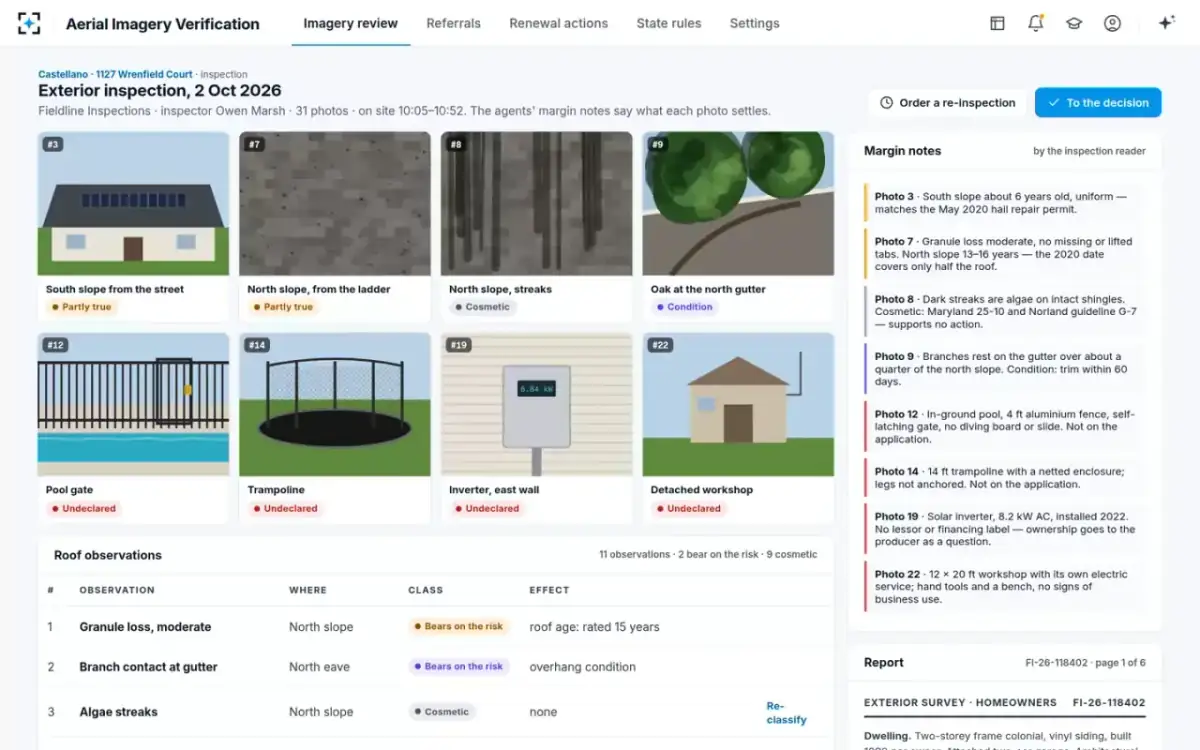
Each line then joins the said-vs-seen list for the referral, priced from the carrier's manual, with the inspection photo beside the aerial crop. The streak line shows how the two are used together: the capture shows dark streaks, the photo shows algae on intact shingles, and the line carries no effect.
The inspector's lines, set beside the image and priced
Inspectors themselves, and everyone else who reads their work, are the subject of what home insurance inspectors look for, and who reads the report. The whole referral is on the Aerial Imagery Verification page.
Questions people ask
Is there a homeowners insurance inspection checklist PDF?
Insurers and inspection firms use their own forms, so there is no single official checklist for an exterior homeowners inspection. For Florida's four-point inspection, the state's Insurance Consumer Advocate publishes a guide listing the photos the report should include. The homeowner's checklist on this page can be printed as it stands.
What is an exterior inspection for home insurance?
A visit in which an inspector photographs and describes the outside of the house for the insurer: each side, each roof slope, hazards and features such as pools and outbuildings. It does not need access inside. The sample visit on this page took 47 minutes and produced 31 photos and 11 roof observations.
What should I expect at a home insurance inspection?
Expect an inspector to walk around the house, photograph it from every side, look at or climb to the roof, and note any pool, trampoline or outbuilding. Expect the report to go to the underwriter; ask if you want a copy. If the report leads to a condition, such as trimming a tree, expect a deadline rather than an immediate cancellation.
How long is a home inspection report valid for insurance?
It depends on the report and the insurer. Florida's consumer guide says a four-point report generally must be dated within 30 days before the application, though each insurer sets its own window; Florida's uniform wind mitigation form is valid for up to five years if nothing material has changed. Exterior underwriting reports usually serve the decision they were ordered for.
What if the inspection report is wrong about my roof?
Send what proves the difference: the invoice or permit for the replacement, or a report from a licensed roofer. Connecticut gives a licensed roofer's or contractor's report submitted by the policyholder as an example of the guardrails it expects in insurers' filed guidelines, and its 2026 advisory says many insurers will review updated information when inspection data is outdated or incomplete.