A 4-point inspection and a wind mitigation inspection are two different Florida home inspections with two different jobs. The 4-point inspection looks at the roof, electrical, plumbing and heating and cooling systems to help an insurer decide whether it will write or renew an older home at all. The wind mitigation inspection records the roof and opening features that resist hurricane winds, on the state's uniform form, so the policy gets the windstorm discount those features earn. One answers "will you insure it?", the other "what will it cost?". Reading one as if it were the other is a pricing error in either direction. Botminds' Aerial Imagery Verification, a homeowners underwriting solution, reads inspection reports and roof and mitigation certificates beside the aerial image, the permits and the application, so each form is used for the decision it was made for.
Two Florida inspections, two questions
4-point inspection
Will the insurer write or renew this home?
Roof, electrical, plumbing and heating and cooling: their type, age and condition. A failing system can mean repairs before a policy is issued.
Wind mitigation inspection
What windstorm discount does this home earn?
Roof covering, roof-to-wall connections, opening protection and the other features Florida law says reduce wind losses, on the state's uniform form.
4 point inspection vs wind mitigation: what each one decides
The 4-point inspection decides insurability; the wind mitigation inspection decides price. Florida's Insurance Consumer Advocate describes the four-point as "a specialized evaluation of a property commonly required by homeowners insurance companies in Florida when issuing or renewing a policy", whose "primary purpose is to assess the condition and safety of these systems to determine a property’s insurability" (Florida Department of Financial Services).
The wind mitigation inspection exists because the law requires discounts. Every residential property rate filing in Florida has to carry discounts, credits or deductible reductions, set on an actuarial basis, for homes with fixtures or construction techniques shown to reduce windstorm losses (Fla. Stat. §627.0629). The inspection is how an insurer learns which of those features a house has.
The difference shows in who sets the form. The wind mitigation form is the state's: §627.711 has the Financial Services Commission adopt one uniform mitigation verification form, and every insurer must use it when a policyholder submits it to claim wind discounts (Fla. Stat. §627.711). We found no statute or rule prescribing a four-point form; the consumer guide says insurers have their own criteria for each of the four systems, with slight variations between them.
The two forms, row by row
Side by side, the two inspections differ on almost every line: who asks for them, who may sign, what they look at, how long they last and what they change.
4 point inspection vs wind mitigation inspection, row by row
4-point inspection: Whether the insurer will issue or renew the policy.
Wind mitigation inspection: Which windstorm discounts, credits or deductible reductions apply.
4-point inspection: Insurers, commonly for older homes; their own criteria.
Wind mitigation inspection: State law: the uniform form must be used by all insurers when a policyholder submits it.
4-point inspection: No state-prescribed form among the rules we read; criteria vary slightly by insurer.
Wind mitigation inspection: OIR-B1-1802, adopted by rule; updated effective 1 April 2026.
4-point inspection: Roofing, electrical, plumbing, heating and cooling: type, age, condition.
Wind mitigation inspection: Wind uplift prevention, roof strength and covering, roof-to-wall and wall-to-foundation strength, opening protection, windows, doors, skylights.
4-point inspection: A verifiable Florida-licensed professional, such as a home inspector or a general, residential or building contractor.
Wind mitigation inspection: An authorised mitigation inspector named in §627.711, who must inspect personally.
4-point inspection: $100 to $300 standalone, per the state’s consumer guide.
Wind mitigation inspection: Not published by the state.
4-point inspection: Generally dated within 30 days before the application; each insurer sets its window.
Wind mitigation inspection: Up to five years, if no material change is made and no inaccuracy found.
What is a 4 point inspection? The four systems, and why insurers ask
A 4-point inspection is a limited inspection of four systems in a home: the roof, the electrical system, the plumbing and the heating, ventilation and air conditioning. The state's consumer guide explains why insurers want it: "As homes age, the likelihood of system failures increases, potentially leading to costly claims" (Florida Department of Financial Services). For the roof it looks at type, age, condition and visible damage; for electrical, wiring type, panel condition and hazards such as exposed wiring; for plumbing, the water heater and its age, pipe types, leaks and whether the house was re-piped; for heating and cooling, age, condition and whether it works.
The report has to show its work. The guide lists the photos it should include: each side of the home, each slope of the roof, the water heater and under-sink plumbing with exposed valves, the open electrical panels, the heating and cooling equipment with its dated manufacturer's plate, and any hazards or deficiencies. It also says the inspection "should generally take approximately one hour", and that one finished in much less may not have been thorough.
Florida's four-point and wind mitigation inspections in four numbers
$100–$300
typical price of a standalone four-point inspection
1hour
approximate length of a thorough four-point inspection
30days
a four-point report is generally dated within this before the application
5years
a wind mitigation form is valid, absent material change
What is a wind mitigation inspection? The state's form and what it records
A wind mitigation inspection records the construction features that reduce hurricane damage, on Florida's uniform mitigation verification form, so the insurer can apply the discounts its rate filing must contain. The features are named in the statute: fixtures or techniques "that enhance wind uplift prevention, roof strength, roof covering performance, roof-to-wall strength, wall-to-floor-to-foundation strength, opening protection, and window, door, and skylight strength" (Fla. Stat. §627.0629).
The form changed in 2026. The Office of Insurance Regulation says that after a residential wind-loss mitigation study completed in June 2024, "the Uniform Mitigation Verification Inspection Form (OIR-B1-1802) has been updated effective April 1, 2026", while the discount forms that show insurers' ranges of credits are still being evaluated, with updates pending (Florida OIR). The rule that adopts the form, 69O-170.0155, took its current version on the same date (Florida Administrative Code). An insurer reading 2026 forms against discount tables from the old study is the kind of mismatch worth checking for.
The seven wind feature families in Florida law, and how much of each an aerial image can see
| Feature family in §627.0629 | What it is about | Visible from the air? |
|---|---|---|
| Wind uplift prevention | How the roof deck and covering resist being lifted | Little: fastening is hidden |
| Roof strength | The roof structure and deck | No |
| Roof covering performance | The covering material and its rating | Partly: material and shape, not rating |
| Roof-to-wall strength | How the roof is tied to the walls | No: inside the attic |
| Wall-to-floor-to-foundation strength | How the walls are tied down | No |
| Opening protection | Shutters and impact-rated openings | Rarely |
| Window, door and skylight strength | The openings themselves | Rarely |
Who may sign each form, and what they certify
The wind mitigation form can be signed only by the people the statute lists, and they must have been there. An insurer must accept as valid a form signed by a home inspector licensed under §468.8314 who has completed at least 3 hours of approved hurricane mitigation training and a proficiency exam, a certified building code inspector, a licensed general, building or residential contractor, a licensed professional engineer or architect, or anyone else the insurer recognises as qualified (Fla. Stat. §627.711).
The signer "must inspect the structures referenced by the form personally, not through employees or other persons", with a narrow exception for engineers' and contractors' direct employees. Knowingly providing a false or fraudulent form to obtain a discount is "a misdemeanor of the first degree", and an insurer may, at its own expense, require the form to be independently verified before accepting it. The four-point has no statutory signer list; the state's guide says it must be completed and signed by a verifiable Florida-licensed professional, such as a contractor or home inspector (Florida Department of Financial Services).
4 point inspection and wind mitigation cost, and who pays
A standalone four-point inspection "may typically range from $100 to $300", according to the state's consumer guide, and may be priced into a package when done with a home inspection. The state does not publish a price for a wind mitigation inspection. Who pays follows who asks: the law lets an insurer require the insured to pay the reasonable cost of an inspection the insured requests to vary a building-code rating factor (Fla. Stat. §627.0629), and an insurer that wants a submitted mitigation form independently verified does so at its own expense (Fla. Stat. §627.711).
The roof has its own rule. For a roof at least 15 years old, an insurer must let the homeowner have it inspected by an authorised inspector "at the homeowner’s expense" before requiring replacement as a condition of writing or renewing, and may not refuse on roof age alone if the inspection shows at least 5 years of useful life left (Fla. Stat. §627.7011). The four-point's roof section is often where that evidence comes from.
Florida's roof rules and the four-point inspection
Florida law limits how far roof age alone can decide insurability, and the four-point is where the roof's age and condition get documented. An insurer may not decline to write or renew a homeowner's policy solely because of the age of a roof less than 15 years old, and age counts from the last date on which the whole roof surface was built or replaced (Fla. Stat. §627.7011). The state's four-point guide gives an example of what insurers ask for: documentation of at least five years of remaining useful life for roofs older than 15 years (shingles) or 20 years (tile or metal).
A roof replaced in parts is where the forms and the application most often disagree, because the counting rule turns on when the whole surface was replaced. The sample file in the solution, a fictional Maryland referral whose people and figures are invented, shows the pattern any state can produce: an application that says 2020, a south slope replaced after hail in May 2020, and a north slope from 2011. How Florida's roof rules shape renewal decisions is covered in Florida's 15-year roof rule, from Botminds' Homeowners Renewal Underwriting.
Reading one form as the other: the pricing error both ways
Treating a four-point as if it answered the wind question, or a wind mitigation form as if it answered the insurability question, misprices the policy in a predictable direction. A four-point that rates the roof "good" says nothing about how it is fastened to the walls; using it to grant a wind credit gives a discount the house may not earn. A wind mitigation form that records the roof covering and how the roof is attached says nothing about the electrical panel or the water heater; using it to skip the four-point writes a risk the insurer's own criteria would have questioned.
The two forms also age differently. A wind mitigation form can stay valid for up to five years if nothing material changes, while a four-point is generally expected within about a month of the application. A file that carries a three-year-old four-point because the wind form is still valid has an out-of-date answer to the insurability question. The same discipline applies to aerial images, whose age rules are set out in the state-by-state map of aerial imagery rules.
4 point inspection vs home inspection: what a buyer's inspection adds
A home inspection for a buyer covers the whole house; a four-point covers four systems for an insurer. The state's guide draws the line itself: "Unlike a comprehensive home inspection, a four-point inspection is limited to evaluating the following systems", and it notes that a four-point done with a home inspection may be priced as part of a package (Florida Department of Financial Services). A buyer's full inspection report does not replace the four-point unless the insurer accepts it, because insurers have their own criteria for each system.
Before a Florida inspection: what to have ready for each form
- For the four-point: access to every system
Water heater, under-sink plumbing, electrical panel with its door open, heating and cooling equipment and its data plate, a view of each roof slope.
- For the four-point: dates of updates
Re-piping, panel replacement, new heating and cooling, roof replacement, with invoices or permits.
- For the wind mitigation form: attic access
Roof-to-wall connections and roof deck fastening are seen from the attic.
- For the wind mitigation form: opening protection paperwork
Product approvals or invoices for impact windows, doors and shutters.
- Check the inspector’s licence
The wind form must be signed by an authorised mitigation inspector under §627.711(2)(a).
- Ask your insurer which window applies
How recent the four-point must be, and whether your existing wind form is still accepted.
Where the forms meet the application in Aerial Imagery Verification
In Aerial Imagery Verification the inspection reader reads inspection reports and photos, and roof and mitigation certificates, and classes each roof observation as bearing on the risk or cosmetic, citing the photo. The property data checker reads permits and assessor data and dates the roof from the permits, while treating a permit as evidence of the work, not proof of its full scope. The reconciler then sets each source beside the application, one line per attribute, and prices each line from the carrier's own manual.
The roof row: application, captures, inspection and permits on one line
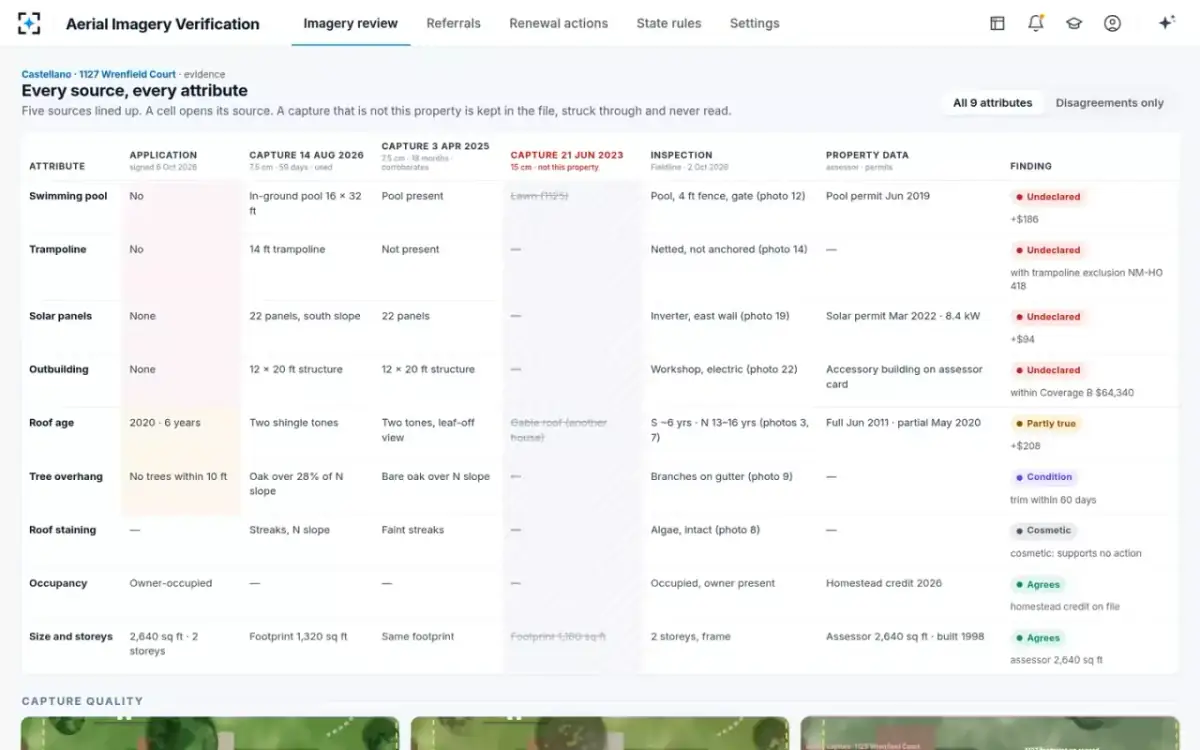
The sample file is a Maryland referral, so it carries no Florida forms, but the roof row shows how a form would be used. The permits say a full roof in June 2011 and a partial one in May 2020; the inspection puts the slopes at about 6 and 13 to 16 years; the application says 2020. Rated at its oldest slope, the roof adds $208 a year, and a condition asks for the 2020 invoice in case the whole roof was replaced. A Florida file would add the four-point's roof section and the wind form's roof covering and attachment answers to the same row.
Two slopes, two ages: what an inspector's roof photos settle
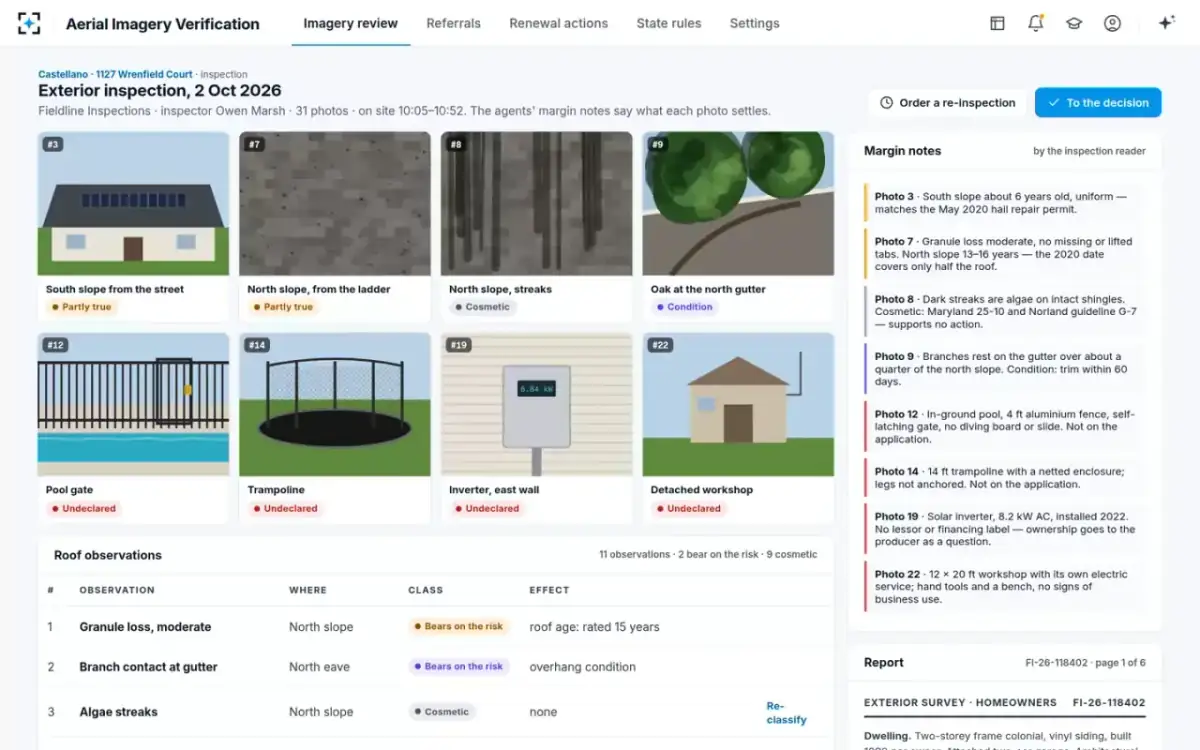
What an exterior report should contain, line by line, is on the homeowners insurance inspection checklist. The solution is on the Aerial Imagery Verification page.
Questions people ask
Do I need both a 4-point and a wind mitigation inspection?
They answer different questions, so a Florida homeowner may need both. The four-point is the insurer's requirement when it asks for one, commonly for older homes; the wind mitigation inspection is the homeowner's way to claim the windstorm discounts that every residential rate filing in Florida must include. Your insurer or agent can tell you whether it needs a four-point for your house.
Can one inspector do both inspections?
Often, if licensed for both. The four-point must be signed by a verifiable Florida-licensed professional such as a home inspector or contractor; the wind form may be signed by, among others, a licensed home inspector with at least 3 hours of approved hurricane mitigation training and a proficiency exam, or a licensed contractor, engineer or architect.
Does a wind mitigation inspection lower my premium?
It can, if the house has the features the form records. Florida law requires residential rate filings to include actuarially reasonable discounts, credits or deductible reductions for those features, and insurers must use the uniform form when a policyholder submits it. The size of the discount depends on the features and the insurer's approved filing.
What happens if a 4-point inspection fails?
The state's consumer guide says homeowners may need to complete repairs before an insurer will issue a policy, depending on the findings, and urges prompt attention to any hazard identified. For an older roof, Florida law also lets the homeowner show at least five years of useful life through an authorised inspection.
Does a new roof need a new wind mitigation form?
Check with your insurer. The Office of Insurance Regulation says the form is valid for up to five years provided no material changes are made to the structure, and a new roof changes features the form records, such as the roof covering. A new form is also the way to claim credit for a better covering or attachment.