Insurance companies are non renewing homeowners policies for two kinds of reasons. Across whole areas, losses from wildfire, hail, wind and hurricanes have risen faster than the premiums insurers collected, and insurers have responded, in the words of the Treasury's Federal Insurance Office, by "raising rates, not renewing policies, or changing coverage options". At the level of one home, insurers now re-read the roof, the trees, the hazard score and the claims at every renewal, and a home that has drifted outside the guidelines is dropped. On state regulators' own data, company-initiated nonrenewals reached 2,019,799 in 2024, up from 1,255,975 in 2023 and 1,088,756 in 2022. Every one of them is a decision that, in most states, an underwriter has to explain in specific terms. Botminds' Homeowners Renewal Underwriting exists for that second half: it re-scores every renewal, brings the changed homes to an underwriter and ties each reason to its source.
Homeowners nonrenewals on state regulators' data, 2024
2,019,799
company-initiated nonrenewals nationwide
+60.8%
on 2023, our arithmetic from the same table
19.6per 1,000
policies in force non-renewed, all zones
25.1per 1,000
in the Western zone, the highest
Why are insurance companies non renewing homeowners policies? The short answer
Because the expected cost of insuring some homes has risen faster than the price insurers can charge or are willing to bet on, and nonrenewal is the quickest way to shed that exposure. The Treasury's study of more than 246 million policies from 2018 to 2022 is the clearest federal account. In the riskiest fifth of ZIP codes the paid loss ratio "was 18 percent higher in the highest risk ZIP Codes—despite homeowners paying higher premiums per policy in these areas" than in the lowest, and "Extended periods during which insurers have elevated paid loss ratios may cause insurers to respond by raising rates, not renewing policies, or changing coverage options" (FIO, Analyses of U.S. Homeowners Insurance Markets, January 2025).
The same study defines the nonrenewal rate by its causes: policies insurers did not renew "due to the risk profiles of properties (e.g., the age of the roof) or areas (e.g., areas with more severe climate-related risks)". Both halves of that definition matter to a homeowner. An area-level decision, such as an insurer reducing exposure in a county, can only be answered by finding another insurer. A property-level one, a roof, a tree, a claim, can often be answered by fixing it or proving it is not there.
How many homeowners policies were non renewed in 2024?
Insurers reported 2,019,799 company-initiated homeowners nonrenewals in 2024 to state regulators, against 103,289,334 policies in force: 19.6 per 1,000. That is the first national count from regulators' own market-conduct data, published in July 2026 (NAIC MCAS homeowners report). It counts only nonrenewals the insurer initiated, not policies the homeowner moved, and excludes nothing for reason, so it mixes property-level and area-level decisions.
Two other sources frame the trend. Testifying to the Senate Budget Committee in December 2024 on a committee data call covering 249 million policies, Wharton's Benjamin Keys said that "since 2020, the average non-renewal rate has almost exactly doubled" (S. Hrg. 118-533); the committee's chairman also noted a letter from the NAIC suggesting the committee's data might contain inconsistencies. The NAIC's figures are the ones to quote for counts. And the cost side moved too: adjusted for inflation, average written premium rose 18% to 43% across the country between 2018 and 2024, on the regulators' data.
Homeowners insurance nonrenewal rates by region, 2022 to 2024
Nonrenewal rates rose in every region, and fastest in the West. Over three years they "nearly tripled in the Midwest and Western Zones, rising from 5.5 to 14.2 in the Midwest Zone and 8.0 to 25.1 in the Western Zone" (NAIC). The regulators publish these figures by NAIC zone, not by state, because company-level market-conduct data is confidential.
Nonrenewals per 1,000 homeowners policies, 2024, with 2022 for comparison
A state-level picture is on its way. In March 2026 state regulators, through the NAIC, launched a homeowners market data call collecting ZIP-code-level data from insurers for policy years 2018 to 2025, including nonrenewals, noting that "a public report analyzing the data is targeted for release in early 2027" (NAIC data call overview). Texas has gone further on reasons: since January 2026 insurers must send the department a quarterly summary of their reasons for declinations, cancellations and nonrenewals, organized by ZIP code, and the department must post an aggregated summary that identifies no insurer (Tex. Ins. Code §551.006).
The West tripled and the Southeast's share fell: where nonrenewals moved
The national total hides a shift in where nonrenewals happen. In 2022 more than half were in the Southeast, Florida's region. By 2024 the Western zone, California's, had the largest share, even though its policy count barely changed.
Share of all US homeowners nonrenewals by NAIC zone, 2022 and 2024
2022 · 1,088,756 nonrenewals
- Southeast · 53%
- Western · 25.3%
- Midwest · 12.6%
- Northeast · 9.1%
2024 · 2,019,799 nonrenewals
- Southeast · 31.2%
- Western · 42.2%
- Midwest · 17.5%
- Northeast · 9.1%
Testimony to the Senate in 2024 drew the same map from a different dataset: Florida and California had the highest rates, but high nonrenewal rates were also "found elsewhere in the country, such as in areas affected by tornadoes and hail" (S. Hrg. 118-533). The Midwest's near tripling is the reminder that the trend is not only a coastal or wildfire story.
What drives the decision: losses, premiums and risk
The regulators' data show both costs and prices moving. Claim frequency, claim severity and insurer-initiated nonrenewals "have generally increased over time, with some of the largest increases occurring between 2021 and 2024", and yet homeowners underwriting profit improved in 2024 in every zone and was positive in three of four (NAIC). Those two findings fit together: insurers raised rates and shed the policies they judged most exposed, and results improved.
Academic work points the same way. Using more than 74 million premiums inferred from mortgage escrow payments, Keys and Mulder document "rapidly rising premiums and a doubling of the pass-through from disaster risk into premiums" (NBER working paper 32579). The Treasury found premiums in the riskiest fifth of ZIP codes averaged $2,321 a year between 2018 and 2022, 82% more than in the safest fifth, and nonrenewal rates in the riskiest fifth more than doubled over the period, from 1.10% to 2.37%.
Insurance companies pulling out of Florida, and the turn since
Florida's exits followed years of underwriting losses, and the regulator now reports the reverse. Florida's Office of Insurance Regulation says the state's domestic property insurers posted a pooled combined ratio of 116% in 2020, 110% in 2021 and 109% in 2022, falling to 83% at year-end 2025. Since the 2022 reforms, it reports 20 new companies writing property coverage, over 190 residential filings for rate decreases or no change, and a 30-day average homeowners rate request of −1.2% (Florida OIR, May 20, 2026). Those are the regulator's own figures in a promotional release, but they are the official ones.
Florida's law also shapes how nonrenewals happen there. A residential nonrenewal needs 120 days' notice; a roof under 15 years old cannot be the sole reason; and a home damaged in a declared hurricane cannot be non-renewed until 90 days after it is repaired. Those rules have their own guides: Florida's 15-year roof rule and what one claim can do.
Insurance companies leaving California: wildfire, rate rules and moratoria
California's Insurance Commissioner describes the market he set out to stabilise in terms of insurers "pausing coverage or withdrawing from California altogether, as well as acceleration of non-renewals" (CDI 2025 Annual Report of the Commissioner). The Department's response has been to let insurers use forward-looking wildfire catastrophe models in rate filings; it completed its review of the first such model in July 2025 and reports 11 homeowners insurance groups expanding coverage under its Sustainable Insurance Strategy. Those are the Commissioner's own claims for his programme.
Alongside, California restricts nonrenewals directly. After a declared wildfire emergency an insurer may not refuse to renew a residential policy in any ZIP code within or adjacent to the fire perimeter for one year "based solely on the fact that the insured structure is located in an area in which a wildfire has occurred", and from 2026 the same applies to commercial property (CDI 2026 Annual Notice). A California nonrenewal also needs 75 days' notice, and where the insurer rates on wildfire risk, the homeowner must get the wildfire score with its range and the reasons for it. Moratoria are handled by Botminds' Binding Restriction Management, and the notices they catch are explained in the California moratorium nonrenewal notice guide; the wildfire score itself is the subject of the wildfire score lookup guide.
Why is my homeowners insurance not being renewed? The reasons at the level of one home
When the reason is about your home rather than your area, it is usually one of a short list, and each has a documented check.
Seven property-level reasons a homeowners renewal gets flagged, and the check behind each
- Roof age
The Treasury names roof age as its example of a property-level nonrenewal reason. Florida bars nonrenewal for age alone on roofs under 15 years, or older roofs an authorized inspector finds have five years of life left.
- Roof condition from an aerial image
Missing shingles, tarps, granule loss. Maryland, Maine, Delaware and Tennessee have warned insurers against acting on blurry, dated or cosmetic imagery without further checks.
- Trees and vegetation
Overhang on the roof and fuel near the house raise wind and wildfire exposure.
- A higher wildfire, hail or wind score
Often from a new hazard model version rather than any change at the property. In California the insurer must disclose the wildfire score and its reasons.
- Claims
Texas lets an insurer refuse to renew after three claims in three years, excluding natural-cause claims, and only after warning the homeowner at the second.
- An undisclosed feature or condition
A pool, a trampoline, an unrepaired defect. Usually found by imagery or inspection.
- Information that is wrong
The wrong house in the image, a roof age from an old permit. Maryland can disallow a nonrenewal resting on erroneous information.
Most of these are about a roof, which matches how a renewal review breaks down from the inside. In a fictional sample insurer's January book run through Homeowners Renewal Underwriting, roof condition and roof age were the top factor for 726 of the 1,284 renewals whose score moved enough to need an underwriter, 57% of them.
Inside one insurer's season: what moved the score, by state and peril
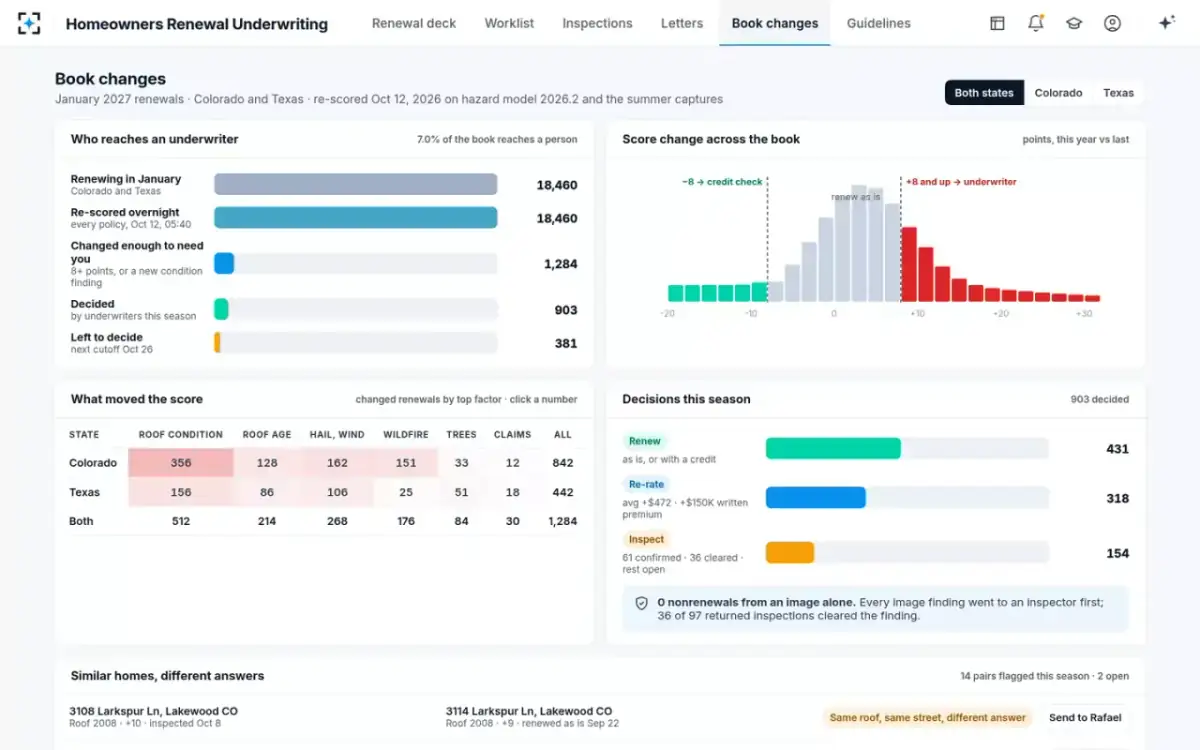
Every nonrenewal is a decision someone has to explain
The national figure has a consequence inside every insurer. Two million nonrenewals are two million letters, and in most states each must give a specific reason. Florida requires the specific underwriting reasons; Texas, since 2026, requires the precise risk factor and the source of the information relied on, and now sees every insurer's reasons by ZIP code each quarter. A nonrenewal programme that grew 61% in a year without a matching growth in the quality of its reasons is a complaint programme.
That is the problem Homeowners Renewal Underwriting addresses. Its agents re-score every renewal on new captures, hazard scores, permits and claims; split each change into filed factors with their sources and dates; check that every image is sharp, current and on the right parcel; and draft one plain reason per factor. A named underwriter decides every changed renewal, the underwriting manager approves every nonrenewal, and none can rest on an image alone. A nightly check pairs similar homes decided differently so that two houses on one street do not get two answers.
Similar homes, different answers, caught the same night
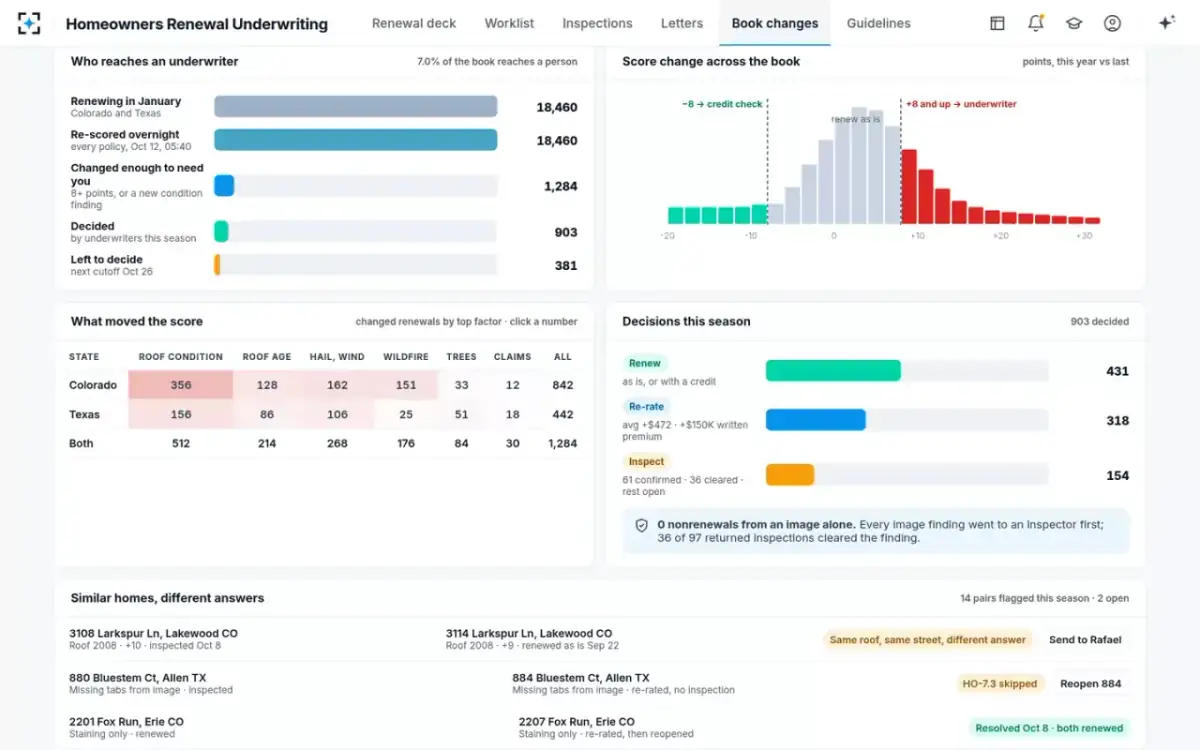
For the full sample season, start from Homeowners Renewal Underwriting; for what makes an individual nonrenewal hold when the homeowner contests it, see the nonrenewal appeal guide.
Questions people ask
What are the home insurance nonrenewal statistics for 2024?
State regulators' Market Conduct Annual Statement data show 2,019,799 company-initiated homeowners nonrenewals in 2024, 19.6 per 1,000 policies in force. By NAIC zone the rate ranged from 11.7 per 1,000 in the Northeast to 25.1 in the West. Cancellations for nonpayment were far more common, at 5,819,825.
Which states have the highest homeowners nonrenewal rates?
The regulators' 2024 national report publishes rates by NAIC zone, not by state, because company data is confidential; the Western and Southeast zones led. Senate testimony on a 2018–2023 data call named Florida and California as the highest, with high rates also in coastal Carolinas, New England and hail and tornado areas. A ZIP-level public report from the NAIC's 2026 data call is targeted for early 2027.
What are the homeowners insurance non renewal rates in California?
The NAIC's national report gives the Western zone, which includes California, a 2024 rate of 25.1 nonrenewals per 1,000 policies, up from 8.0 in 2022. The California Department of Insurance collects and publishes its own nonrenewal data on its wildfire data pages.
Is a nonrenewal the same as a cancellation?
No. A nonrenewal ends the policy at its expiry date with advance notice; a cancellation ends it mid-term, usually only for limited reasons such as nonpayment or fraud. Regulators count them separately: in 2024 insurers reported 852,908 company-initiated cancellations after the effective date, against 2,019,799 nonrenewals.
Will nonrenewals keep rising?
The regulators' data cannot say, and the 2024 figures already show improving underwriting results. Florida's regulator reports new insurers entering and average rate requests turning negative, and California has opened its rate process to catastrophe models. Where losses remain high relative to premium, the federal studies suggest nonrenewal rates will stay elevated.