Reunderwriting homeowners insurance means reviewing policies already on the books against current underwriting standards and current data, usually at renewal, and deciding to renew, re-rate, require an inspection or repair, or not renew. Its cost is mostly underwriter time, and the expensive mistake is to spend that time evenly: a book re-read policy by policy pays the same hours for the 93% of homes whose risk did not move as for the 7% whose did, and the reading runs into the state notice dates. Botminds' Homeowners Renewal Underwriting re-scores every renewal 90 days out on new hazard scores, aerial captures, permits and claims, and sends an underwriter only the homes that changed. The cost formula below starts from that changed share, because that is where the money is.
The worked figures come from a fictional sample insurer, Larkmoor Mutual, and its January 2027 renewals in Colorado and Texas, as they run through the solution; wage figures come from the Bureau of Labor Statistics, and the time per review is an assumption you should replace with your own.
The unit economics of one renewal season, in four numbers
7.0%
of a sample January book changed enough to need an underwriter
17,176
sample renewals that needed no person at all
$39.12/hr
median underwriter pay, 2025, before benefits and overhead
154
field inspections ordered from 1,284 changed renewals
What is reunderwriting homeowners insurance? A definition, and where the term comes from
Reunderwriting is underwriting an existing policy again, as if it were new, against today's data and today's guidelines. On a homeowners book it is done at renewal, policy by policy, or as a book-wide exercise when a carrier changes its guidelines, files a new rating plan or decides to reduce exposure in an area. The word turns up in statute: Texas, listing what does not count as a claims-based "premium surcharge", names a "reduction or elimination of a discount", "reassignment of an insured from one rating tier to another, re-rating an insured, or re-underwriting an insured by using multiple affiliates" (Tex. Ins. Code §551.107(f)). The statute, in other words, keeps re-rating and re-underwriting apart from the claims-based surcharge it limits.
What makes homeowners reunderwriting distinctive is how much of the input changes every year without any action by the homeowner. A roof is a year older. A hazard vendor ships a new model version. A hail season leaves storm reports within a mile. A summer capture shows a tree that has grown over the roof. The policy did not change; the evidence about it did.
Why re-reading a whole book costs the same for a policy that did not change
A manual renewal review has a near-fixed cost per policy, because most of it is gathering. The underwriter, or an assistant, pulls the policy, the captures, the hazard scores, the permit and the claims before knowing whether anything moved. Only then does the review reveal whether a decision is needed. For an unchanged home the gathering was the whole job, and it produced nothing but a confirmation.
Botminds' estimate for one changed renewal that needs a roof inspection puts two days of its elapsed time into pulling captures, scores, permits and claims, and one into reading the roof. Whatever the hours inside those days, the same pulling and reading happen on every unchanged policy a person reviews. That is the cost a change-first process removes, and it scales with the unchanged share of the book, not with the changed one.
Where the changed share comes from: what moved 1,284 scores
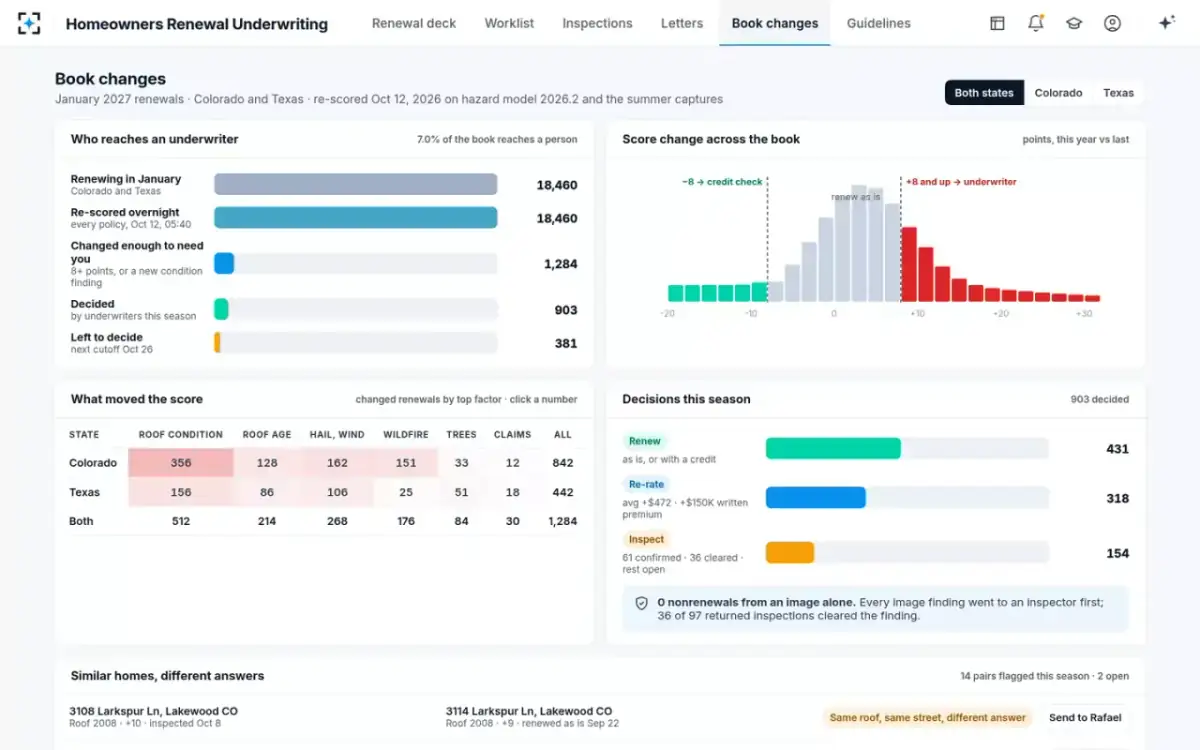
The changed share is not random, and its make-up tells a finance partner what the review budget is actually buying. In the sample book, the 1,284 renewals that crossed the eight-point threshold or picked up a new condition finding break down by the factor that moved each one most:
What moved the changed renewals: roofs first, hazards second
January book · 18,460
- Renews on guideline · 93%
- Changed · 7%
Changed renewals · 1,284, by top factor
- Roof condition · 39.9%
- Hail and wind · 20.9%
- Roof age · 16.7%
- Wildfire · 13.7%
- Trees and claims · 8.9%
Two readings follow. First, more than half of the changed share is about the roof, its condition or its age, which is why roof evidence quality drives so much of the cost and so much of the regulatory risk. Second, claims are the smallest driver, at 30 of 1,284. A reunderwriting programme that keys on claims alone would miss almost all of the change.
The reunderwriting cost formula, term by term
The return on a change-first renewal process is four terms: hours not spent on unchanged policies, premium not lost to missed notice dates, inspections spent where they settle a question, and the running cost of the process. Each term has an owner who can price it.
The return on change-first renewal review, as a sum
Hours not spent on unchanged renewals
(N − Nc) × h × w
N renewals in the season, Nc changed, h hours to gather and read one by hand, w loaded hourly cost. Sample: 18,460 − 1,284 = 17,176 renewals.
Priced by underwriting operations and finance
Premium not given away to a missed notice
n_late × ΔP
Changed renewals decided after the state notice date, times the premium change they would have carried. A late re-rate waits a full term; a late nonrenewal carries the risk at last year’s terms.
Priced by the underwriting manager and actuarial
Inspections, ordered only where evidence disagrees
n_insp × c_insp
Field visits times the vendor’s price. Sample: 154 ordered from 1,284 changed renewals.
Priced by underwriting operations
Running the process
licence + data + set-up
Software, the captures and hazard scores you already buy, and connecting the policy system and inspection vendor. Fill in from your own quotes.
Priced by procurement and IT
There is a fifth term worth naming even though it is hard to price: adverse actions not taken on wrong evidence. Each one would have cost a complaint, a reversal and, in states such as Maine, a hearing at which the insurer carries the burden of proving its reason (Maine Bulletin 483). In the sample season, 36 image findings were cleared on site. None of them became a letter.
A worked example on 18,460 renewals
Put numbers to the first term and its scale becomes plain. Suppose, as an assumption to be replaced with your own time study, that gathering and reading one homeowners renewal by hand takes 20 minutes. Reading the 17,176 unchanged renewals in the sample book is then about 5,725 hours. At the BLS median underwriter pay of $39.12 an hour, that is roughly $224,000 of salary before benefits and overhead, spent to confirm that nothing changed (BLS).
The 1,284 changed renewals still need people, and they should get more time each, not less: reading the roof against last year's capture, deciding whether to inspect, writing reasons that a regulator will accept. A change-first process does not lower the cost of those reviews so much as move the hours to them. The hours that disappear are the 5,725 spent on homes nobody needed to see.
The second term is where timing becomes money. The sample insurer's average re-rate this season is +$472 on 318 re-rated renewals. Any changed renewal whose decision misses the notice date gives up that change for a full policy term. Ten such late decisions on homes that warranted a re-rate would be about $4,700 of premium for a year; a late nonrenewal costs far more, because the insurer carries the very risk it decided not to keep.
The season's economics on one screen
The inspection line: the cost that buys accuracy
Inspections are the one cost a change-first process can raise, and it should. An inspection is the only step that settles what an aerial image suggests, and several state regulators now expect it before an adverse decision rests on imagery. The question for the budget is whether inspections go where the evidence disagrees, or everywhere.
Of 1,284 changed renewals, 154 needed a field visit, and 36 visits cleared the finding
Twelve percent of the changed renewals, and less than 1% of the book, went to the field. Of the returned reports, 37% cleared the image finding. Without the inspection those 36 homes would have been re-rated or worse on a finding that was not there; with it, the insurer paid for 97 visits and avoided 36 errors. That is the trade the inspection line buys, and it is why the guide on when to order a renewal inspection treats the order date as part of the cost.
The cost of a missed notice date
A missed notice date has a statutory price, and it is paid in coverage the insurer did not mean to give. In Texas, without timely notice the insurer has to renew if the insured asks (§551.105; the notice clocks of four states are set side by side in a personal lines underwriter's renewal season). In Florida, if the 120-day residential notice is late, coverage continues until replacement cover starts or a full notice period after the late notice, whichever comes first, at the old premium unless a later rate filing would lower it (§627.4133(2)(d)). In California a late nonrenewal notice keeps the existing policy in force for 75 days from the date it is mailed (CDI 2026 Annual Notice).
The probability of missing a date is what a policy-by-policy list drives up. A list worked in effective-date or policy-number order reaches its last changed home whenever it reaches it. A worklist ranked by each renewal's own decision cutoff, with the manager warned ten days ahead of any cutoff with a renewal still open, turns that probability into a managed queue. In the sample book the first cutoff is Oct 26 for renewals on Jan 9, and nothing open has passed its cutoff.
How much does underwriting cost, against what is at stake in premium?
The review budget should be read against the premium it protects, and that premium has grown. State regulators' Market Conduct Annual Statement data show that, "Adjusted for inflation, average direct written premium has increased since 2018, ranging from 18% to 43% across the country" (NAIC, Examining Homeowner Property Insurance Market Dynamics, 2026). The Treasury's Federal Insurance Office found the paid loss ratio 18% higher in the riskiest ZIP codes than in the safest, even though premiums there were higher (FIO, January 2025).
Both figures point the same way. The difference between a right and a wrong renewal decision is bigger in dollars than it was, and it is concentrated in the homes whose risk has moved. Spending underwriter hours evenly across a book is the one allocation that ignores both facts.
Re-underwriting a homeowners book of business: when the whole book does need reading
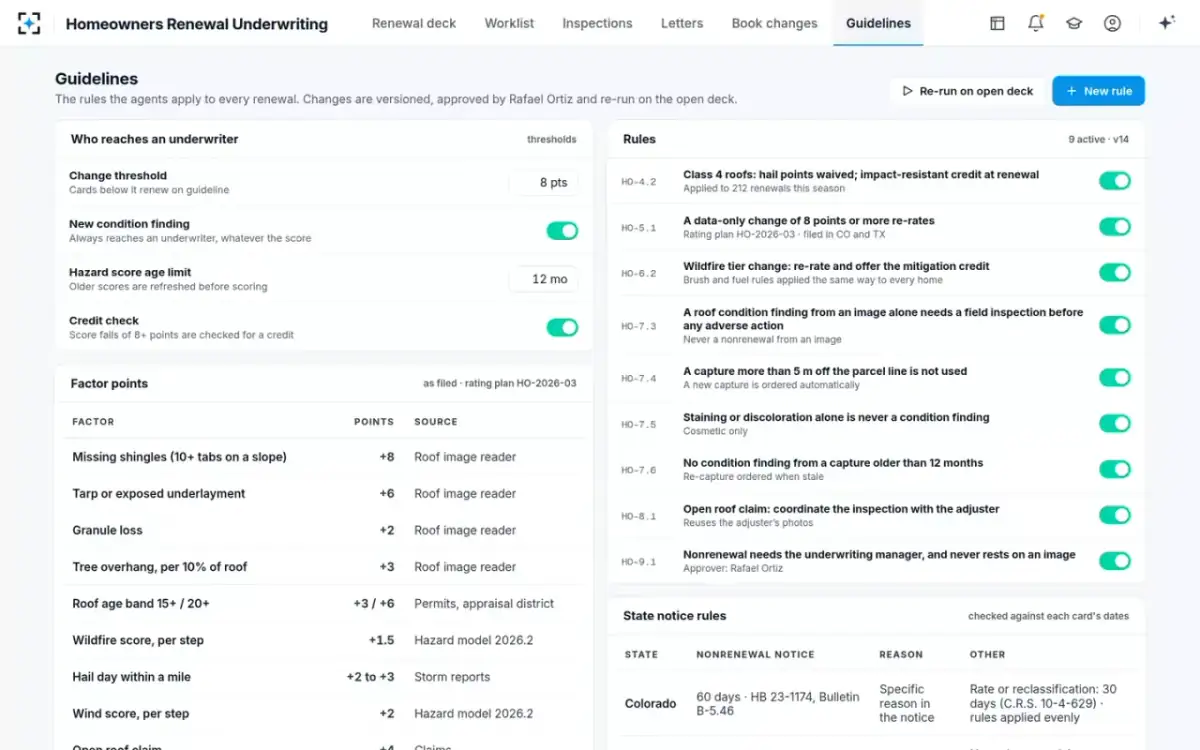
Sometimes every policy does need a fresh look, and the change-first process handles that too by changing what counts as a change. A new rating plan, a revised guideline, a new hazard model version or a decision to reduce exposure in a county all alter the score of policies whose homes did not change. In the solution, a guideline change is versioned, approved by the underwriting manager and re-run on the open deck, so the affected renewals surface as changed and the rest stay on guideline.
What a book-wide exercise should not do is skip the rules that protect individual homeowners. California bars wildfire-based nonrenewals in ZIP codes in or next to a declared fire perimeter for a year, and Florida bars nonrenewal of hurricane-damaged homes until 90 days after repair; Botminds' Binding Restriction Management handles those declared-emergency rules, starting from the moratorium ZIP codes. Where the book-wide change is a rate change, the policy-level effect is the subject of dislocation analysis, in Rate Dislocation Analysis. And the reasons behind the rise in nonrenewals that book-wide exercises produce are traced in why insurers are non-renewing homeowners policies.
For the full sample season, worked through screen by screen, start from Homeowners Renewal Underwriting.
The threshold is a setting the manager owns
Questions people ask
What does re underwriting mean in insurance?
Underwriting an existing policy again against current guidelines and data, usually at renewal. The outcome can be to renew as is, renew with a credit or surcharge, require an inspection or repair, move the policy to another tier or affiliate, or not renew. Texas statute uses the term, keeping re-rating and re-underwriting apart from the claims-based surcharge it regulates.
What is reunderwriting a homeowners policy, from the homeowner's side?
It is the insurer checking whether your home still fits its rules: roof age and condition, wildfire or hail exposure, claims. It can lead to an inspection request, a new premium or a nonrenewal notice. In most states any adverse outcome must come with a specific reason and arrive by the state's notice date, 60 days ahead in Texas and Colorado and 120 in Florida.
How often do insurers reunderwrite homeowners policies?
Every renewal is an opportunity, so at least once a year. Many carriers also run book-wide reviews after a guideline or rating change. With automated re-scoring the review can happen every renewal for every policy, with people seeing only the share that changed: 7.0% in the sample January book.
How much does underwriting a renewal cost?
No regulator publishes a per-review cost. Build it from your own time study and BLS's 2025 median underwriter pay of $39.12 an hour plus benefits and overhead. The largest lever is not the cost per review but the number of reviews: reading only the changed share removed 17,176 manual reviews from the sample season.
Does reunderwriting lead to more nonrenewals?
Not necessarily. A change-first review also finds homes whose risk fell, such as a new impact-resistant roof, and should credit them; the sample insurer checks every score fall of eight points or more for a credit. Nonrenewals did rise nationally, to 2,019,799 in 2024 on state regulators' data, and the Treasury's analysis ties higher nonrenewal rates to the ZIP codes with the highest expected climate losses.