A personal lines underwriter decides whether an insurer will offer, renew or reprice a policy for a household, usually homeowners or private auto, and on what terms. The federal job description is short: analyse applications, determine the risk, screen against set criteria, "review recommendations from underwriting software", decide whether to offer insurance and set premiums and coverage (BLS). In homeowners renewal season the work changes shape. The whole book has to be read again against new hazard scores, new aerial captures, an older roof and new claims, and every home whose risk moved needs a decision before the state's nonrenewal notice date, which is 60 days out in Texas and Colorado and 120 in Florida. Botminds' Homeowners Renewal Underwriting re-scores every renewal 90 days out and brings the underwriter only the homes that changed, with each change split into its sources.
The examples below follow a fictional sample insurer, Larkmoor Mutual, through its January 2027 Colorado and Texas renewals as they run through the solution. Every person and address in them is invented.
The desk in four numbers
125,600
jobs held by insurance underwriters in the US, 2025, all lines
$81,370
median annual pay, 2025
−4%
projected change in underwriter jobs, 2025 to 2035
120days
Florida notice before a homeowners nonrenewal; 60 in Texas and Colorado
What does a personal lines underwriter do? The job in one paragraph
A personal lines underwriter prices and selects risks for individuals rather than businesses. BLS draws the line itself: "Within the broad field of property and casualty, underwriters may specialize in commercial (business) insurance or personal insurance" (BLS). The personal side is a volume business. A commercial underwriter may spend days on one account; a homeowners underwriter works thousands of policies that look alike on paper and differ in a roof, a tree line or a claim.
Most of those policies never reach a person. New business is screened by the rating plan and underwriting rules, and most renewals roll forward on the same terms. What lands on the desk are the exceptions: a referral from an agent, an inspection that found something, a hazard score that crossed a band, a claim, a roof that has aged into a surcharge or out of eligibility. The underwriter's job is to decide those exceptions consistently, within the filed rating plan and the written guidelines, and in time for the notices the state requires.
That last condition is what makes renewals different from new business. A new application can wait a day for a missing document. A renewal has a statutory clock running from the moment it is pulled, and if the decision misses the notice date the policy renews as it was.
Renewal season: the 90 days before a homeowners policy renews
Renewal season, for a homeowners underwriter, is the window between pulling a block of renewals and the last day a notice can lawfully be mailed. The sample insurer pulls each renewal 90 days before its effective date, which leaves room to re-score, inspect where needed, decide and mail. The opening of the window is the insurer's choice; the notice date at its end is the law's.
One Colorado renewal's 89 days: two weeks to decide, then the law's 60
- Decision window14 d
- Cutoff to notice date15 d
- Notice period Colorado requires60 d
The insurer's own cutoff sits ahead of the legal date because a decision is not a notice. Someone has to draft the letter, the underwriter has to sign it, the producer gets a copy, and the mail has to leave in time. At Larkmoor that buffer is 15 days. A carrier writing in Florida needs a much earlier cutoff, because the notice there must go out "at least 120 days before the effective date" of the nonrenewal (Fla. Stat. §627.4133(2)(b)); California sits at 75 days for a nonrenewal (California Department of Insurance, 2026 Annual Notice).
A morning on the renewal deck: one changed home, start to signature
At the sample insurer, all 18,460 policies renewing in January were re-scored overnight on Oct 12. Only 1,284 of them, 7.0%, moved eight points or more or picked up a new condition finding; the other 17,176 renew as they are. Jenna Albright, a personal lines underwriter, opens her deck at the first of those 1,284: Mark and Alicia Brennan, 7342 Saddleback Court, Castle Rock, 29 days from the Colorado notice date.
The underwriter's first screen: the home that changed most, nearest its date
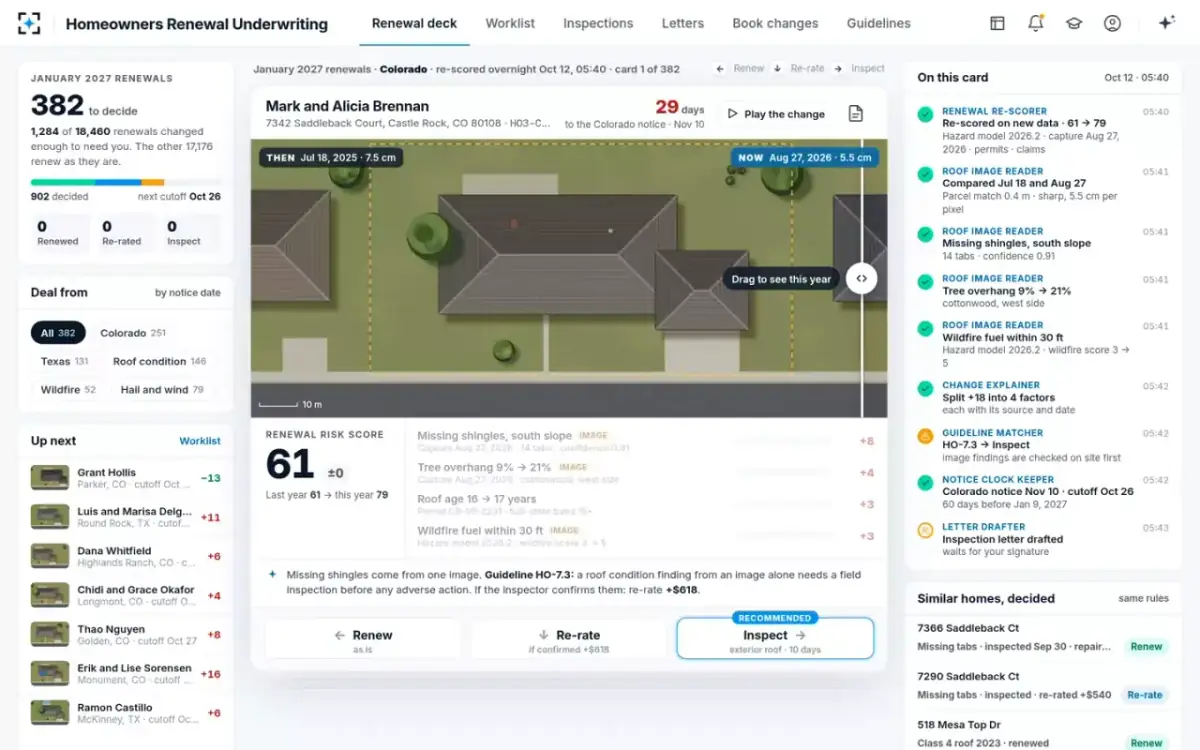
Under the old method, the first hour on this home would go to fetching: the July 2025 and August 2026 captures, the wildfire score from the hazard vendor, the roof permit from Douglas County, five years of claims. Here those arrive attached. What remains is the judgment. Fourteen missing tabs on the south slope show up in one image only, so guideline HO-7.3 says inspect before any adverse action. Jenna swipes Inspect; an exterior roof inspection goes to the field vendor, due back Oct 22, four days before the cutoff; the next card slides up. That card is Grant Hollis in Parker, whose new Class 4 roof on permit dropped his score 13 points: renew with a $402 credit.
Two decisions in a few minutes is not the point. The point is that both were decisions. Neither home's file required the underwriter to gather anything, and neither will produce a letter that says only that "risk characteristics changed".
Where the days go on one changed renewal
On a renewal that needs a roof inspection, the inspection is the only step that genuinely takes days. Most of the rest is queueing and gathering. Botminds' estimate for one such renewal splits it like this:
By hand, most of a changed renewal's 19 days is waiting and inspecting
Worked by hand · 19 days
- Waiting on the list · 31.6%
- Pulling data, reading the roof · 15.8%
- Inspection · 42.1%
- Decide, write · 10.5%
With the agents · 7.1 days
- Waiting, reading · 8.5%
- Inspection · 84.5%
- Decide, write · 7%
Read the first bar from the underwriter's side and two things stand out. Six days of waiting is not a staffing failure; it is what a list worked in policy-number or effective-date order does to the home at position 900. And the eight days of inspection are only partly the vendor's: an inspection ordered late in the window is an inspection that cannot be waited for. The hours that need an underwriter, the two days of deciding and writing, are the smallest slice of the bar, and the ones most squeezed when the list runs long.
The notice date is the underwriter's real deadline
A homeowners nonrenewal is only valid if the notice reaches the insured in time, and each state sets its own clock. Texas puts it most bluntly: unless the insurer has mailed notice of nonrenewal "not later than the 60th day before the date on which the insurance policy expires", it "must renew an insurance policy, at the request of the insured" (Tex. Ins. Code §551.105). Colorado moved from 30 to 60 days for homeowners in 2023 (HB23-1174). Florida requires 120 days for residential property, and California 75.
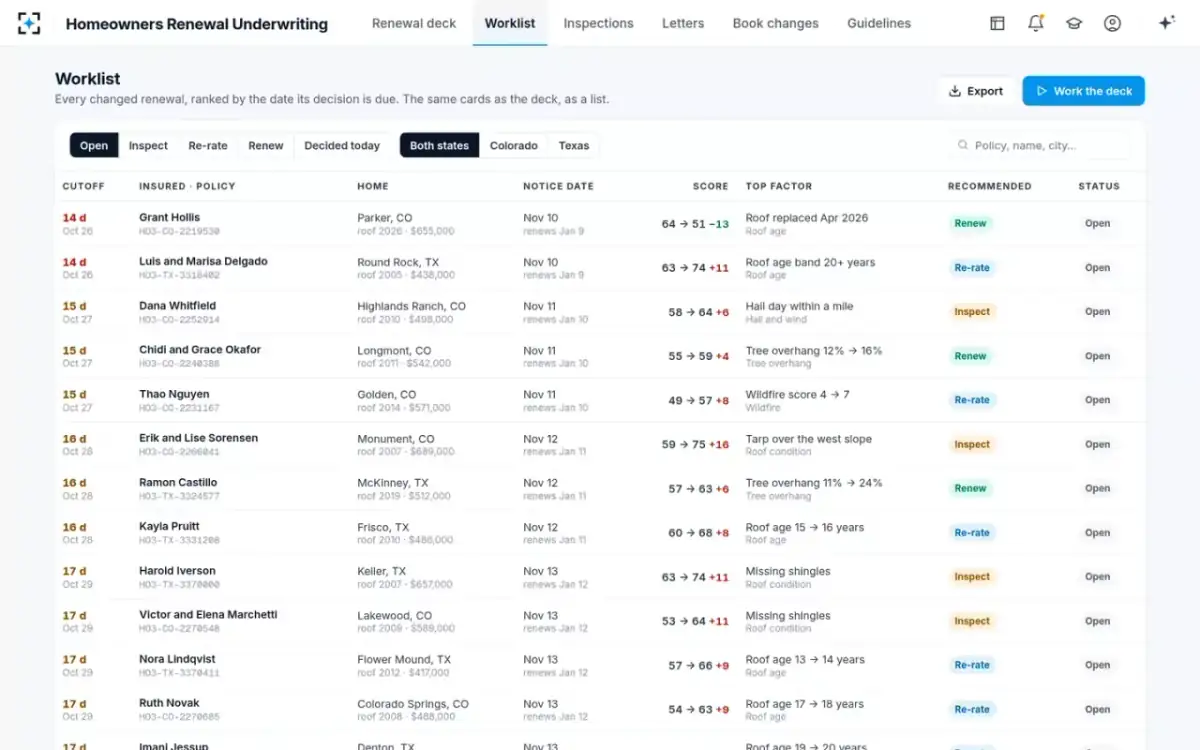
Miss the date and the consequence is mechanical. In Florida, coverage stays in force until replacement coverage starts or until a notice period's worth of days after the late notice, whichever comes first (§627.4133(2)(d)). In California the existing policy runs on unchanged terms for 75 days from a late notice (CDI 2026 Annual Notice). Either way a home the underwriter meant to non-renew or re-underwrite carries last year's terms for months. That is why the worklist in the solution is ranked by cutoff, not by score, and why the manager is warned ten days before any cutoff with a renewal still open.
The worklist: every changed renewal, ranked by the day its decision is due
What the letter must now say: Texas's 2026 rule on reasons and sources
The underwriter's signature is now on a more demanding document. Since January 1, 2026, Texas requires an insurer's written statement for a declination, cancellation or nonrenewal to "state the precise incident, circumstance, or risk factors" that violate the guidelines and to "state the source of information on which the insurer relied" (Tex. Ins. Code §551.002(c), as amended by HB 2067). Insurers must also send the department a quarterly summary of those reasons, organized by ZIP code (§551.006).
For the underwriter, that turns a habit into a rule: every reason on a letter needs its source and date beside it, as the letter is drafted, not reconstructed when a complaint arrives. Florida has long required the specific reasons for a nonrenewal, underwriting reasons included (Fla. Stat. §627.4091). The page on what makes a nonrenewal hold on appeal scores a sample file against each state's test.
Who else carries the renewal: manager, product, operations, producer
A renewal season is not one underwriter's work. Five roles touch the same January book, and each one's week changes when the fetching and first-pass scoring move to agents.
Five people, one January book: what each did before, and what each does now
Today
Works the renewal list policy by policy, pulling captures, permits and hazard scores for each, and reaches the end close to the notice dates.
With agents
Sees only the renewals that changed, each with the roof then and now and the score split by factor.
Still theirs: Every Renew, Re-rate and Inspect decision, and the signature on every letter.
Today
Approves every nonrenewal and exception and owns consistency across the book.
With agents
Gets a nightly list of similar homes that got different answers, each ready to send back or reopen.
Still theirs: Approval of nonrenewals, exceptions, re-rates over $1,000 and every guideline change.
Today
Owns the rating plan, the roof condition factor and the state filings.
With agents
Sets the factor points as filed, so every surcharge on every renewal traces to one of them.
Still theirs: The filed rating plan.
Today
Chases the renewal calendar, the inspection vendor and the notice mailing by hand.
With agents
Works from a worklist ranked by decision cutoff, with inspection orders due back 10 days after they go out.
Still theirs: Vendor management and the mailing.
Today
Hears from the insured first, often before knowing why.
With agents
Gets a copy of every letter, with each reason, the photo dates and how the insured can send their own roofer’s report.
Still theirs: The conversation with the client.
The manager's line deserves a second look. Consistency across a book, two similar homes on one street getting the same answer, is the thing a list worked by several people over several weeks cannot guarantee. In the sample season the nightly check paired 14 similar homes decided differently; 12 were resolved and two were still open, one sent to the manager and one flagged to reopen.
Personal lines underwriter salary and job outlook
BLS reports a 2025 median pay of $81,370 a year, or $39.12 an hour, for insurance underwriters, with 125,600 jobs (BLS). The figures cover every line; BLS does not split personal from commercial, and job adverts describe single vacancies, not the market. Employment is "projected to decline 4 percent from 2025 to 2035", a loss of about 4,800 jobs.
BLS puts the decline down to automated underwriting software, which lets underwriters process applications faster and so reduces how many are needed. That describes new business more than renewals. A renewal's work is mostly re-reading data that changed, which is exactly where automation removes hours, and deciding what the change means, which is where it does not.
Will AI replace insurance underwriters? What changes and what stays
AI will remove much of the gathering and first-pass scoring from an underwriter's day; it is not positioned to take the decision or the signature. Two things hold that line in personal lines. Adverse decisions on a homeowners policy must be explained in specific terms to the insured, and in Texas with the source of every piece of information. And regulators now expect a human answerable for those decisions: the NAIC's model bulletin on insurers' use of AI asks insurers to weigh how far people take part in the final decision when they set their controls. The AI homeowners underwriting process, task by task sets out which tasks move to agents and which stay with a named underwriter.
In the solution that line is drawn plainly. Six agents re-score, read the roof, split the change, match the guidelines, keep the clock and draft the letter. A named underwriter decides every renewal, and nothing is sent until that underwriter signs: "I reviewed this letter and every reason in it." Nonrenewals go to the manager and, in the sample book, none rested on an image alone. For the full picture of the season, start from Homeowners Renewal Underwriting.
Questions people ask
What is a personal lines underwriter?
An underwriter who selects and prices insurance for individuals and households, mainly homeowners, renters, condominium and private passenger auto. BLS groups them with all property and casualty underwriters and notes that within that field underwriters "may specialize in commercial (business) insurance or personal insurance". The work is high-volume and rule-driven, with the underwriter deciding the exceptions.
What is in a personal lines underwriter job description?
The BLS duties list covers it: analyse applications, determine the risk, screen against set criteria, use and review the recommendations of underwriting software, obtain more information where needed, decide whether to offer insurance, and set premiums and coverage. In homeowners, add renewal review, ordering and reading inspections, and signing the notices each state requires.
What does a personal lines underwriting assistant do?
An underwriting assistant, or technician, prepares files for the underwriter: pulling reports, ordering inspections, chasing missing documents and preparing notices for signature. In renewal season that preparation is most of the volume, which is why it is the work most affected when captures, hazard scores, permits and claims arrive already attached to each changed renewal.
How long does homeowners insurance underwriting take?
A quote can bind the same day, but underwriting continues after binding. Texas lets an insurer cancel a new homeowners policy in its first 60 days if it finds an undisclosed condition that increases the hazard, or if it does not accept a required inspection report dated within 90 days before the policy starts (Tex. Ins. Code §551.104(g)). Florida likewise limits cancellation after the first 60 days.
How does a renewal underwriter decide which policies to review?
Usually by a change threshold: a rise in the renewal score, a new condition finding, a claim, or a roof crossing an age band. In the sample book the threshold is eight points or any new condition finding, which sent 1,284 of 18,460 January renewals, 7.0%, to an underwriter. The threshold is a setting the underwriting manager approves.