ASOP No. 23, Data Quality, is the Actuarial Standards Board's standard for how U.S. actuaries select, review, use and rely on data. In plain words it asks four things. Review the data, which is less than an audit: know what each field means and look for values that are questionable or relationships that are significantly inconsistent. Consider comparing the data with the data used in the prior analysis when consistency can reasonably be expected. Decide what to do about deficiencies: use the data, get better data, adjust it or the results, or decline. And disclose the sources, the review, the significant adjustments and any limitations. For a reserving actuary, the data is usually a claim and payment extract, so ASOP 23 data quality comes down to what happens between the extract landing and the first triangle. Botminds' Reserving Data Validation is built around those duties: agents find and explain the questionable values and changes, and the actuary decides and signs.
The claims examples come from a fictional mutual insurer's third-quarter 2026 extract, 486,215 claims in nine reserving segments, as it runs through the solution. Quotations are from the standard's December 2016 revision unless stated.
ASOP 23 as a sequence: select, review, compare, decide, disclose
A person decides
Select the data (section 3.2)Decide what data the assignment needs, considering whether it is appropriate, current, internally consistent, reasonable against relevant external information and sufficient.
Agent
Find questionable values and inconsistencies (section 3.3b)Profile every field: negative case reserves, accident dates after report dates, open counts that do not roll forward, payments outside their period.
Never: decides whether a value is wrong
Agent
Compare with the prior analysis’s data (section 3.3)Match each claim to the extract used last quarter and list what changed: line, dates, state, cause, claims that vanished.
Never: calls a change expected without a cited change-log entry
A person decides
Decide how to use the data (section 3.4)Accept it, obtain corrected data, apply a judgmental adjustment, widen the range of estimates, arrange a fuller review, or decline.
Agent
Draft the disclosures (section 4.1)Sources, review performed, adjustments with their claims, unresolved questionable values, limitations, reliance on others.
Never: signs
A person decides
Sign and communicateThe actuary signs the data memo and carries the disclosures into the actuarial communication.
What is ASOP 23?
ASOP No. 23 is one of the actuarial standards of practice the Actuarial Standards Board sets for actuaries practising in the United States, and the one that governs data. It was first adopted in 1993, revised in 2004, and revised again in December 2016; the current text applies to "any actuarial work product for which data were provided to or developed by the actuary on or after April 30, 2017" (ASOP No. 23, section 1.4). The standard defines data narrowly: "Numerical, … or classification information, or information derived mathematically from such items, but not general or qualitative information." A claims extract, its coding tables and the triangles built from it are all data; a claims manager's account of a new settlement policy is not.
The standard is short, and people often search for an ASOP 23 summary. The table below is one, section by section, in reserving terms.
ASOP 23 summary, section by section, in reserving terms
| Section | What it says | In a reserving review |
|---|---|---|
| 1.2 Scope | Applies to selecting, reviewing, using or relying on data, and to preparing data other actuaries will use; does not require an audit | Covers the reserving actuary and any actuary preparing the extract |
| 2.5 Review | An examination of the obvious characteristics of data to see if they appear reasonable and consistent; less detailed than an audit | Profiling the extract, testing roll-forwards, comparing with last quarter |
| 3.2 Selection | Consider appropriateness, currency, internal consistency, external reasonableness, sufficiency, known limitations | Choosing the extract, its valuation date and the segments |
| 3.3 Review | Know each data element’s definition; look for questionable values and inconsistent relationships; consider comparing with prior data | Field definitions, negative case reserves, claims that changed line |
| 3.4 Use | Five choices: acceptable, enhance, adjust, arrange more review, or decline | Release, wait for claims data, restate for reserving, escalate, or do not opine on that part |
| 3.5 and 3.6 Reliance | Data supplied by others is their responsibility for accuracy; disclose reliance | Claims data and finance supply; the actuary reviews and discloses |
| 3.8 Limits | No duty to detect falsification, compile extra data to hunt errors, or audit | The review is a reasonableness test, not a forensic one |
| 4.1 Disclosure | Sources, review, unresolved questionable values, improvements, adjustments, uncertainty, reliance | The data memo and the data section of the actuarial report |
Does ASOP 23 require an audit of data?
No. The scope section says so in a sentence of its own: "This standard does not require the actuary to perform an audit of the data." The reviewers kept that sentence even though section 3.8 repeats it, because, they wrote in their response to comments, it "is helpful in understanding the scope." The difference between the two activities is defined:
Audit and review are two different tests of the same extract
Audit (section 2.2): “A formal and systematic examination of data for the purpose of testing its accuracy and completeness.”
Review (section 2.5): “An examination of the obvious characteristics of data to determine if such data appear reasonable and consistent for purposes of the assignment.”
Audit (section 2.2): Is each value true?
Review (section 2.5): Does the data look right for this use, and does it agree with itself and with what came before?
Audit (section 2.2): No
Review (section 2.5): Yes, unless the actuary judges it unnecessary or impractical, and then the actuary discloses why
Audit (section 2.2): Testing payments to cheques and reserves to files
Review (section 2.5): Roll-forwards, ties to the general ledger, comparison with last quarter, questionable values
The American Academy of Actuaries' practice note on loss reserve opinions puts the consequence in a frequently asked question: is the appointed actuary required to attest that no errors exist in the data examined? "A: No." (Academy practice note, 2025; non-binding guidance). What the actuary does attest to is a review, and the review has content.
What is a review of data under ASOP 23?
Two efforts and a comparison. If the actuary performs a review, the actuary should "make a reasonable effort to determine the definition of each data element used in the analysis" and "make a reasonable effort to identify data values that are questionable or relationships that are significantly inconsistent" (section 3.3). If questionable values could have a significant effect, the actuary should consider improving the data, and must disclose unresolved ones in summary form.
On a claims extract, definitions are where reviews fail quietly. Does "incurred" include IBNR? Is a reopened claim a new claim number or the old one? Are recoveries netted in paid or held in a separate field? In the sample quarter, 312 Homeowners claims showed negative case reserves totalling −$1.9 million after a recoveries module change started posting recoveries into the case reserve field. Every value was a valid number; the definition had changed. The standard also says what it does not promise: "A review of data may not always reveal defects."
The Academy's practice note helps with proportion. Values "that could reasonably result from random variations in claim experience or from normal coding errors (e.g., a small downward development in the number of claims reported for a particular accident year and line of business) generally need not be questioned", and data that "were either explained or adjusted satisfactorily" still "comport with a finding of reasonableness and consistency" (Academy practice note, 2025).
How should actuaries compare data with the prior period?
Claim by claim where the analysis repeats, because that is where consistency can reasonably be expected. Section 3.3 is the sentence a reserving team should pin above its desk:
If the actuary performs a review, the actuary should also consider comparing current data with the data used in the prior analysis for consistency, if similar work has been previously performed for the same or recent periods and if such consistency can reasonably be expected.
Actuarial Standards Board, ASOP No. 23, section 3.3
The next line closes the obvious gap: "If the actuary does not have the prior data, the actuary should consider requesting the prior data." For quarterly reserving that means keeping last quarter's extract exactly as used, not a refreshed copy, because a refreshed copy already contains this quarter's changes. The 2016 revision made the condition explicit; its transmittal memo says the comparison applies "only if such consistency can reasonably be expected."
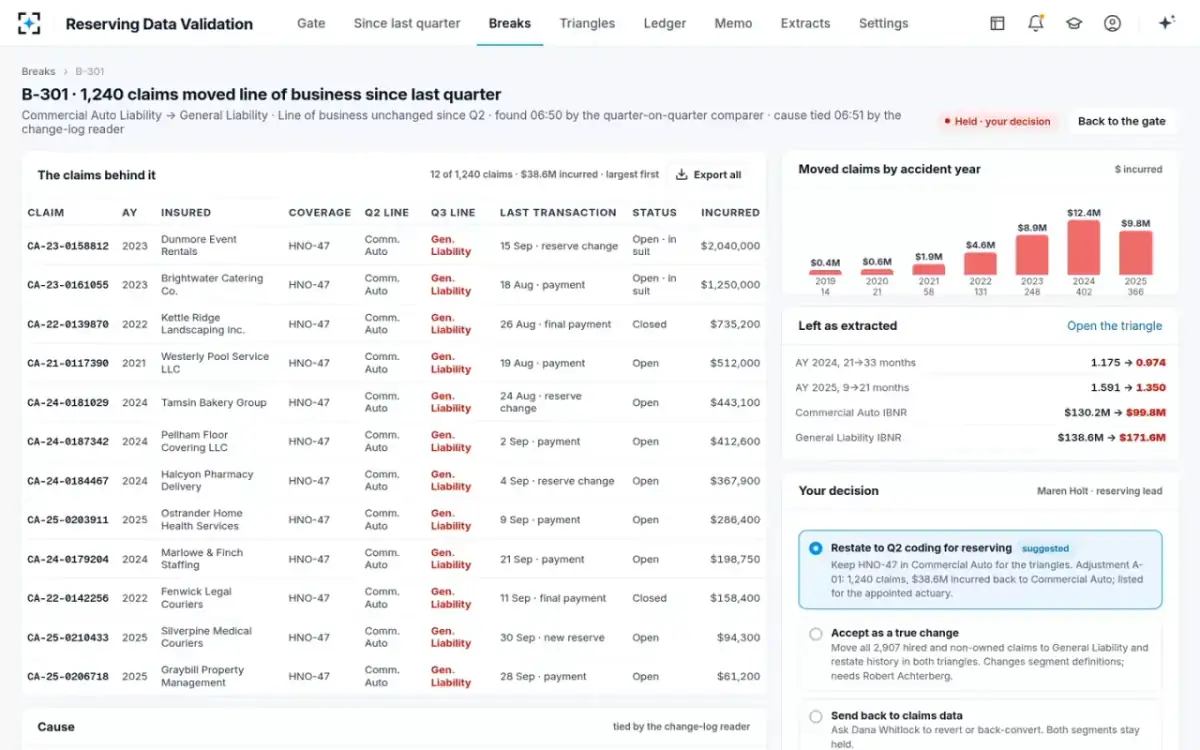
A total-by-total comparison is not enough to meet the spirit of it. In the sample quarter, 471,902 claims matched the locked second-quarter extract and 3,714 had changed something since. Most were expected and tied to change tickets: 2,104 catastrophe codes added for a July hailstorm, bodily injury codes merged within a line, test claims purged. One was not: 1,240 claims had moved from Commercial Auto to General Liability under a coding-table change. Company totals barely moved, so only the claim-level comparison showed it. How such a move distorts both triangles is worked through in line of business mapping.
A comparison with the prior data that names the claims
What should an actuary do with questionable data?
Choose one of five responses, and disclose the choice. Section 3.4 lists them: the data are of acceptable quality; the data need enhancement and it is practical to get corrected data; "judgmental adjustments or assumptions can be applied to the data"; a more extensive review is needed and should be arranged; or the data are so inadequate that the actuary should obtain different data, complete only the parts the data support with the principal's consent, or decline. The 2016 revision added an alternative that reserving actuaries use often: the actuary "may compensate for the data deficiencies by adjusting the results, such as by increasing the range of reasonable estimates."
The sample quarter used three of the five. Personal Auto Physical Damage's 23 accident dates after report dates were acceptable as noted items. Homeowners' negative case reserves needed corrected data, so the segment was held and claims data was asked to re-post them by a date. The recode was a judgmental adjustment: restate the 1,240 claims to the prior coding for reserving, listed with its claims and approver.
Does ASOP 23 apply to data prepared for other actuaries?
Yes, and the 2016 revision made that its first key change. An actuary who prepares data, or is responsible for its preparation, for other actuaries' use should apply the relevant parts of the standard as if planning to use the data, taking account of the assignment it will serve. Asked whether that covers colleagues in the same firm, the reviewers answered that the scope "provides no exception for actuaries working within the same firm, and made no change" (ASOP No. 23, Appendix 2). An actuarial analyst who builds the extract for the reserving actuary is therefore inside the standard; a claims data analyst who is not an actuary is a supplier, whose data the actuary reviews and relies on with disclosure. The claims data analyst guide follows that seat.
What must actuaries disclose about data?
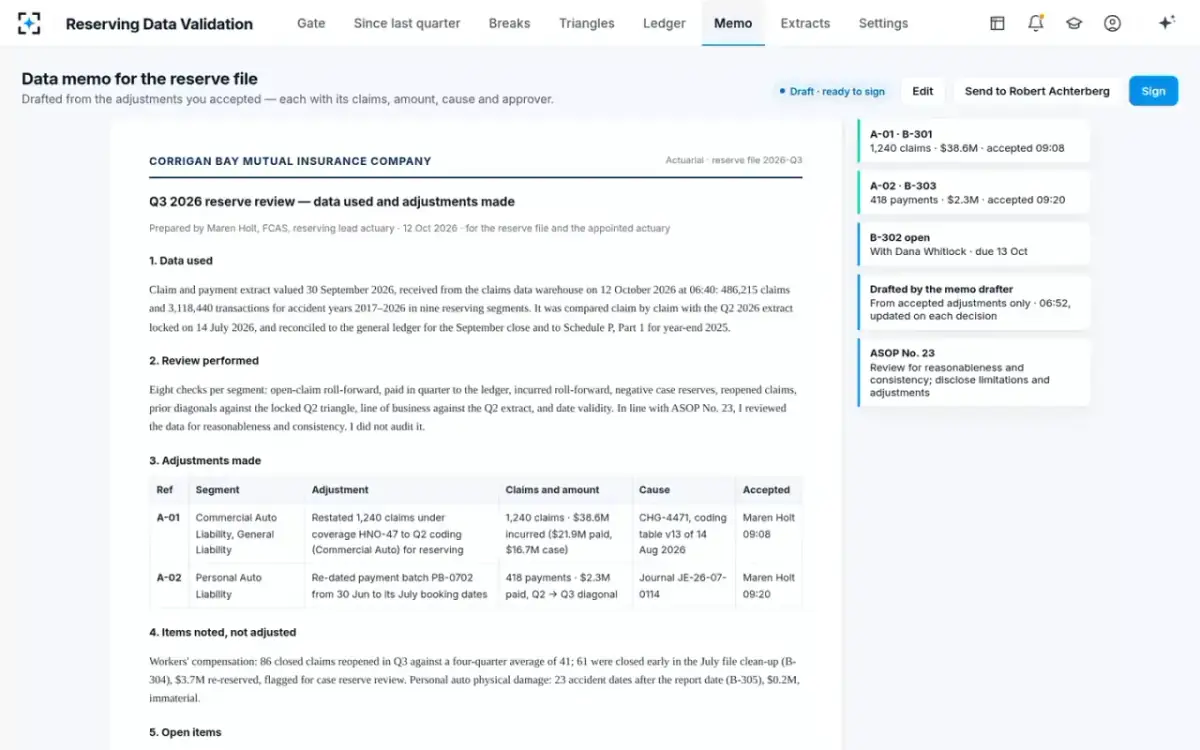
Section 4.1 lists the disclosures an actuarial communication should contain "when relevant and material", and most of them are "in summary form". A reserving data memo that follows the list item by item is the simplest way to meet it.
ASOP 23 disclosures, section 4.1, and where each sits in a data memo
- The sources of the data
The extract, its valuation date and system; the general ledger close; Schedule P, Part 1.
- Limitations on use from uncertain data quality
For example a segment whose history mixes two codings.
- Whether a review was performed, and if not, why
The checks run, in a sentence each.
- Unresolved questionable values, in summary
Open items, with the claims and the owner.
- Significant steps taken to improve the data
Corrected data requested and received, re-posted recoveries.
- Significant judgmental adjustments to the data or results
Each restatement with its claims, amount, cause and approver.
- Highly uncertain or biased results known from data quality
And their nature and size where reasonably determinable.
- Reliance on data and information supplied by others
Claims data, finance, any third-party administrator.
A data memo drafted in ASOP No. 23 terms
When is ASOP 23 effective, and how does it sit with ASOP 43, ASOP 36 and the opinion instructions?
The current ASOP 23 has applied since 30 April 2017, and the standards on reserving defer to it on data. ASOP No. 43, on property and casualty unpaid claim estimates, says simply that "The actuary should refer to ASOP No. 23, Data Quality, with respect to the selection of data to be used, relying on data supplied by others, reviewing data, and using data" (ASOP No. 43, section 3.6.3). ASOP No. 36, on statements of actuarial opinion on loss reserves, was revised in 2024 and applies to opinions issued on or after 1 October 2024 (ASOP No. 36).
The NAIC's annual statement instructions then ask the appointed actuary to state that the data were evaluated for reasonableness and consistency and reconciled to Schedule P, Part 1. The Academy's practice note reads the first statement as a pointer back to this standard: "the Appointed Actuary is to comply with ASOP No. 23 when evaluating data" (Academy practice note, 2025). The reconciliation is a separate test with its own regulatory expectations, covered in the Schedule P reconciliation guide, and the opinion itself is annotated line by line in a statement of actuarial opinion example. How the review is run on every extract before triangles are built is on the Reserving Data Validation page.
Questions people ask
Is ASOP 23 only for property and casualty actuaries?
No. It applies to actuaries in every practice area who select, review, use or prepare data, including life, health and pension work. The 2016 revision was prompted partly by the growing use of non-traditional data sources in predictive models; the reserving examples here are one application.
Does ASOP 23 require actuaries to detect fraud in the data?
No. Section 3.8 says the actuary is not required to determine whether data or other information supplied by others are falsified or intentionally misleading, to compile additional data solely to search for errors, or to audit the data. The review is a test of reasonableness and consistency.
Is ASOP 23 being revised?
The Actuarial Standards Board's 2025 annual report describes revision work on ASOP No. 41 and a decision to revise ASOP No. 43, but no exposure draft revising ASOP No. 23. The December 2016 text, effective 30 April 2017, is the current standard.
What is questionable data under ASOP 23?
Values that look wrong or relationships that are significantly inconsistent, such as large negative paid claims, a closing date before the opening date, or a segment whose open claims do not roll forward from last quarter. A questionable value is not necessarily incorrect; the standard asks the actuary to identify it, consider improving the data and disclose unresolved ones.
Does ASOP 23 apply to AI tools that check data?
The data an AI tool reads is still data under ASOP 23, and the actuary still reviews it and discloses reliance. The tool itself is a model, which brings ASOP No. 56 into play; the Academy's 2024 professionalism paper says as much for generative AI.